Ably Startup Credits: $500 in credits
Realtime messaging infrastructure, pub/sub, presence, and push notifications for live features at scale.
Premium: $79/year for unlimited deals
Already have an account? Log in
Deal Highlights
What Ably Gives a Startup
Ably is realtime messaging infrastructure. It handles the hard parts of moving data between users, devices, and servers the instant that data changes. That means pub/sub channels, presence, message history, and push notifications, all delivered over a global network built for low latency and high concurrency. Through this deal a startup gets $500 in credits, enough runway to build and ship live features without paying for infrastructure while the product is still finding its audience.
Realtime is one of those capabilities that looks simple from the outside and turns into a swamp the moment a team tries to build it in-house. Keeping thousands of WebSocket connections alive, recovering messages after a dropped connection, syncing state across regions, and scaling all of it during a traffic spike is a full engineering discipline on its own. Ably absorbs that discipline so a startup can spend its time on the feature users actually see rather than the plumbing underneath it. The $500 in credits lets a team prove the feature works and watch it hold up under real usage before a single dollar leaves the bank.
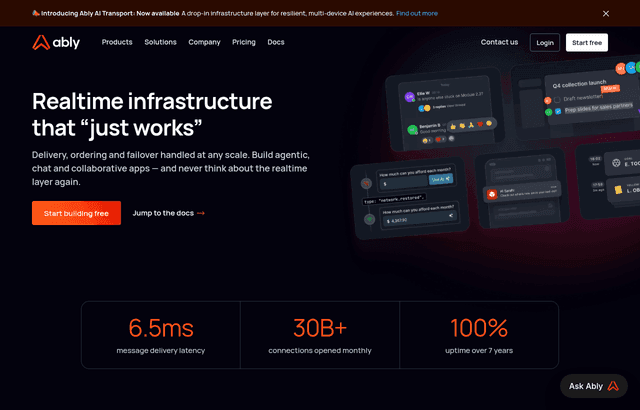
Ably, one of the tools included in this startup deal.
Pub/Sub Channels That Scale Without Babysitting
The core of Ably is publish and subscribe messaging. A client publishes a message to a named channel, and every client subscribed to that channel receives it in milliseconds. This pattern powers live chat, collaborative editors, live sports scores, auction bidding, ride tracking, and dashboards that update as numbers change. It is the backbone of almost every feature people describe as feeling alive.
Building pub/sub yourself means running and scaling a message broker, managing connection state, and solving fan-out when one message needs to reach ten thousand subscribers at once. Ably runs this as managed infrastructure across a global edge network. A startup publishes to a channel and trusts that delivery, ordering, and scale are handled. When usage grows from a hundred concurrent users to a hundred thousand, the code does not change. That property matters enormously for a small team, because it removes an entire category of rewrites that would otherwise land exactly when the product is succeeding and the team has the least spare time.
Channels are also cheap to create and organize. A startup can use one channel per chat room, one per document, or one per user session, and Ably handles the routing. This flexibility lets the data model match the product instead of forcing the product to bend around infrastructure limits.
Presence So Users Can See Each Other
Presence answers a question every collaborative product eventually needs to answer: who is here right now? Ably tracks which clients are currently connected to a channel and broadcasts join and leave events as they happen. This is what powers the row of avatars at the top of a shared document, the green online dot next to a contact, the live cursor showing where a teammate is working, and the count of people watching a stream.
Presence sounds trivial until a team tries to keep it accurate. Connections drop on flaky mobile networks. Browsers close without warning. A user opens the same app in three tabs. Without careful handling, presence lists fill up with ghosts and undercount real users. Ably handles connection lifecycle and cleans up presence state automatically, so the list a startup shows its users stays trustworthy. For any product built around collaboration or community, accurate presence is the difference between a feature that feels solid and one that quietly erodes user trust every time it shows someone as online who left an hour ago.
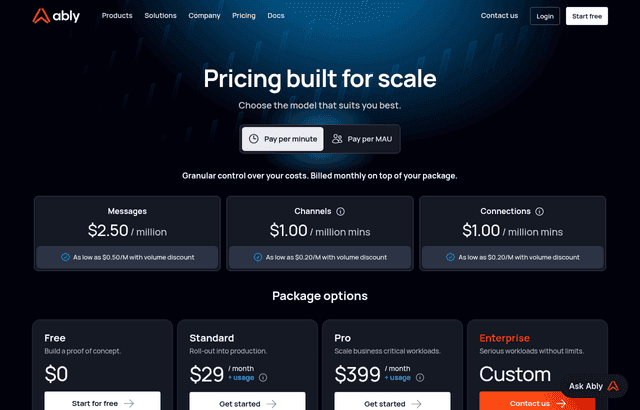
A look at Ably before the discount, so you can see what the deal saves you.
Message History and Connection Recovery
Networks are unreliable. Phones move between wifi and cellular, laptops sleep, and tunnels swallow signal. A realtime feature that loses messages every time a connection blips is worse than no realtime feature at all, because users notice the gaps and stop trusting what they see.
Ably stores message history and supports connection recovery. When a client reconnects after a drop, it can resume from where it left off and receive the messages it missed rather than starting from a blank slate. History also lets a startup load the recent context of a channel when a user first joins, so a new participant in a chat sees the last several messages instead of an empty screen. These are the details that separate a demo from a product. A team that relies on Ably gets correct behavior on unreliable networks without writing and testing the tricky reconnection logic itself, which is some of the most bug-prone code in any realtime system.
Push Notifications That Reach Users Off the Page
Realtime is not only about what happens while a user is staring at the screen. Push notifications reach users when the app is closed or backgrounded. Ably includes push notification delivery to browsers and mobile devices, tied to the same channel model that drives in-app updates.
For a startup this consolidation is valuable. Instead of wiring up one system for in-app realtime and a separate stack for push, a team publishes to Ably and can route the same event to a live channel and to a push notification. That keeps the messaging logic in one place and reduces the number of moving parts a small team has to reason about. Re-engagement is one of the strongest levers a young product has, and push notifications tied directly to realtime events let a startup pull that lever without building notification infrastructure from scratch.
Reliability Guarantees a Small Team Cannot Build Alone
The reason established products pay for realtime infrastructure is reliability. Ably is engineered around guarantees that are genuinely hard to achieve: ordered message delivery, exactly-once semantics on message processing, and continuity across regional failures. A message published in one part of the world reaches subscribers everywhere with predictable latency, and the system is designed to keep working when individual data centers do not.
A startup cannot realistically build these guarantees on its own during its early years. Doing so would consume the entire engineering team and still likely fall short of what a dedicated infrastructure company delivers. By starting on Ably, a team inherits a level of reliability that would otherwise take years to reach, and it inherits it on day one. That head start lets the startup make promises to its own customers, especially larger ones evaluating the product, that it could not credibly make while running homegrown WebSocket servers held together with reconnect hacks.
SDKs and Protocols Across Every Platform
Ably provides SDKs across the languages and platforms a modern product touches: JavaScript in the browser, native mobile on iOS and Android, and server-side languages for the backend. It also speaks standard protocols, so a team is not locked into a single client style. This breadth matters because a realtime feature rarely lives in one place. The web app publishes, the mobile app subscribes, and the backend both listens and injects events. Consistent SDKs across all of them mean a startup writes the integration once per platform and gets the same behavior everywhere.
For a small team, good SDKs are a productivity multiplier. They handle authentication, connection management, retries, and channel subscriptions with a few lines of code, which means a developer can go from an empty file to a working realtime prototype in an afternoon. That speed is exactly what the $500 in credits is meant to unlock: the ability to try an idea quickly, see it working, and decide whether to build on it.
Ably Compared to Building It Yourself or Using Alternatives
The most common alternative to Ably is a team standing up its own WebSocket servers, often with a library on top of a message broker. This works for a prototype and breaks under growth. Self-managed realtime means owning scaling, load balancing sticky connections, cross-region sync, presence cleanup, message persistence, and on-call duty when connections pile up at 2am. The apparent savings evaporate the first time the system falls over during a launch, and the engineering time spent keeping it alive is time not spent on the product.
Other managed options exist, including realtime features bundled into larger backend platforms and open-source frameworks a team hosts itself. Bundled realtime is convenient when a startup already lives inside that platform, but it often trails a dedicated provider on the harder guarantees like global ordering, connection recovery, and presence accuracy at scale. Self-hosted open-source frameworks give control but hand the operational burden back to the team, which defeats much of the point for a startup that wants to move fast.
Ably's position is that realtime is its entire focus. The company exists to deliver messages reliably and at scale, and the product reflects that concentration through its guarantees, its global network, and the maturity of its SDKs. For a startup weighing whether to build or buy, the calculation usually favors buying, because the credits cover the early phase and the infrastructure removes a risk that could otherwise sink a launch. The question is rarely whether homegrown realtime can be made to work, but whether a small team should spend its scarce engineering hours getting it there instead of shipping features.
Making the $500 in Credits Count
The credits are most valuable when a team uses them to remove risk early. The first move is to build the realtime feature against Ably during development rather than mocking it, so the team learns how the product behaves on real infrastructure from the start. Because the credits cover early usage, there is no reason to prototype on a throwaway solution and migrate later. Migrating realtime plumbing after launch is painful, and starting on the infrastructure the team intends to keep avoids that entirely.
The second move is to load-test with the credits before a public launch. Ably makes it straightforward to simulate many concurrent connections, and doing so while the credits absorb the cost tells a startup exactly how the feature holds up under a spike. Knowing that number before launch day, rather than discovering it during a traffic surge, is worth far more than the dollar value of the credits.
The third move is to consolidate messaging onto Ably rather than scattering it. A team that routes chat, presence, live updates, and push through one provider keeps its architecture simple and its debugging sane. Using the credits to prove that consolidated model works sets the startup up to scale without re-architecting. It also gives the team a single dashboard for understanding message volume and connection counts, which becomes the basis for forecasting cost as usage grows.
A final way to stretch the credits is to instrument usage carefully during the trial period. Understanding which channels carry the most traffic and where messages fan out most widely helps a startup design its channel structure efficiently, so that when it moves onto paid usage the bill reflects genuine product value rather than wasteful patterns baked in during early development.
Who Should Claim This Deal
This deal fits any startup building features that need to feel live. If the product includes chat, collaboration, live dashboards, location tracking, multiplayer interaction, notifications, or anything where users expect updates the instant something changes, Ably is directly relevant. The requirement is exactly that: a startup building real-time features.
It is an especially strong fit for teams that know realtime is core to their product but do not want to build the infrastructure themselves. A collaboration tool, a live events platform, a fintech app streaming prices, a logistics product tracking vehicles, or a social app showing who is online all sit squarely in Ably's wheelhouse. For these teams the $500 in credits removes the cost of proving the feature works and buys time to reach real usage before infrastructure spend begins.
It is a weaker fit for a product with no realtime element at all, where the messaging layer would sit unused. But for the large and growing set of startups whose products depend on immediacy, claiming these credits is a low-risk way to start on infrastructure the team can grow into rather than one it will have to grow out of. The teams that get the most from it are the ones that treat the credits not as a discount but as a chance to build their realtime layer correctly from the first commit.
Who Is This Deal For?
Early-Stage Startups
Seed and pre-seed companies looking to move fast without overspending on tools.
Growing SaaS Teams
Series A+ companies scaling their stack and optimizing software costs.
Solo Founders
Indie hackers and bootstrapped founders who need enterprise tools at startup prices.
Get $500 in credits off Ably
Premium deal. Upgrade once, unlock everything.
!Eligibility Requirements
Startup building real-time features
Frequently Asked Questions
Everything you need to know about this startup deal.
Ably powers realtime features in applications: chat messaging, live notifications, data synchronization, collaborative editing, live dashboards, IoT data streaming, and multiplayer interactions. Any feature where data must reach connected clients in milliseconds uses the kind of pub/sub messaging infrastructure Ably provides.
Get the weekly deals digest
New verified startup deals every week. No spam, ever. Unsubscribe anytime.
Related Offers

Toggl Track
Used by 1,100 members
Free Plan
Simple and intuitive time tracking for teams with reporting and integrations.
View offer
Auth0
Used by 994 members
1 year of B2B Professional free
Get 1 year of the Auth0 B2B Professional plan free, with up to 100,000 monthly active users, SSO, enterprise MFA and SCIM.
View offer
Bugsnag
Used by 471 members
Free Plan
Error monitoring and stability management for web and mobile applications.
View offer
Turborepo
Used by 1,880 members
Free & Open Source
High-performance build system for JavaScript and TypeScript monorepos by Vercel.
View offer
Windmill
Used by 1,501 members
Free Plan
Open-source developer platform for building internal tools, workflows, and scripts.
View offer
Height
Used by 1,442 members
Free Plan
AI-powered project management tool with autonomous task management and workflows.
View offerDeal Summary
Looking for more startup deals?
Browse all offers