
Deno: Free and Open Source Tool
Modern JavaScript/TypeScript runtime with built-in security and web standard APIs.
Premium deal
Already have an account? Log in
Deal Highlights
The SaaSOffers Deno deal
Offer: Free & Open Source.
Who qualifies: anyone. There are no requirements and no promo code. You download the Deno runtime and use it.
We checked these plans and prices against Deno's official pricing and help pages in November 2026.
This is not an exclusive discount. The Deno runtime is free for everyone under the MIT License, and Deno Deploy has a $0 plan that anyone can sign up for. SaaSOffers lists it so you can compare it with paid tools in the same category.
Read this before you start a new project on Deno. On October 9, 2026, Deno founder Ryan Dahl announced that the entire Deno team is joining Cloudflare. The post gives concrete timelines. Deno will support the runtime for another year with monthly releases for bug fixes and security updates, then end its own development of the runtime. Deno stays open source, and others can continue it. Deno Deploy will keep operating for 6 months and then shut down. Deno will provide migration support to Cloudflare Workers for paying Deploy customers. JSR, the package registry, will keep running on Cloudflare infrastructure.
So the runtime is still free and works today, at version 2.9.8 on deno.com. But a startup choosing a runtime for the next 5 years should weigh that timeline.
What the Deno runtime includes
Deno is a JavaScript and TypeScript runtime. It runs TypeScript, JSX and npm packages straight from source, with no tsc, no ts-node and no bundler. Deno says it reads package.json, node_modules, tsconfig.json, CommonJS and node: imports, and lockfiles from npm, yarn and pnpm.
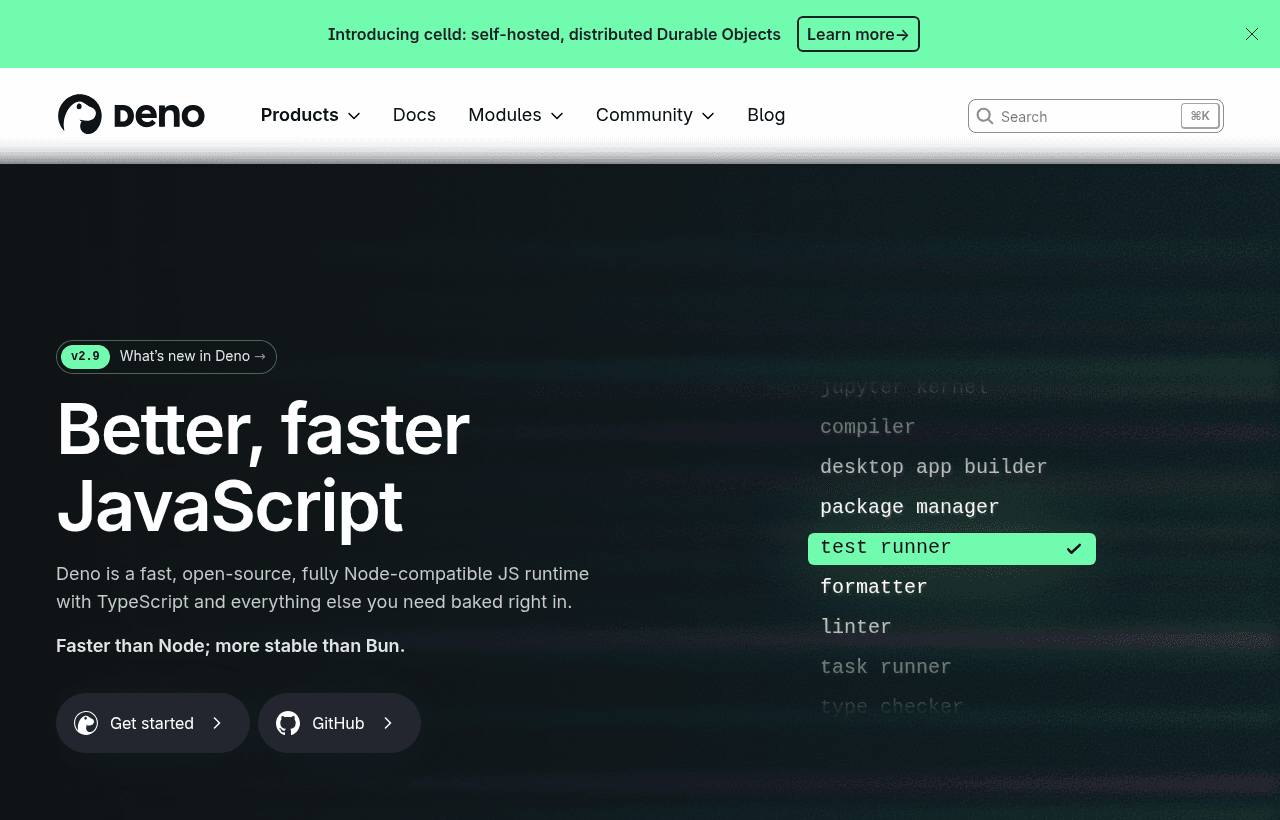
The binary ships 13 built-in tools that a Node project would add as separate packages: package manager, test runner, formatter, linter, task runner, type checker, coverage tool, workspace manager, benchmarker, doc generator, Jupyter kernel, compiler and desktop app builder. The matching commands include deno fmt, deno lint, deno test, deno bench, deno check, deno compile and deno doc.
Security by default
Deno runs code with no access to the file system, network, environment variables or subprocesses unless you grant it. You grant access with --allow-* flags, and most can be scoped. --allow-net=example.com allows one host. --allow-read=./data allows one folder. --allow-env=API_KEY allows one variable. --deny-* flags override allows, so --allow-read --deny-read=/etc reads everything except /etc. A refused call throws a NotCapable error.
Deno's docs warn about 3 escape hatches. -A turns the sandbox off and gives the same access as Node. --allow-run lets a program start subprocesses that run outside the sandbox. --allow-ffi loads native libraries that Deno cannot police.
Standard library and web APIs
Deno ships an audited standard library on JSR with modules for assertions, collections, CSV, dates, dotenv, encoding, file system, HTTP, paths, semver, TOML, UUID, YAML and more. It uses the same web APIs as the browser, including fetch, Request, Response, Web Crypto, WebSocket, streams and URLPattern. Deno lists Temporal, Set methods, iterator helpers, Promise.try and Float16Array as available today.
Speed claims
Deno's homepage publishes an install benchmark on an 18-package dependency tree: 598 ms warm and 5.3 s cold for Deno, 766 ms warm and 4.9 s cold for Bun, and 3.8 s warm and 15.8 s cold for npm. These are Deno's own numbers on an Apple M5, using canary builds.
Deno Deploy plans and prices
Deno Deploy is the paid hosting product. Its pricing covers Deploy, Deno Sandbox and Subhosting. Prices are monthly. The pricing page shows no annual billing option, so the yearly column is 12 times the monthly price. Deploy is scheduled to shut down 6 months after the October 9, 2026 announcement.
| Plan | Price billed yearly | Price billed monthly | Key limits |
|---|---|---|---|
| Free | $0 | $0 | 1M requests, 20 GiB egress, 10 hours active CPU, 150 GiB-hours memory, 10 apps, 5 custom domains, 3 team members |
| Pro | No annual plan ($240 a year at the monthly rate) | $20/month | 5M requests, 200 GiB egress, 50 hours CPU, 750 GiB-hours memory, 50 apps, 100 domains, 10 team members, email support |
| Builder | No annual plan ($2,400 a year at the monthly rate) | $200/month | 25M requests, 2,000 GiB egress, 500 hours CPU, 7,500 GiB-hours memory, 10,000 apps, 1,000 domains, 25 team members |
| Enterprise | Custom | Custom | Unlimited domains, 99.95% reliability SLA, email support SLA, onboarding support |
Overage rates on Pro and Builder are the same: $2 per extra million requests, $0.20 per extra GiB of egress, $0.10 per extra CPU hour, $0.025 per extra GiB-hour of memory and $0.08 per GiB-month of extra revision storage. Deploy bills memory at 768 MB for each second an app is loaded. Idle apps shut down after about 20 to 30 seconds, so you do not pay memory while scaled to zero.
Deno KV
Deno KV is the built-in key-value database. Free includes 1 GiB of storage, 1,000,000 read units and 500,000 write units a month. Pro includes 5 GiB, 5,000,000 reads and 2,500,000 writes. Builder includes 10 GiB, 25,000,000 reads and 12,500,000 writes. Extra storage costs $0.75 per GiB, extra reads $1 per million and extra writes $2.50 per million. A read unit is 4 KiB and a write unit is 1 KiB.
Builds, logs and sandboxes
Free allows 1 concurrent build and 15 builds an hour. Pro allows 3 and 60. Builder allows 20 and 250. Logs and traces are kept 1 day on Free and 1 week on Pro and Builder. App metrics keep 1 month on Free and 3 months on paid plans. Deno Sandbox runs untrusted code in isolated microVMs. It is not on Free. Pro allows 3 concurrent sandboxes per region with 5 GiB of volume storage, and Builder allows 20 with 50 GiB. Extra volume storage costs $0.20 per GiB-month.
What the free plan does not include
The runtime itself has no paid tier and no limits. The limits below apply to the Deno Deploy Free plan:
- No wildcard subdomains. Pro and above include them.
- No Deno Sandbox access.
- No email support. Free gets community support on Discord only.
- Only 3 team members, 10 active apps and 5 custom domains.
- Hard monthly caps: 1M requests, 20 GiB of egress and 10 hours of active CPU, with no overage option listed.
- Logs and traces for 1 day only.
- No reliability SLA. Only Enterprise has the 99.95% SLA.
- No long-term future. Deploy shuts down 6 months after October 9, 2026, on all plans.
What it costs: worked examples
The runtime costs $0 for any team size. These examples price Deno Deploy at list rates, then the same workload on Cloudflare Workers, where Deno offers migration support for paying Deploy customers.
Example 1: a 5-person team on Deploy Pro
A team of 5 fits inside Pro's 10-member limit. Assume 8 million requests, 300 GiB of egress and 80 CPU hours a month, with memory inside the 750 GiB-hours included.
- Pro plan: $20
- Requests: 8M minus 5M included = 3M × $2 = $6
- Egress: 300 minus 200 GiB included = 100 GiB × $0.20 = $20
- CPU: 80 minus 50 hours included = 30 hours × $0.10 = $3
That is $49 a month, or $588 a year. The Free plan would cap this app at 1M requests.
Example 2: a 12-person team
Pro allows 10 team members. A 12-person team needs Builder at $200 a month, or $2,400 a year, even if the traffic is small. A 10-person team can stay on Pro at $20 a month, so the 11th seat costs $180 a month in practice. If only the 3 engineers who deploy need accounts, Free or Pro may still work.
The same workload on Cloudflare Workers
Cloudflare's Workers Paid plan costs $5 a month and includes 10 million requests and 30 million CPU milliseconds. Extra requests cost $0.30 per million and extra CPU $0.02 per million milliseconds. Cloudflare charges nothing for egress. Example 1's 8 million requests fit inside the included 10 million. 80 CPU hours is 288 million ms, so the extra 258 million ms cost 258 × $0.02 = $5.16. The total is about $10.16 a month against $49 on Deploy Pro. CPU time on Workers counts only while code runs, so real CPU use can differ from Deploy's active CPU figure.
Who Deno is for
- Teams that want TypeScript with no build step and one binary for format, lint, test and compile.
- Scripts, CLIs and internal tools where
deno compileproduces a single executable and the 1-year support window is enough. - Teams running untrusted or third-party code that benefit from scoped permission flags.
- Existing Deno users. The runtime keeps getting monthly bug fix and security releases for about a year after October 9, 2026.
- Teams already planning to run on Cloudflare. Deno's team is folding its work into the Workers and Durable Objects platform.
Who Deno is not for
- Startups starting a long-lived production backend today. Deno's own team will stop developing the runtime after about a year.
- Anyone choosing Deno Deploy for new hosting. It shuts down 6 months after the announcement.
- Teams that need a vendor SLA on the runtime. Deno for Enterprise exists, but its future after the Cloudflare move is not covered on the pricing page.
- Teams that rely on
-Ain production. With every permission granted, the security model gives the same access as Node.
Deno compared with alternatives
| Deno | Bun | Cloudflare Workers | |
|---|---|---|---|
| What it is | JS/TS runtime, plus Deno Deploy hosting | JS runtime, package manager, test runner and bundler in one binary | Serverless platform on Cloudflare's network |
| Price | Runtime free; Deploy $0, $20, $200 a month | Free | Free plan; Paid from $5 a month per account |
| License | MIT | MIT, with LGPL-2 JavaScriptCore statically linked | Hosted service |
| Current version | 2.9.8 | 1.4.4 | Not applicable |
| Free tier limits | Deploy Free: 1M requests a month, 10 CPU hours | Not applicable (runtime only) | 100,000 requests a day, 10 ms CPU per request |
| Ownership news | Team joining Cloudflare, announced October 9, 2026 | Bun says it has joined Anthropic | Gains the Deno team |
Bun is the closest drop-in choice for a Node-compatible runtime with built-in tooling. Its homepage says you can use bun install or bun test in an existing Node.js project. Deno's docs include a guide for migrating from Bun, which shows how close the two are.
Cloudflare is where Deno's work is heading. Workers Paid includes 10 million requests a month, up to 5 minutes of CPU per invocation (30 seconds by default) and up to 500 Workers per account. Workers Free allows 100,000 requests a day and 100 Workers. Deploy customers get migration support to Workers.
Node.js remains the default most hosting platforms support. We did not compare its details here.
Setting up Deno
- Install with
curl -fsSL https://deno.land/install.sh | shon macOS or Linux, or the Windows command on deno.com. - Run an existing Node project with
deno taskordeno run. Deno readspackage.jsonand npm, yarn and pnpm lockfiles. - Start with scoped flags such as
--allow-net=api.example.comand--allow-env=API_KEY. Avoid-Aoutside local scripts. - Declare permissions in
deno.jsonso the whole team runs with the same set. - Add
deno fmt,deno lintanddeno testto CI. They cover formatting, linting and tests with no extra packages to install. - Prefer
@stdpackages from JSR for basics like CSV, YAML and UUID. JSR keeps running on Cloudflare infrastructure. - If you host on Deno Deploy, plan the move now. Write down your apps, domains and KV data, and ask Deno about migration support to Workers.
- Avoid Deno-only APIs in code you may need to move. Web standard APIs like
fetchandRequestalso work on Workers.
How to get it
- Open the deal from this SaaSOffers page. There is no promo code and no application.
- Install the runtime from deno.com. Version 2.9.8 is current.
- For hosting, sign up for Deno Deploy Free at $0, or Pro at $20 a month for 10 team members.
- Read Deno's October 9, 2026 announcement before you commit production workloads, and set a review date for the end of the 1-year support window.
Who Is This Deal For?
Early-Stage Startups
Seed and pre-seed companies looking to move fast without overspending on tools.
Growing SaaS Teams
Series A+ companies scaling their stack and optimizing software costs.
Solo Founders
Indie hackers and bootstrapped founders who need enterprise tools at startup prices.
Get Free & Open Source off Deno
Premium deal. Upgrade once, unlock everything.
Frequently Asked Questions
Everything you need to know about this startup deal.
Get the weekly deals digest
New verified startup deals every week. No spam, ever. Unsubscribe anytime.
Related Offers

Retool
Used by 1,559 members
1 year free, up to $60K
Build internal tools 10x faster with the low-code platform used by companies like Amazon, DoorDash, and Mercedes-Benz.
View offer
Replicate
Used by 1,772 members
$500 in credits
Run open-source ML models in the cloud, deploy Llama, Stable Diffusion, and custom models via API without GPU management.
View offer
ZoomInfo
Used by 2,014 members
Free Trial
B2B data platform for sales and marketing intelligence with contact databases.
View offer
Chore
15% off your first month
Chore runs your startup's back office for you: payroll, HR, bookkeeping, compliance and equity, inside the tools you already use. 15% off your first month through SaaSOffers.
View offerDeal Summary
Looking for more startup deals?
Browse all offers