
Hygraph Promo Code
There is currently no promo code for this product. Federated content platform with GraphQL-native headless CMS.
No deal for Hygraph right now
Leave your email and we will let you know the moment we add a Hygraph deal.
See Hygraph alternatives with real dealsNo deal for Hygraph right now
Leave your email and we will let you know the moment we add a Hygraph deal.
See Hygraph alternatives with real dealsOur Hygraph listing: Free Community
We checked these plans and prices against Hygraph's official pricing and docs pages in November 2026.
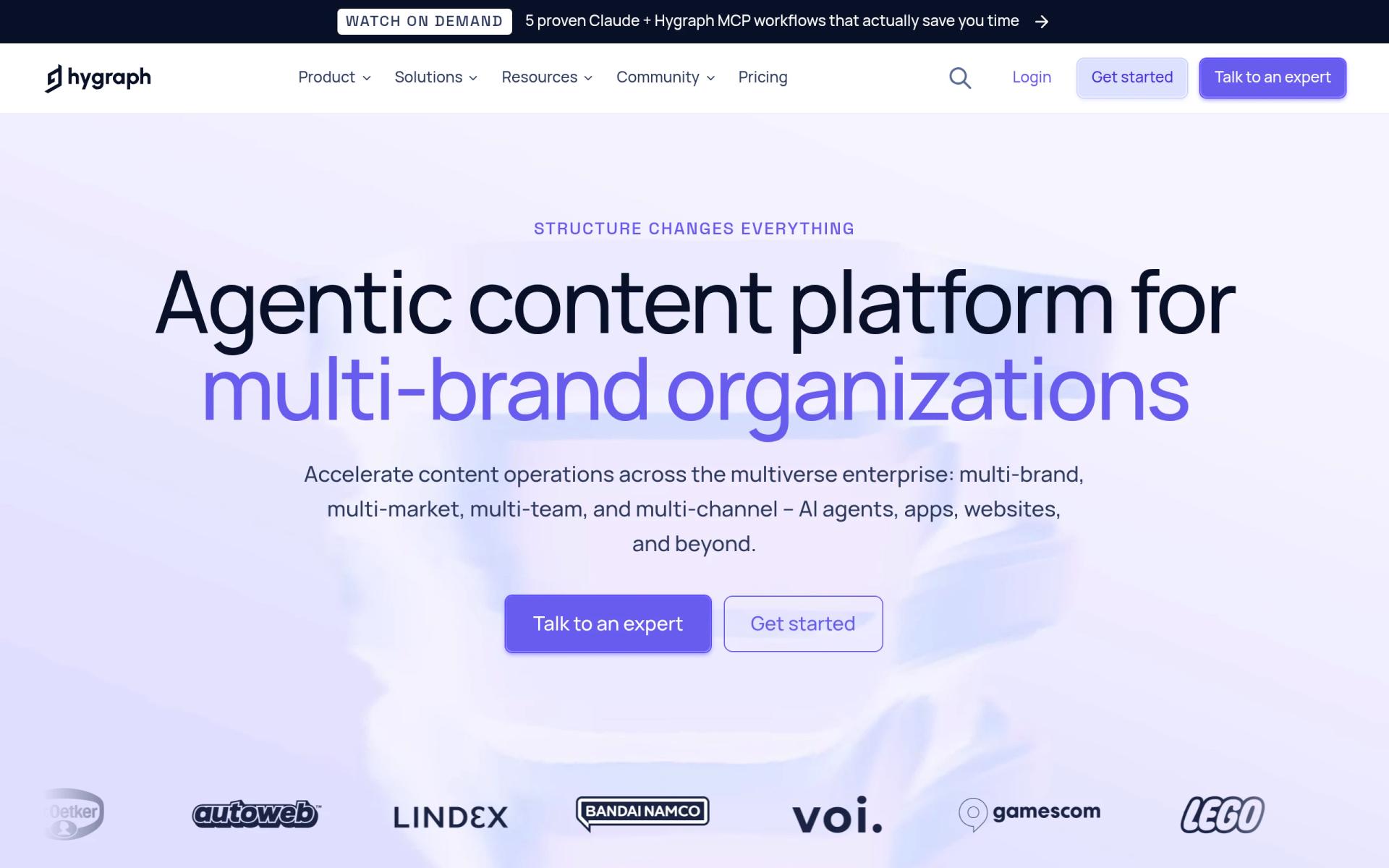
Hygraph is a hosted headless CMS with a GraphQL API. You model content in a schema builder, editors fill it in, and your site or app reads it from one GraphQL endpoint. Hygraph also pulls in data from other APIs through a feature it calls content federation.
On Hygraph's own pricing page the free tier is named Hobby, not Community. It costs $0, is described as free forever, and asks for no credit card. Anyone can sign up for it, so this listing gives you nothing beyond the public free plan. Hygraph's pricing page does not mention a startup program. We also could not find one on its site (hygraph.com/startups returns a 404). The page does say it offers special pricing for students, non-profits and open-source projects, and you contact sales for that.
What the Hobby plan caps
Hygraph's pricing page lists these limits for Hobby:
- 1,000 content entries
- 500,000 API calls
- 100 GB of asset traffic
- 3 seats
- 20 models and 10 components
- 2 locales
- 1 environment
- 5 webhooks and 3 API tokens
- 100,000 AI tokens
- 2 standard roles and no custom roles
- 50 MB maximum upload per asset
- 5 requests per second on uncached queries
- No version retention
Asset storage is listed as unlimited on every plan. Cached requests are not rate limited, and Hygraph's docs say limits can be lifted on dedicated clusters and Enterprise plans.
The 1,000 entry cap is the one most teams meet first. A blog with 300 posts plus a few hundred product records gets close quickly. Count every row in every model.
Hobby does not bill overages. The page says usage is blocked once you hit a limit, until the next billing period. For a side project that is a safe failure. For a live site it means API calls start failing at 500,000 in a month, so a traffic spike matters.
What Hobby leaves out
The pricing page marks several things as missing on Hobby:
- Remote sources. Hobby has 0. Growth has 1, Enterprise up to 10. This is the content federation feature, and the plan shows 0 on the pricing table.
- Version history. Hobby keeps none. Growth keeps 14 days and Enterprise up to 365 days.
- Extra environments. Hobby has 1, Growth 2, Enterprise up to 10.
- Support. Hobby gets community support only. Email support starts on Growth.
- Scheduled publishing. Listed under Enterprise only.
- SSO, audit logs, multitenancy, custom roles and automatic backups. All Enterprise only.
- Taxonomies, content variants and segments. Not on Hobby or Growth.
Live preview, AI Assist, and commenting and assignment workflows are included on all plans, Hobby among them.
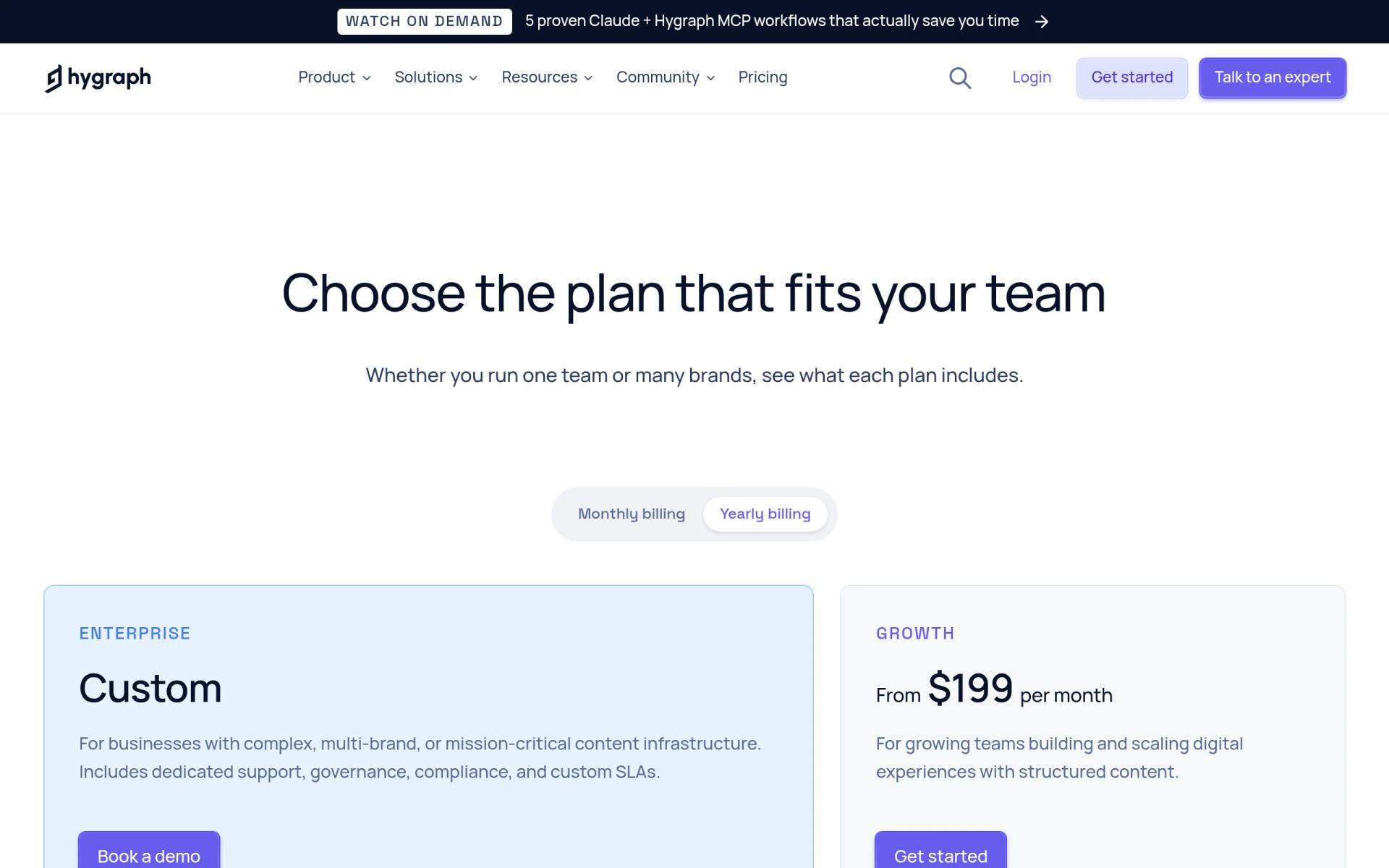
Growth starts at $199 a month and covers 10 seats
Hygraph lists three plans. Growth is "from $199 per month". The page shows no annual price, so we do not give one. Enterprise is custom.
| Plan | Price | Entries | API calls | Asset traffic | Seats | Environments |
|---|---|---|---|---|---|---|
| Hobby | $0 | 1,000 | 500,000 | 100 GB | 3 | 1 |
| Growth | From $199 a month | 10,000 | 1,000,000 | 500 GB | 10 | 2 |
| Enterprise | Custom | 1,000,000+ | 50,000,000+ | 25,000 GB+ | 200 | Up to 10 |
More Growth limits: 40 models, 20 components, 3 locales, 1 remote source, 10 webhooks, 5 API tokens, 300,000 AI tokens, 4 standard roles, 200 MB per asset upload, 25 requests per second uncached, and 14 days of version retention.
Growth bills overages to your card at the end of the billing cycle. The page prices overages at $20 per 1 million API operations and $0.20 per GB of asset traffic over the 500 GB allowance.
Hygraph's FAQ says charges are in USD, with EUR for some European customers. Credit cards work on all plans. Bank transfer is for Enterprise only.
The jump from Hobby to Growth
Hobby to Growth is a jump from $0 to $199 a month, or $2,388 over 12 months of monthly billing. There is no step in between. The pricing page shows no seat add-on for Growth either. At 10 seats you are on the edge of the next tier, which is Enterprise.
What does $199 buy over Hobby? Ten times the entries, double the API calls, five times the asset traffic, a remote source, 14 days of history, a second environment and email support. If you need none of those, stay on Hobby. If your one requirement is a staging environment or history, the price is steep for a startup.
Enterprise is priced for large companies
Hygraph's pricing FAQ puts Enterprise at roughly $32,000 to $300,000 a year, combining a platform fee with one or more project fees. Extra locales on Enterprise cost $150 a month each. AI Agents are expected to cost around $10,000 a year. Bank transfer is accepted.
Hygraph's own FAQ says it is built for multi-brand enterprises, global teams and complex digital operations. That tells you who the product is aimed at. Hobby is a way to build on it. A small startup that outgrows Hobby will pay Growth's price, and a company that needs SSO or custom roles is looking at the Enterprise range.
If you want to test Enterprise features, you can start a 30-day Enterprise trial from a Hobby project without a credit card.
Worked math for four team sizes
Team of 3 on a content site. Hobby fits: 3 seats, $0. Say the site serves 200,000 uncached API calls a month. That sits well under 500,000. The 1,000-entry cap is the real limit, so 1,000 entries is the number to watch. Cost per year: $0.
Team of 5. Hobby has 3 seats, so 5 people need Growth. $199 x 12 = $2,388 a year at the monthly price, assuming the "from" price applies. You also get seats to 10, so a sixth through tenth teammate costs nothing more.
Team of 8 with 3 million API calls a month on Growth. Growth includes 1 million. The other 2 million cost 2 x $20 = $40. Total: $199 + $40 = $239 a month, or $2,868 a year. Caching in your own framework or CDN cuts the calls that reach Hygraph.
Team of 11. Growth caps at 10 seats and the page lists no add-on. You would need to contact Hygraph, and Enterprise is the listed next tier.
Where Hobby ends and where the API pushes back
The API limits come from Hygraph's API limits docs. They are per plan:
| Limit | Hobby | Growth | Enterprise |
|---|---|---|---|
| Query size (HTTP 413) | 10 KB | 15 KB | 20 KB |
| Mutation size (HTTP 413) | 30 KB | 70 KB | 80 KB |
| Requests per second (HTTP 429) | 5 | 25 | Up to 500 |
| Concurrent queries per environment | 10 | 30 | 60 |
| Concurrent mutations per environment | 5 | 10 | 20 |
These apply to uncached GraphQL queries on shared regions. Requests served from the CDN cache are not limited. Dedicated clusters and enterprise plans can have the limits lifted.
A build that fetches pages in parallel can hit 5 requests per second quickly. A static site generator pulling 200 pages in one build can trigger 429 errors on Hobby. Slow the build's concurrency, or batch with fewer, larger queries. Keep queries under 10 KB too, since a long query with many nested fields can cross that line.
Content federation, in Hygraph's words
Hygraph's docs describe content federation as "sourcing data from multiple systems and making it available through a single GraphQL API." It connects to external systems directly, so data such as prices or stock is pulled at query time rather than synced on a schedule.
Remote sources connect external APIs, whether GraphQL or REST. For a GraphQL source, Hygraph generates the custom types by introspection. For a REST source you write the types yourself in SDL, one for every URL path you plan to query. A remote field is always tied to a single remote source and a single custom type.
For a store whose product data lives in another system, this lets your frontend ask Hygraph for both the editorial content and the live price in one query. The catch for this deal: the pricing page gives Hobby 0 remote sources. Growth gives 1.
Hosting, regions and delivery
The FAQ says Hygraph projects are hosted on AWS. On shared infrastructure there are nine regions listed in the FAQ: Sydney, Sao Paulo, Montreal, Frankfurt, Mumbai, Tokyo, North Virginia, Oregon and London. The pricing table, though, shows 3 shared regions for Hobby and Growth and 9 shared for Enterprise. That looks like a difference between the old FAQ and the current plans, so check which regions your plan allows when you create the project.
Assets are delivered through Filestack, which uses Fastly as its CDN. Enterprise uptime SLAs go up to 99.95%. Enterprise also lists automatic backups with one-click recovery, performance monitoring and audit logs with 90-day retention. None of that is on Hobby or Growth.
Hygraph exposes webhooks for content changes, which you can use to trigger a site rebuild or clear a cache. Hobby has 5, Growth 10.
Who Hygraph on the free plan suits
- A developer building a prototype or a portfolio site. Three seats, 1,000 entries and GraphQL, for $0.
- A small team testing GraphQL against a headless CMS. You learn the schema builder and the query model before paying.
- A project where the content is small and structured. A docs site, a landing page set, a product catalog under 1,000 rows.
Reasons to pass on Hygraph
- Teams that need more than 3 editors. Hobby caps at 3 seats and Growth jumps to $199.
- Sites with real traffic. At 500,000 API calls, usage stops. If your traffic is unpredictable, that is a risk.
- Anyone who needs rollback. Hobby keeps no version history.
- Teams that want a startup discount. We found none on Hygraph's site.
- Teams that want to self-host. Hygraph is managed only. See Strapi below.
How Hygraph compares with three rivals
These figures come from each vendor's pricing page, as recorded in our November 2026 checks.
| Hygraph | Strapi | Sanity | Webiny | |
|---|---|---|---|---|
| Free plan | Hobby, 3 seats, 1,000 entries | Community, self-hosted, MIT | Free, up to 20 seats, 10,000 documents | Community, no user limit, 1 tenant |
| First paid plan | Growth, from $199 a month | Growth, $45 a month (self-hosted) | Growth, $15 per seat a month | Business Small, $79 a month |
| Hosting | Hygraph's cloud | Your servers, or Strapi Cloud | Sanity's cloud | Your AWS account |
| API metering | 500,000 calls on Hobby, then blocked | None on Community | 250,000 requests a month on Free; Growth adds $1 per 25,000 | None |
| GraphQL | Native | Available | Available through its API | Headless CMS API |
Strapi is the closest alternative if you want to host your own CMS. Its Community edition has no license fee, and its Cloud Pro plan lists at $90 a month for 1,000,000 API requests. Sanity is also hosted, and its free plan gives 20 seats where Hygraph's gives 3. Webiny runs inside your own AWS account, and its Business Small plan lists at $79 a month for up to 8 users.
On entry price, Hygraph's Growth at $199 is above the first paid plans of the other three in this table. On the free plan, Sanity gives more seats and documents. Hygraph's reasons to pick it are the GraphQL-first API and federation, not the cheap tier.
Getting set up on Hygraph
- Model before you write. Hobby gives 20 models and 10 components. Plan your content types before creating entries so you do not burn the 1,000-entry cap on test data.
- Cache the API. Cached requests are not rate limited, so use your framework's static generation or a CDN in front of the content API.
- Keep queries small. Ask only for the fields a screen needs. It helps the 10 KB query size limit and the 5 requests per second limit.
- Use a webhook for rebuilds. Hobby has 5, so one build trigger leaves four spare.
- Back up your own schema. Hobby has no version history and no automatic backups, and the FAQ says all content can be fetched through the API as JSON, so schedule an export.
Who Is This Deal For?
Early-Stage Startups
Seed and pre-seed companies looking to move fast without overspending on tools.
Growing SaaS Teams
Series A+ companies scaling their stack and optimizing software costs.
Solo Founders
Indie hackers and bootstrapped founders who need enterprise tools at startup prices.
Get No deal right now off Hygraph
Free for all startups. Claim instantly.
Frequently Asked Questions
Everything you need to know about this startup deal.
Get the weekly deals digest
New verified startup deals every week. No spam, ever. Unsubscribe anytime.
Related Offers

Retool
Used by 1,559 members
1 year free, up to $60K
Build internal tools 10x faster with the low-code platform used by companies like Amazon, DoorDash, and Mercedes-Benz.
View offer
Zoom
Used by 1,090 members
$20 off per user
Get $20 off per user on Zoom, the video conferencing platform used by hundreds of thousands of businesses for meetings, webinars, and team collaboration.
View offer
ZoomInfo
Used by 2,014 members
14-day free trial
B2B data platform for sales and marketing intelligence with contact databases.
View offer
Chore
15% off your first month
Chore runs your startup's back office for you: payroll, HR, bookkeeping, compliance and equity, inside the tools you already use. 15% off your first month through SaaSOffers.
View offerDeal Summary
Looking for more startup deals?
Browse all offers