
LaunchDarkly Startup Credits: $1,000 in credits
Ship features safely with feature flags, control rollouts, run experiments, and kill bad deployments instantly.
Premium: $79/year for unlimited deals
Already have an account? Log in
Deal Highlights
The SaaSOffers LaunchDarkly deal
Offer: $1,000 in credits on LaunchDarkly.
Who qualifies: an early-stage startup, new LaunchDarkly account.
You claim it through SaaSOffers. There is no promo code to enter.
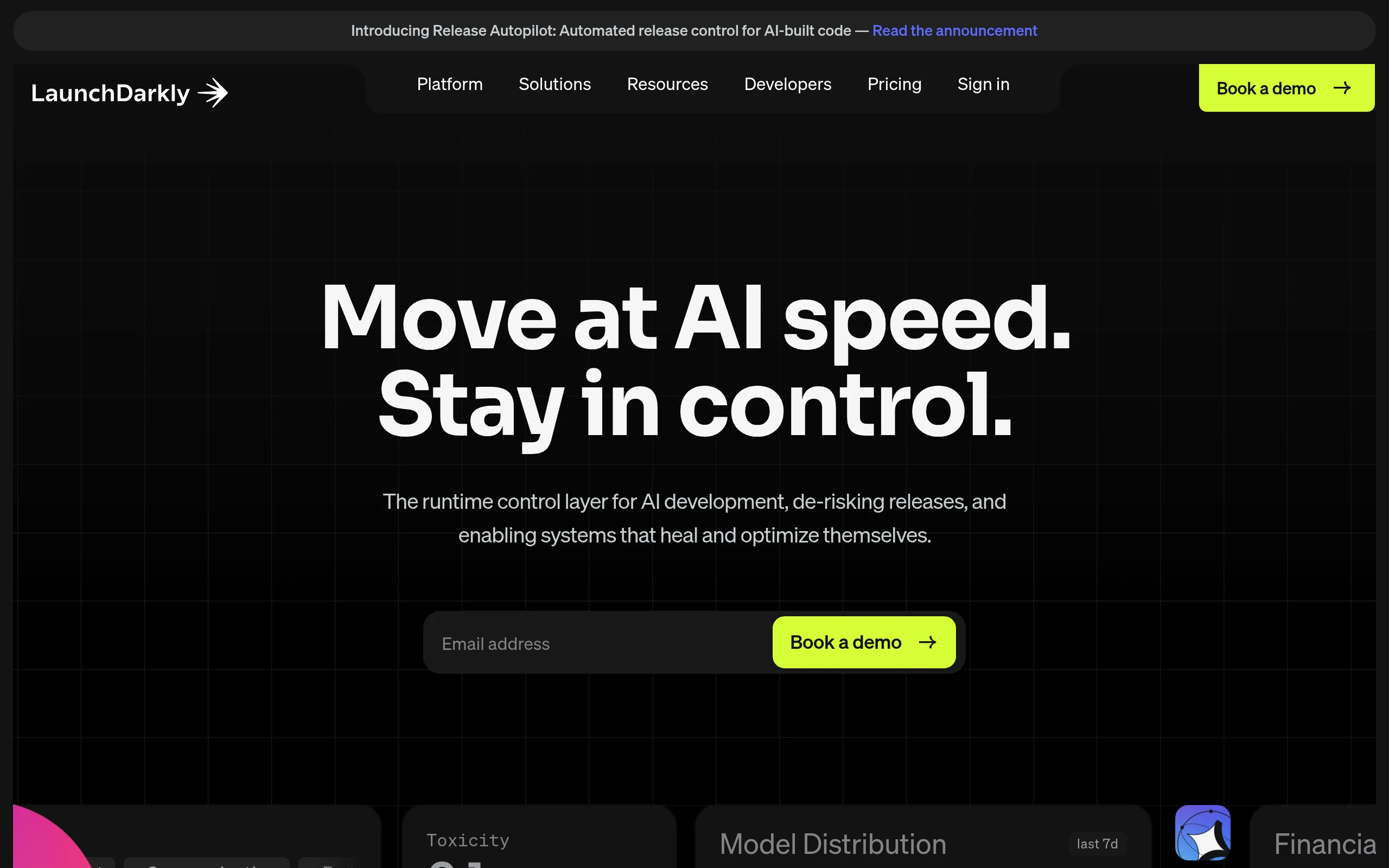
We checked these plans and prices against LaunchDarkly's official pricing and help pages in November 2026.
LaunchDarkly is a feature flag and release platform. You wrap new code in a flag, deploy it switched off, then turn it on for a few users, a segment, or everyone. If something breaks, you switch the flag off without a redeploy. The platform now also covers experimentation, observability (session replay, errors, logs, traces) and AgentControl for AI configs.
LaunchDarkly does have a free plan, called Developer. The $1,000 in credits matters once you move to the paid Foundation plan, which bills by usage. LaunchDarkly's own site does not publish a startup credit program, so the credit terms come from this deal, not from a public LaunchDarkly page.
LaunchDarkly plans and prices
LaunchDarkly sells three plans: Developer, Foundation and Enterprise. There are no seat fees on Developer or Foundation. You pay for usage: service connections for server-side SDKs, and monthly active users (MAU) for client-side SDKs.
| Plan | Price billed yearly | Billed monthly | Key limits |
|---|---|---|---|
| Developer | $0 | $0 | Unlimited seats and flags, 5 service connections, 1K client-side MAU/mo, 1 project and 3 environments, 14 days data retention |
| Foundation | $10 per service connection/mo (first 5 included), $8.33 per 1K client-side MAU/mo | Not listed | Unlimited projects and environments, 30 days data retention, 14-day trial |
| Enterprise | Custom | Custom | Everything in Foundation plus approvals, custom roles, flag scheduling, SCIM, audit logging, 100+ days retention |
One detail to know. The Foundation card lists $8.33 per 1K client-side MAU billed yearly. The comparison table on the same page lists $10 per 1K MAU per month. The gap matches a yearly versus pay-as-you-go rate, but LaunchDarkly does not say so. Confirm the rate on your quote before you budget.
Developer (free)
Developer costs $0 per month, forever, with no credit card. It includes:
- Unlimited seats and unlimited feature flags
- 30 SDKs: 13 client-side, 13 server-side and 4 edge
- 5 service connections and 1K client-side MAU per month
- 5K session replays and 5K errors per month
- 10M logs and 10M traces per month
- 100K Experimentation MAU per month at no extra charge
- 5K AI runs per month on AgentControl, with 14 days of data retention
- 1 project and 3 environments
- Bronze support
LaunchDarkly warns you as you approach the Developer limits and notifies you when you pass them. If usage keeps exceeding the limits, the account converts to read-only mode. Plan for that before you put a production app on the free tier.
Foundation (pay as you go)
Foundation starts with a 14-day trial. After that you pay for what you use. There are no platform fees and no seat fees.
- Your first 5 service connections each month are included. Each extra one is $10 per month.
- Client-side MAU is $8.33 per 1K per month billed yearly (the comparison table shows $10 per 1K).
- 5K AI runs per month are included, then $5 per additional 1K runs.
- 5K session replays, 5K errors, 10M logs and 10M traces per month are included. Usage above that is billed as you go.
- Unlimited projects and environments.
- 30 days of AgentControl data retention.
- Bronze support.
LaunchDarkly bills self-serve Foundation and Enterprise accounts at the start of each month for usage above the entitlements in the prior month. Custom rates exist for Kubernetes, serverless, Python and Ruby workloads.
Enterprise (custom)
Enterprise adds the governance features larger teams ask for:
- Advanced user targeting
- Custom roles and teams (advanced RBAC)
- Flag-level workflows and approvals, plus experiment approvals
- Flag scheduling and release automation
- Release Assistant and SCIM provisioning
- Audit logging
- 100+ days data retention and 100 days AgentControl retention
- Silver support, with Gold and Platinum available
- A 99.99% uptime SLA on Gold or Platinum
Guardian is a separate Enterprise add-on for release monitoring, guardrail metrics and automatic rollback. LaunchDarkly does not list its price.

What the free plan doesn't include
Developer is generous on flags and seats. These are the gaps:
- Only 1 project and 3 environments
- Only 5 service connections and 1K client-side MAU per month, with read-only mode if you keep going over
- 14 days of data retention instead of 30 on Foundation
- No audit logging (Enterprise only)
- No approvals or flag scheduling (Enterprise only)
- No custom roles (Enterprise only)
- No uptime SLA
- SSO/SAML: the comparison table shows a dash with "2FA included" on Developer and Foundation. The Enterprise card says SSO and SAML are included on every plan. The page contradicts itself, so check with sales if SSO is a requirement.
How LaunchDarkly counts usage
Service connections
A service connection is one server-side SDK connected to one environment for a month. LaunchDarkly measures it in minutes and assumes 43,800 minutes per month. A connection that stays up all month counts as 1. One that runs for half a month counts as 0.5. LaunchDarkly does not round, but it may combine partial connections, so two half-month connections count as one.
Pre-production environments count too. If your API runs in development, staging and production, that is 3 service connections, not 1.
Serverless functions are billed by connection time. An invocation averaging one minute counts as 1/43,800 of a service connection. One averaging one second counts as 1/2,628,000.
For SDKs that poll instead of stream, LaunchDarkly counts 732 poll requests per month as one service connection. That figure is 30.5 days times 24 hours, so hourly polling equals one connection. Polling more often costs more.
If you run the Relay Proxy, LaunchDarkly bills the server-side SDKs connected to it, not the proxy itself.
Client-side MAU
Each unique client-side user or device in a month is one MAU. LaunchDarkly counts unique context keys evaluated in the month. If you change a user's key, that user counts again. Custom attributes do not affect the count. Use stable keys for logged-in users to avoid paying twice for the same person.
The Account usage metrics page shows seats, client-side MAU, Data Export events, service connections and Experimentation MAU used in the month.
What $1,000 in credits covers
These examples use the Foundation rates on the pricing page. We show both MAU rates because the page lists two. We could not confirm on LaunchDarkly's site how credits are applied to a bill, so confirm that when you redeem.
Example 1: a small SaaS app
Setup: 2 backend services, each running in 5 environments, so 10 service connections, plus a web app with 5K client-side MAU.
- Service connections: 10 minus 5 included = 5 billable x $10 = $50 per month
- MAU at $8.33 per 1K: 5 x $8.33 = $41.65 per month
- Total: $91.65 per month, or $1,099.80 over 12 months
- $1,000 in credits covers about 10.9 months ($1,000 / $91.65)
At the $10 per 1K MAU rate, MAU costs $50 and the total is $100 per month. The credits then cover 10 months.
Example 2: a growing product
Setup: 20 service connections and 20K client-side MAU.
- Service connections: 20 minus 5 = 15 x $10 = $150 per month
- MAU at $8.33 per 1K: 20 x $8.33 = $166.60 per month
- Total: $316.60 per month, or $3,799.20 over 12 months
- $1,000 in credits covers about 3.2 months ($1,000 / $316.60)
At the $10 per 1K MAU rate, the total is $350 per month and the credits cover about 2.9 months.
The lesson from both examples: on LaunchDarkly, client-side MAU drives cost faster than server connections once a consumer app grows. A B2B app with a few hundred users stays cheap for a long time.
Who LaunchDarkly is for
- Teams that deploy several times a week. Shipping behind flags lets you merge to main daily and release when ready.
- Products with paying customers to protect. A percentage rollout to 1% of users, then 10%, then 100%, keeps a bad release small.
- B2B apps with account-level targeting. You can turn a feature on for one customer account for a beta, then for a segment.
- Teams that want flags and experiments in one place. A/B/n tests, sequential testing, CUPED, SRM detection and multi-armed bandits are listed on all three plans.
- Teams building AI features. AgentControl lets you change model configs and prompts at runtime and roll them back like any other flag.
- Startups selling to regulated buyers. LaunchDarkly lists SOC 2 Type II and ISO 27001 on its security page, plus a FedRAMP authorization for its federal environment.
Who LaunchDarkly is not for
- A solo founder with one app and one environment. The Developer plan is enough, so the credits add little.
- Consumer apps with large anonymous traffic. At $8.33 to $10 per 1K client-side MAU, 100K MAU costs $833 to $1,000 per month on MAU alone. That uses the full $1,000 in about one month.
- Teams that only need a few on/off switches. Environment variables or a config table may be enough until you need targeting or gradual rollouts.
- Teams that need audit logs or approvals now. Those are Enterprise only, which is custom-priced.
LaunchDarkly vs alternatives
| Tool | Free plan | First paid tier | Billing model |
|---|---|---|---|
| LaunchDarkly | 5 service connections, 1K client-side MAU/mo, unlimited seats | Foundation: $10 per extra service connection/mo, $8.33 per 1K MAU/mo billed yearly | Usage (connections and MAU), no seat fees |
| Statsig | 2M events/mo, unlimited flag and config checks, 50,000 session replays | Pro: $150/mo with 5M events, then $0.05 per 1K events | Events |
| Flagsmith | 50,000 requests/mo, 1 team member, 1 project | Start-Up: $45/mo, or $40/mo billed yearly, 1,000,000 requests, 3 team members | Requests and seats |
Statsig fits a team that wants experimentation first, with flag checks that do not count against the bill. Pro starts at $150 per month.
Flagsmith fits a small team that wants a flat monthly price. Start-Up is $40 per month billed yearly, with 1,000,000 requests. Scale-Up is $250 per month billed yearly ($300 monthly) with 5,000,000+ requests and 5 team members included. Request overage starts at $50 per million.
LaunchDarkly fits a team that wants unlimited seats, deep targeting, and observability and experiments next to flags.
Setting up LaunchDarkly well
- Start on Developer. Wire one SDK into one service and one environment. Learn the flag workflow before you pay for anything.
- Count environments before you upgrade. Every server-side SDK in every environment is a connection. Three services in three environments is 9 connections, and 4 of them are billable on Foundation.
- Use stable context keys. Key logged-in users by their account ID, not a session ID, so one person counts as one MAU.
- Stream instead of polling when you can. If you must poll, remember that 732 polls per month equal one connection.
- Set application IDs. The Service connections usage page groups usage by SDK App ID. Connections without an
applicationIdshow as "Unknown". - Delete old flags. Each flag is a branch in your code. Remove a flag once a feature is fully rolled out.
- Watch the usage page monthly. Overage bills at the start of the next month, so check usage before the month closes.
How to get the LaunchDarkly offer
- Open the LaunchDarkly deal on SaaSOffers and sign in with your SaaSOffers account.
- Confirm you meet the requirements: an early-stage startup and a new LaunchDarkly account.
- Follow the claim steps on the deal page to request the $1,000 in credits. There is no promo code.
- Create your LaunchDarkly account with your company email. An existing account does not qualify.
- Start on Developer or the Foundation trial, connect your first SDK, and check that the credits appear on the Billing page before you scale usage.
Who Is This Deal For?
Early-Stage Startups
Seed and pre-seed companies looking to move fast without overspending on tools.
Growing SaaS Teams
Series A+ companies scaling their stack and optimizing software costs.
Solo Founders
Indie hackers and bootstrapped founders who need enterprise tools at startup prices.
Get $1,000 in credits off LaunchDarkly
Premium deal. Upgrade once, unlock everything.
!Eligibility Requirements
Early-stage startup, new LaunchDarkly account
Frequently Asked Questions
Everything you need to know about this startup deal.
Get the weekly deals digest
New verified startup deals every week. No spam, ever. Unsubscribe anytime.
LaunchDarkly guides
- 15 Best Feature Flag Tools for Safe Deployments (2026)The 15 best feature flag tools for safe deployments in 2026. Compare Amplitude, LaunchDarkly, Flagsmith, Unleash, GrowthBook and 10 more platforms for gradual rollouts, A/B testing, and kill switches.
- Mixpanel vs Amplitude vs PostHog for Startup Analytics (2026)The honest 2026 comparison of Mixpanel vs Amplitude vs PostHog for startup product analytics. Pricing, features, free tiers, and which is best for your startup.
Related Offers

Retool
Used by 1,559 members
1 year free, up to $60K
Build internal tools 10x faster with the low-code platform used by companies like Amazon, DoorDash, and Mercedes-Benz.
View offer
Zoom
Used by 1,090 members
$20 off per user
Get $20 off per user on Zoom, the video conferencing platform used by hundreds of thousands of businesses for meetings, webinars, and team collaboration.
View offer
ZoomInfo
Used by 2,014 members
Free Trial
B2B data platform for sales and marketing intelligence with contact databases.
View offer
Chore
15% off your first month
Chore runs your startup's back office for you: payroll, HR, bookkeeping, compliance and equity, inside the tools you already use. 15% off your first month through SaaSOffers.
View offerDeal Summary
Looking for more startup deals?
Browse all offers