
Payload CMS: Free and Open Source Tool
Next-gen TypeScript headless CMS built with React and self-hostable.
Premium: $79/year for unlimited deals
Already have an account? Log in
Deal Highlights
Payload has been part of Figma since June 2025
Payload announced on June 17, 2025 that it had joined Figma. That was 509 days before we checked the site on November 8, 2026. Founder James Mikrut wrote that Payload stays open source, stays self-hostable and is still run by the same team. Payload's own FAQ says the company is "not ready to share specifics just yet" about plans with Figma. Since the deal, Payload no longer lists a public hosted plan.
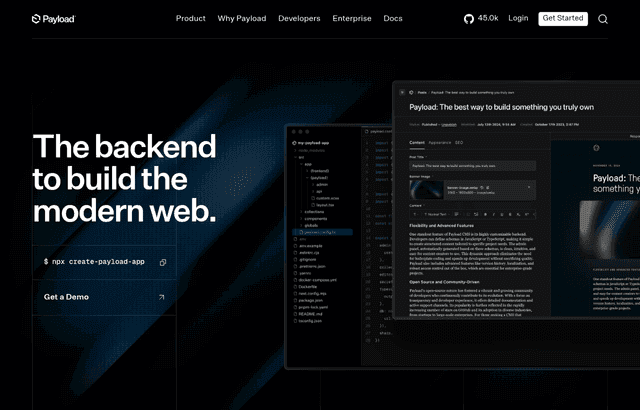
What our Payload listing offers
Offer: Free & Open Source.
Who qualifies: our listing sets no requirements.
There is no promo code and no SaaSOffers redemption link for this listing. Payload is free to everyone. You download it from Payload's site or GitHub, and nothing on our side changes the price or adds credits. We list it so you can compare it with paid CMSs, not because we can get you a better deal than Payload's own.
We checked these plans and prices against Payload's Get started, Enterprise and docs pages in November 2026.
Payload calls itself "the Next.js fullstack framework." You write a Payload Config in TypeScript. From it Payload generates a React admin panel, a database layer with migrations, REST and GraphQL APIs, and direct-to-database Node.js calls (the Local API). It installs into a new or existing Next.js app, so the CMS and your frontend can live in 1 repository and deploy together.
The MIT license covers commercial use
The repository license is the standard MIT License, copyright 2018 to 2026 Payload CMS, LLC. MIT lets you use, change and sell products built on Payload with no fee and no revenue cap. Payload's "Get started" page says Payload is "open source and MIT licensed" and that you can deploy it anywhere you can run a Node.js app, free, forever.
Some facts from the GitHub repository on November 8, 2026:
- 45,721 stars and 4,408 forks.
- Latest release: v3.93.0, published November 4, 2026.
- Last code push: November 7, 2026.
So the project was still shipping releases after the Figma deal. Release v3.93.0 is a 3.x version. Payload 3 needs Node.js 20.9.0 or later, any JavaScript package manager (Payload prefers pnpm) and a compatible database.

There is no Payload pricing page any more
payloadcms.com/pricing returned a 404 when we checked. The "Pricing" link in Payload's footer now opens the "Get started" page, which shows 2 options: self-hosted for free, or Enterprise through a sales demo. Payload Cloud, the hosted service Payload used to sell, has no plans on that page. The /cloud address opens only a login screen, and Payload's Cloud docs pages return 404. Search engines index Payload's Cloud login page with a note that new signups are paused during the move to Figma and that existing projects keep running. We could not load that note ourselves, so treat it as Payload's indexed text, not something we saw.
| Plan | Price billed yearly | Billed monthly | Key limits |
|---|---|---|---|
| Self-hosted | $0 | $0 | MIT license, community support only, Node.js 20.9.0+, MongoDB, Postgres or SQLite, you pay your own hosting |
| Vercel template | $0 from Payload | $0 from Payload | Official Website Template with Vercel Blob storage and a Neon database; Vercel and Neon bill you |
| Cloudflare template | $0 from Payload | $0 from Payload | Starter with R2 image storage and a D1 database; Cloudflare bills you |
| Enterprise | Not published | Not published | Quote via demo; dedicated support, SSO, visual editing, unlimited custom domains, white-labeled email service, self-hosted or hosted by Payload |
| Payload Cloud | Not offered | Not offered | No public plans; new signups reported paused |
Payload's Cloud terms say cloud subscriptions are invoiced in advance each month and enterprise-tier customers each quarter, unless an order says otherwise. Fees under those terms are non-refundable. Enterprise prices are not public, so you only learn the number after a demo.
What the free version does not include
The open source core is the whole framework. Collections, fields, access control, auth, uploads, versions and drafts, localization, live preview and the Jobs Queue are all in it. What Payload holds back is listed on its Enterprise and "Get started" pages:
- Single sign-on with any SAML or OAuth 2.0 identity provider.
- Publishing workflows with notifications and inline feedback.
- The Visual Editor. Payload's Enterprise page still marks it "Coming Soon", while "Get started" lists visual editing as an Enterprise feature.
- Static A/B variant testing.
- AI Auto-Embedding for retrieval-augmented generation, plus Enterprise AI (translations, image generation, a writing assistant).
- Payload's Enterprise page mentions audit logs next to version control but does not say whether they are Enterprise-only. Versions and drafts are in the open source build.
- Multi-player editing, also marked "Coming Soon".
- Dedicated engineering support. Free users get community help on Discord and GitHub.
- Hosting by Payload, unlimited custom domains and a white-labeled email service.
- Influence over the roadmap.
Most small teams never need these. The gap that matters most for companies with strict IT rules is SSO. If your company requires Okta or Google Workspace login for every tool, the free version does not do it out of the box.
You still pay for servers, a database and file storage
Payload costs $0, but it has to run somewhere. Payload's docs say it deploys "anywhere that Next.js can run" and name Vercel, Netlify, SST, DigitalOcean and AWS. Production needs a long, complex secret in PAYLOAD_SECRET and a DATABASE_URL for your database.
Uploads need care. On hosts with an ephemeral filesystem, such as Heroku or DigitalOcean App Platform, files can disappear when the server restarts. Payload's fix is a persistent disk (a DigitalOcean Droplet or Amazon EC2) or a storage adapter. It ships 6: Vercel Blob, AWS S3, Azure, Google Cloud Storage, Uploadthing and R2. The R2 adapter is in beta and meant for Cloudflare Workers. On Node hosts, Payload suggests the S3 adapter pointed at R2's S3-compatible API.
Typical bills for the pieces, from each provider's pricing page in November 2026:
| Piece | Option | Monthly price | What you get |
|---|---|---|---|
| App hosting | Vercel Hobby | $0 | Personal, non-commercial use only, 1 developer seat |
| App hosting | Vercel Pro | $20 | 1 deploying seat and $20 usage credit; extra developer seats $20 each |
| App hosting | DigitalOcean Droplet | $6 or $12 | 1 GiB or 2 GiB memory, 1 vCPU, 25 or 50 GiB SSD |
| Database | Neon Free | $0 | 1 GB storage and 100 CU-hours per project, scales to zero after 5 minutes idle |
| Database | Neon Launch | Usage | $0.106 per CU-hour, $0.35 per GB-month, no minimum |
| Database | Supabase Pro | From $25 | 8 GB disk per project, $10 compute credit |
| Database | DigitalOcean Managed PostgreSQL | $15.15 | 1 GiB memory, 1 vCPU, 10 GiB disk |
Vercel Hobby rules out a company site, so a startup on Vercel starts at $20 a month. Vercel Blob storage costs $0.023 per GB and comes out of the $20 Pro credit first.
Two startups, priced out
Worked example 1: a 5-person team with a marketing site and blog
1 developer and 4 marketers edit the site. The team deploys Payload's Vercel template on Vercel Pro and keeps the Neon Free database.
- Payload license: $0.
- Vercel Pro: $20 x 12 = $240 a year.
- Neon Free: $0, while the site fits in 1 GB and 100 CU-hours a month.
- Year one: $240, plus any Vercel usage past the $20 monthly credit.
The same 5 editors on Strapi's self-hosted Growth plan cost $45 + 2 x $15 = $75 a month, or $900 a year, before hosting. Add the same $240 of Vercel and Strapi comes to $1,140. Sanity Growth at $15 per seat is 5 x $15 = $75 a month, also $900 a year, with hosting included. Payload saves $900 a year against Strapi and $660 against Sanity, because it has no seat price at all.
Worked example 2: a 10-person team running a content app
2 developers and 8 editors use Payload as the backend for a directory app with relational data. They pick Postgres and host on DigitalOcean so uploads sit on a persistent disk.
- Payload license: $0.
- Droplet, 2 GiB: $12 x 12 = $144 a year.
- Managed PostgreSQL, 1 GiB: $15.15 x 12 = $181.80 a year.
- Year one: $144 + $181.80 = $325.80.
Strapi Growth for 10 users is $45 + 7 x $15 = $150 a month, or $1,800 a year, plus the same $325.80 of hosting, so $2,125.80. Sanity Growth for 10 seats is 10 x $15 = $150 a month, or $1,800 a year. Payload comes in $1,800 a year under Strapi on the same servers. The trade is that your developers own upgrades, backups and uptime. If they need SSO, Payload means an Enterprise quote, while Strapi Growth sells SSO as an add-on at $150 a month plus $50 per user a month.
Where Payload fits
- Next.js teams. Payload installs into the app you already have. One repository holds the frontend, the admin panel and the API.
- TypeScript-heavy teams.
payload generate:typeswrites apayload-types.tsfile from your config, so queries against a missing field fail at compile time. - Products that need an app backend, not just a blog. Payload handles auth, access control down to the document, field and operation level, and custom endpoints. Payload pitches it for headless e-commerce and digital asset management too.
- Multi-site or multi-brand setups. The official Multi-Tenant plugin is free, as are Form Builder, MCP, Nested Docs, Redirects, Search, Sentry, SEO, Stripe, Import/Export and Ecommerce.
- Background work. The Jobs Queue runs large or scheduled tasks, such as a nightly cron or a job set for a future date.
Who Payload CMS is not for
- Teams with no developer. There is no hosted sign-up for new users, so someone must deploy, update and back up a Node.js app.
- Companies that need SSO or approval workflows today. Both sit behind an Enterprise quote with no public price.
- Teams that want a visual page editor now. Payload's Visual Editor was still marked "Coming Soon" on its Enterprise page. Storyblok and Sanity ship visual editing on their hosted plans.
- Anyone uneasy about roadmap risk. Payload has said little about its plans inside Figma. The MIT license protects your copy of the code, but it does not promise future features.
How Payload compares with other CMSs
These figures come from each vendor's own pricing page in November 2026.
| Payload | Strapi (self-hosted) | Sanity | Webiny | |
|---|---|---|---|---|
| Free plan | Self-hosted, MIT, no user limit | Community, free forever, MIT | Free, up to 20 seats, 10,000 documents | Community, no user limit, 1 tenant |
| First paid plan | Enterprise, quote only | Growth, $45 a month | Growth, $15 per seat a month | Business Small, $79 a month |
| Users on first paid plan | Set in your quote | 3 included, $15 a month each extra | Up to 50, paid per seat | Up to 8 |
| Hosting | Your servers, any Node.js host | Your servers | Sanity's cloud | Your AWS account |
| API metering | None from Payload | Unlimited usage on Community | 250,000 API requests a month, then $1 per 25,000 | None |
Strapi is the closest match: also self-hosted and MIT on its free tier, but Live Preview, Releases and Content History need Growth, and review workflows and audit logs need Enterprise. Sanity is fully hosted, so nobody on your team runs servers, but you pay per seat and per API request past 250,000. Webiny runs in your own AWS account and charges for roles and multi-tenancy from $79 a month, where Payload's Multi-Tenant plugin is free.
Setup tips that save money later
- Choose the database on day one. Payload's docs suggest MongoDB for many dynamic fields and Postgres or SQLite when relationships must be enforced. Nearly every feature works on all 3 adapters. SQLite still lacks the Point field.
- Use a storage adapter on any host that restarts. Vercel Blob, S3 or R2 keeps uploads safe. A Droplet's disk also works.
- Regenerate types in CI. Run
payload generate:typeson every build so the frontend never drifts from the schema. - Plan cron on serverless hosts. On Vercel, Payload's docs say to skip the Jobs Queue's
autoRunand have an external cron call its endpoints. - Watch Neon's free compute. 100 CU-hours a month suits a quiet site. A busy one moves to Launch at $0.106 per CU-hour.
- Pin your Payload version. Releases come often. Upgrade on a branch and read Payload's migration guides first.
How to claim the Payload CMS deal
- Note there is no SaaSOffers link or code for Payload. The software is free to everyone at the same terms.
- Open payloadcms.com/get-started, or run
npx create-payload-appwith Node.js 20.9.0 or later. - Or use Payload's one-click Vercel or Cloudflare template from the same page.
- Pick MongoDB, Postgres or SQLite, set
PAYLOAD_SECRETandDATABASE_URL, and deploy. - If you need SSO, publishing workflows or dedicated support, book a demo from Payload's Enterprise page and ask for the price in writing.
Who Is This Deal For?
Early-Stage Startups
Seed and pre-seed companies looking to move fast without overspending on tools.
Growing SaaS Teams
Series A+ companies scaling their stack and optimizing software costs.
Solo Founders
Indie hackers and bootstrapped founders who need enterprise tools at startup prices.
Get Free & Open Source off Payload CMS
Premium deal. Upgrade once, unlock everything.
Frequently Asked Questions
Everything you need to know about this startup deal.
Get the weekly deals digest
New verified startup deals every week. No spam, ever. Unsubscribe anytime.
Related Offers

Retool
Used by 1,559 members
1 year free, up to $60K
Build internal tools 10x faster with the low-code platform used by companies like Amazon, DoorDash, and Mercedes-Benz.
View offer
Replicate
Used by 1,772 members
$500 in credits
Run open-source ML models in the cloud, deploy Llama, Stable Diffusion, and custom models via API without GPU management.
View offer
ZoomInfo
Used by 2,014 members
Free Trial
B2B data platform for sales and marketing intelligence with contact databases.
View offer
Chore
15% off your first month
Chore runs your startup's back office for you: payroll, HR, bookkeeping, compliance and equity, inside the tools you already use. 15% off your first month through SaaSOffers.
View offerDeal Summary
Looking for more startup deals?
Browse all offers