
Plaid Startup Credits: $1,000 in credits
Connect your app to users' bank accounts with the financial data API powering Venmo, Coinbase, and thousands of fintech products.
Premium: $79/year for unlimited deals
Already have an account? Log in
Deal Highlights
What Plaid Does and Why Fintech Runs on It
Plaid is the financial data API that connects an application to its users' bank accounts, and it is the infrastructure sitting behind a huge share of the fintech products people use every day, including Venmo, Coinbase, and thousands of others. When an app needs to verify a bank account, check a balance, pull transaction history, or move money, Plaid is the layer that securely handles the connection to the user's financial institution so the product does not have to build and maintain thousands of fragile bank integrations itself.
The startup deal provides $1,000 in credits, available to fintech startups building with financial data. Those credits cover the early development and testing period when a team is wiring up bank connectivity for the first time, letting them build and validate the core of their product before the cost of real usage arrives. For a fintech startup, reliable bank connectivity is usually not a feature but the foundation the whole product rests on, so lowering the cost of getting it right early is genuinely valuable.
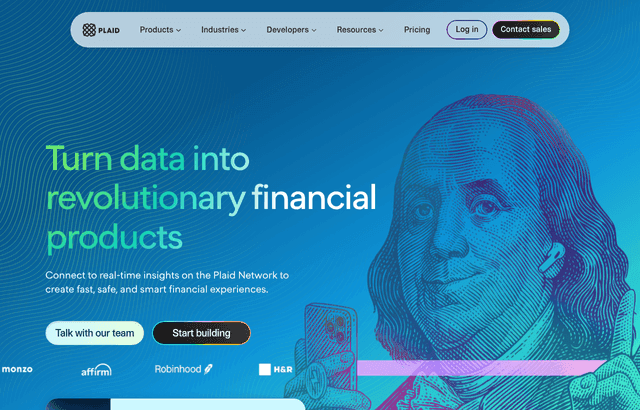
Plaid, one of the tools included in this startup deal.
The Problem Plaid Solves
Connecting directly to banks is brutally hard. Every institution has its own systems, its own authentication, its own quirks, and its own failure modes, and there are thousands of them. A startup that tried to build these connections itself would spend enormous effort maintaining integrations that break constantly, and would still cover only a fraction of the banks its users actually use. Plaid abstracts all of that behind one API, so a startup writes to a single interface and gets coverage across the vast majority of institutions its users will have accounts with.
That abstraction is the entire value. Instead of a team burning months on bank plumbing, they integrate Plaid once and immediately have the ability to verify accounts, read balances and transactions, and initiate transfers across a huge network of institutions. The engineering effort that would have gone into fighting bank connections goes into the actual product instead, which for an early-stage fintech is the difference between shipping and stalling.
Account Verification and Funding
The most common first use of Plaid is verifying a bank account and funding it. When a user connects their bank through Plaid, the app can confirm the account is real and belongs to them, and can then set up transfers without the slow, error-prone process of micro-deposits and manually entered account numbers. For any product that moves money, this is the on-ramp, and making it fast and reliable directly affects how many users complete setup rather than abandoning it.
A smooth connection flow matters more than it looks. Every extra step or moment of friction when a user links their bank is a point where people drop off, and for a fintech product the linked bank account is often the thing that makes the whole product usable. Plaid's connection flow is designed to make that step as painless as possible across a wide range of institutions, which lifts the completion rate on the single most important action in a lot of fintech onboarding.
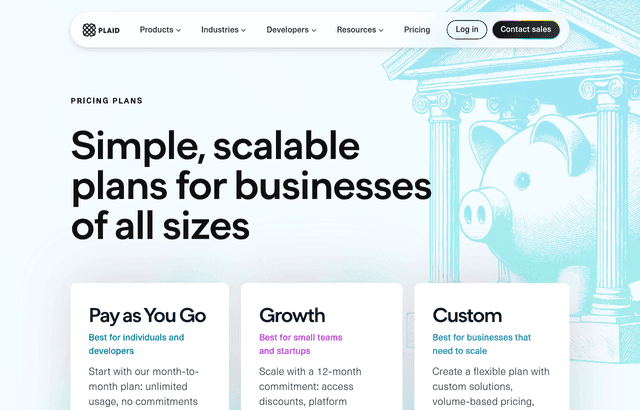
A look at Plaid before the discount, so you can see what the deal saves you.
Transaction Data and What You Build on It
Beyond verification, Plaid gives access to transaction data, and this is where a lot of fintech products find their value. A budgeting app categorizes spending, a lending product assesses income and cash flow, a personal finance tool shows a user their complete financial picture, and all of it depends on clean, reliable access to transaction history. Plaid delivers that data in a structured form so the product can build features on top of it rather than wrestling with raw bank exports.
The quality of that data shapes what the product can do. Well-structured, categorized transaction data lets a startup build features that would otherwise take enormous effort to derive, and the breadth of Plaid's institution coverage means those features work for most users rather than only those who happen to bank somewhere the startup managed to integrate. Building on this data is how a lot of fintech products deliver insight that feels like magic to the user but is really the product of reliable connectivity underneath.
Handling the Realities of Bank Connectivity
Building on financial connectivity means building for its realities rather than assuming ideal conditions. Bank connections occasionally fail, institutions change their systems, users need to re-authenticate, and coverage is never perfect. A product designed well handles these gracefully, telling the user clearly when a connection needs attention and recovering smoothly, rather than breaking in a confusing way that makes the user distrust the whole product. Designing for these cases from the start is the mark of a fintech team that understands what it is building on.
The practical discipline is to treat re-authentication and connection health as first-class parts of the product rather than edge cases bolted on later. Users will need to reconnect accounts, connections will drop, and the product that handles this smoothly keeps its data fresh and its users confident, while the one that ignores it accumulates broken connections and quiet data gaps that undermine everything built on top. The credits give a team the room to build these paths properly during development instead of discovering them in production.
The Trust and Compliance Weight of Financial Data
Handling financial data carries obligations that a startup cannot treat casually. Users are connecting their bank accounts, which is among the most sensitive things they can share, and that demands rigorous security, transparency about what the product accesses and why, and compliance with the regulations that govern financial data. A fintech startup that establishes these practices early, minimal access, clear disclosure, serious security, builds on solid ground, while one that treats them as afterthoughts is building on a foundation that will crack under a breach or a compliance failure.
Plaid helps here by being built around the security and compliance expectations of the financial industry, so a startup building on it inherits a connection layer designed for that scrutiny rather than having to construct it alone. That does not remove the startup's own responsibility, but it means the hardest part of the trust equation, the secure connection to the bank itself, is handled by infrastructure built for the job. The team's responsibility becomes handling the data it receives responsibly, which is a far more manageable task than also securing every bank connection.
The Cost Model of Financial Connectivity
Understanding how financial-data APIs are priced helps a startup build economically, because cost is tied to the connections and the data the product uses. Pricing in this category is typically based on the accounts connected and the types of data or actions used, so a product that connects many accounts or pulls rich data continuously costs more than one that connects fewer accounts or accesses data occasionally. Modeling cost around how the specific feature uses the connectivity, how many users link accounts and how often the product accesses their data, is how a team understands what it will actually cost at scale rather than being surprised by the bill.
The discipline is to access the data the feature needs when it needs it rather than pulling everything continuously, which both controls cost and treats user data more responsibly. A feature that refreshes on a sensible cadence tied to real use is cheaper and more respectful than one that constantly polls every connected account for data it does not immediately need. The credits are the budget to build and learn that usage pattern before the cost of scale arrives, so a team should use the period to understand how its real usage translates into cost.
Bank Connectivity as a Foundation to Build On
The strategic point for a fintech startup is that reliable bank connectivity is often the foundation the entire product rests on, and getting it right early shapes everything above it. Because so much of a financial product's value depends on accessing user financial data reliably and handling it well, the connectivity is not a feature to bolt on but infrastructure to design carefully around, and the early decisions about how the product accesses, handles, and secures financial data have long consequences.
The guidance is to treat the connectivity as core infrastructure worthy of careful design, building for the realities of connection failures, coverage gaps, and re-authentication from the start, and to establish responsible data practices as foundations rather than afterthoughts. A startup that builds thoughtfully on financial connectivity, respecting both its technical realities and the trust and compliance it carries, creates a solid base for a financial product, while one that treats it carelessly builds on something that will fail under the weight of broken connections, user distrust, or a compliance lapse. The $1,000 in credits lowers the cost of building that foundation properly during the exact stage when getting it right sets up everything that follows.
Coverage and Why Institution Breadth Matters
A detail that decides whether a fintech product works for real users is how many financial institutions the connectivity layer actually supports. A product can build a beautiful experience, but if a large share of users cannot connect the bank they actually use, the product fails for them at the first step. Plaid's value here is the breadth of its institution coverage, which means most users can find and connect their bank, and the product works for the majority rather than only for customers who happen to bank at one of a handful of supported institutions.
For a startup this breadth removes a problem that would otherwise be nearly impossible to solve alone. Building and maintaining connections to thousands of institutions is exactly the kind of work that would consume a small team entirely, and coverage is the thing users notice immediately when it is missing. Inheriting broad coverage through Plaid means a startup can launch to a wide market rather than apologizing to the large fraction of users whose bank it never got around to supporting. That reach, available from the first integration, is a major part of why building on Plaid beats building bank connections in-house.
From Prototype to Production
The credits are most useful as the bridge from prototype to production. Early on, a fintech team is validating that its core idea works: that it can connect accounts, read the data it needs, and build the feature that makes the product valuable. That validation involves a lot of testing and iteration, and the credits cover that exploration so the team can prove the concept before committing to the cost of scale. Using the period to nail down exactly how the product uses financial data, and how that usage translates into cost, sets up a clean transition to paid usage.
The teams that get the most from this treat the credit window as the time to build not just the happy path but the whole system: the connection flow, the re-authentication handling, the data refresh cadence, the error states, and the security and compliance practices around all of it. A product that emerges from the credit period with those pieces solid is ready to grow, while one that used the credits only to demo the happy path still has the hard parts ahead. The credits are worth the most when they fund building the foundation properly, not just proving the idea once.
Who Should Claim This Deal
The Plaid credits fit any fintech startup whose product depends on connecting to users' bank accounts, whether for verification, funding, transaction data, or moving money. If a team is at the point of wiring up bank connectivity for the first time, the $1,000 in credits covers the development and testing period when the core of the product gets built, letting the team validate the idea and build the foundation properly before the cost of real usage arrives. For a product where reliable bank connectivity is the base everything rests on, that is exactly the right stage to lower the cost of getting it right.
Who Is This Deal For?
Early-Stage Startups
Seed and pre-seed companies looking to move fast without overspending on tools.
Growing SaaS Teams
Series A+ companies scaling their stack and optimizing software costs.
Solo Founders
Indie hackers and bootstrapped founders who need enterprise tools at startup prices.
Get $1,000 in credits off Plaid
Premium deal. Upgrade once, unlock everything.
!Eligibility Requirements
Fintech startup building with financial data
Frequently Asked Questions
Everything you need to know about this startup deal.
Plaid connects your application to users' bank accounts through a secure API. Users authenticate with their bank through Plaid's Link UI, and your application receives access to account data — transactions, balances, identity, and account numbers — without handling bank credentials directly.
Get the weekly deals digest
New verified startup deals every week. No spam, ever. Unsubscribe anytime.
Related Offers

Stripe Atlas
Used by 6,540 members
$500 off incorporation
Get $500 off Stripe Atlas and incorporate your startup as a US Delaware C-Corp in minutes. The legal foundation every investor expects.
View offer
TinCheck
Used by 75 members
First real-time check free
Real-time IRS TIN and name verification from Sovos. Catch a wrong contractor or vendor TIN before it becomes a stacked IRS penalty and a backup-withholding headache.
View offer
Navan
Used by 1,799 members
3 months free
Get 3 months of Navan free. The all-in-one travel and expense management platform that replaces your corporate card, expense reports, and travel booking.
View offer
Ramp
Used by 877 members
$500 cashback bonus
Corporate card and spend management for startups, 1.5% cashback, real-time expense tracking, and automated accounting.
View offer
doola
Used by 480 members
30% off first purchase
Get 30% off your first purchase, the all-in-one platform to form a US LLC or C-Corp, get an EIN, open a US bank account, and stay tax-compliant from anywhere in the world.
View offer
Expensify
Used by 2,178 members
3 months free Collect
Expense management and corporate cards, receipt scanning, approval workflows, and reimbursement automation.
View offerDeal Summary
Looking for more startup deals?
Browse all offers