
Remote Discount Code: $1,000 off first year
Get $1,000 off your first year of Remote, the global HR platform that handles compliant hiring, payroll, benefits, and equity for international employees and contractors in 180+ countries.
Free · Opens in new tab
Free · No account required. Sign up to track your deals.
Deal Highlights
Remote is the global HR platform that lets you hire, pay, and manage employees and contractors anywhere in the world without setting up local entities, navigating dozens of country-specific payroll systems, or risking misclassification penalties. Across 180+ countries, Remote handles everything from compliant employment contracts and local benefits packages to multi-currency payroll, equity grants, IP protection, and offboarding, all under a single platform with a single point of contact.
The $1,000 off your first year of Remote is one of the most generous startup deals in the category, meaningful at any scale and especially valuable for small startups making their first 1-3 international hires where the savings represent 1-3 months of platform fees.
What You Get
- $1,000 off your first year of Remote
- Employer of Record (EOR) services in 80+ countries (Remote owns and operates local entities)
- Contractor management and compliant pay-out in 180+ countries
- Compliant local employment contracts drafted by in-country legal experts
- Country-specific benefits packages (health insurance, retirement, leave entitlements)
- Multi-currency payroll with local-currency pay-out and FX management
- Equity grants for employees in countries where Remote supports stock options
- Strong IP and invention assignment protection in every supported country
- Onboarding workflows tailored to each country's legal requirements
- Compliance updates as labor laws change (Remote handles the change-management, not you)
- Dedicated account management for Enterprise tiers
- Integration with HRIS systems (BambooHR, Rippling) and accounting tools (QuickBooks, Xero, NetSuite)
- Self-service dashboard for employees to view payslips, benefits, and time off
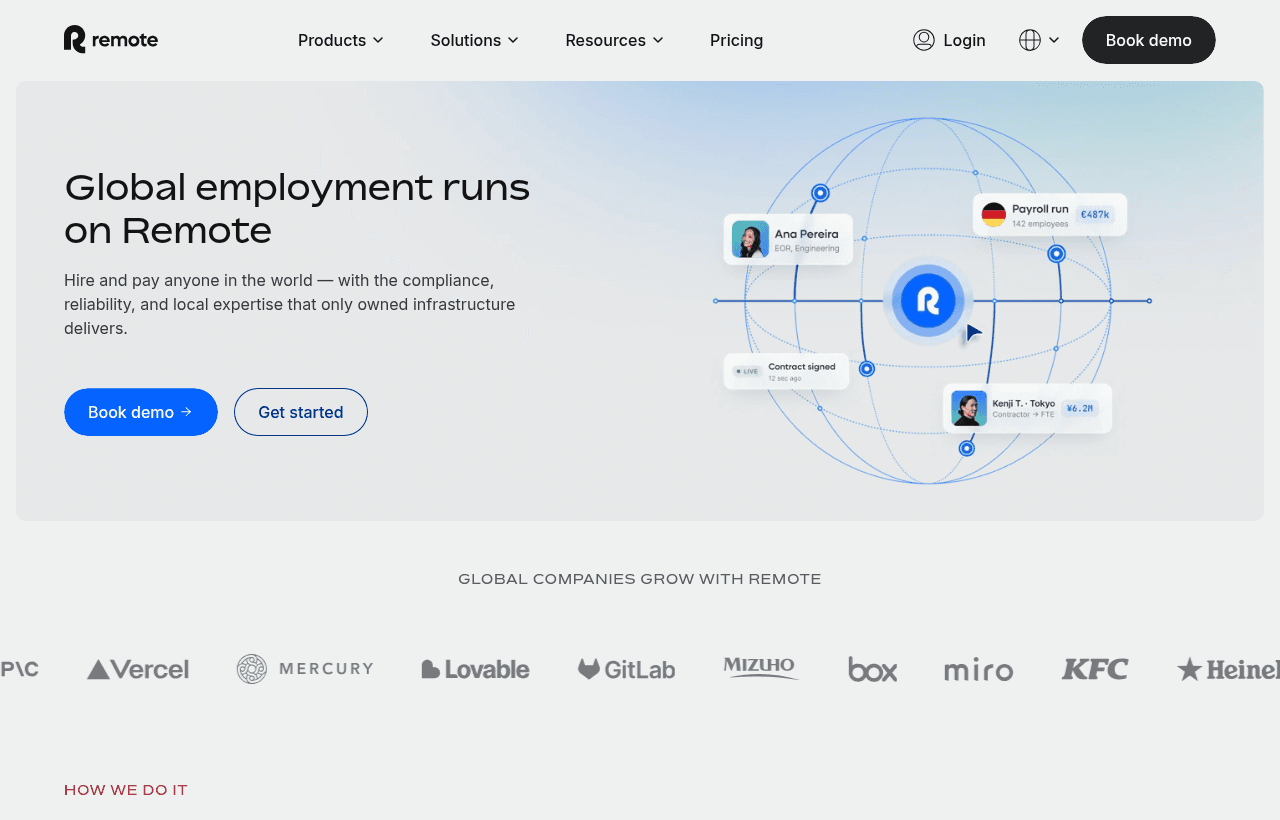
Remote, one of the tools included in this startup deal.
Why Remote for Startups Going Global
The decision to hire internationally used to require either (1) setting up a local subsidiary in each country (months of legal work, ongoing compliance overhead, $30K-$80K per country) or (2) hiring people as contractors and hoping they don't get reclassified as employees by local tax authorities (massive misclassification risk: back taxes, penalties, and reputational damage).
Both paths are bad. The first is too slow and expensive for early-stage startups. The second is dangerously non-compliant, countries like Germany, France, the UK, Brazil, and India have aggressive enforcement on contractor misclassification, with penalties that can exceed the entire wage cost of the worker.
Employer of Record services solve this by acting as the legal employer of your international team members on your behalf. Remote owns and operates local entities in 80+ countries; the worker is legally employed by Remote (with all proper tax withholding, benefits, and labor-law compliance), but reports to your team and works on your products as if they were your direct employee.
Three patterns where Remote particularly shines:
- Hiring senior engineers in lower-cost countries (Latin America, Eastern Europe, India) without setting up local entities or risking misclassification
- Operating across the EU with full compliance (GDPR, country-specific labor codes, mandatory benefits)
- Onboarding executives and equity-bearing hires in countries with complex stock-option taxation
Pricing Structure
Remote operates on a transparent per-hire monthly fee model:
- Contractor Management: Lowest-cost tier, typically a small fixed monthly fee per contractor for compliant invoicing, multi-currency payouts, and minimal compliance protection. Best for short-term project work or genuinely independent contractors.
- Employer of Record (EOR): Higher monthly fee per employee covering full employment compliance, local benefits, payroll tax handling, IP protection, and termination support. Best for long-term hires who function as full employees.
- Remote Talent (recruiting + EOR bundle): Combines hiring help with EOR services for teams without internal recruiting capacity.
- Enterprise: Custom pricing for high-volume international hiring with dedicated account management, premium SLAs, and advanced security.
The pricing is transparent and predictable per-hire, which contrasts with traditional EOR providers who often quote opaque "ask for pricing" rates.
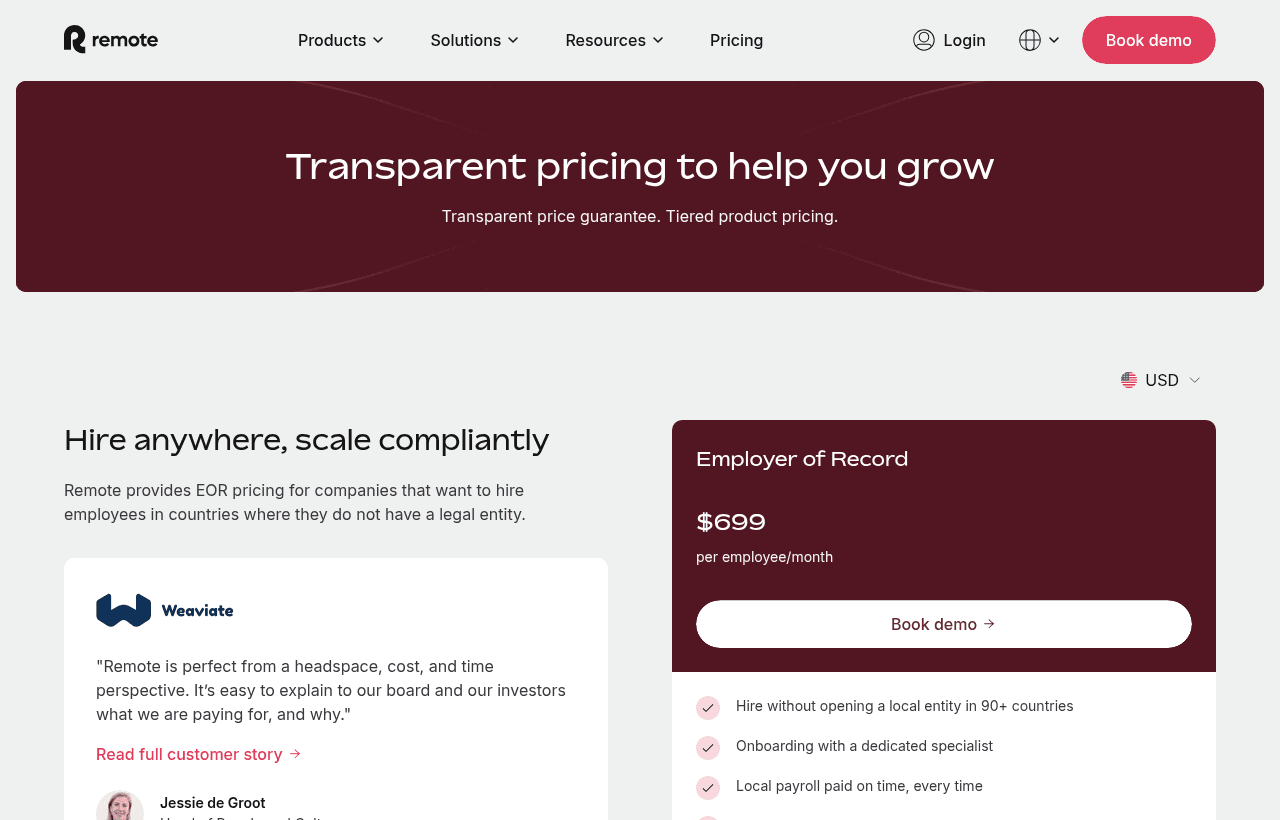
A look at Remote before the discount, so you can see what the deal saves you.
Side-by-Side: Remote vs the Main Alternatives
| Dimension | Remote | Deel | Rippling | Oyster | Multiplier |
|---|---|---|---|---|---|
| Country coverage | 180+ for contractors, 80+ for EOR | 150+ for contractors, 100+ for EOR | Strong (Rippling EOR) | 180+ for contractors | 150+ for contractors |
| Owned entities | Yes (most countries) | Yes (most countries) | Mixed (some partner) | Mixed | Mixed |
| Pricing transparency | Strong (published) | Strong (published) | Strong | Strong | Strong |
| Equity support | Strong | Strong | Strong | Decent | Decent |
| Benefits depth | Strong locally tailored | Strong | Strong (Rippling-deep) | Decent | Decent |
| HRIS / payroll integration | Strong | Strong | Built-in (Rippling) | Decent | Decent |
| IP protection | Strong | Strong | Strong | Strong | Strong |
| Pricing positioning | Mid-market | Mid-market | Premium | Mid-market | Value-leaning |
| Best fit | Startups going global, IP-heavy roles | Fast-growing startups, breadth of features | Companies already on Rippling for US payroll | Mid-market global hiring | Cost-conscious global hiring |
Remote and Deel are the two clear leaders in the EOR category, with similar feature depth and country coverage. Remote tends to win on transparent pricing, owned-entity model in more countries, and strong reputation among EU and APAC employees. Deel tends to win on breadth of adjacent features (banking, equity, contractor management speed). Rippling is the right choice if you're already running US payroll on Rippling and want the unified HRIS. Oyster and Multiplier are competitive at the value end. For most startups, short-list Remote and Deel, run them through the same hiring flow for a comparable role, and pick based on responsiveness and exact country availability.
Common Use Cases
- Hiring a senior engineer in Argentina, Poland, or India without setting up a local entity
- Compensating EU employees compliantly with country-specific labor protections (notice periods, mandatory benefits, severance rules)
- Onboarding a CFO or VP-level hire in a country where you have no presence with proper equity grants and tax-efficient compensation structuring
- Migrating misclassified contractors to compliant employee status before audits force the issue
- Running fully-distributed teams with employees in 5-15 countries without operating subsidiaries
- Acquiring international talent during US hiring freezes with budget-friendly geographic flexibility
How to Claim
- Click "Get Deal", opens the Remote signup with the SaaSOffers referral
- Create your Remote account and set up your company profile
- The $1,000 first-year discount applies automatically at first invoice
- Initiate your first hire, Remote walks you through country-specific compliance, contract drafting, and benefits selection
- Once the employee accepts and signs, Remote handles all ongoing payroll, tax, and compliance
- Continue to add hires as needed; the discount applies across the first 12 months
Best For
- Early-stage startups making their first international hires
- Mid-market companies scaling distributed teams across 5-15 countries
- Companies hiring in countries with strict labor laws (Germany, France, Brazil, India, Mexico)
- IP-heavy companies (SaaS, AI, biotech) needing strong invention-assignment in employment contracts
- Equity-granting companies hiring abroad and needing compliant stock-option administration
- Companies migrating from contractor-based international teams to a compliant employee model
When Remote Wins
- You hire in countries where Remote owns local entities (most major markets)
- Strong IP and invention assignment in employment contracts is critical → Remote's contracts are battle-tested
- You value transparent, published pricing → Remote's pricing is publicly listed (vs. some competitors who quote case-by-case)
- You hire in the EU and care about strong employee experience → Remote's EU reputation among employees is strong
- You want a single platform handling both contractors and EOR employees with consistent tooling
When an Alternative Is Stronger
- You're already deep in Rippling for US payroll → Rippling's unified HRIS is sharper
- You need adjacent features Remote doesn't offer (e.g. banking, broader cards) → Deel has slightly broader product breadth
- You're hiring in a country where Remote uses a partner entity vs. owns one → check coverage, sometimes another provider has better local presence
- You're cost-conscious at very small scale → some value-leaning competitors are slightly cheaper at the low end
Real-World Workflow Example
Imagine you are a US Series A startup hiring a senior backend engineer in Argentina at $90K/year. Traditional path: set up an Argentine subsidiary ($30K-$50K and 6-9 months) or hire as a contractor and risk misclassification. Remote path:
- Sign up for Remote with the $1,000-off-first-year deal
- Initiate hire in Remote's dashboard, pick Argentina, enter role, salary, start date
- Remote drafts a compliant Argentine employment contract with proper IP assignment, probation period, severance terms
- Engineer reviews and signs the contract through Remote's platform
- Remote sets up local benefits (health insurance, mandatory bonuses, vacation accrual) and tax withholding
- On payroll day, you fund Remote in USD; Remote pays the engineer in ARS (Argentine pesos) with all employer taxes handled
- Engineer has access to a self-serve dashboard for payslips, time off, and benefits
End-to-end: 1-3 weeks from offer to first payroll vs. 6-9 months for setting up a subsidiary. Compliance is fully handled.
Real Cost Comparison Math
- Setting up a foreign subsidiary: $30K-$80K upfront + $10K-$20K/year ongoing + months of delay
- Hiring as a contractor (misclassification risk): possibly $0 upfront, but penalties of 2-5x annual wages if reclassified by tax authorities
- Remote EOR with $1,000 first-year discount: predictable monthly fee per employee, fully compliant
- Hiring locally in the US instead of abroad: 30-60% higher salary cost in many engineering roles
For startups with budgets sensitive to even a few thousand dollars in compliance overhead, the $1,000 discount is meaningful. More importantly, Remote removes the entire mental load of figuring out which countries your team is in, what each one's labor laws require, and how to stay compliant as the team grows.
A final consideration is that global hiring is not only a compliance question but a competitive one: the ability to hire the best person for a role regardless of where they live is a genuine advantage over competitors limited to their local market, and a platform that removes the legal barrier turns that advantage into something a small company can actually use. For a startup competing for talent against larger, better-funded rivals, being able to hire globally and compliantly widens the pool you draw from, and the discount lowers the cost of proving that global hiring works for your team during the stage when every hire matters most.
Building a Distributed Company Deliberately
Employing people across countries is a capability, and building a genuinely distributed company on top of it is a discipline worth approaching deliberately. The platform solves the legal and payroll mechanics of global employment, but a distributed team also needs the practices that make people in different places and time zones work well together: clear asynchronous communication, documented decisions, and a culture that does not depend on everyone being in one room. A startup that hires globally without building those practices gets the talent access but struggles with the coordination, while one that pairs the legal capability with real distributed-work discipline turns global hiring into a genuine strength. The compliance platform is the foundation that makes hiring anyone anywhere possible; what you build on it determines whether that reach becomes an advantage or a source of friction, and being intentional about the working practices from the first international hire is what lets a small company operate as a coherent team across borders rather than a scattered set of individuals.
The final strategic point is that the ability to hire without geographic constraint changes not just where you can find people but how you can build the company, letting you assemble the specific team the product needs rather than the team your location happens to offer. For a startup, whose success depends heavily on the quality of its early hires, that widened access can be decisive, and pairing it with the deliberate distributed-work practices that make a spread-out team cohesive turns global hiring from a compliance convenience into a genuine competitive capability. The platform removes the legal barrier that would otherwise make employing people across borders impractical for a company too small to build its own international infrastructure, and the discount lowers the cost of establishing that capability during the earliest stage, when each hire carries the most weight and the freedom to hire the best person anywhere matters most.
Who Is This Deal For?
Early-Stage Startups
Seed and pre-seed companies looking to move fast without overspending on tools.
Growing SaaS Teams
Series A+ companies scaling their stack and optimizing software costs.
Solo Founders
Indie hackers and bootstrapped founders who need enterprise tools at startup prices.
Get $1,000 off first year off Remote
Free for all startups. Claim instantly.
!Eligibility Requirements
Startup hiring internationally
Frequently Asked Questions
Everything you need to know about this startup deal.
An EOR is a service that legally employs workers on your behalf in a country where you do not have a registered entity. The worker is technically employed by the EOR (which handles local taxes, benefits, labor-law compliance, and payroll), but reports to your team and works on your products day-to-day. EOR is the standard mechanism for hiring full employees internationally without setting up local subsidiaries. Remote operates as an EOR in 80+ countries through owned local entities.
Get the weekly deals digest
New verified startup deals every week. No spam, ever. Unsubscribe anytime.
Related Offers

Vestwell
Used by 290 members
14-day free trial
Get a 14-day free trial of Vestwell, the modern 401(k) and retirement benefits platform that powers small business plans, IRAs, and pooled employer plans with API-first technology.
View offer
Assembly
Used by 2,457 members
Free Plan
Employee recognition and engagement platform with rewards, surveys, and team building.
View offer
Oyster HR
Used by 1,316 members
$1,000 off first year
Get $1,000 off Oyster. The global employment platform for hiring, paying, and managing remote employees and contractors in 180+ countries.
View offer
ADP
Used by 2,527 members
Free Quote
Enterprise payroll, HR, and workforce management solutions for businesses of all sizes.
View offer
Justworks
Used by 1,773 members
Free Demo
PEO and payroll platform for startups, payroll, benefits, HR, and compliance in one place.
View offer
Gusto
Used by 2,125 members
6 months free Simple
Modern payroll, benefits, and HR for US-based startups, run your first payroll in minutes, not days.
View offerDeal Summary
Looking for more startup deals?
Browse all offers