
Vercel Coupon: Free Pro plan (1 year)
Deploy frontend applications with zero configuration on the platform built for Next.js, free Pro plan for startups.
Free · Opens in new tab
Already have an account? Log in
Deal Highlights
What Vercel Gives a Startup
Vercel is a platform for deploying frontend applications with zero configuration, built by the team behind Next.js and tuned for it above all. The offer is a free Pro plan for a full year, aimed at early-stage startups with a new Vercel account. That is a substantial gift. The Pro plan is what small teams actually build on, and getting it free for a year means a startup can run its production frontend on serious infrastructure through the crucial early stretch without paying for hosting. A year is long enough to launch, grow, and find traction before the bill ever arrives.
The core promise is zero-configuration deployment. A startup connects its repository, and Vercel builds and deploys the application automatically, handling the plumbing that would otherwise consume an engineer's time. There is no server to provision, no build pipeline to assemble, no deployment scripts to maintain. Push code, and it goes live. For a small team whose scarcest resource is engineering hours, removing the entire category of deployment work is a direct and immediate benefit. The team spends its time on the product, not on the machinery that ships it.
Because Vercel is built by the makers of Next.js, the fit for a Next.js application is unusually tight. Every feature of the framework is supported first-class, and the platform is optimized for exactly the way Next.js apps are built and run. A startup building on Next.js, which is a common and sensible choice, gets a hosting platform that understands its framework completely. That alignment means fewer surprises, better performance, and a smoother path from code to production than a generic host could offer. The free Pro year lets a team enjoy that fit without the cost during the period it matters most.
Vercel, one of the tools included in this startup deal.
Deployment That Just Happens
The zero-configuration model is worth dwelling on because deployment is where a shocking amount of early engineering time disappears. Setting up a deployment pipeline the traditional way means choosing hosting, configuring build steps, wiring up environment variables, handling caching and static assets, setting up domains and certificates, and then maintaining all of it as the app changes. None of that work is the product. It is necessary plumbing, and it is exactly the kind of undifferentiated effort a startup should avoid owning if it can. Vercel owns it instead.
With Vercel, deployment becomes a property of pushing code. The team connects the repository, and every push triggers a build and deploy automatically. The platform figures out how to build the app, serves it from a fast global network, and handles the details that a team would otherwise have to configure by hand. That means an engineer who has never set up a deployment pipeline can still ship a production app on the first day, because there is essentially nothing to set up. The barrier between writing code and having it live drops to almost nothing.
For a startup, that immediacy changes the pace of shipping. When deploying is effortless, the team deploys often, which is exactly the behavior that leads to fast iteration and quick response to problems. There is no friction discouraging a small fix from going out, so small fixes go out. The compounding effect of frequent, painless deployment is a team that moves faster and a product that improves in smaller, safer steps. Removing deployment friction is one of the highest-leverage things a startup can do for its own velocity.
Preview Deployments That Change How Teams Work
One of Vercel's most valuable features is preview deployments. Every branch or pull request gets its own live, deployed version of the app at a unique URL, automatically. That sounds like a small convenience and is actually a significant change in how a team builds and reviews work. Instead of reviewing a change by reading code or running it locally, anyone can open the preview URL and see the change running as a real, deployed application.
For a startup this is transformative in a few practical ways. Reviewers can experience a change rather than imagine it from a diff, which catches problems that code review alone misses. Non-technical teammates, a founder, a designer, a marketer, can look at a feature and give feedback before it ships, without needing to run anything. Stakeholders can be shown work in progress at a real URL. The whole feedback loop tightens, because seeing the actual running change is faster and more reliable than describing or imagining it.
Preview deployments also make the team more confident about what it ships. When every change has been seen running in a production-like environment before it merges, there are fewer surprises when it reaches customers. That safety net encourages a team to move quickly, because the cost of a mistake is caught early on a preview rather than late in production. For a small team without a large QA function, having every change automatically deployed somewhere it can be inspected is a powerful, built-in check that would be a real effort to build otherwise.
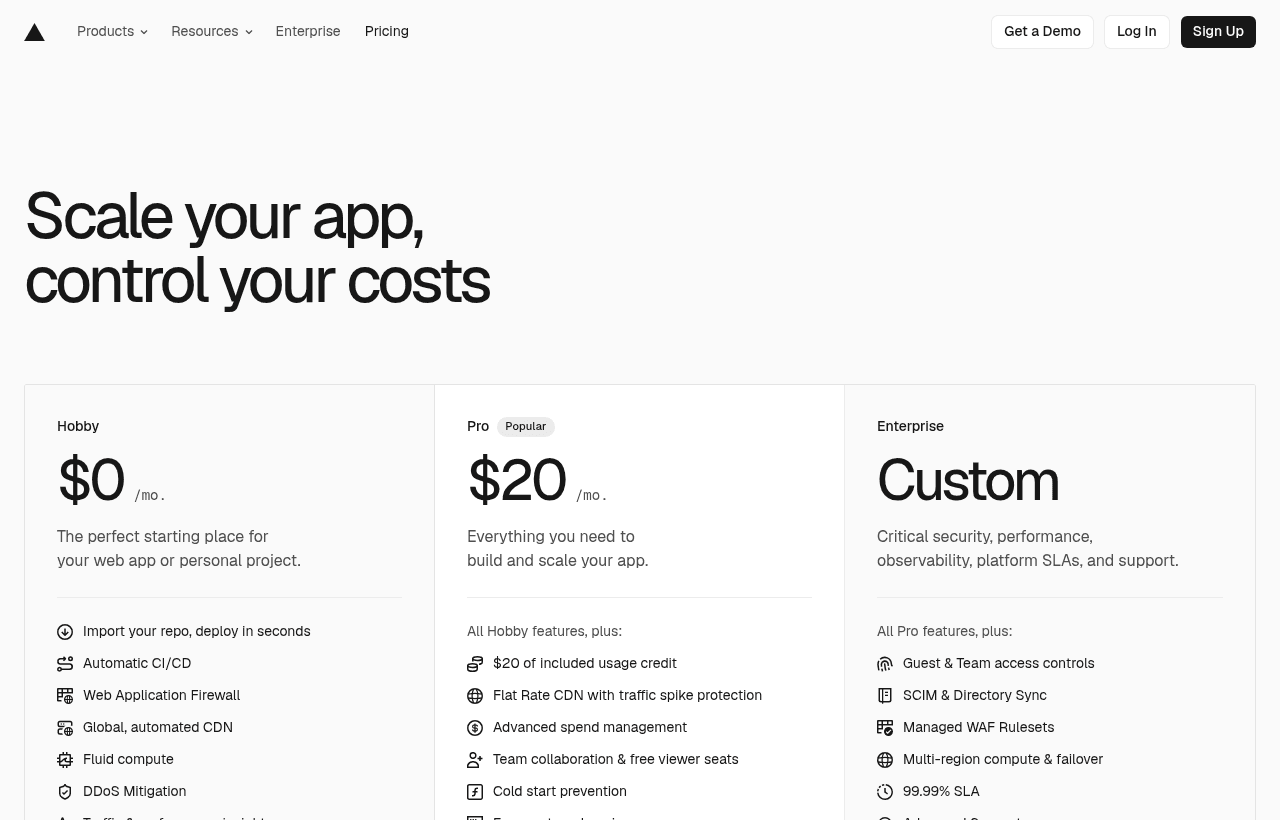
A look at Vercel before the discount, so you can see what the deal saves you.
Performance and Global Reach Out of the Box
Vercel serves applications from a fast, globally distributed network, so a startup's app is quick for users wherever they are, without the team doing anything to arrange it. Performance matters more than early teams often realize. A slow site loses users and hurts conversion, and building a globally fast delivery setup by hand, with caching and edge distribution, is a serious infrastructure project. Vercel provides that as a default, so the startup's product is fast from launch without a performance engineering effort.
That out-of-the-box speed levels the playing field. A tiny startup gets the same class of global, high-performance delivery that a large company would build with a dedicated infrastructure team. Its app loads quickly for users around the world, which improves the experience and the metrics that follow from it. For a company trying to win users and prove traction, not being handicapped by a slow site is a real advantage, and getting it for free on the Pro plan for a year removes even the cost of that advantage.
The platform also handles the operational side of running at scale: it absorbs traffic spikes and scales the app automatically without the team provisioning capacity or worrying about a launch overwhelming a server. For a startup, a sudden burst of traffic from a launch, a press mention, or a viral moment should be a good problem, not an outage. Vercel's automatic scaling means the app stays up when attention arrives, so the team can capitalize on the moment instead of scrambling to keep the site alive. That reliability under load is exactly what a company hoping to grow needs from its hosting.
Vercel Compared to Rolling Your Own Hosting
The alternative is hosting the frontend on a general cloud provider and building the deployment, delivery, and scaling setup yourself. That path offers maximum control and can be cheaper at very large scale, but it is a substantial engineering commitment. The team has to assemble the build pipeline, configure the global delivery and caching, set up preview environments, handle scaling, and maintain all of it. For a startup, that is a lot of undifferentiated infrastructure work standing between the team and the product.
Vercel's advantage is that all of that comes built-in and integrated, especially for a Next.js app. The deployment, the previews, the global performance, and the scaling are provided and work together without the team assembling or maintaining them. The trade is the familiar build-versus-adopt one: rolling your own gives control and potential cost savings at scale, while adopting Vercel gives speed and removes a large maintenance burden. For an early-stage startup whose priority is shipping product fast with a small team, adopting the integrated platform is usually the clear win.
The free Pro plan for a year sharpens that calculation further. During the exact period when a startup most needs to conserve both cash and engineering time, Vercel removes the hosting cost and the infrastructure work at once. A team can defer the whole question of self-hosting until it has scale and reason to reconsider, by which point it will know far more about its actual needs. Starting on Vercel and revisiting later, if ever, is a sensible default for most frontend-heavy startups.
Making the Free Pro Year Count
A year of free Pro is a long runway, so the move is to build the real product on it rather than treating it as a temporary trial. Connect the production repository, get the app deploying automatically, and make Vercel the actual home of the frontend from the start. Lean into the workflow the platform enables: deploy often, use preview deployments for every change, and build the team's habits around the fast feedback loop. The value comes from adopting the way of working, not just the hosting.
Put the preview deployments to full use, because they are where a lot of the platform's leverage hides. Make it standard for every change to be reviewed on its preview URL, and pull non-technical teammates into that loop so feedback happens before things ship. A startup that builds this review habit during the free year gets better quality and faster iteration baked into how it works, which persists well beyond the promotional period. The workflow becomes the team's normal, and its benefits keep compounding.
Use the year to grow without hosting cost as a constraint on experimentation. Launch features, run campaigns, handle traffic spikes, and scale up, all without watching a hosting meter, so the team can focus purely on finding traction. By the time the free year ends, a startup that has used it well will have a launched, growing product, a fast global frontend, and a shipping culture built around effortless deployment. That is a strong position from which to evaluate what comes next, and a far better one than a team still fighting its own infrastructure.
How Vercel Scales With the Company
The reason to adopt Vercel early is that it grows with the startup rather than being outgrown. On day one it hosts a simple app that a couple of people push to. As the company grows, more engineers push more often, the app gains complexity, and traffic rises, and the platform handles all of that without the team re-architecting its deployment. The zero-config model, the previews, and the automatic scaling that serve a two-person team also serve a twenty-person one. The workflow the team learns early stays valid as it scales.
That continuity is valuable because it spares the startup a painful re-platforming at exactly the moment it can least afford the distraction. Many infrastructure choices made early get thrown out when a company scales, costing months. Building on a platform designed to carry an app from prototype to substantial production traffic means the deployment layer keeps working as the company grows, and the team's accumulated knowledge of it keeps paying off. There is no wall where the tool stops fitting.
As the team expands, the self-service nature of the platform keeps deployment from bottlenecking on one person. Any engineer can push and deploy, every change gets its own preview, and the platform handles the rest, so shipping stays fast even as more people contribute. That distributed, low-friction deployment is exactly what a growing engineering team needs to maintain velocity. The platform that made one founder productive on day one makes an entire team productive as it scales.
Who Should Claim This Deal
Vercel is the right fit for an early-stage startup building a frontend application, especially on Next.js, that wants to ship fast without owning deployment infrastructure. The offer targets exactly that team: early-stage, with a new Vercel account, getting the Pro plan free for a year. If the product is a web app and the team would rather spend its engineering hours on features than on build pipelines and hosting, Vercel meets that need directly and the free year removes the cost during the period it matters most.
The fit is tightest for Next.js applications, where the platform's optimization and first-class support make the experience seamless, but any frontend team that values zero-config deployment, preview environments, and global performance out of the box will benefit. A startup with unusual hosting requirements or a plan to run its own infrastructure at scale might eventually choose differently, but for the common case of a frontend-heavy early startup that needs to launch and grow quickly, this is a strong default. Few things accelerate an early team like removing deployment from its list of concerns.
For a founder or team about to launch a web product, this deal is a clear one to claim. Connect the repository, let the app deploy itself, adopt the preview-driven workflow, and grow through the free year without a hosting bill. Claiming the free Pro plan gives a startup production-grade frontend infrastructure and a fast shipping workflow at exactly the stage when both speed and saved cash matter most.
Who Is This Deal For?
Early-Stage Startups
Seed and pre-seed companies looking to move fast without overspending on tools.
Growing SaaS Teams
Series A+ companies scaling their stack and optimizing software costs.
Solo Founders
Indie hackers and bootstrapped founders who need enterprise tools at startup prices.
Get Free Pro plan (1 year) off Vercel
Premium deal. Upgrade once, unlock everything.
!Eligibility Requirements
Early-stage startup, new Vercel account
Frequently Asked Questions
Everything you need to know about this startup deal.
Vercel has a free Hobby plan that supports personal projects with 100GB bandwidth and limited team features. The startup deal provides the Pro plan free for 12 months, which adds team collaboration, 1TB bandwidth, advanced analytics, and higher serverless function limits — the features growing startup teams need.
Get the weekly deals digest
New verified startup deals every week. No spam, ever. Unsubscribe anytime.
Related Offers

Toggl Track
Used by 1,100 members
Free Plan
Simple and intuitive time tracking for teams with reporting and integrations.
View offer
Auth0
Used by 994 members
1 year of B2B Professional free
Get 1 year of the Auth0 B2B Professional plan free, with up to 100,000 monthly active users, SSO, enterprise MFA and SCIM.
View offer
Bugsnag
Used by 471 members
Free Plan
Error monitoring and stability management for web and mobile applications.
View offer
Turborepo
Used by 1,880 members
Free & Open Source
High-performance build system for JavaScript and TypeScript monorepos by Vercel.
View offer
Windmill
Used by 1,501 members
Free Plan
Open-source developer platform for building internal tools, workflows, and scripts.
View offer
Height
Used by 1,442 members
Free Plan
AI-powered project management tool with autonomous task management and workflows.
View offerDeal Summary
Looking for more startup deals?
Browse all offers