Most startups end up on Mailchimp by accident. It is the default. You needed a signup form on launch day, Mailchimp was free, you wired it up in twenty minutes, and three years later you are still on it. Nobody chose it on the merits.
This is the comparison I wish I had read before that decision compounded. ActiveCampaign vs Mailchimp, judged the way a founder actually cares about it: what it costs as you grow, whether the automation can carry real revenue work, how deliverable the email actually is, and what changes now that ActiveCampaign's Active Intelligence runs parts of the marketing for you instead of you running all of it by hand.
I will be honest about where Mailchimp is the right call. It often is. But the gap widens fast the moment your marketing stops being "send a newsletter" and starts being "move people through a funnel."
The 30-second answer
Stay on Mailchimp if your email is mostly broadcasts to one list, your team is one person, and you are pre-revenue. It is cheaper at tiny scale and friendlier on day one.
Move to ActiveCampaign once email is tied to revenue: lifecycle automation, lead scoring, behavior-triggered sequences, and a CRM that talks to your sends. The automation builder is a different class of tool, and Active Intelligence removes the busywork that used to make that power expensive to operate.
The trap is the middle. Teams stay on Mailchimp two years past the point it fits because switching feels like a project. The cost of staying is invisible, so it never gets counted. This post counts it.
The moment is always the same. You try to build a sequence that branches on behavior, and you hit a wall you did not know was there. Mailchimp's Standard plan caps you at six journey starting points. Essentials caps automation flows at four steps. And there is no real CRM underneath, so a deal-stage change cannot trigger anything. You do not outgrow Mailchimp gradually. You hit one of those three ceilings on a Tuesday and realize the tool has been deciding your marketing's shape for you.
The scoring matrix
Seven dimensions that decide this for a startup. Scores are out of 10, weighted toward what affects revenue, not what looks good in a feature grid. Plan limits and prices below are as of May 2026.
Onboarding speed, Mailchimp 9 / ActiveCampaign 6. A non-technical founder ships a campaign in Mailchimp in under an hour. ActiveCampaign has a steeper first day. The power is there before the payoff is.
Automation depth, ActiveCampaign 9 / Mailchimp 5. Mailchimp's Essentials plan caps automation flows at four steps, and Standard limits you to six journey starting points. ActiveCampaign handles branching logic, conditional paths, goals that fast-forward already-converted contacts, and actions that write back to the CRM, with no journey-count cap in the way. "If they opened twice but did not book a call, wait two days, then route to sales with a score bump" is one workflow in ActiveCampaign. In Mailchimp it is a spreadsheet and a prayer.
CRM integration, ActiveCampaign 9 / Mailchimp 4. ActiveCampaign's CRM and email live in one system. A sales reply or a deal-stage change can trigger marketing, and marketing engagement feeds lead scoring. Mailchimp has no real CRM underneath, so you cannot trigger automation from a deal-stage change at all. Its CRM-adjacent features feel bolted on because they were.
Lead scoring, ActiveCampaign 9 / Mailchimp 3. Native and automation-driving in ActiveCampaign. For any sales-assisted motion, that is the difference between "marketing sends email" and "marketing hands sales warm, ranked leads."
Deliverability control, ActiveCampaign 8 / Mailchimp 7. Both can land in the inbox. The structural edge goes to ActiveCampaign because its segmentation and automation make it trivial to stop emailing people who stopped caring, and suppressing disengaged contacts is the single biggest lever on sender reputation.
AI and autonomy, ActiveCampaign 9 / Mailchimp 6. Covered in depth below. The short version: Mailchimp's AI writes you a subject line; ActiveCampaign's Active Intelligence changes what the automation does next.
Price at tiny scale, Mailchimp 8 / ActiveCampaign 5. Mailchimp wins the first invoice. It does not win the third one. The pricing section does that math.
Totals, on these weights: ActiveCampaign clears Mailchimp everywhere revenue is involved and loses only on day-one ease and entry price. That is the entire decision in two sentences.
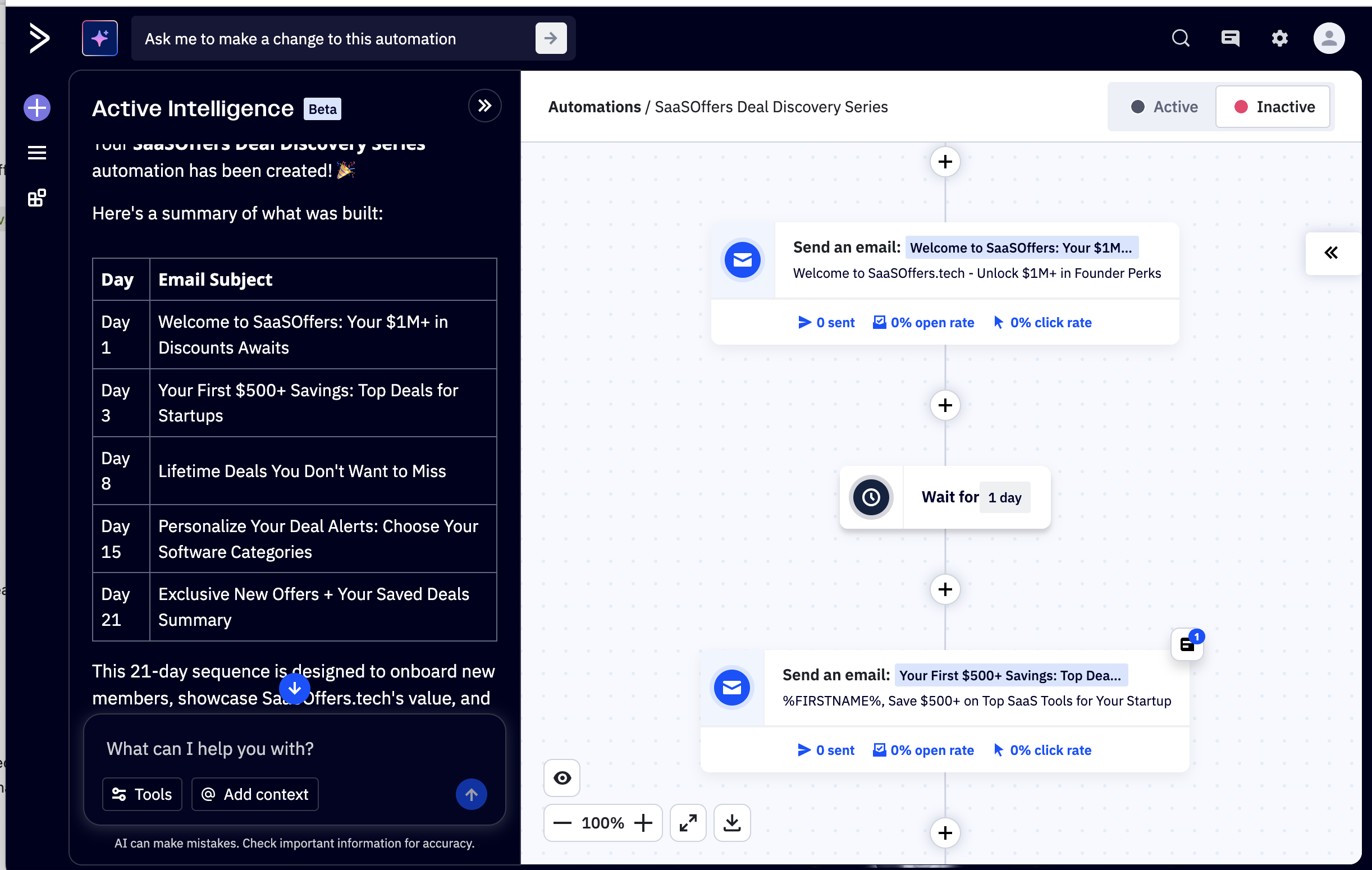
ActiveCampaign's Active Intelligence built this entire 21-day onboarding sequence, the SaaSOffers Deal Discovery Series, from a single plain-English prompt in our own account. The left panel is the AI's build summary; the right is the live automation it produced.
Where Mailchimp genuinely wins
Credibility first. If this post only praised one tool, you should not trust it.
Onboarding speed. Covered above. Real advantage on day one for a non-technical founder.
Free tier for true zero. Mailchimp's free plan works if your list is tiny and you broadcast occasionally: roughly 250 contacts and 500 sends a month as of May 2026. It has no automation flows. ActiveCampaign does not compete on "free forever." It competes on "worth paying for."
Content and brand tooling. Mailchimp's content studio, basic landing pages, and template library are fine for a company that treats email as a newsletter. If that is all you need, depth elsewhere is wasted on you.
If you read those and thought "that is exactly us," stop here. You do not have an email tool problem. Bookmark this for the quarter it stops being true.
Where ActiveCampaign pulls ahead
The matrix scored it. Here is what those scores mean in practice.
Automation in ActiveCampaign models a real funnel, not a sequence. The CRM is attached, not adjacent, so sales activity and marketing activity feed each other inside one system. Lead scoring is a native primitive that drives automation directly, which is what turns "we send email" into "we hand sales ranked, warm leads." And the segmentation discipline that protects deliverability is built into the same automation layer, so suppressing disengaged contacts is a rule, not a chore.
None of this matters if email is broadcast-only. All of it matters the moment email touches revenue.
The real differentiator: Active Intelligence
Feature-by-feature comparisons go stale because both tools ship constantly. The structural shift worth writing about is this: ActiveCampaign's Active Intelligence moves marketing automation from "you configure every rule" to "the system proposes, predicts, and executes parts of it for you."
That is the autonomous-marketing argument, and it is not a slogan once you map it to the work a two-person growth team actually does.
Predictive timing and content. Instead of guessing send windows and hard-coding them, Active Intelligence uses engagement signals to optimize when and what each contact receives. The human sets the goal. The system handles the per-contact execution no founder has time to tune by hand.
AI agents that do the assembly work. The expensive part of automation was never the strategy. It was the assembly: drafting variants, building segments, wiring conditions, watching results, adjusting. ActiveCampaign's AI agents compress that loop. You describe the outcome, the system drafts the path, you approve and correct. You move from operator to editor.
Personalization that scales past your headcount. Every startup wants per-segment, per-behavior messaging. Almost none can staff it. Active Intelligence is how a small team gets personalization that previously required a marketing ops hire, because the per-contact decisions run inside guardrails you set.
The honest comparison point: Mailchimp has AI features too. The difference is depth of integration. In ActiveCampaign, the intelligence sits inside the same automation and CRM layer that already runs your funnel, so it acts on the full picture of a contact. Bolt-on AI writes you a subject line. Active Intelligence changes what the automation does next.
Here is the concrete version, not the capability pitch. We gave Active Intelligence one plain-English prompt: build a 21-day onboarding series for SaaSOffers with these six emails on these days. The AI agent returned the full sequence, emails, waits, and structure, in minutes. The whole thing, prompt to a live automation we could review and activate, took about 15 minutes. The screenshot above is that exact build, the SaaSOffers Deal Discovery Series, in our own account. Building the same six-email branching sequence by hand in Mailchimp's Customer Journey builder is an afternoon, and that is if you do not hit the journey-starting-point cap first.
Pricing, and the cost nobody computes
Sticker price is the wrong number. The right number is cost per outcome as the list grows and the automation gets real. Prices below are as of May 2026. Check the live pages before you quote them, both companies change pricing often.
Mailchimp's headline numbers look cheap. Essentials starts around $13/mo and Standard around $20/mo, both at a 1,500-contact base and both discounted 50% for the first 12 months before they revert. The catch is what those tiers do not do: Essentials caps automation at four steps, Standard caps you at six journey starting points, and neither gives you a real CRM. The plan that removes the worst limits is Premium at $350/mo. There is no middle.
ActiveCampaign at 1,000 contacts runs $19/mo Starter, $59/mo Plus, $99/mo Pro on monthly billing, roughly 20% less annually. Plus and up include the generative AI features, and Pro adds conditional content, A/B testing inside automations, and advanced segmentation. Both platforms multiply price by contact count as you grow, so model your real list size, not the entry tier.
Read those two paragraphs again. The honest comparison is not "$20 Mailchimp vs $59 ActiveCampaign." It is "$20 Mailchimp that caps your automation at six journeys and has no CRM" vs "$59 ActiveCampaign that does not." At the point this decision actually matters, the gap is the capability, not the invoice.
Now the line nobody puts on a spreadsheet: the cost of staying.
- Engineer hours rebuilding logic the platform should own. Two days of founder-engineer time a quarter, conservatively, is real money for a startup.
- Revenue lost to sequences you never shipped because the tool made them painful. One un-shipped abandoned-intent flow is a recurring leak, not a one-time miss.
- A marketing ops contractor hired to do what Active Intelligence now runs inside the platform. That is a four-figure monthly line item that quietly never gets attributed to the email tool choice.
Stack those and the Mailchimp renewal stops looking like the cheap option. It looks like the expensive one with a small invoice.
Put a real number on it. A startup on Mailchimp Standard at $20/mo is not saving $39 against ActiveCampaign Plus. It is paying $20 to be told "six journeys, four-step flows, no CRM triggers" and then paying a contractor or burning founder-engineer days to work around exactly that. The renewal is small. The workaround is the real bill, and it never shows up on the Mailchimp invoice.
How ActiveCampaign compares to the rest
Mailchimp is the most common switch story, but the contest-relevant alternatives sort cleanly, and covering them makes this post answer more of what people actually search.
ActiveCampaign vs HubSpot. HubSpot is more platform, more price, more onboarding. For a startup that wants deep automation without enterprise weight or an enterprise invoice, ActiveCampaign delivers most of the automation value at a fraction of the total cost and complexity.
ActiveCampaign vs Klaviyo. Klaviyo is ecommerce-first and excellent in that lane. If your revenue is not store-driven, its strengths do not apply to you and ActiveCampaign's broader CRM and lifecycle model fits better.
ActiveCampaign vs Brevo. Brevo competes on price at the low end. The pattern is the same as Mailchimp: fine until automation gets real, then you feel the ceiling and pay the switching cost later instead of now.
ActiveCampaign vs Kit (ConvertKit). Kit is built for creators and does that job well. For a startup running a sales-assisted or lifecycle motion rather than a creator audience, the model does not match and the automation depth is not there.
The through-line: most alternatives win a narrow lane or the first invoice. ActiveCampaign with Active Intelligence wins the case where email is tied to revenue and the team is too small to operate marketing by hand. That is most startups past seed.
Switching from Mailchimp: what it actually involves
The fear is overblown. The work is mostly mechanical.
Export contacts and tags from Mailchimp. Import into ActiveCampaign, mapping tags to lists and custom fields. Rebuild your top three automations first, not all of them. Most teams have three that matter and a graveyard of ones that never worked. Repoint forms and integrations. Run both in parallel for one cycle so nothing drops. Then cut over.
Plan two focused days, not two weeks. The thing that makes it feel huge is the same thing that makes it worth doing. You finally see how much manual scaffolding you built around Mailchimp's limits.
Who should switch, who should stay
Stay on Mailchimp if email is broadcast-only, you are one person, you are pre-revenue, and "newsletter" fully describes the use case. No tool upgrade fixes a use case that simple, and you should not pay for power you will not use.
Switch to ActiveCampaign if email is tied to revenue, you run or want lifecycle automation, you have any sales-assisted motion, or you are spending human hours doing what Active Intelligence runs autonomously. The earlier you switch, the less migration debt you carry, because the automation graveyard only grows.
How to get started
If you are switching, start on a plan that includes the automation and CRM, not the cheapest tier. The cheap tier reproduces the exact limitation you are leaving Mailchimp to escape.
Start your ActiveCampaign trial here
Build your single highest-value automation first. A welcome-to-activation sequence or an abandoned-intent flow. Let Active Intelligence handle timing and per-contact variation. Measure against whatever that flow did on Mailchimp, if it existed there at all. One real automation running well tells you more than any comparison table, including this one.
Frequently Asked Questions
The bottom line
Mailchimp is a fine place to start and a common place to stay too long. The decision is not "which email tool has more features." It is "do I want marketing I operate by hand, or marketing the platform helps run." ActiveCampaign with Active Intelligence is the second thing. For any startup where email touches revenue, that is the version worth paying for.
Affiliate disclosure: This post contains affiliate links. If you start a paid ActiveCampaign plan through a link here, SaaSOffers may earn a commission at no extra cost to you. We only recommend tools we would tell a founder friend to use, and the honest "stay on Mailchimp if this is you" sections above are there for a reason.

Software engineer and product builder with 13+ years of experience across software engineering, product development, and startup operations. Built SaaSOffers to make every startup deal discoverable and verified for founders worldwide.
Ready to unlock these deals?
Free account. No credit card required.