Every founder has the same marketing problem, and it is not the one they think. The problem is not "we do not have automation." Most startups have an email tool with automation features. The problem is that nobody has time to operate it. The strategy is in your head. The execution sits in a backlog labeled "when we hire someone."
Autonomous marketing is the answer to that specific gap. Not "marketing with AI features bolted on." Marketing where the system does the assembly and the babysitting, and you do the deciding. ActiveCampaign calls its version Active Intelligence, and the distinction worth writing about is not what it can generate. It is what it can run without you in the loop for every step.
This is a founder's breakdown of what that actually means in 2026: what Active Intelligence genuinely automates, the real time math for a small team, and the part most vendor pages skip, where a human still has to stay in the loop.
The bottleneck was never the automation
Sit with a two-person startup for a week and watch where the marketing time goes. Almost none of it is strategy. The strategy fits on an index card: onboard new signups, win back the quiet ones, push the people who looked at pricing toward a call.
The time goes to assembly. Drafting the five emails. Building the segment. Wiring the conditions. Setting the waits. Checking it did not break. Watching the numbers. Adjusting the send time because Tuesday underperformed. Rebuilding the segment because the first one was wrong.
That is the work autonomous marketing removes. Not the thinking. The operating. A founder does not need a tool that can theoretically build a sophisticated funnel. They need one that builds and runs it so the funnel exists at all instead of staying in the backlog forever.
What "autonomous" actually means here
Autonomous is an overused word. Pin it down with three concrete layers, because that is how Active Intelligence actually shows up in the product.
Layer one: AI agents that do the assembly. You describe the outcome in plain language. The system drafts the structure: the emails, the waits, the sequence. You review and correct instead of building from a blank canvas. This is the layer that turns a backlog item into a live automation in one sitting.
Layer two: predictive execution per contact. Once a flow is live, Active Intelligence handles the per-contact decisions a human never has time to tune. When to send for this person. Which variation fits this behavior. The human sets the goal. The system runs the thousand small executions underneath it.
Layer three: optimization toward a goal, not a setting. You tell it the outcome you want. It works the flow toward that outcome and surfaces what is on track and what is at risk, instead of making you reverse-engineer that from a reporting tab nobody opens.
The through-line: you move from operator to editor. That is the entire promise of autonomous marketing compressed into one sentence, and it is the right test to hold any tool against.
What this looked like in our own account
Concrete beats abstract, so here is the real version, not a capability pitch.
We needed an onboarding series for SaaSOffers: a 21-day sequence, six emails, specific subjects on specific days, designed to show new members the value of the platform without overwhelming them. Classic backlog item. The kind that stays unbuilt for a quarter because building it by hand is an afternoon nobody has.
We gave ActiveCampaign's Active Intelligence one plain-English prompt describing exactly that. The AI agent returned the full sequence, emails, waits, and structure, in minutes. Prompt to a reviewable, activatable automation took about 15 minutes total. We named it the SaaSOffers Deal Discovery Series. It is live.
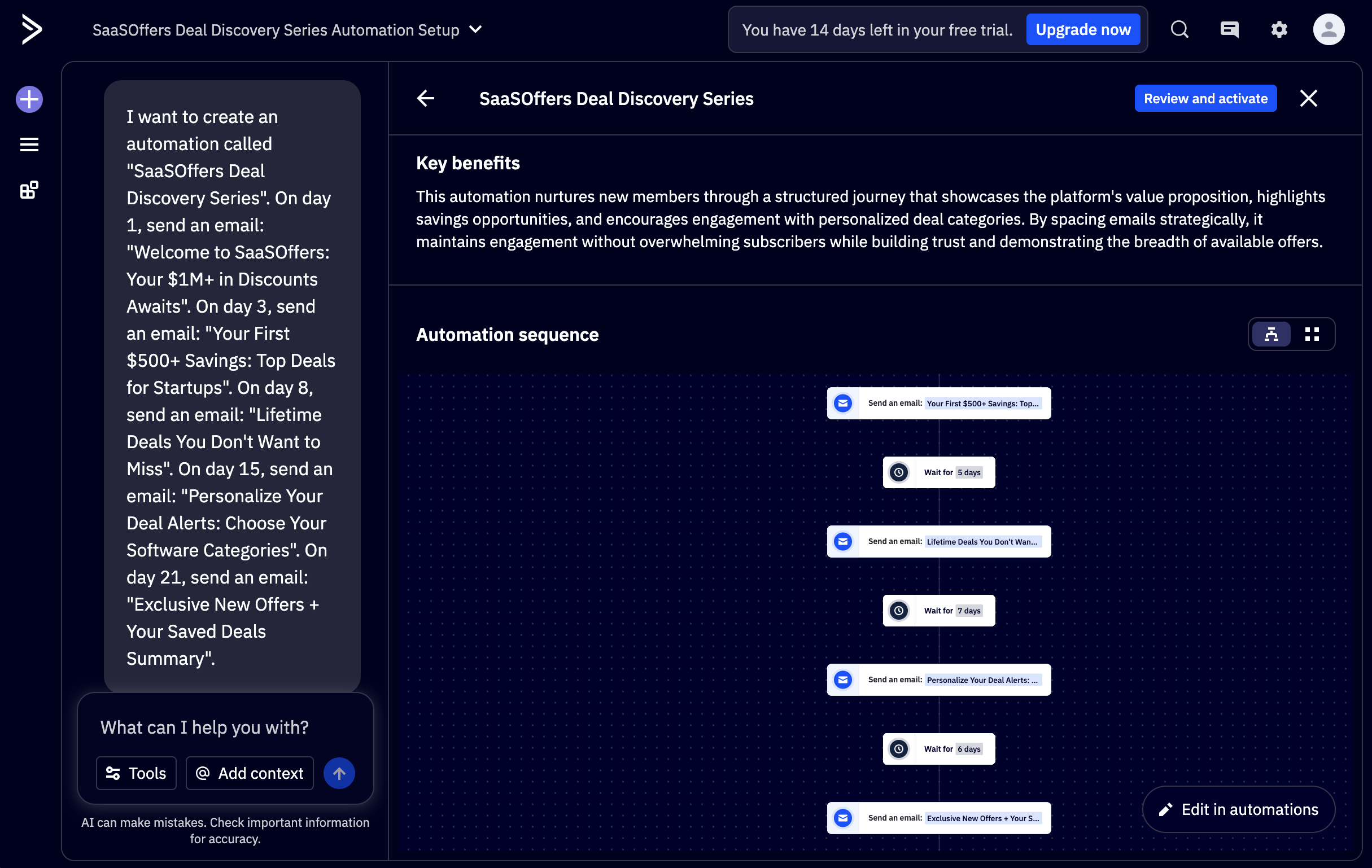
One plain-English prompt on the left. The full multi-step onboarding automation ActiveCampaign's Active Intelligence generated on the right. This is the assembly work autonomous marketing removes, captured in our own account.
The point of that story is not "AI is impressive." It is the time conversion. The afternoon that automation would have cost, the afternoon it never got because there was no afternoon to spare, collapsed into 15 minutes of describing and reviewing. The backlog item became a shipped asset the same morning we decided we wanted it. That is what autonomous marketing buys a startup. Not better email. Shipped email that otherwise would not exist.
The time math, honestly
Vendor pages love a "save X hours a week" number. Treat those skeptically and do the math from your own side instead.
A small team running real lifecycle marketing by hand spends time in four buckets: building flows, building and fixing segments, tuning send timing and variants, and reading results to decide what to change. For most startups that is the bulk of a part-time marketing role, scattered across a founder's week in the worst possible way, in twenty-minute fragments between everything else.
Autonomous marketing does not zero that out. It collapses the first bucket from afternoons to minutes, takes the timing-and-variant bucket almost entirely, and turns the results bucket from "go dig" into "here is what is at risk." The building bucket does not vanish, it shrinks to describing and approving.
The honest framing is not "ten hours back." It is "the work stops happening in fragments." A founder cannot do deep marketing ops in twenty-minute gaps. They can describe an outcome and approve a draft in twenty minutes. Autonomous marketing fits the shape of how a founder actually has time, which is why the work finally gets done at all.
Personalization you could never staff
Every startup wants behavior-based, per-segment messaging. Almost none can staff the person who maintains it. That gap is permanent under manual operation, because personalization is not a one-time build. It is continuous maintenance: new segments, shifting behavior, decaying relevance.
This is the clearest case for autonomous marketing. Active Intelligence makes the per-contact decisions continuously, inside guardrails you set, so personalization stops being a headcount question. The startup gets the kind of differentiated messaging that used to require a marketing ops hire, without the hire. Not because the AI is smarter than that person would have been, but because it does the part that person mostly did: the relentless, unglamorous upkeep.
One loop, before and after
Take a single common flow and run it both ways. The quiet-list re-engagement loop: people who opened things three months ago and went silent.
Under manual operation, that loop mostly does not exist. Building it means defining the inactivity window, building the segment, writing the win-back sequence, picking send times, and then maintaining the segment forever as people drift in and out of "quiet." Every startup knows it should run this. Most never do, because the maintenance never fits the week. The flow lives permanently in the someday column, and the revenue in that silent segment quietly decays.
Under autonomous operation, the shape changes. You describe the outcome: re-engage contacts who have gone quiet for ninety days, three touches, then suppress if still silent. Active Intelligence assembles the structure. Predictive execution decides when each quiet contact actually gets each touch instead of blasting them all on the same Tuesday. The segment maintains itself as behavior changes, because membership is evaluated continuously rather than rebuilt by hand. Your job shrinks to the part only you can do: making the three emails sound like your company and deciding how hard to push before you let people go.
Same loop. In one world it is a backlog item that never ships. In the other it is live by lunch and maintains itself. Multiply that across onboarding, abandoned intent, win-back, and post-purchase, and the difference is not "marketing is faster." It is "the marketing exists."
Where a human still has to stay in the loop
Any honest piece on autonomous marketing has to include this section, and most do not. Autonomous is not unattended.
The system does not know your positioning. It will assemble a competent generic sequence. Making it sound like you, and not like every other onboarding email, is still your job. The screenshot above is a starting structure we reviewed and shaped, not something we shipped blind.
It does not own judgment calls. Whether to push harder on a quiet segment or let it rest is a brand decision with brand consequences. The system can execute either. It should not be the one choosing.
It does not replace strategy. It replaces the operation of strategy. If the index card is wrong, autonomous marketing will execute the wrong thing faster. Garbage in scales too.
This is the educational core of the whole topic: autonomous marketing is leverage on a good plan, not a substitute for having one. Treating it as "set it and forget it" is how you ship a fast, polished, on-brand version of a bad idea. The founders who win with it are the ones who stay the editor and let the system be the operator, not the ones who leave the room.
How to set it up so it is actually autonomous
If you want this to work, set it up in the order that matters.
Start with the one flow that touches revenue first, usually onboarding or an abandoned-intent sequence. Describe the outcome to Active Intelligence in plain language, the way you would brief a contractor. Be specific about goal, audience, and constraints. Review the draft as an editor: fix the voice, kill the generic lines, keep the structure. Let predictive execution own timing and per-contact variation from day one instead of hard-coding a send time you guessed. Set the goal explicitly so the system optimizes toward an outcome, not a setting. Then leave it alone long enough to produce signal, and come back as the editor, not the operator.
The mistake is treating the first AI-built draft as either finished or worthless. It is neither. It is a fast first structure that removes the part you hate and keeps the part only you can do.
Start with ActiveCampaign and build your first autonomous flow
Frequently Asked Questions
The bottom line
Autonomous marketing is not about AI writing better subject lines. It is about the gap between the marketing strategy in a founder's head and the marketing that actually ships. That gap is operating time nobody has. ActiveCampaign's Active Intelligence closes it by taking the assembly and the babysitting and leaving you the deciding. You stay the editor. The system becomes the operator. For a startup, that is the difference between a marketing plan and a marketing plan that exists in production.
Build your first autonomous flow in ActiveCampaign
Affiliate disclosure: This post contains affiliate links. If you start a paid ActiveCampaign plan through a link here, SaaSOffers may earn a commission at no extra cost to you. We only recommend tools we would tell a founder friend to use, and we built our own onboarding automation on the platform before writing this.

Software engineer and product builder with 13+ years of experience across software engineering, product development, and startup operations. Built SaaSOffers to make every startup deal discoverable and verified for founders worldwide.
Ready to unlock these deals?
Free account. No credit card required.