Deel Review 2026: The Honest Verdict from a Real Deel Customer
We use Deel at SaaSOffers. Not as a hypothetical, not as something we evaluated and walked away from. Deel is the platform we run our contractor and international team operations on every month.
This review reflects that experience. The actual setup flow, the real pricing we pay, the parts of the product we depend on weekly, and the limitations we have worked around or learned to live with.
If you want a marketing brochure, the Deel website covers that. If you want a balanced view of what Deel does well, where it falls short, and whether it fits your specific company, here it is.
What Deel Actually Is in 2026
Deel started as a global contractor-payment platform in 2019 and expanded aggressively into adjacent products. The current platform covers six main product lines:
- Contractor Management. Compliant invoicing, multi-currency payouts, and tax-form handling for contractors in 150+ countries.
- Employer of Record (EOR). Deel acts as the legal employer of your international team, handling local payroll, benefits, and labor-law compliance in 100+ countries.
- Deel US Payroll. Native US payroll administration. Newer to the platform, launched as Deel expanded.
- Deel HR. HRIS bundled free with paid Deel services. Employee records, time off, performance, document storage.
- Deel Card. Multi-currency payment card primarily for contractors and per-diem use cases.
- Deel Engage. Performance management and engagement add-on.
The breadth is impressive. Few competitors cover all six product lines on a single platform. We use the contractor management heavily, the HR module for our team records, and the Perks marketplace covered below.
Setting Up Deel: Our Actual Experience
Setup varies meaningfully depending on which product you start with. We started with contractor management and expanded from there, which is the typical path most distributed startups take.
Contractor onboarding is Deel's fastest path. Inviting a contractor takes about 2 minutes from our side: enter their name, email, country, contract terms, and payment frequency. The contractor receives an invitation, completes their tax form (W-9 for US contractors, W-8BEN for non-US contractors, or local equivalents), provides payment details, and signs. Our typical end-to-end time has been same-day to 24 hours for contractors who are responsive.
The contractor-side experience is polished. Every contractor we have onboarded commented that the flow is smoother than the patchwork of PayPal, Wise, and manual invoices they were dealing with at previous companies. That matters because a frustrated contractor is one who churns within three months.
EOR onboarding takes longer because real employment law is involved. Typical timeline: 1 to 3 weeks from offer to first day of work. Deel drafts a country-compliant employment contract, manages local registrations, sets up benefits, and handles regulatory paperwork. Some countries (Germany, Brazil, India) have additional compliance steps that extend the timeline to 3 or 4 weeks. This is dramatically faster than setting up a foreign subsidiary, but it is not "click a button and you have an employee tomorrow." Real legal work is happening.
US Payroll onboarding is similar to setting up Gusto or Rippling Payroll: connect a bank account, configure pay schedules, import or add employees, set up tax filings. Typical first-payroll-ready timeline: 1 to 2 weeks.
For most companies starting with Deel, we recommend the same sequence we took. Contractor management first for immediate value, then EOR for any full-time international hires, then US payroll only if migrating off Gusto or similar.
Country Coverage in Practice
Country coverage is where Deel's marketing meets operational reality, and the operational reality is genuinely strong.
For contractor management, Deel supports payouts in 150+ countries with local-currency payment options in most of them. We have paid contractors in countries we never thought we would touch and the flow worked. The compliance burden on contractor management is lighter than EOR (the contractor is responsible for their own tax compliance in most jurisdictions), so country breadth here is broad.
For EOR, Deel operates in 100+ countries, but not all are "Deel owns the local entity" countries. In some markets, Deel partners with local entities rather than owning the entity directly. The functional difference for the customer is small (compliance still works), but it is worth knowing because Deel's owned-entity coverage is the strongest legal-protection scenario.
The major markets are all directly covered: US, Canada, UK, EU members, Australia, New Zealand, India, Brazil, Mexico, Argentina, Singapore, Hong Kong, Japan, and most of LATAM, APAC, and EMEA. For the typical distributed startup with employees in 5 to 15 countries, Deel's coverage is comprehensive enough that you are unlikely to find a country it does not support.
Pricing: What We Actually Pay
Deel's pricing model is per-product and transparent, a notable improvement over the opaque "ask for a quote" model that dominates the EOR category.
- Contractor Management. Around $49 per contractor per month for compliant invoicing and payouts. This is what we pay per active contractor. Roughly competitive with Remote, Oyster, and other contractor-management platforms.
- Employer of Record. Pricing starts around $599 per employee per month for the standard EOR service, with higher prices in some countries based on local complexity. Includes employment, benefits administration, payroll tax handling, and IP protection.
- Deel US Payroll. Per-employee monthly fee for US-only payroll. Pricing is competitive with Gusto and Rippling Payroll.
- Deel HR. Free with paid Deel services. The HRIS is bundled, not add-on.
- Deel Card. Free to issue, with FX and transaction fees on usage.
- Enterprise. Custom pricing for larger organizations with high contractor or EOR volume.
Pricing transparency is a meaningful advantage. We modeled our year-one Deel cost in a spreadsheet before signing. Try doing that with most legacy EOR providers and you will spend a week chasing sales reps for quotes.
Deel Perks: The Underrated Differentiator
This is the part of Deel that most reviews skip and that we have come to genuinely value: the Perks marketplace built into Deel HR.
When you have a Deel account, you and your team get access to a marketplace of partner discounts and credits. Software, productivity tools, learning, financial services, health and wellness, employee benefits.
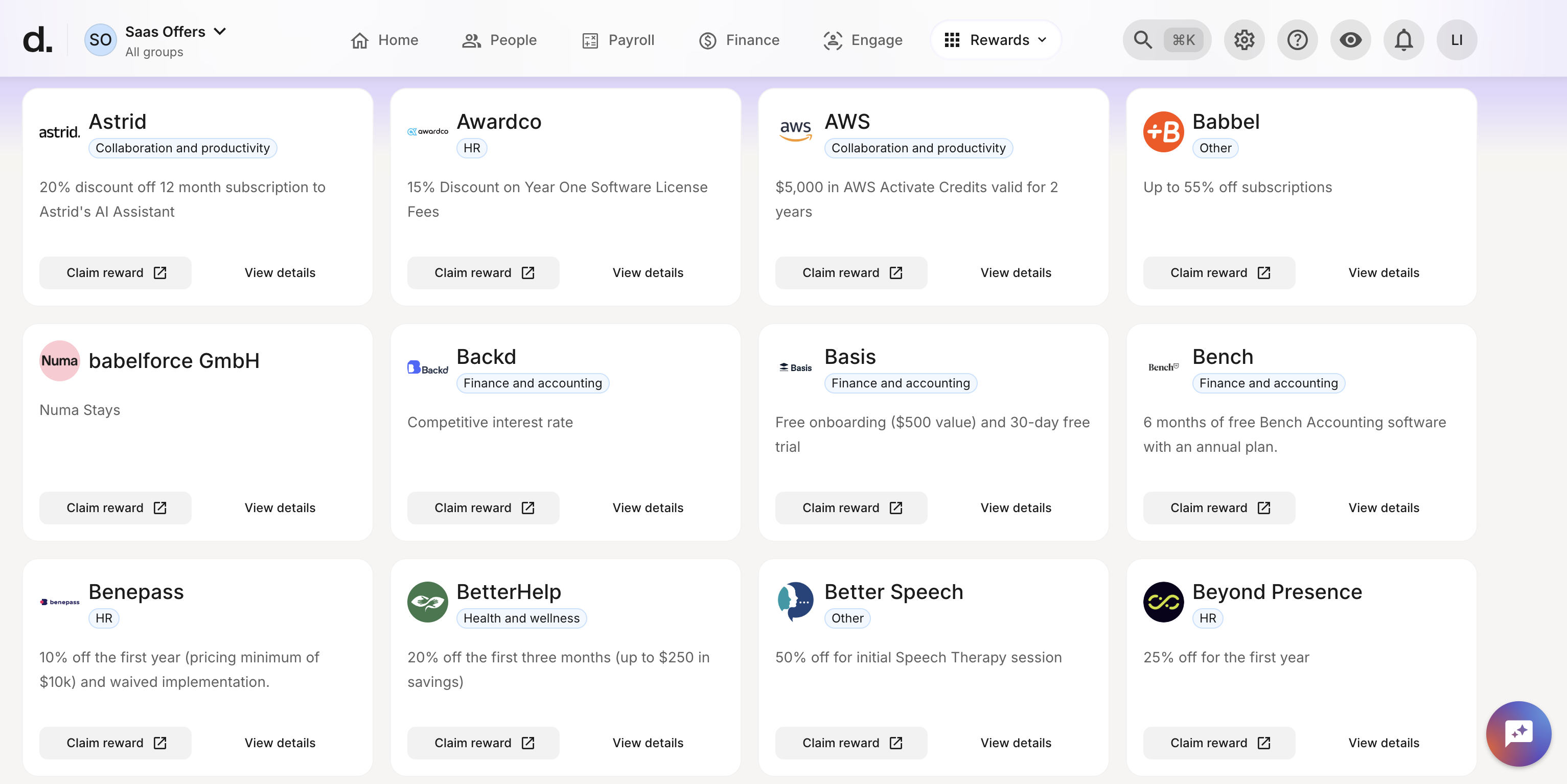
A live view of the Deel Perks marketplace inside our Deel HR dashboard. Partner discounts spanning AWS credits, language learning, accounting software, mental health benefits, and more, all bundled with our Deel subscription at no extra cost.
Examples currently available in our Deel dashboard:
- AWS: $5,000 in AWS Activate credits valid for 2 years
- Babbel: Up to 55% off language-learning subscriptions
- Bench: 6 months of Bench Accounting software free with annual plan
- Awardco: 15% off year-one license fees on employee recognition software
- BetterHelp: 20% off the first three months for employee mental health benefits
- Better Speech: 50% off initial Speech Therapy session
- Beyond Presence: 25% off the first year
- Astrid: 20% off 12-month subscription on Astrid's AI Assistant
- Plus dozens of other partner deals across collaboration, HR, finance, and health
This is real value bundled with a paid product you would already be paying for. The AWS credits alone, if you qualify, are worth more than a year of Deel contractor management. The bookkeeping and HR tooling perks compound the savings further. We have personally claimed several of these for our SaaSOffers operations.
No other major EOR or global-payroll platform has anything close. Remote, Rippling, Oyster, and Multiplier do not bundle a curated partner perks marketplace into their HR product. The closest analog is what platforms like JustWorks or TriNet offer to their PEO customers, but those are dramatically more expensive, more US-focused, and lock you into a deeper relationship.
For us as a SaaS company that runs a startup deals platform, the irony is not lost. Deel is essentially running a competing perks marketplace inside their product, and theirs is good. Different audience focus (Deel Perks is bundled-with-employment, SaaSOffers is curated-deals-for-founders), but a real and useful feature for any Deel customer.
If you are evaluating Deel vs alternatives and the pricing comparison is close, the Perks marketplace is worth weighing as part of the total value calculation. For most teams, claiming 2 or 3 perks in the first year covers the platform fee.
What Deel Does Well from Real Use
After more than a year of running our operations on Deel, here is where the platform genuinely delivers.
Contractor management is best-in-class. The volume of contractors processed through Deel (likely millions across the platform's lifetime) means edge cases are well-covered. Tax form handling for non-US contractors is rigorous. Multi-currency payouts arrive reliably. The contractor-side experience respects their time, which matters because frustrated contractors do not stay long.
Country breadth is genuinely useful. When we needed to pay a designer in Indonesia or a developer in Argentina, Deel had the country covered with proper local payment rails. For startups whose hiring decisions are driven by talent (where the best person happens to live) rather than geography (where you already have entities), this breadth is the structural advantage.
Product breadth reduces vendor sprawl. Running Deel for contractors, EOR, HR, and Perks means we have one vendor relationship, one billing relationship, one consolidated dashboard for our distributed team. Compared to running Wise plus Remote plus BambooHR plus a separate perks platform, the consolidation has real operational savings.
Equity grants for international employees are handled well. Equity is the trickiest area of cross-border employment. Different countries treat options, RSUs, and ESOPs very differently for tax purposes. Deel's equity admin is meaningfully ahead of cheaper providers, which often handle equity poorly or not at all.
The IP and invention-assignment language in employment contracts is rigorous. This matters for IP-heavy companies (SaaS, AI, biotech, hardware) where the question "do we actually own the code our employees and contractors produce" has to be answerable in any court globally. We reviewed Deel's contracts with legal counsel and they hold up.
Transparent pricing builds trust. We do not dread the renewal conversation. The cost is what we expected when we signed up. That is not normal in the EOR category.
Where Deel Has Honest Limitations
A balanced review covers limitations too. None of these are deal-breakers. Most are just trade-offs worth knowing.
It is not the cheapest option. Companies focused on minimizing per-employee cost may find smaller competitors (Multiplier, Plane, Native Teams) priced lower at similar feature depth. The trade-off is platform breadth, ecosystem maturity, and the Perks marketplace. For us that has been worth it. For budget-constrained teams it might not be.
Deel US Payroll is newer than the established US-payroll incumbents. Gusto has 13+ years of US-payroll-specific track record. Rippling is built around US payroll as the structural core of its platform. Deel US Payroll launched more recently as part of Deel's expansion into adjacent products. It is a credible product, but the depth and edge-case handling that comes from a decade-plus of US-only focus is not fully there yet. We do not run our US payroll on Deel. We kept that on a US-payroll specialist and that combination has worked well for us.
The IT-management story is limited compared to Rippling. Rippling's structural moat is unifying HR plus IT (laptop provisioning, app management, single-sign-on) plus Finance (corporate cards) on one workforce graph. Deel does not have a comparable IT product. For companies that want one platform handling HR plus IT together, Rippling is structurally better.
The Deel Card is narrower than full corporate-card platforms. Companies wanting a corporate-card platform with bill pay, expense management, and enterprise spend controls (Brex, Ramp, Airbase territory) will not find that depth in the Deel Card. It is primarily a contractor-payment and per-diem tool. We pair Deel with a separate corporate card for our broader spend management.
Customer support quality varies by tier. Lower-tier plans receive standard support. Higher-tier and Enterprise customers get dedicated CSMs. We are at the smaller end of the customer base and our support experience has been responsive when we needed it, but the dedicated-CSM tier is reserved for higher-volume customers.
Deel vs the Main Alternatives
The full comparison pages on SaaSOffers cover this in depth (Deel vs Remote and Deel vs Rippling), but here is the short version.
| Comparison | Deel wins when... | Alternative wins when... |
|---|---|---|
| vs Remote | Product breadth matters (contractor + EOR + HR + Perks on one platform), equity admin is a priority | You only need EOR and contractor management, prefer Remote's owned-entity model in more countries, or value Remote's strong EU reputation among employees |
| vs Rippling | You are international-first or international-heavy (60%+ employees outside the US) | You are US-first (80%+ US) and want unified HR + IT + Finance on one workforce graph |
| vs Oyster | Country breadth and product depth | Cost-conscious mid-market with simpler product needs |
| vs Multiplier | Ecosystem maturity, equity admin, brand recognition, Perks | Smaller team, tighter budget, simpler EOR needs |
Deel and Remote are the two clear leaders for global EOR and contractor needs. Rippling is the clear leader for US-heavy companies wanting unified HR, IT, and Finance. Smaller competitors are credible at lower prices for simpler needs. Most distributed startups end up shortlisting Deel and Remote, getting quotes for both, and choosing based on country availability fit, responsiveness during the sales process, and Perks value.
Who Should Use Deel
After running Deel for our own startup and evaluating competitors thoroughly, here are the company shapes where Deel is genuinely the right choice.
- Distributed startups making their first 1 to 10 international hires. Exactly the situation we were in when we started.
- Mid-market companies (50 to 500 employees) scaling distributed teams across 5 to 15 countries.
- IP-heavy companies (SaaS, AI, biotech) where invention-assignment rigor matters globally.
- Companies hiring in countries with strict labor laws (Germany, France, Brazil, India, Mexico) where misclassification penalties are severe.
- Companies that want product breadth on one platform: contractor, EOR, HR, and Perks under one vendor.
- Equity-granting companies with international hires who need compliant stock-option administration.
- Procurement teams that value transparent pricing and want to model costs before talking to sales.
- Teams that would benefit from the Perks marketplace, where claiming 2 or 3 partner perks per year materially offsets the platform cost.
Who Should Probably Pick Something Else
- Companies that are primarily US-based with only occasional international hires. A combination of Gusto or Rippling for US plus Deel for the few international hires often makes more sense than putting everyone on Deel. This is roughly our setup at SaaSOffers.
- Companies that want unified HR plus IT plus Finance on one workforce graph. Rippling is structurally better for this shape.
- Cost-sensitive teams at very small scale. Smaller competitors may serve simple needs at lower price points.
- Companies that need a full corporate-card platform. Pair Deel with Brex or Ramp rather than relying on Deel Card alone.
How to Get $1,500 in Deel Credits
Through SaaSOffers, new Deel customers can claim $1,500 in credits applied to their first invoice. This is one of the most generous startup deals in the global-payroll category.
The credit covers your first three months of contractor management (around 30 contractors) or roughly two months of one EOR employee, depending on country. For startups making their first international hires, the credit effectively makes the first quarter of global hiring free.
Claim your $1,500 in Deel credits →
The credit is automatic once you sign up through SaaSOffers. No application required, no qualification gating beyond being a new Deel customer.
The Verdict
Deel earns its position as the most-mentioned name in global payroll for reasons we have experienced firsthand. Deep country coverage, strong contractor and EOR products, transparent pricing, polished platform UX, the Perks marketplace, and the operational maturity that comes from processing employment for tens of thousands of companies.
It is not the cheapest option. It is not the right choice for every company shape. Compare it fairly against Remote and Rippling for your specific situation. But for the typical distributed startup making global hiring decisions in 2026, Deel is on our short list for a reason, and ended up as the right answer for our own company.
If you have decided Deel fits your needs, the $1,500 credit through SaaSOffers makes the entry meaningfully cheaper than going direct. If you are still evaluating, the side-by-side comparison pages (Deel vs Remote, Deel vs Rippling) cover the alternatives in detail.
Claim the Deel deal: $1,500 in credits →
This review is based on our experience using Deel at SaaSOffers as a paying customer. We maintain a commercial relationship with Deel through our affiliate program. Editorial content is independent of that relationship. We cover strengths, limitations, and competitor comparisons honestly because misleading our readers would damage the long-term value of the platform we are building. Last reviewed: April 2026.

Software engineer and product builder with 13+ years of experience across software engineering, product development, and startup operations. Built SaaSOffers to make every startup deal discoverable and verified for founders worldwide.
Ready to unlock these deals?
Free account. No credit card required.