
Convex Promo Code
There is currently no promo code for this product. Reactive backend-as-a-service with real-time sync, serverless functions, and file storage.
No deal for Convex right now
Leave your email and we will let you know the moment we add a Convex deal.
See Convex alternatives with real dealsNo deal for Convex right now
Leave your email and we will let you know the moment we add a Convex deal.
See Convex alternatives with real dealsOur Convex listing: the Free Plan
Convex's Free plan is public. Anyone can start on it at convex.dev without a deal, so our listing does not add a discount on top. Convex also runs a startup program that is a bigger benefit than the free tier: up to 1 year of the Professional plan free, no seat fees, and 30% off usage fees. We cover its terms below.
We checked these plans and prices against Convex's official pricing and help pages in November 2026.
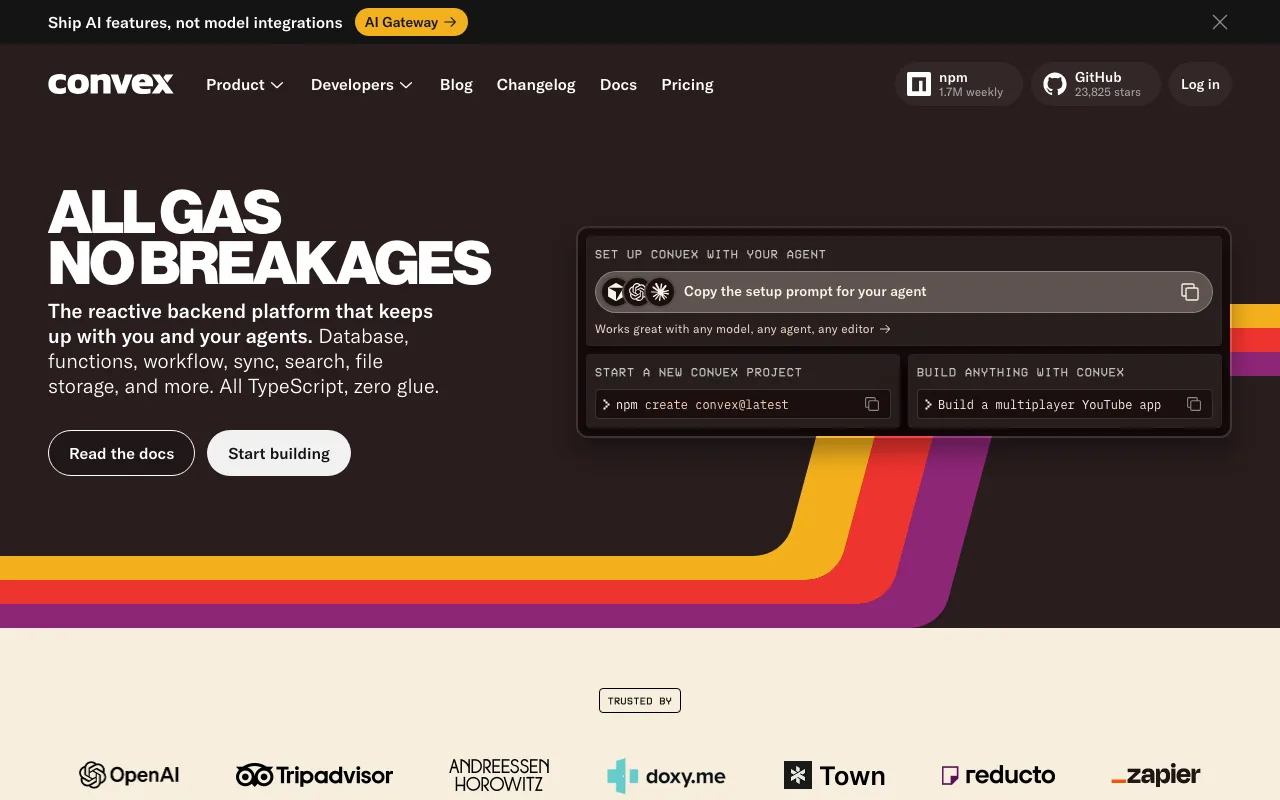
Convex is a reactive backend. You write your database schema and your server functions in TypeScript, and Convex runs them, stores the data, serves files and pushes fresh query results to connected clients. Its GitHub repository describes it as "the open-source reactive database". The repository's license is FSL-1.1-Apache-2.0 (Functional Source License). A self-hosting guide exists for teams that want to run it themselves.
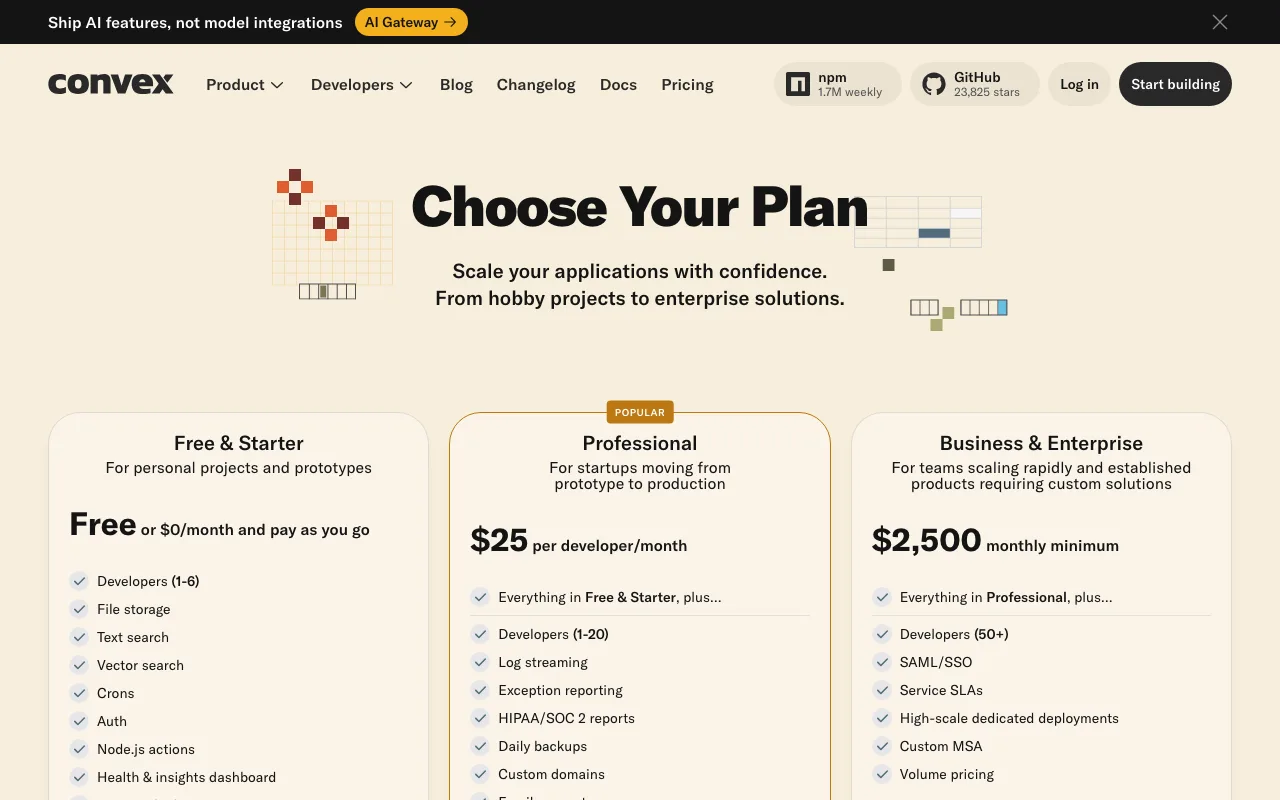
Free, Starter and Professional, and what each costs
Convex's pricing page groups "Free & Starter" into one $0 column. The limits page treats them as two states of that column: Free has fixed allowances, while Starter lists the same allowances as "included" and bills pay-as-you-go beyond them. Starter needs a card on file. On Free, Convex's limits page says new mutations that insert or update data may fail once a cap is hit.
The pricing page shows no yearly prices. Professional is listed per developer per month, so any yearly figure below is that price times 12 and is our inference.
| Plan | Price billed yearly | Billed monthly | Key limits |
|---|---|---|---|
| Free & Starter | Not listed | $0, pay-as-you-go past the allowances | 1M function calls, 0.5 GB database, 1 GB files, 1 GB egress, 40 deployments, 1 to 6 developers |
| Professional | Not listed | $25 per developer | 25M function calls, 50 GB database, 100 GB files, 50 GB egress, 300 deployments, 1 to 20 developers |
| Business & Enterprise | Annual commit discounts mentioned, no rates | $2,500 monthly minimum | 50+ developers, custom pricing |
Every meter and its overage price
Query and mutation compute is free on both columns. Everything else is metered:
| Meter | Free & Starter included | Overage | Professional included | Overage |
|---|---|---|---|---|
| Function calls | 1M | $2.20 per 1M | 25M | $2 per 1M |
| Database storage | 0.5 GB | $0.22 per GB | 50 GB | $0.20 per GB |
| Database I/O | 1 GB | $0.22 per GB | 50 GB | $0.20 per GB |
| File storage | 1 GB | $0.033 per GB | 100 GB | $0.03 per GB |
| Data egress | 1 GB | $0.132 per GB | 50 GB | $0.12 per GB |
| Action compute | 20 GB-hours | $0.33 per GB-hour | 250 GB-hours | $0.30 per GB-hour |
| Search storage | 0.5 GB | $0.55 per GB | 1 GB | $0.50 per GB |
| Search queries | 3,000 query-GBs | $0.11 per 1,000 | 50,000 query-GBs | $0.10 per 1,000 |
Included amounts are shared across regions. Vector search is available on both columns, but the pricing page states no allowance for it.
What the 1 GB egress and 0.5 GB database really allow
The free allowances are small in two places. The database holds 0.5 GB in total, and data egress is 1 GB a month. A document can be up to 1 MiB, so 0.5 GB is roughly 500 documents at that maximum, though real documents are far smaller. Egress is the number to watch if you serve files: one 5 MB image downloaded 200 times uses the whole month.
Function calls are the generous part. One million calls a month is about 33,000 a day. A single reactive page counts each query run as a call, so a chatty client can use them faster than you expect.
The S16 deployment class on Free & Starter also caps live users at 1,000 concurrent sessions. Professional moves you to S256 with 10,000 sessions, 256 concurrent queries and 256 concurrent mutations, against 16 and 16 on the free class.
What the Free plan leaves out
According to the pricing page, the Free & Starter column does not include:
- Daily backups and fast backup and restore
- Log streaming and streaming data exports
- Exception reporting
- Custom domains
- Custom roles and the audit log
- Email support
- The Management API
- SAML and SSO
- Service SLAs
- HIPAA or SOC 2 reports and a BAA
- Dedicated deployments
The page shows the analytics engine as "Soon" and does not state a log retention period or a project limit. Several of these start only at Business or Enterprise, so Professional will not fill every gap.
Limits that apply to every plan
Convex's limits page lists these values for functions and the database. Most are the same on all plans.
- Queries and mutations: 1 second of user code. That is short, so heavy work belongs in an action.
- Convex runtime actions: 30 minutes and 64 MiB of memory. Node runtime actions: 10 minutes and 512 MiB.
- Function arguments and return values: 16 MiB each (Node actions take 5 MiB of arguments).
- One transaction can scan 32,000 documents, write 16,000 documents, and read or write 16 MiB.
- A mutation can schedule 1,000 functions, and a deployment can hold 1,000,000 outstanding scheduled functions.
- Tables: 10,000 per deployment, with 32 indexes per table and 16 fields per index.
- Documents: 1 MiB, 1,024 top-level fields, nesting depth 16.
- Full-text search: 4 search indexes per table and 1,024 results at most. Vector search: 4 vector indexes per table, dimensions 2 to 4,096, 256 results at most.
- Scheduled jobs running at once: 8 on S16, 256 on S256.
The 32,000-document scan limit matters most. A query that filters a large table without an index will hit it. Add an index early.
Reactive queries, transactions and files
A Convex query is a function that re-runs when the data it read changes, and connected clients receive the new result. You do not write subscription code. This is the core idea behind Convex's description of itself as a reactive database.
For writes, Convex's docs describe optimistic concurrency control and say the implementation "provides true serializability", stronger than snapshot isolation. Because transactions are deterministic, Convex can re-run a conflicted one, and the docs say "We can run several retries if necessary."
File storage works in three steps. A mutation generates an upload URL, the client POSTs the file to it and receives a storage ID, and a second mutation saves that ID on a document. The upload URL expires in 1 hour, the POST has a 2-minute timeout, and the docs say file size is not limited. In one transaction you can store or read 10 files up to 16 MiB total.
Cron jobs and scheduled functions
Cron jobs live in convex/crons.ts. Each takes a unique name, a schedule and a mutation or action. You can use crons.interval() for seconds, minutes or hours, crons.cron() with a five-field string in UTC, or the named hourly, daily, weekly and monthly helpers. The docs advise avoiding minute 0 because it is the busiest time, and they ship a lint rule for it.
At most one run of each cron job executes at a time. If a run goes long, later runs may be skipped and the skip is logged in the dashboard. The page states no numeric limit on how many cron jobs you can define.
Authentication options
Convex's auth page lists these routes:
- Clerk, noted for Next.js and React Native support
- WorkOS AuthKit, described as "built for B2B apps and free for up to 1M users"
- Auth0
- Any OpenID Connect provider that issues JWT ID tokens, through the custom integration
- Convex Auth, a Convex-native library for React and React Native, which the page calls beta
Convex Auth covers social providers, email or SMS codes and passwords. Because it is in beta, a production product with strict requirements may prefer one of the hosted providers. Clerk is one of them, and we list it separately.
The startup program: up to a year of Professional free
Convex's startups page lists these terms:
- Benefit: up to 1 year free of Convex Professional, no seat fees, and 30% off usage-based fees, up to $30k.
- Team size and stage: Series A or earlier, fewer than 20 employees, pre-seed to Series A with less than $3 million raised.
- Age: founded less than 3 years ago. Measured from November 9, 2026, that means founded after November 9, 2023.
- Presence: a valid company profile on LinkedIn, Crunchbase, PitchBook or a similar platform, with proof of traction or funding, plus a live site or product at MVP stage.
- Process: be on at least the Starter plan with a card on file, then apply at convex.dev/startups/apply. A human reviews applications on a rolling basis.
The page does not say whether the 30% discount applies during the free year, how it interacts with the free seats, or when the year ends. Ask in the Convex Discord if you need those answers before you build around it.
Worked math with real prices
All prices are list prices from the pricing page. Yearly figures are monthly times 12 because no yearly price is listed.
Example 1: a solo founder on Starter
Assume 3M function calls, 2 GB of database, 4 GB of database I/O, 5 GB of files and 3 GB of egress in a month.
- Function calls: 2M over x $2.20 = $4.40
- Database storage: 1.5 GB over x $0.22 = $0.33
- Database I/O: 3 GB over x $0.22 = $0.66
- File storage: 4 GB over x $0.033 = $0.132
- Egress: 2 GB over x $0.132 = $0.264
- Total: about $5.79 a month, or $69.43 a year
On function calls alone, Starter would cost $25 at roughly 12.4M calls, the point where one Professional seat starts to look comparable. Professional also adds backups and email support, which Free & Starter lacks.
Example 2: a 5-developer team on Professional
Assume 40M function calls, 70 GB of database and 80 GB of egress. Other meters stay inside their allowances.
- Seats: 5 x $25 = $125
- Function calls: 15M over x $2 = $30
- Database storage: 20 GB over x $0.20 = $4
- Egress: 30 GB over x $0.12 = $3.60
- Monthly total: $162.60, or $1,951.20 a year
If the startup program applies, there are no seat fees, which removes the $125. If the 30% off applies to the $37.60 of usage, that leaves $26.32 a month, or $315.84 for the year. The saving would be $1,635.36. Treat that as a best case until Convex confirms how the discount works for your account.
Who it fits
- A TypeScript team building a live app. Collaborative tools, dashboards, chat and feeds benefit from queries that update on their own.
- A founder who wants one backend. Database, functions, cron, files and search sit in one service.
- A startup under the program's size limits. Fewer than 20 people and under $3 million raised puts you in range.
Who Convex is not for
- Teams that need SQL. Convex stores documents with a TypeScript schema. If your team already writes SQL and wants Postgres tooling, Supabase is closer to that.
- Teams that need compliance paperwork now. SOC 2 reports, a BAA and SAML are not on the Free & Starter column.
- Apps that serve many large files. The 1 GB egress allowance is small, and overage is $0.132 per GB.
- Backends with long synchronous work. A query or mutation gets 1 second of user code.
Convex compared with Supabase and Appwrite
| Convex | Supabase | Appwrite | |
|---|---|---|---|
| Data model | Documents, TypeScript schema | Postgres | Tables (TablesDB default) |
| Free tier | $0, 1M calls, 0.5 GB database, 1 GB files | $0, 500 MB database, 50,000 MAU, 1 GB files, 2 active projects | $0, 2 projects, 75K MAU, 2 GB storage |
| Paid entry | $25 per developer | From $25 | $25 |
| Free tier pausing | No pausing stated; writes may fail at the cap | Paused after 1 week of low activity | Project freezes at the limit |
Supabase and Appwrite figures come from our own pages on those tools: Supabase and Appwrite. Convex bills per developer, while Supabase's $25 is per organization plus compute, so compare totals for your team rather than entry prices.
Setting up Convex well
- Define a schema from day one and index every filtered query.
- Keep queries and mutations short. Move calls to other services into actions.
- Use separate deployments for dev and production. The Free column allows 40.
- Set up an auth provider before you ship. Clerk, Auth0 and WorkOS AuthKit are all listed in the docs.
- Stream logs to Axiom, Datadog, PostHog or a webhook once you have users. Log streaming starts on Professional; Free & Starter does not include it.
How to get the Convex offer
- Upgrade to SaaSOffers Premium, then open this deal's claim link on SaaSOffers.
- Create your Convex account and start on the Free plan.
- Build your project and check the usage page against the allowances above.
- If you meet the startup program terms, add a card to move to Starter and apply at convex.dev/startups/apply.
- Confirm the program's terms in writing before you plan around the free year.
Who Is This Deal For?
Early-Stage Startups
Seed and pre-seed companies looking to move fast without overspending on tools.
Growing SaaS Teams
Series A+ companies scaling their stack and optimizing software costs.
Solo Founders
Indie hackers and bootstrapped founders who need enterprise tools at startup prices.
Get No deal right now off Convex
Premium deal. Upgrade once, unlock everything.
Frequently Asked Questions
Everything you need to know about this startup deal.
Get the weekly deals digest
New verified startup deals every week. No spam, ever. Unsubscribe anytime.
Related Offers

Retool
Used by 1,559 members
1 year free, up to $60K
Build internal tools 10x faster with the low-code platform used by companies like Amazon, DoorDash, and Mercedes-Benz.
View offer
Zoom
Used by 1,090 members
$20 off per user
Get $20 off per user on Zoom, the video conferencing platform used by hundreds of thousands of businesses for meetings, webinars, and team collaboration.
View offer
ZoomInfo
Used by 2,014 members
14-day free trial
B2B data platform for sales and marketing intelligence with contact databases.
View offer
Chore
15% off your first month
Chore runs your startup's back office for you: payroll, HR, bookkeeping, compliance and equity, inside the tools you already use. 15% off your first month through SaaSOffers.
View offerDeal Summary
Looking for more startup deals?
Browse all offers