
Hugging Face Startup Credits: $1,000 in GPU credits
The GitHub of machine learning, host models, datasets, and spaces for ML development and deployment.
Free · Opens in new tab
Already have an account? Log in
Deal Highlights
What Hugging Face Gives a Startup
Hugging Face is the GitHub of machine learning. It hosts models, datasets, and Spaces for building and shipping ML, and this deal hands an AI or ML startup $1,000 in GPU credits to run real workloads on that infrastructure. For a young team, that combination matters. You get the central library where the open machine learning world already lives, and you get compute to train, fine-tune, and serve on top of it without buying your own hardware first.
The value here is not just the credits, though the credits are real and they move the needle. It is that Hugging Face sits at the center of how modern AI gets built. When a researcher publishes a new model, it usually lands on Hugging Face. When a team open-sources a dataset, it usually lands there too. A startup that plugs into this ecosystem early stops reinventing pieces that already exist and starts assembling from the best components the field has produced. The $1,000 in GPU credits then turns that access into action, because reading about a model and actually running it are two different things, and only one of them ships a product.
This deal is aimed at AI and ML startups, which is the requirement, and it fits that stage well. Early ML teams burn money fast on compute and waste weeks on plumbing. Hugging Face compresses both problems. The platform gives you the models and data, the credits give you the runway to experiment, and the tooling gives you a path from a notebook experiment to a hosted endpoint that other parts of your product can call.
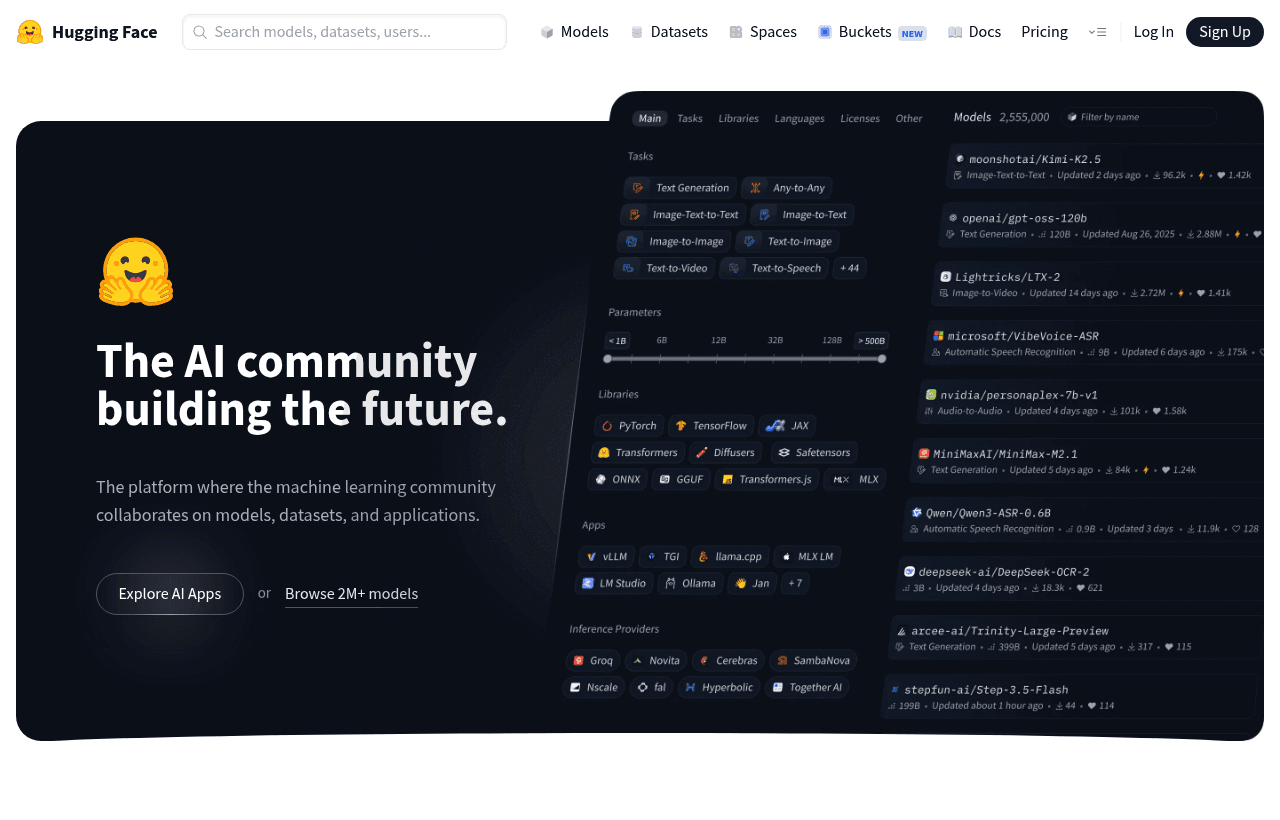
Hugging Face, one of the tools included in this startup deal.
The Model Hub and Why It Changes Your Build Speed
The Hub is the reason most teams show up. It hosts hundreds of thousands of models across text, vision, audio, and multimodal tasks. For a startup, this is the difference between starting from zero and starting from a strong baseline. Instead of training a language model or an image classifier from scratch, which takes enormous compute and expertise, the team pulls a pretrained model that already works and adapts it to the specific problem.
That shift changes your timeline. A founder who wants to test whether an AI feature is even worth building can grab a relevant model, run it against real inputs, and have a signal in a day rather than a quarter. If the signal is good, the team invests. If it is weak, the team moves on before sinking a payroll cycle into it. The Hub makes that cheap experimentation possible, and cheap experimentation is how small teams find product-market fit before the money runs out.
The models come with standardized interfaces, so swapping one for another is usually a small change rather than a rewrite. That matters because the state of the art moves quickly. A model that was best last quarter may be beaten this quarter, and a startup built on Hugging Face conventions can adopt the newer model without tearing up its stack. You stay current without paying the full cost of staying current.
Datasets Without the Scavenger Hunt
Good models need good data, and finding data is one of the least glamorous, most time-consuming parts of ML work. Hugging Face hosts a large library of datasets alongside the models, covering everything from text corpora to labeled images to audio. For a startup, this removes a common early blocker. Rather than spending weeks scraping, cleaning, and formatting data before any modeling can begin, the team pulls a ready dataset and starts working.
The dataset tools also handle the boring but critical mechanics of loading large data efficiently, streaming it so it does not have to fit in memory, and versioning it so experiments stay reproducible. A team that can reproduce its own results is a team that can debug, improve, and defend its work when a customer or investor asks how the model was built. That discipline is hard to bolt on later, and starting on a platform that encourages it saves pain down the road.
Hosting your own datasets on the Hub also helps when the team grows. Instead of a private drive full of files that only one engineer understands, the data lives in a versioned, documented place that new hires can find and use on their first week. For a startup that plans to scale its ML team, that shared foundation pays off every time someone joins.
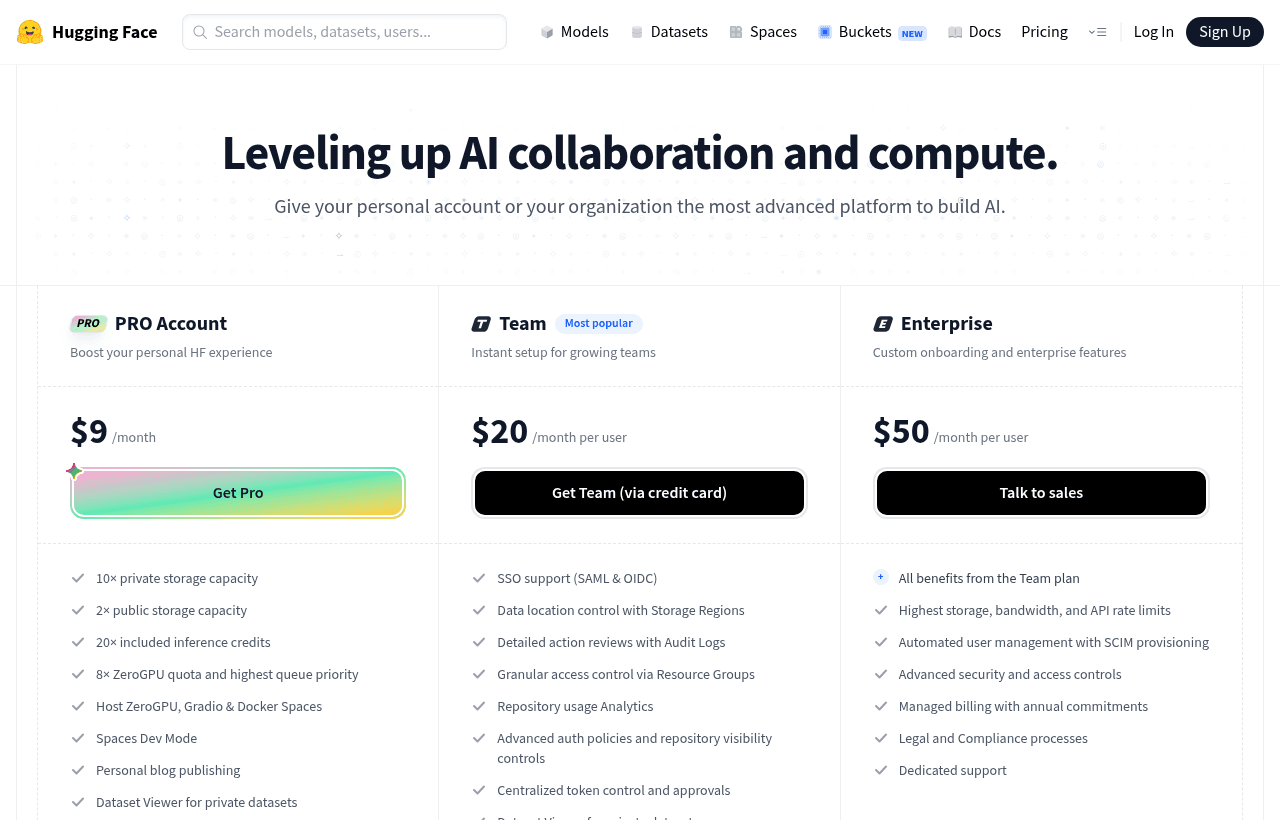
A look at Hugging Face before the discount, so you can see what the deal saves you.
Spaces and Getting to a Demo Fast
Spaces let you host live ML apps directly on Hugging Face. For a startup, this is a fast route from a working model to something a person can click. You wrap the model in a simple interface, push it to a Space, and get a shareable link. That link is enough to show an investor, put in front of a design partner, or gather feedback from early users before the real product exists.
Speed to a demo is a genuine advantage for a small team. Decisions get made faster when people can interact with a thing instead of reading a description of it. A Space turns an abstract claim, our model can summarize support tickets, into a page where someone types a ticket and watches the summary appear. That is far more convincing, and it costs a fraction of the effort of building production infrastructure. Founders can validate demand first and build the heavy version only once the demand is proven.
Spaces also serve as living documentation for the team. A hosted demo of each model the company relies on gives everyone, including non-engineers, a way to see what the system does. Sales can show it, support can reference it, and new engineers can poke at it to understand behavior before touching the code.
The $1,000 in GPU Credits as Runway
The credits are the practical heart of this deal. GPU compute is expensive, and for an ML startup it is often the largest variable cost after salaries. Training and fine-tuning both demand GPUs, and so does serving models under real traffic. A thousand dollars in credits buys a meaningful amount of experimentation before the team has to commit real cash or lock into a long contract.
Use the credits where they create the most learning. Fine-tuning a strong base model on your own data is usually a better bet than training from scratch, because it needs far less compute and often produces better results for a narrow task. Running a proper evaluation, where you test several candidate models against your real inputs, is another high-value use, because choosing the right model early saves money on every inference call for the life of the product. The credits let you make that choice on evidence rather than on a guess.
Treat the credits as a limited runway for reducing risk, not as free compute to spend without a plan. The teams that get the most from a credit grant are the ones that decide, before they start, what question each run is meant to answer. When the credits confirm that an approach works, you scale it with confidence. When they show that an approach fails, you saved yourself from paying for that failure at full price and at larger scale.
Open Source at the Core
Hugging Face is built on open source, and that culture is worth leaning into. The libraries that connect to the Hub are widely used, well documented, and supported by a large community. When a startup engineer hits a problem, the odds are high that someone has hit it before and written down the fix. That community knowledge is a hidden asset. It shortens debugging, lowers the barrier for junior engineers, and reduces the risk of being stuck alone with a tool nobody else understands.
Open foundations also protect a startup from lock-in. Because the models and data are portable and the tooling is open, a team is never fully trapped inside one vendor's walls. If the company later needs to move some workloads elsewhere, the open standards make that possible. For founders who worry about betting the company on a platform, that portability is reassuring, and it makes the decision to adopt Hugging Face lower risk than adopting a closed alternative.
Hugging Face Compared to Rolling Your Own
The alternative to Hugging Face is building the same capabilities in house: your own model storage, your own dataset pipelines, your own serving infrastructure, and your own place to publish demos. A large, well-funded lab can justify that. A startup usually cannot. Every week spent building ML plumbing is a week not spent on the product that customers actually pay for, and the plumbing you build will likely be worse than the shared, battle-tested version that thousands of teams already use.
Compared to closed AI platforms, Hugging Face gives you more control and more visibility. You can inspect models, host your own, and keep your data in a place you understand, rather than sending everything into a black box. Compared to stitching together raw cloud services yourself, Hugging Face gives you a coherent, ML-specific workflow instead of a pile of generic infrastructure you have to assemble. The team gets the benefits of standardization without giving up the ability to customize where it counts.
The trade-off is that you adopt the platform's conventions, and for most early teams that is a good trade. Conventions that the whole field uses are conventions your engineers already know or can learn quickly, and building on them means every new hire arrives partly trained.
Making the $1,000 in GPU Credits Count
To get full value, connect the credits to a concrete goal before spending them. Pick the one ML capability that would most change your product if it worked, and design a small set of runs to prove or disprove it. Pull a strong base model from the Hub, gather a focused dataset, fine-tune, and evaluate against inputs that look like real production traffic. That single loop, done well, teaches you more than a dozen unfocused experiments.
Instrument everything. Track which model, which data, and which settings produced which result, so that when a run works you can repeat it and when it fails you understand why. The credits are finite, and reproducibility is what keeps you from spending them twice on the same lesson. Host your best result as a Space so the rest of the team can see and react to it, and keep your winning model and dataset on the Hub so the knowledge stays with the company rather than in one engineer's local folder.
Plan the transition past the credits from the start. Know roughly what your inference and training costs will look like at small scale, so that when the free credits run out there is no surprise. A team that has already measured its real costs during the credit period can make a calm, informed decision about what to keep running, rather than a panicked one when the first full bill arrives.
How Hugging Face Scales With the Team
What makes this deal worth claiming early is that Hugging Face grows with the company rather than being outgrown. In the first weeks it is a place to experiment fast and cheaply. As the team matures, the same platform becomes the shared registry for the models and datasets the company depends on, the hosting layer for internal demos, and a serving option for real endpoints. The tools you learn on day one are the tools you still use when the ML team is ten people, so the early investment in learning them compounds.
The ecosystem also keeps pulling the team forward. Because the newest research and models keep landing on the Hub, a startup that lives there is never far from the current frontier. You do not have to run a research program to stay near the edge of the field. You just have to keep pulling from the place where the field already publishes, and that is a real advantage for a small team competing against larger, better-resourced rivals.
Who Should Claim This Deal
This deal fits an AI or ML startup that is actively building with machine learning, which is exactly the requirement it carries. If the team is training, fine-tuning, or serving models, or plans to soon, Hugging Face is likely already part of the workflow or should be, and the $1,000 in GPU credits gives that work real runway. Teams that want to test an AI feature before committing serious money to it will get particular value, because the credits let them find the answer cheaply.
It fits best when there is at least one person who can work with models and data, since the platform rewards hands-on use. A founder who wants to validate an ML idea, a small ML team choosing its infrastructure, or an early-stage company that has decided AI is core to its product will all find this worth claiming. If machine learning is central to what a startup is building, Hugging Face plus GPU credits is one of the cleaner head starts available, and claiming it early means the compounding benefits start sooner.
Who Is This Deal For?
Early-Stage Startups
Seed and pre-seed companies looking to move fast without overspending on tools.
Growing SaaS Teams
Series A+ companies scaling their stack and optimizing software costs.
Solo Founders
Indie hackers and bootstrapped founders who need enterprise tools at startup prices.
Get $1,000 in GPU credits off Hugging Face
Premium deal. Upgrade once, unlock everything.
!Eligibility Requirements
AI/ML startup
Frequently Asked Questions
Everything you need to know about this startup deal.
The Hugging Face Hub (model hosting, datasets, community) is free. GPU compute (Inference Endpoints, AutoTrain, Spaces with GPU) costs money. The $1,000 GPU credit covers compute costs for several months of development and deployment.
Get the weekly deals digest
New verified startup deals every week. No spam, ever. Unsubscribe anytime.
Related Offers

Higgsfield
55% off annual Business plan
55% off an annual Higgsfield Business plan. Higgsfield is an AI video and image studio with Seedance, Kling, Veo and more in one account.
View offer
Seedance
55% off annual Business plan
55% off an annual Higgsfield Business plan with Seedance included. Seedance is ByteDance's AI video model for text, image and reference-driven clips.
View offerChromaDB
Used by 306 members
Free & Open Source
Open-source embedding database for building AI applications with semantic search.
View offer
Laxis
Used by 2,176 members
Free Plan
AI meeting assistant that records, transcribes, and generates actionable meeting notes.
View offer
Pictory
Used by 659 members
Free Trial
AI-powered video creation tool, turn text, scripts, and blogs into videos.
View offer
Segment
Used by 2,293 members
$25,000 in credits
Collect, clean, and route customer data to every tool in your stack with the leading customer data platform.
View offerDeal Summary
Looking for more startup deals?
Browse all offers