
Segment Startup Credits: $25,000 in credits
Collect, clean, and route customer data to every tool in your stack with the leading customer data platform.
Free · Opens in new tab
Already have an account? Log in
Deal Highlights
What Is Segment?
Segment is the customer data platform (CDP) that collects event data from your website, mobile app, and servers, then routes it to every analytics, marketing, and data warehouse tool in your stack. Instead of integrating each tool separately, installing Mixpanel's SDK, Google Analytics' SDK, HubSpot's tracking code, and your data warehouse loader independently. You install Segment once and it sends data everywhere simultaneously.
In 2026, Segment (owned by Twilio) is used by over 25,000 companies and routes data to 300+ destinations. For startups, Segment solves the problem that becomes painful at the 5-tool mark: keeping user data consistent across analytics, marketing, support, and data warehouse tools without building custom integration pipelines.
Segment, one of the tools included in this startup deal.
Why This Deal Matters for Data-Driven Startups
Every startup adds tools over time. Month 1: Mixpanel for analytics. Month 3: HubSpot for CRM. Month 5: Intercom for support. Month 8: a data warehouse for reporting. Each tool needs the same user events, signups, purchases, feature usage, but each has its own SDK, its own data format, and its own integration requirements.
Without Segment, you write integration code for every tool. With Segment, you write integration code once. The $25,000 startup credit covers Segment's Team plan for 12–24 months. The period when your stack is growing fastest and integration complexity compounds.
What's Included in the Segment Startup Deal
Through SaaSOffers, qualifying startups receive:
- $25,000 in Segment credits
- Unlimited sources: Website, mobile app, server-side event collection
- 300+ destinations: Route data to analytics, marketing, CRM, and warehouses
- Real-time event streaming: Events reach destinations in seconds
- Identity resolution: Unify anonymous and identified user profiles
- Protocols: Data governance with tracking plans and schema enforcement
- Warehouses integration: Direct sync to BigQuery, Snowflake, Redshift
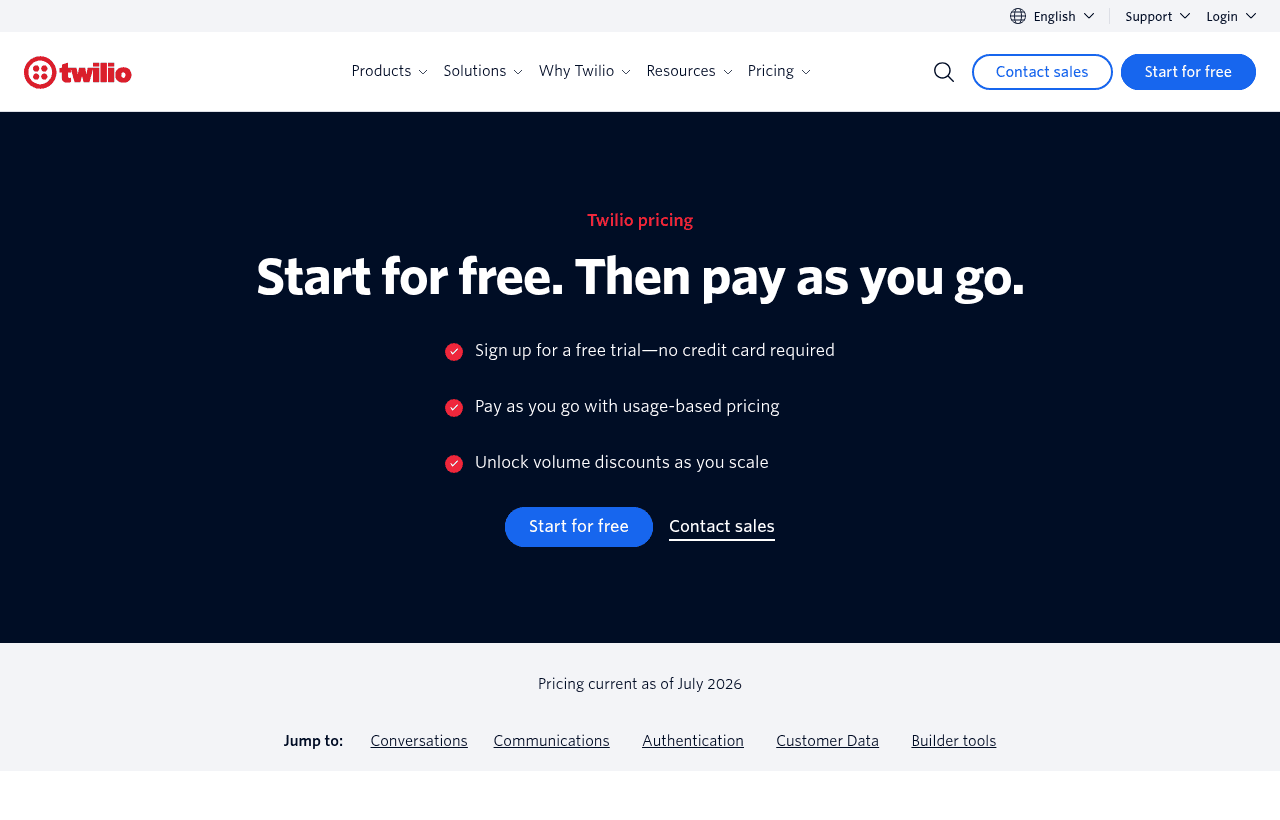
A look at Segment before the discount, so you can see what the deal saves you.
Eligibility Requirements
- Startup under 2 years old, pre-Series B
- New Segment workspace
- Applied through a qualifying startup platform
How to Claim This Segment Deal. Step by Step
Step 1: Create a free account on SaaSOffers at saasoffers.tech and access the Segment startup deal.
Step 2: Click "Get Deal" and follow the link to Segment's startup program application.
Step 3: Create your Segment workspace at segment.com. Define your first source (typically your web app using Analytics.js).
Step 4: Install the Segment snippet on your website or the SDK in your mobile app. A single JavaScript snippet replaces all individual tool SDKs.
Step 5: Define your tracking plan. The events you will track (Signed Up, Feature Used, Plan Upgraded) and their properties (plan_name, revenue, feature_name). A clear tracking plan from day one prevents data quality issues that compound over months.
Step 6: Connect your first destinations. Mixpanel for product analytics, HubSpot for CRM, and your data warehouse for long-term storage. Each destination takes 2–5 minutes to configure in Segment's UI.
Step 7: Enable identity resolution to unify anonymous visitors with identified users. When an anonymous visitor signs up, Segment merges their pre-signup browsing data with their post-signup profile, giving you complete user journey visibility.
Key Features of Segment for Startups
One SDK, Every Destination
Install Segment's SDK once. Data flows to Mixpanel, Google Analytics, HubSpot, Intercom, your data warehouse, and any other connected destination simultaneously. Adding a new analytics tool takes 5 minutes (enable in Segment dashboard) instead of 2 days (install SDK, configure events, test data flow).
Identity Resolution
Users interact with your product across devices and sessions, browsing anonymously on mobile, signing up on desktop, returning via email link on tablet. Segment's identity graph merges these interactions into a single user profile, giving every downstream tool a complete view of each user's journey.
Protocols. Data Quality Governance
Segment Protocols lets you define a tracking plan (which events, which properties, which types) and enforce it. Events that violate the schema are flagged, blocked, or redirected. This prevents the most common analytics problem: bad data entering your tools and corrupting reports for months before anyone notices.
Warehouse Sync
Segment syncs all collected events to your data warehouse (BigQuery, Snowflake, Redshift) in structured tables. This creates a single source of truth for all user behavior data, queryable with SQL, joinable with other business data, and available for custom reporting that no single analytics tool provides.
Replay. Backfill Historical Data
When you add a new destination, Segment can replay historical events to that destination, backfilling data as if the tool had been connected from day one. This means adding Amplitude in month 6 gives you 6 months of historical data, not a blank slate.
The Real Value: Instrument Once, Send Everywhere
The core idea behind a customer data platform like Segment is worth stating plainly, because it is the whole reason to use one and it is easy to miss.
Without Segment, every analytics and marketing tool you adopt needs its own instrumentation. You add Mixpanel's SDK and tag your events for it, then add Google Analytics and tag again, then a marketing tool, then a warehouse, each with its own integration, its own event definitions, and its own code scattered through your product. Every new tool is another engineering project, and every change to what you track means editing many integrations. Worse, the tools drift out of sync, so your analytics and your marketing platform disagree about what a user did, because they were instrumented separately.
Segment inverts this. You instrument your events once, sending them to Segment, and Segment forwards that single clean stream to every connected destination. Adding a new tool becomes flipping a switch to route your existing events to it, not a new instrumentation project. Changing what you track is one change in one place. And every tool receives the same data, so they agree.
For a startup, the payoff is speed and consistency. You can adopt, test, and drop analytics and marketing tools without engineering work each time, and your data is consistent across all of them because it comes from one source. That single-source-of-truth for customer events is the durable value, more than any individual feature.
The Cost Reality of a CDP
Being honest about this matters, because a customer data platform is priced differently from the tools it feeds, and the model catches teams out.
Segment prices around the volume of data it processes, typically measured in tracked users or the number of events flowing through. That is a different axis from the per-seat or per-contact pricing of the tools it connects to, and it means the cost scales with your traffic and how much you instrument. A high-traffic product sending many events per user can see this grow substantially, and the common surprise is instrumenting everything on the theory that data is good, then finding the volume-based bill climb faster than expected.
The discipline is to be deliberate about what you send through the CDP. Track the events that feed real decisions and real tools, not every possible interaction. High-frequency, low-value events, every scroll, every mouse movement, multiply your volume without adding insight, and routing them through a volume-priced platform is paying for noise. A clean, intentional event schema controls both the bill and the quality of your data, which happen to be the same discipline.
The honest framing of whether Segment is worth its cost: it earns its price when you use several tools that all need the same data, because it replaces the engineering cost of maintaining many integrations and the mess of inconsistent data. If you use only one analytics tool, a CDP is overhead, and instrumenting that one tool directly is simpler and cheaper. The value grows with the number of destinations you feed.
Segment vs Direct Tool Integration
| Factor | With Segment | Without Segment |
|---|---|---|
| Adding a new tool | 5 minutes (dashboard toggle) | 1–3 days (SDK install, event mapping, testing) |
| Data consistency | Same events everywhere | Tool-specific implementations drift |
| Removing a tool | 1 click (disable destination) | Code removal + testing |
| Data warehouse | Automatic sync | Custom ETL pipeline |
| Identity resolution | Built-in | Manual cross-tool matching |
| Cost | $25,000 credits | Engineering time per integration |
Who Is the Segment Deal For?
Product-led growth startups with 5+ tools in their stack: The more tools you use, the more valuable Segment becomes. At 3 tools, direct integration is manageable. At 8 tools, Segment saves weeks of integration engineering per quarter.
Data-driven teams building a data warehouse: If you plan to warehouse your user event data for custom reporting and analysis, Segment's warehouse sync is the simplest path from event collection to structured warehouse tables.
Startups that expect to switch or add analytics tools: If you might switch from Mixpanel to Amplitude, or add Heap alongside your current analytics, Segment makes the switch a 5-minute destination change instead of a multi-day SDK swap.
Real Startup Use Cases
GrowthApp (B2B SaaS, product-led): GrowthApp installed Segment's JavaScript SDK once and connected 8 destinations: Mixpanel (product analytics), HubSpot (CRM), Intercom (support), Customer.io (email), BigQuery (warehouse), Google Analytics (marketing), Amplitude (experimentation), and Slack (real-time notifications). Adding each destination took 3–5 minutes. Without Segment, the estimated integration time was 3–4 weeks.
DataMart (e-commerce analytics): DataMart used Segment to collect purchase events from their Shopify integration and route them to BigQuery for revenue reporting, Mixpanel for funnel analysis, and Google Ads for conversion tracking. When they switched from Mixpanel to Amplitude in month 8, the migration took 10 minutes, disable one destination, enable another. Historical data was backfilled via Replay.
HealthTrack (mobile health app): HealthTrack used Segment's mobile SDKs (iOS + Android) to collect health tracking events and route them to their analytics stack while maintaining HIPAA compliance through Segment's data governance features. Protocols enforced that no PHI (protected health information) was sent to non-HIPAA-compliant destinations.
Tips to Maximize Your Segment Credits
- Define your tracking plan before writing any code. Write down every event you want to track and its properties. This 2-hour exercise prevents months of inconsistent data that corrupts every downstream tool.
- Start with 3–4 destinations, not 10. Connect your primary analytics tool, CRM, and data warehouse first. Add more destinations as you need them. Every active destination consumes credits based on event volume.
- Use server-side tracking for sensitive events. Revenue events, user profile updates, and subscription changes should be tracked server-side (not client-side) for accuracy and security. Segment's server libraries ensure these events are not affected by ad blockers.
- Enable Protocols immediately. Schema enforcement catches bad data at the source. A misspelled event name caught by Protocols on day 1 prevents corrupted analytics reports discovered on day 90.
- Monitor monthly tracked users (MTUs). Segment pricing scales with MTUs. Monitor your MTU count monthly and archive inactive users to keep within your credit-funded tier.
Segment Alternatives
Looking for Segment alternatives? While Segment is a strong choice for analytics, it is not always the right fit for every team. Compare Segment against the top alternatives in our category. Each with verified startup deals and credits. See all Segment alternatives →
Many startups end up using a combination of tools, and there are no restrictions on claiming multiple deals through SaaSOffers. Whether you need a cheaper option, different features, or a better startup deal, there is an alternative worth considering.
Get the Tracking Plan Right First
The single most important thing about adopting Segment, or any customer data platform, is deciding what to track before you write the code, because a CDP amplifies whatever discipline, or lack of it, you bring to your event data.
Agree a tracking plan: the events you will send, named consistently, with a defined set of properties on each. Inconsistent naming is the classic failure, where one part of the code sends "Signed Up" and another sends "user_signup", producing two unrelated events that fracture every downstream report. A tracking plan written down and enforced in review prevents this, and it is far cheaper to establish at the start than to reconcile a chaotic schema after months of bad data have accumulated across every connected tool.
Because Segment sends to many destinations, the cost of getting the schema wrong is multiplied: a badly-named or missing event is badly-named or missing in every tool at once, and fixing it means reprocessing and re-syncing everywhere. The same leverage that makes a CDP powerful makes its data-quality mistakes expensive. Invest the modest upfront effort in a clean, deliberate event schema, and the platform pays it back across every tool it feeds. Skip that effort, and you have simply distributed a mess more efficiently.
Who Is This Deal For?
Early-Stage Startups
Seed and pre-seed companies looking to move fast without overspending on tools.
Growing SaaS Teams
Series A+ companies scaling their stack and optimizing software costs.
Solo Founders
Indie hackers and bootstrapped founders who need enterprise tools at startup prices.
Get $25,000 in credits off Segment
Premium deal. Upgrade once, unlock everything.
Frequently Asked Questions
Everything you need to know about this startup deal.
A CDP collects user behavior data from all your digital touchpoints (website, app, server) and routes it to every tool in your stack — analytics, marketing, CRM, data warehouse. Segment is the most widely used CDP for startups. It replaces individual tool SDKs with a single integration point, ensuring consistent data across all tools.
Get the weekly deals digest
New verified startup deals every week. No spam, ever. Unsubscribe anytime.
Related Offers

Higgsfield
55% off annual Business plan
55% off an annual Higgsfield Business plan. Higgsfield is an AI video and image studio with Seedance, Kling, Veo and more in one account.
View offer
Seedance
55% off annual Business plan
55% off an annual Higgsfield Business plan with Seedance included. Seedance is ByteDance's AI video model for text, image and reference-driven clips.
View offerChromaDB
Used by 306 members
Free & Open Source
Open-source embedding database for building AI applications with semantic search.
View offer
Laxis
Used by 2,176 members
Free Plan
AI meeting assistant that records, transcribes, and generates actionable meeting notes.
View offer
Pictory
Used by 659 members
Free Trial
AI-powered video creation tool, turn text, scripts, and blogs into videos.
View offer
Krisp
Used by 982 members
Free Plan
AI-powered noise cancellation and meeting assistant for virtual calls.
View offerDeal Summary
Looking for more startup deals?
Browse all offers