
LangChain Startup Credits: $500 in LangSmith credits
Framework for building LLM-powered applications, chains, agents, RAG, and tool use with any model provider.
Free · Opens in new tab
Already have an account? Log in
Deal Highlights
What LangChain Gives a Startup
LangChain is a framework for building LLM-powered applications, and this deal comes with $500 in LangSmith credits. In plain terms, LangChain gives an AI startup the building blocks to assemble chains, agents, retrieval-augmented generation, and tool use across any model provider, and LangSmith gives the team the visibility to see what those systems are actually doing. For a team building LLM applications, that combination covers both halves of the job: building the thing and understanding it once it runs.
The framework matters because building on top of large language models is not just calling an API. Real LLM applications string together multiple steps, retrieve relevant context, call external tools, and coordinate agents that decide what to do next. Wiring all of that together from scratch, for every model provider, is a lot of undifferentiated work. LangChain provides the structure so a startup can focus on what makes its product distinct rather than reinventing the plumbing that every LLM app needs. The $500 in LangSmith credits then lets the team observe, debug, and evaluate those systems, which is exactly where LLM applications tend to go wrong.
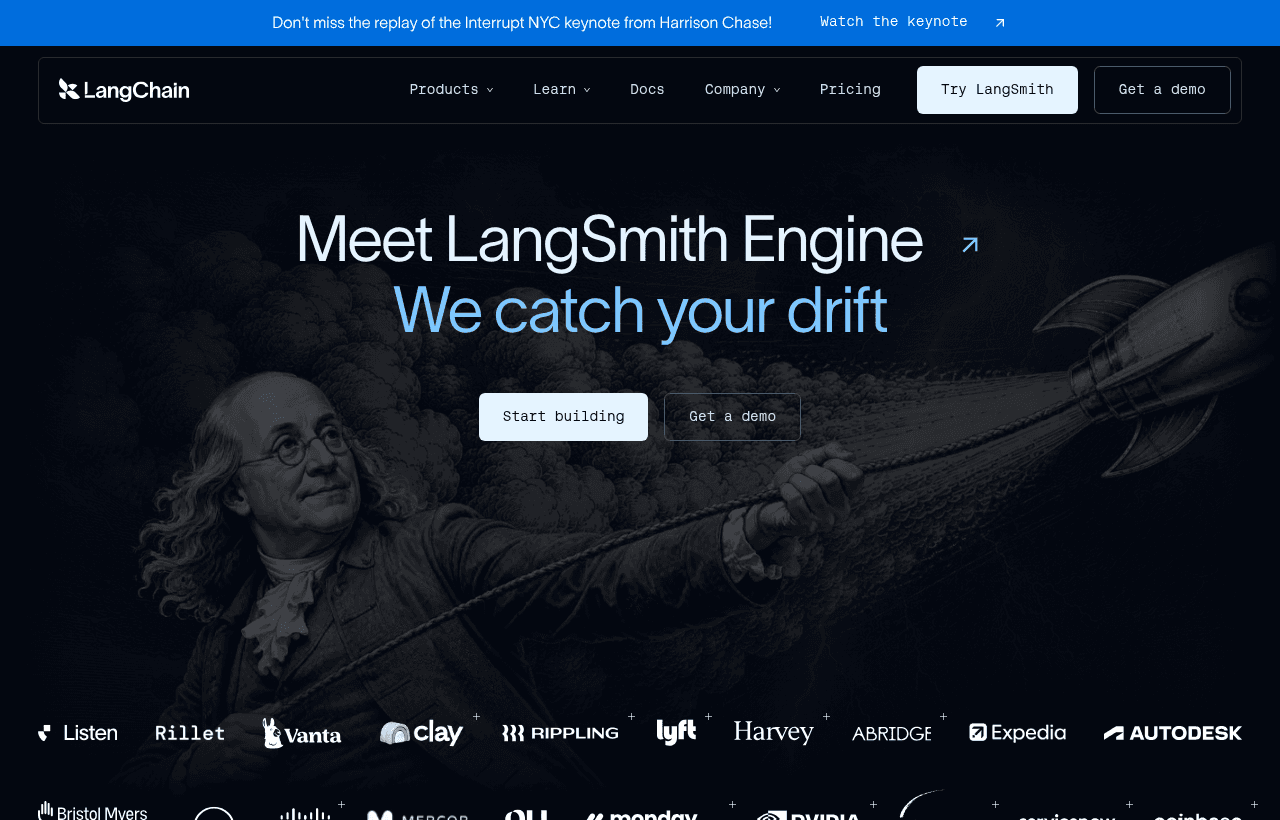
LangChain, one of the tools included in this startup deal.
A Framework Built for the Way LLM Apps Actually Work
The reason LangChain exists is that serious LLM applications are made of many parts working together. A single prompt to a model is rarely the whole product. Instead, the app might take a user's question, retrieve relevant documents, feed them to the model with the right context, call a tool to look something up, and then compose an answer. That is a chain of steps, and building it reliably means managing state, handling failures, and coordinating the pieces.
LangChain gives a startup the abstractions for exactly this. Chains let the team compose multi-step workflows. Agents let the model decide which tools to use and in what order. Retrieval-augmented generation lets the app ground its answers in the team's own data rather than only the model's training. Tool use lets the model reach out to external systems to take actions or fetch information. These are the core patterns of modern LLM applications, and LangChain provides them as a coherent framework rather than as things the team stitches together by hand.
For an AI startup, this is leverage. The team is building on well-worn patterns instead of discovering them the hard way, which means it ships faster and on a more solid footing. The framework encodes a lot of hard-won knowledge about how to structure these applications, so a small team gets to stand on that rather than learning every lesson through its own painful bugs.
Any Model Provider, No Lock-In
One of LangChain's most practical benefits for a startup is that it works across any model provider. The LLM landscape moves fast. New models appear constantly, prices change, and the best model for a given task this month may not be the best next month. A startup that hardcodes its application to a single provider is betting that provider will always be the right choice, which is a risky bet in a field that changes this quickly.
LangChain decouples the application from the underlying model. The team builds its chains, agents, and retrieval logic against the framework, and can switch or mix model providers underneath without rewriting the application. That flexibility is worth a lot. It means the startup can choose the best model for each job, adapt as the market shifts, and avoid being trapped by a single vendor's pricing or availability. When a better or cheaper model comes along, adopting it is a change of configuration rather than a rebuild.
For an early team, this optionality is a hedge against a fast-moving and unpredictable market. The product's core logic stays stable while the models underneath it evolve. That separation lets a startup keep pace with the state of the art without constantly rearchitecting, which is a real advantage when the whole field is moving as fast as this one.
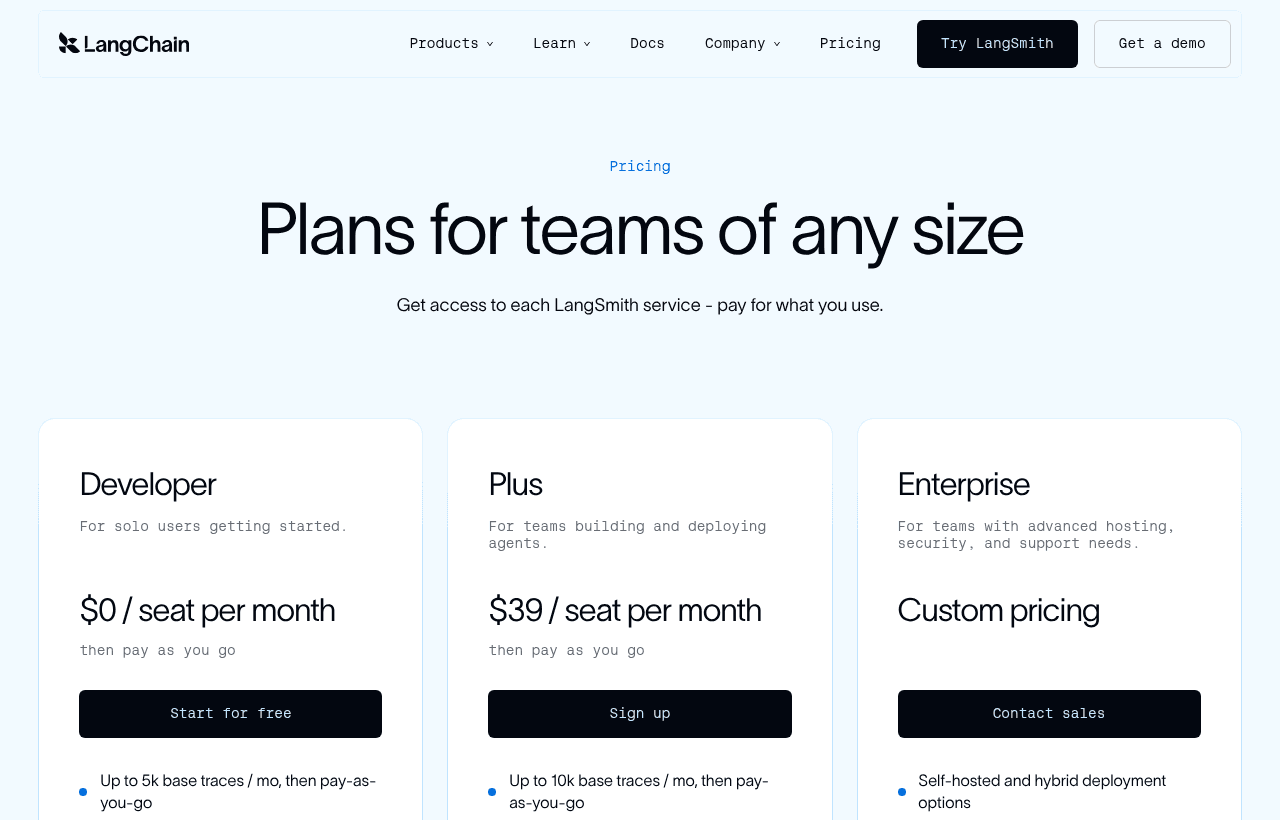
A look at LangChain before the discount, so you can see what the deal saves you.
LangSmith and the Problem of Seeing Inside an LLM App
Building an LLM application is one challenge. Understanding what it does once it runs is another, and often the harder one. LLM systems are notoriously opaque. When an agent gives a wrong answer, takes a strange action, or costs more than expected, it is genuinely difficult to see why without the right tooling. This is where the $500 in LangSmith credits earn their place.
LangSmith gives a startup observability into its LLM applications. The team can trace what happened on a given request, see each step the chain or agent took, inspect the prompts and responses, and understand where things went right or wrong. For debugging, this is transformative. Instead of guessing why an agent misbehaved, the team can look at the actual sequence of steps and pinpoint the problem. For an early team without a lot of people to throw at mysterious bugs, that visibility saves enormous amounts of time.
The credits also cover evaluation, which matters because LLM applications need to be measured, not just built. How do you know a change to a prompt or a chain made the product better rather than worse? Without evaluation, you are guessing. LangSmith lets a startup evaluate its LLM systems systematically, so the team can make changes with evidence rather than hope. That discipline is what separates an LLM product that steadily improves from one that changes randomly and hopes for the best.
Why Observability Is Not Optional for LLM Products
It is tempting for an early team to treat observability as something to add later, once the product is working. With LLM applications, that instinct is a trap. These systems fail in subtle, non-obvious ways that are almost impossible to catch without tracing. A prompt change that looks harmless can degrade quality across a whole category of inputs. An agent can take an expensive path that nobody notices until the bill arrives. A retrieval step can quietly return irrelevant context that corrupts every answer.
LangSmith gives a startup the ability to see these problems rather than discover them through user complaints. The $500 in credits let the team build observability in from the start, while the product is small and the habits are easy to form, rather than bolting it on after quality problems have already cost the team users. Establishing this early means the team always has visibility into what its LLM systems are doing, which is exactly when that visibility is cheapest to adopt and most valuable to have.
The payoff is confidence. A startup that can trace and evaluate its LLM applications ships changes knowing whether they helped, debugs problems by looking at what actually happened, and controls costs by seeing where they come from. That confidence compounds. It lets the team move faster because it is not flying blind, and moving faster with confidence is exactly what an early AI startup needs.
LangChain Compared to Building From Scratch
The realistic alternative to LangChain is building the same abstractions yourself, directly against model APIs. Plenty of teams start this way, calling a model API directly and adding structure as they go. That works for a simple prototype. It stops working as the application grows into multi-step chains, agents, retrieval, and tool use, because now the team is building and maintaining its own framework alongside its product, and reinventing patterns that already exist and are well understood.
LangChain replaces that with a framework built and maintained by people focused on exactly this problem, used across a huge range of LLM applications. A startup gets battle-tested abstractions instead of homegrown ones, and gets to spend its engineering time on what makes its product unique rather than on the shared plumbing. The comparison is about leverage: build your own framework and maintain it forever, or build on one that already exists and put your energy into the product.
Pairing the framework with LangSmith sharpens the advantage further. Building your own observability and evaluation tooling for LLM systems is a serious project in its own right, and the $500 in credits mean a startup does not have to. It gets both the building blocks and the visibility as adopted infrastructure rather than as things it has to construct. For a small team, that is the difference between shipping an AI product quickly and getting lost in the infrastructure underneath it.
Making the $500 in LangSmith Credits Count
Credits reward teams that build real observability into their product, so the goal is to instrument the LLM application from the start rather than saving LangSmith for a crisis. The strongest move is to trace your systems from day one. When every chain and agent run is traced, the team always has a record to look at when something goes wrong, instead of trying to reproduce a mysterious failure after the fact.
Use the credits to build good evaluation habits early. Set up evaluations for the parts of the product that matter most, so that when the team changes a prompt or restructures a chain, it can measure whether the change actually improved things. This turns development from guesswork into something evidence-driven, which is exactly the discipline that produces a steadily improving LLM product rather than one that lurches around. Establishing this while the product is small is far easier than retrofitting it later.
Treat the credits as runway to make observability and evaluation part of how the team works, not a trial to sample. A startup that builds these practices in during the credit period will not face a painful gap when the credits run out, because the instrumentation and habits are already in place. Continuing on a paid plan becomes a billing decision rather than a scramble to add visibility the team should have had all along.
Getting Started the Right Way
The path into LangChain is to build one real capability end to end before expanding. Pick the core LLM feature your product needs, a retrieval-based answer system, an agent that uses a couple of tools, whatever is central, and build it with LangChain from input to output. Wire LangSmith in from the start so you can trace that feature as you build it. Seeing the actual steps your system takes, while you build it, teaches the team how everything fits together far better than reading about it.
From there, add capabilities as the product demands them, and keep them traced and evaluated as you go. Because LangChain provides consistent abstractions, growing from one chain to several, or adding agents and tools, builds on the same foundation rather than requiring a new approach each time. The observability you set up early keeps working as the system grows, so the team never loses visibility as the product becomes more complex.
Keep the model choice flexible from the beginning. Because LangChain works across providers, resist hardcoding assumptions about a single model into your product logic. Building with the flexibility in mind means that when a better model appears, the team can adopt it easily. That discipline, established early, is what lets a startup keep pace with a fast-moving field without constant rewrites.
Who Should Claim This Deal
This deal is aimed squarely at an AI startup building LLM applications, and the requirement makes that explicit. If the team is building a product on top of large language models, with any real complexity, chains, agents, retrieval, or tool use, LangChain gives it the framework to do so on solid footing, and the $500 in LangSmith credits give it the visibility to understand and improve what it builds. Together they cover both building and operating an LLM product.
It is an especially strong fit for a startup whose product depends on LLM systems working reliably and improving over time, which describes most serious AI products. Teams building anything beyond a single prompt call, retrieval systems, agents, multi-step workflows, get the most from the framework's abstractions, and the most from LangSmith's tracing and evaluation because those systems are exactly the ones that fail in hard-to-debug ways. Any team that wants to avoid vendor lock-in on models will also value the framework's provider flexibility.
The startups that will get less from this are those doing something very simple with a model that a direct API call handles fine, or teams not building on LLMs at all. For everyone else building real LLM applications, LangChain plus $500 in LangSmith credits is a strong foundation: proven building blocks for constructing AI systems, and the observability to make them work. Claim it, build your core feature on the framework with tracing from the start, and give the team both the tools to build and the visibility to improve.
Who Is This Deal For?
Early-Stage Startups
Seed and pre-seed companies looking to move fast without overspending on tools.
Growing SaaS Teams
Series A+ companies scaling their stack and optimizing software costs.
Solo Founders
Indie hackers and bootstrapped founders who need enterprise tools at startup prices.
Get $500 in LangSmith credits off LangChain
Premium deal. Upgrade once, unlock everything.
!Eligibility Requirements
AI startup building LLM applications
Frequently Asked Questions
Everything you need to know about this startup deal.
LangChain is an open-source framework for building LLM applications. It provides abstractions for chains (sequential calls), agents (tool-using LLMs), RAG (search + generation), and memory. Available for Python and JavaScript/TypeScript.
Get the weekly deals digest
New verified startup deals every week. No spam, ever. Unsubscribe anytime.
Related Offers

Higgsfield
55% off annual Business plan
55% off an annual Higgsfield Business plan. Higgsfield is an AI video and image studio with Seedance, Kling, Veo and more in one account.
View offer
Seedance
55% off annual Business plan
55% off an annual Higgsfield Business plan with Seedance included. Seedance is ByteDance's AI video model for text, image and reference-driven clips.
View offerChromaDB
Used by 306 members
Free & Open Source
Open-source embedding database for building AI applications with semantic search.
View offer
Laxis
Used by 2,176 members
Free Plan
AI meeting assistant that records, transcribes, and generates actionable meeting notes.
View offer
Pictory
Used by 659 members
Free Trial
AI-powered video creation tool, turn text, scripts, and blogs into videos.
View offer
Segment
Used by 2,293 members
$25,000 in credits
Collect, clean, and route customer data to every tool in your stack with the leading customer data platform.
View offerDeal Summary
Looking for more startup deals?
Browse all offers