
Langfuse Coupon: Free Plan
Open-source LLM engineering platform for observability, analytics, and evaluation.
Free · Opens in new tab
Already have an account? Log in
Deal Highlights
What Langfuse Gives a Startup
Langfuse is an open-source LLM engineering platform for observability, analytics, and evaluation, and this deal starts a team on the Free Plan. In plain terms, it gives an AI startup a way to see what its LLM-powered features are actually doing, measure how well they work, and improve them with evidence instead of guesswork. For any team building on large language models, that visibility is not a luxury, it is the difference between a product that steadily gets better and one that changes at random and hopes for the best.
LLM applications are hard to reason about from the outside. When a model gives a bad answer, costs more than expected, or behaves inconsistently, it is genuinely difficult to understand why without the right tooling. Langfuse is that tooling. It traces what happens inside your LLM features, gives you analytics on how they perform, and lets you evaluate quality systematically. Because it is open source and the Free Plan carries no cost, a startup can adopt it early and build good engineering habits around its AI product from the beginning.
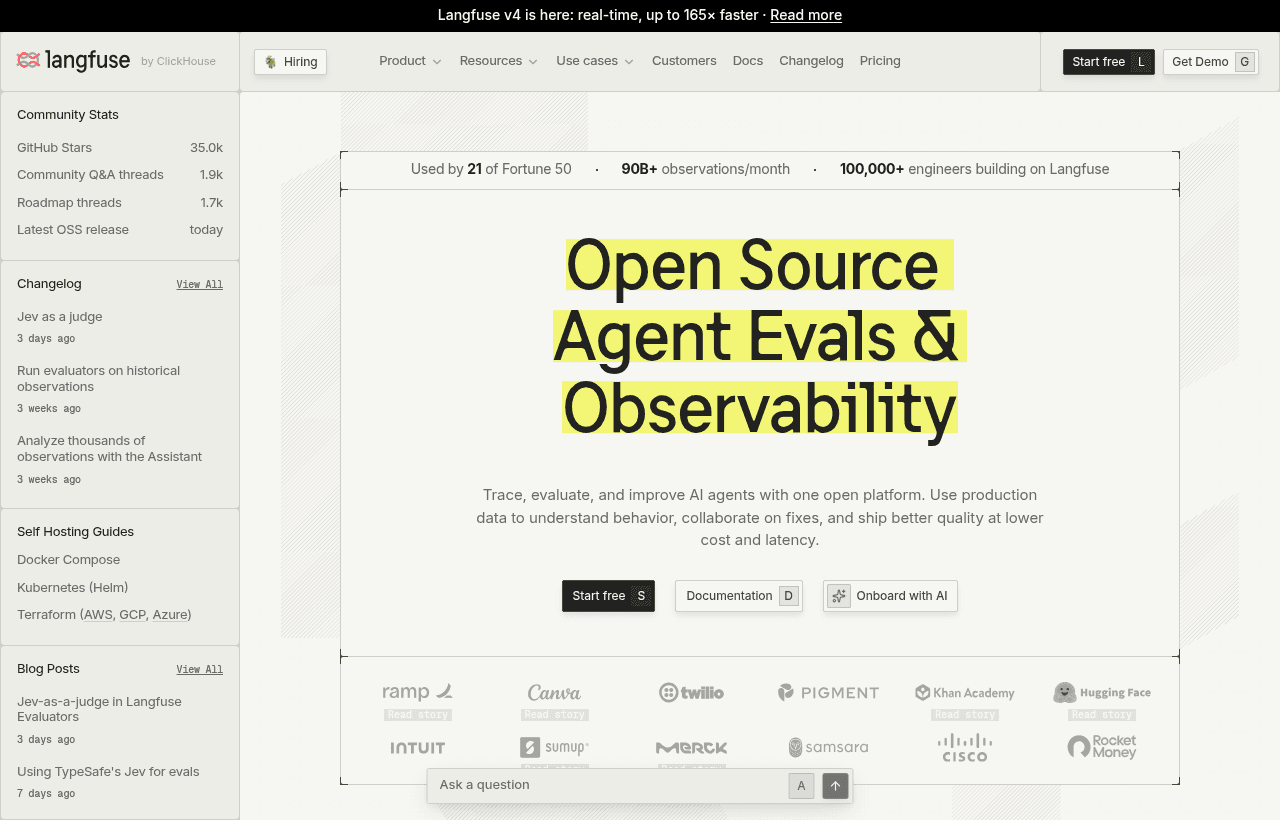
Langfuse, one of the tools included in this startup deal.
Observability That Makes LLM Features Understandable
The core of Langfuse is observability, and for LLM applications that word carries real weight. Unlike traditional software where a bug usually produces a clear error, LLM systems fail in soft, subtle ways. A model returns a plausible but wrong answer. A multi-step flow takes a strange path. A prompt that worked yesterday produces worse results today. None of these throw an obvious exception, which makes them maddening to debug without visibility into what actually happened.
Langfuse gives a startup that visibility. It traces the calls your application makes to the model, capturing the prompts, the responses, and the steps in between. When something goes wrong, the team can look at the actual trace rather than guessing. That single capability changes how a team debugs its AI product. Instead of trying to reproduce a mysterious failure by trial and error, the team inspects the real sequence of events and finds the problem directly.
For an early team without a lot of engineers to spend on investigation, this is a large time saver. Debugging LLM features by guesswork can consume days. Debugging them with traces in front of you takes a fraction of that. Langfuse turns the opaque behavior of an LLM application into something the team can actually see, which is the foundation for improving it.
Analytics That Show How the Product Really Performs
Beyond individual traces, Langfuse provides analytics across your LLM usage, and that broader view answers questions a single trace cannot. How often is the product being used, and for what? Where is the cost concentrated? Which features or flows produce the most problems? Without analytics, a startup is running its AI product blind to these patterns, reacting to individual complaints without seeing the shape of the whole.
Langfuse gives a startup that shape. The team can see how its LLM features are being used in aggregate, understand where costs come from, and spot patterns that point to opportunities or problems. This matters especially for cost, which is one of the easiest things to lose control of with LLM applications. Model usage can grow quietly until the bill becomes a real concern. Analytics let a startup see where the spend is going and make deliberate decisions about it rather than being surprised.
The analytics also inform product decisions. Seeing how users actually engage with the AI features, which ones get used, which ones fail, tells the team where to focus. For a small startup with limited time, knowing where the product's LLM features are working and where they are struggling is exactly the guidance needed to spend effort where it counts. Langfuse turns raw usage into that kind of insight.
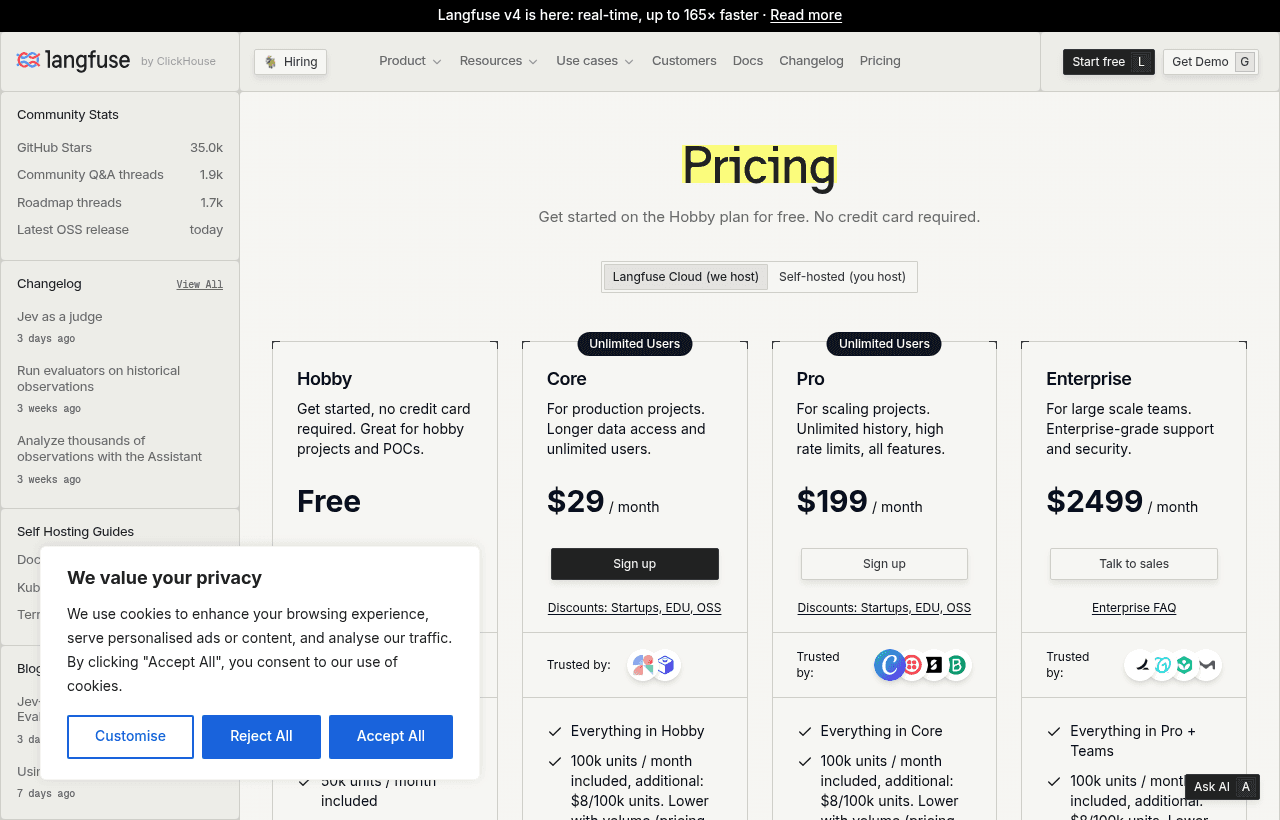
A look at Langfuse before the discount, so you can see what the deal saves you.
Evaluation That Replaces Guesswork With Evidence
The hardest question in building an LLM product is deceptively simple: did that change make the product better? Because model outputs are variable and quality is subjective, it is genuinely hard to know whether a new prompt, a different model, or a restructured flow improved things or quietly made them worse. Teams that cannot answer this question end up changing their AI features based on gut feeling and hoping for the best, which is a poor way to build a product people rely on.
Langfuse provides evaluation, which lets a startup answer that question with evidence. The team can set up ways to measure the quality of its LLM outputs and check, systematically, whether a change improved them. That discipline transforms development. Instead of shipping a prompt change and hoping, the team ships it and measures. Over time, this is what produces an LLM product that steadily improves, because every change is validated rather than assumed.
For an early team, building this habit early is especially valuable. Evaluation is easy to establish while the product is small and hard to retrofit once the product is large and its behavior is tangled. A startup that measures the quality of its AI features from the beginning develops a culture of evidence-driven improvement that pays off at every stage. Langfuse gives the team the tools to make that culture practical rather than aspirational.
Open Source and the Control It Gives
Langfuse being open source is a meaningful part of its value for a startup, not just a technical detail. Open source means the team can run the platform on its own terms, inspect how it works, and avoid being locked into a single vendor's roadmap or pricing. For infrastructure as central as observability into your core AI product, that control matters.
An LLM startup's traces and analytics contain sensitive information about how its product works and what its users do. Being able to run an open-source platform gives the team options about where that data lives and how it is handled, which is reassuring both for the team and, increasingly, for its customers. As a startup grows and starts selling to more careful buyers, being able to speak to how it handles its own data is an advantage. The open-source foundation gives the team that flexibility rather than forcing it into whatever a closed vendor decides.
Open source also means longevity and trust. The team can see exactly what it is running, is not at the mercy of a vendor's pricing changes for a critical piece of its stack, and can rely on the platform continuing to exist regardless of any single company's fortunes. For a startup making a foundational choice about how it will understand its AI product, that durability is worth choosing deliberately.
Langfuse Compared to Flying Blind
The realistic alternative to Langfuse is not a competing platform, it is running an LLM product without proper observability and hoping problems stay small. Plenty of teams start this way, shipping AI features with nothing more than basic logging and finding out about problems from users. That approach hides exactly the information a team needs. Quality problems go unnoticed until they cost users, costs creep up unseen, and every debugging session starts from scratch because there is no trace to look at.
Langfuse replaces that blindness with visibility. Instead of guessing why an LLM feature misbehaved, the team looks at the trace. Instead of being surprised by costs, the team sees them in the analytics. Instead of hoping a change helped, the team evaluates it. The comparison is between operating an AI product in the dark and operating it with the lights on, and for a product whose behavior is as subtle as an LLM application's, that difference is enormous.
The Free Plan and open-source nature make the choice easy. There is no cost barrier and no vendor lock-in standing between a startup and real LLM observability. A team can adopt Langfuse early, build good engineering habits around its AI product, and grow into more capacity as usage increases. Starting with visibility rather than adding it after problems appear is exactly the right order, and this deal makes that order affordable.
Making the Free Plan Count
A free plan only helps if the team builds observability into how it works, so the goal is to instrument your LLM features from the start rather than saving Langfuse for a crisis. The strongest move is to trace your AI features from day one. When every model call and multi-step flow is traced, the team always has a record to inspect when something goes wrong, which turns debugging from a guessing game into a lookup.
Use the platform's analytics and evaluation together to drive improvement. Watch the analytics to understand how your features are used and where costs concentrate, and set up evaluation for the parts of the product that matter most so you can measure the effect of every change. This combination, seeing what happens and measuring whether changes help, is what makes an LLM product improve steadily rather than drift. Establishing it while the product is small is far easier than adding it after the product is complex.
Treat the Free Plan as the foundation of a lasting engineering practice, not a trial to sample. A startup that builds tracing, analytics, and evaluation into how it develops its AI product now will carry that discipline forward as it grows. If usage eventually justifies more capacity, that is a natural step rather than a change in how the team works, because the habits and the instrumentation are already in place.
Getting Started the Right Way
The path into Langfuse is to instrument one real LLM feature end to end before expanding. Pick the AI feature at the center of your product and wire Langfuse in so that every call it makes is traced. Run some real usage through it and look at the traces. Seeing the actual prompts, responses, and steps of your own feature, and spotting something you did not expect, is usually all it takes for the team to understand why this visibility matters.
From there, extend the instrumentation to your other LLM features and start using the analytics and evaluation in earnest. Because Langfuse gives a consistent way to observe and measure, growing the coverage builds on the same foundation rather than requiring a new approach each time. Set up evaluation for the outputs that matter most so that improving the product becomes an evidence-driven loop rather than a series of hopeful guesses.
Keep the practice sustainable by focusing on what matters. You do not need to evaluate everything or scrutinize every trace. Concentrate observability on the features that are most important to the product and most prone to failing quietly. That focus keeps the effort manageable for a small team while still catching the problems that count, which is what makes the habit stick as the team stays busy building.
Who Should Claim This Deal
This deal fits any startup building features on top of large language models, which is a fast-growing share of software startups. If the team ships anything that calls an LLM and cares whether it works well, Langfuse gives it the observability, analytics, and evaluation to understand and improve those features. The Free Plan and open-source foundation mean there is no cost barrier and no lock-in standing between the team and real visibility into its AI product.
It is an especially strong fit for a startup whose product depends on LLM features being reliable and improving over time, which describes most serious AI products. Teams building anything with real complexity, multi-step flows, retrieval, agents, get the most from the tracing because those systems fail in the subtle ways that are impossible to debug blind. Teams watching their model costs carefully will value the analytics, and any team that wants to improve its AI product with evidence rather than guesswork will value the evaluation. The open-source nature is a further draw for teams that care about controlling their own data and stack.
The startups that will get less from this are those doing something trivial with a model, or not building on LLMs at all. For everyone else building real LLM features, Langfuse on the Free Plan is a strong foundation: see what your AI features do, measure how well they work, and improve them deliberately. Claim it, instrument your core feature from the start, and give the team the visibility that turns an opaque AI product into one it can actually engineer.
Who Is This Deal For?
Early-Stage Startups
Seed and pre-seed companies looking to move fast without overspending on tools.
Growing SaaS Teams
Series A+ companies scaling their stack and optimizing software costs.
Solo Founders
Indie hackers and bootstrapped founders who need enterprise tools at startup prices.
Get Free Plan off Langfuse
Premium deal. Upgrade once, unlock everything.
Frequently Asked Questions
Everything you need to know about this startup deal.
Yes. Self-hosted is free. Cloud free tier includes 50K observations per month.
Get the weekly deals digest
New verified startup deals every week. No spam, ever. Unsubscribe anytime.
Related Offers

Higgsfield
55% off annual Business plan
55% off an annual Higgsfield Business plan. Higgsfield is an AI video and image studio with Seedance, Kling, Veo and more in one account.
View offer
Seedance
55% off annual Business plan
55% off an annual Higgsfield Business plan with Seedance included. Seedance is ByteDance's AI video model for text, image and reference-driven clips.
View offerChromaDB
Used by 306 members
Free & Open Source
Open-source embedding database for building AI applications with semantic search.
View offer
Laxis
Used by 2,176 members
Free Plan
AI meeting assistant that records, transcribes, and generates actionable meeting notes.
View offer
Pictory
Used by 659 members
Free Trial
AI-powered video creation tool, turn text, scripts, and blogs into videos.
View offer
Segment
Used by 2,293 members
$25,000 in credits
Collect, clean, and route customer data to every tool in your stack with the leading customer data platform.
View offerDeal Summary
Looking for more startup deals?
Browse all offers