
LogRocket Startup Credits: $500 in credits
Session replay and error tracking, see exactly what users experience and debug issues with full context.
Premium: $79/year for unlimited deals
Already have an account? Log in
Deal Highlights
What LogRocket Gives a Startup
LogRocket is session replay and error tracking that lets a team see exactly what users experience and debug issues with full context, and this deal puts $500 in credits toward it. The credits matter because they let a startup adopt a serious debugging tool during the exact period when the product is changing fastest and breaking most often. You get to see your real users' sessions and your real errors without a bill hanging over every investigation.
The core idea is simple and powerful. Instead of guessing what happened when something went wrong, you watch it. LogRocket records what users actually did, captures the errors they hit, and ties the two together so you can reconstruct any problem from the inside. For a startup whose product is young and whose users are patient only up to a point, that ability to see and fix problems quickly is a direct advantage.
This deal is aimed squarely at a startup debugging user experience, which is the stated requirement. That is not a niche use case. It is the daily reality of every early product team. Users hit bugs, get confused, and drop off, and the team's job is to figure out why and fix it before those users leave for good. LogRocket is built to make that job faster, and the credits let you prove it on your own product.
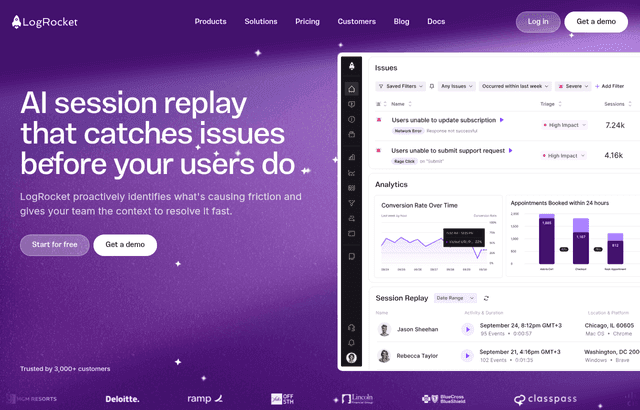
LogRocket, one of the tools included in this startup deal.
Seeing Exactly What Users Experience
The hardest part of fixing a bug is often just understanding it. A user reports that something did not work, but their description is vague, incomplete, or plain wrong about what actually happened. Engineers then spend hours trying to reproduce a problem they cannot see, working from secondhand accounts. That gap between what a user reports and what actually occurred is where enormous amounts of engineering time disappear.
LogRocket closes that gap by showing you the real session. You watch what the user saw, what they clicked, where they hesitated, and where things broke. There is no guessing and no lengthy back-and-forth asking the user to remember details they never noticed. The evidence is right there in the replay. For a small team that cannot afford to burn days on every bug, this is a transformative shift in how debugging works.
Seeing the real experience also catches problems users never report. Most people who hit a bug do not file a ticket. They just leave. LogRocket lets you find those silent failures by watching sessions where users struggled or dropped off, revealing issues you would otherwise never learn about. For a startup, every one of those silent failures is a lost customer, so surfacing them is worth real money.
The $500 in credits lets you build this visibility into your product from an early stage. Rather than flying blind and reacting to whatever complaints happen to reach you, you get a clear window into how people actually use what you built.
Debugging With Full Context
Error tracking on its own tells you that something broke. LogRocket tells you the whole story around the break. When an error fires, you can see the session that led to it: what the user did in the minutes before, what state the application was in, and what exactly happened at the moment of failure. That context is the difference between a fix that takes ten minutes and one that takes ten hours.
Context matters because most bugs are not simple. They depend on a specific sequence of actions, a particular piece of data, or an unusual path through the product that nobody anticipated. Without context, you see only the crash and have to reverse-engineer everything that led to it. With full context, the cause is often obvious the moment you watch the replay. You see the exact step that triggered the problem, and the fix follows naturally.
For a startup shipping fast, this speed compounds. When your team can resolve issues quickly, you spend less time firefighting and more time building. You also ship with more confidence, because when something does break in production, you know you can diagnose it fast rather than dreading a long, painful investigation. That confidence lets a small team move at a pace that would otherwise be reckless.
The credits let you establish this way of working before your user base grows large. Debugging habits set early tend to stick, and starting with full-context debugging means your team never learns the slow, guess-and-check habits that plague teams working without visibility.
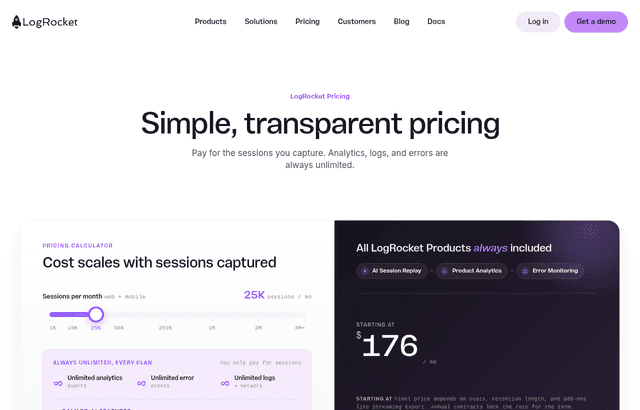
A look at LogRocket before the discount, so you can see what the deal saves you.
Catching Problems Before Users Complain
The most dangerous bugs are the ones you do not know about. A user hits a broken checkout, gets frustrated, and leaves without saying a word. Multiply that by every silent failure across your product, and you have a steady, invisible leak of customers that no support ticket will ever reveal. LogRocket helps you find and plug those leaks.
Because it tracks errors across all sessions, LogRocket surfaces problems whether or not anyone reports them. You can see which errors happen most often, which affect the most users, and which are quietly costing you conversions. That lets your team prioritize by real impact rather than by which user complained loudest. For a startup with limited engineering time, fixing the bugs that hurt the most users first is exactly the right way to spend that time.
This proactive stance changes the relationship between your product and your users. Instead of waiting for complaints and reacting, you find and fix problems before most users even notice. The result is a product that feels more polished and reliable than its age would suggest, which is a powerful impression for an early company to make. The $500 in credits funds this proactive monitoring during the stage when your product is least stable and most in need of it.
Turning Support Into Fast Resolution
When a user does report a problem, LogRocket transforms how your team handles it. Instead of a frustrating exchange where support asks the user to explain what happened and the user cannot quite remember, the team pulls up the actual session. The problem becomes visible immediately, and the path to a fix is clear.
This speeds up support and makes it far more accurate. Support and engineering stop talking past each other, because everyone is looking at the same recorded reality. A support person can hand engineering a session that shows exactly what went wrong, and engineering can fix it without a lengthy investigation. For a small team where the same people often do both support and engineering, this efficiency is especially valuable.
Fast, accurate resolution also improves the customer experience directly. A user who reports a bug and sees it fixed quickly walks away impressed rather than annoyed. That kind of responsiveness builds loyalty, and loyalty is what keeps early customers around long enough to become the foundation of a real business. The credits let you deliver this experience from the start.
LogRocket Compared to Logs and Guesswork
The traditional way to debug production issues is to read logs and try to reproduce the problem. Logs are useful, but they are a thin, abstract record of what happened. They tell you that certain events occurred in a certain order, but they do not show you the user's actual experience, and they rarely capture the full context around a failure. Reproducing a bug from logs alone is often slow and sometimes impossible.
LogRocket sits above that approach by giving you the visual, contextual record that logs lack. Where logs give you fragments, session replay gives you the whole picture. You do not have to imagine what the user did; you watch it. For the class of bugs that depend on specific user behavior, which is a large share of them, this is dramatically faster than piecing together the story from log lines.
The comparison to pure guesswork is even starker. Many small teams debug by hypothesizing what might have gone wrong and testing each guess. That works eventually, but it is slow and demoralizing. LogRocket replaces guessing with seeing. The cause is in the replay, so you spend your time fixing rather than hunting. The $500 in credits lets you make that shift without a budget conversation, which for an early team removes the main barrier to adopting a better way of working.
None of this means you throw away your logs. LogRocket complements them, adding the user-experience layer that logs cannot provide. Together they give a startup both the technical detail and the human context needed to understand any problem fully.
Making the $500 in Credits Count
Credits are most valuable when they buy you lasting habits rather than a brief experiment. The goal is to leave the credit period with LogRocket woven into how your team ships and debugs, so the benefit continues long after the credits are spent.
Start by instrumenting the parts of your product where problems hurt most: signup, checkout, onboarding, and any core workflow where a bug means a lost customer. Watch real sessions through these flows and you will almost certainly find friction and failures you did not know about. Fixing those early is where the credits pay for themselves many times over, because each fix protects revenue and retention.
Build the habit of watching sessions when something goes wrong instead of guessing. Every time an error fires or a user reports an issue, pull up the replay first. This trains your team to work from evidence, which makes every investigation faster and every fix more accurate. By the time the credits run out, this habit should feel automatic.
Use the error tracking to build a prioritized list of what to fix. Let the data on which errors affect the most users guide where your limited engineering time goes. This turns LogRocket from a debugging tool into a decision-making tool, helping you spend effort where it matters most.
Finally, connect the insights to your broader product decisions. The patterns you see in real sessions, where users get confused or drop off, are guidance for improving the product itself, not just fixing bugs. Treat the credit period as a chance to learn how your users actually behave, and let that learning shape what you build next.
Getting Started Without Slowing Down
Adding LogRocket to a product is designed to be quick, which suits a startup that wants value fast. You install it, and it begins recording sessions and capturing errors without a long setup project. From there, the value is immediate: the next time something breaks, you have the replay to explain it.
Because the tool works quietly in the background, it does not slow down your shipping. Your team keeps building and releasing, and LogRocket keeps watching, ready whenever you need to understand a problem. That low overhead is exactly what an early team needs, since anything that adds friction to shipping tends to get abandoned. The credits let you keep this running through your most active development period.
Who Should Claim This Deal
This deal fits a startup that is actively debugging user experience, which is precisely the stated requirement and precisely the situation most early product teams are in. If your product is young, changing fast, and occasionally breaking in ways you struggle to reproduce, LogRocket gives you the visibility to fix problems quickly, and the $500 in credits removes the cost barrier during your most fragile stage.
It suits teams that are tired of guessing what went wrong and want to see it instead. If your engineers are burning hours trying to reproduce bugs from vague reports, session replay will give them that time back. It suits products where user experience directly drives revenue, where a broken flow means a lost sale, because catching those silent failures protects the money coming in.
It is a weaker fit for products with almost no user-facing interface or for teams that already have deep, mature observability they are happy with. But for the large majority of early startups still learning how their users behave and still fighting to make the product reliable, this deal is a strong match. Claim it, instrument your critical flows, and use the credits to build the habit of debugging from evidence rather than guesswork.
Who Is This Deal For?
Early-Stage Startups
Seed and pre-seed companies looking to move fast without overspending on tools.
Growing SaaS Teams
Series A+ companies scaling their stack and optimizing software costs.
Solo Founders
Indie hackers and bootstrapped founders who need enterprise tools at startup prices.
Get $500 in credits off LogRocket
Premium deal. Upgrade once, unlock everything.
!Eligibility Requirements
Startup debugging user experience
Frequently Asked Questions
Everything you need to know about this startup deal.
LogRocket records sessions with full technical context — console logs, network requests, Redux state, and error stack traces alongside the visual replay. Hotjar records visual-only sessions with click/scroll heatmaps and feedback surveys. LogRocket is for debugging. Hotjar is for UX optimization.
Get the weekly deals digest
New verified startup deals every week. No spam, ever. Unsubscribe anytime.
Related Offers

Higgsfield
55% off annual Business plan
55% off an annual Higgsfield Business plan. Higgsfield is an AI video and image studio with Seedance, Kling, Veo and more in one account.
View offer
Seedance
55% off annual Business plan
55% off an annual Higgsfield Business plan with Seedance included. Seedance is ByteDance's AI video model for text, image and reference-driven clips.
View offerChromaDB
Used by 306 members
Free & Open Source
Open-source embedding database for building AI applications with semantic search.
View offer
Laxis
Used by 2,176 members
Free Plan
AI meeting assistant that records, transcribes, and generates actionable meeting notes.
View offer
Pictory
Used by 659 members
Free Trial
AI-powered video creation tool, turn text, scripts, and blogs into videos.
View offer
Segment
Used by 2,293 members
$25,000 in credits
Collect, clean, and route customer data to every tool in your stack with the leading customer data platform.
View offerDeal Summary
Looking for more startup deals?
Browse all offers