
Paddle Startup Credits: $500 processing credit
Merchant of record for SaaS. Paddle handles payments, tax, compliance, and billing so you don't have to.
Free · Opens in new tab
Already have an account? Log in
Deal Highlights
What Merchant of Record Actually Means
Paddle is a merchant of record for software companies, and understanding that phrase is the key to understanding why it matters. Most payment processors just move money: they charge the customer's card and deposit the funds, and everything else, sales tax, VAT, compliance, fraud, billing disputes, is the software company's problem. A merchant of record is different. Paddle becomes the seller of record for the transaction, which means it takes on the tax calculation and remittance, the compliance, the fraud handling, and the billing infrastructure, and the software company simply receives its revenue. The startup deal includes a $500 processing credit for SaaS startups with global customers, lowering the cost of getting onto this model.
For a SaaS startup selling internationally, this distinction is enormous. The moment a software company sells to customers in multiple countries, it walks into a thicket of sales tax and VAT obligations that differ by jurisdiction, change over time, and carry real penalties for getting wrong. Paddle taking on the merchant-of-record role means the startup does not have to become a global tax compliance operation to sell software abroad, which is exactly the kind of complexity that can otherwise swallow a small team.
Paddle, one of the tools included in this startup deal.
The Global Tax Problem Paddle Solves
Selling software across borders means dealing with sales tax in the US, VAT in Europe, GST in other regions, and a growing list of jurisdictions that expect a software seller to register, collect the right amount, and remit it correctly. Each of these has its own rules about what is taxable, at what rate, with what thresholds, and the rules shift as governments update their treatment of digital goods. For a small startup, keeping up with this across every country its customers live in is not just hard but genuinely a full function that would consume people and attention the company does not have.
Paddle absorbs this entirely. Because it is the merchant of record, Paddle is the party responsible for calculating the correct tax on each sale, collecting it, and remitting it to the right authority, across all the jurisdictions where the startup's customers are. The startup sees its revenue net of that handled complexity rather than facing a wall of registrations and filings. This is the single biggest reason a global SaaS startup reaches for Paddle: it converts an open-ended compliance liability into something someone else owns, so the team can sell worldwide without building a tax operation to support it.
Billing and Subscription Management
Beyond tax, Paddle provides the billing infrastructure that a SaaS business runs on. Subscriptions, upgrades and downgrades, proration, failed-payment recovery, invoicing, and the whole machinery of recurring revenue are things every SaaS company needs and that are surprisingly involved to build and maintain well. Paddle provides this as part of the platform, so a startup gets robust subscription billing without dedicating engineering effort to building and maintaining a billing system that is not itself the product.
The failed-payment handling deserves particular attention because it directly affects revenue. A meaningful share of subscription churn is involuntary, cards expire, payments fail, and without good recovery those customers silently drop off even though they never chose to leave. Paddle's billing includes the retry and recovery logic that reclaims a lot of that revenue automatically, which for a subscription business is money that would otherwise leak away unnoticed. Getting this handled by the platform means a startup captures revenue it would likely lose if it built the minimum viable billing itself.
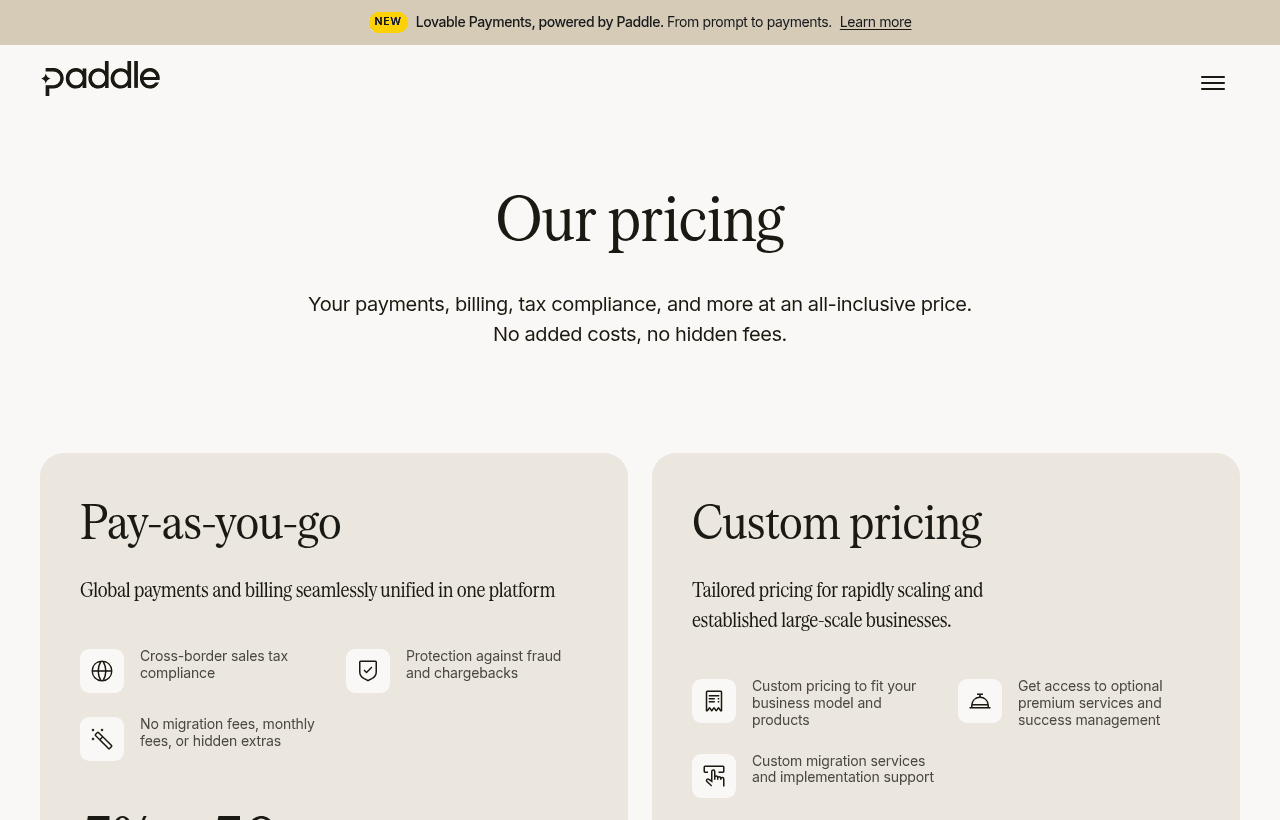
A look at Paddle before the discount, so you can see what the deal saves you.
Compliance, Fraud, and Chargebacks
Because Paddle is the merchant of record, it also takes on the parts of selling that startups least want to deal with: payment compliance, fraud screening, and chargeback handling. Card network rules, PCI compliance, fraud detection, and the dispute process are all areas where mistakes are costly and expertise is required, and Paddle handling them means the startup is not exposed to the full weight of that responsibility. Fraud and chargebacks in particular are draining to manage, and having the platform absorb the bulk of that burden frees the team from work that produces no product value.
This shifts the risk profile of selling software in a way that matters for a small company. A startup handling its own payments carries the compliance obligations and the fraud and chargeback exposure directly, and a bad run of either can be genuinely damaging to a company without the resources to absorb it. With Paddle as merchant of record, much of that exposure sits with Paddle rather than the startup, which lets a small team sell globally without taking on risk it is poorly positioned to manage. For a founder, that transfer of risk and operational burden is a large part of the value, even though it is less visible than the tax handling.
Paddle Compared to Stripe
The natural comparison is Stripe, which is an excellent payment processor but not a merchant of record. With Stripe, the startup remains the seller, which means the startup is responsible for its own sales tax and VAT registration and remittance across jurisdictions, its own billing logic, and its own compliance. Stripe offers tools that help with tax and billing, but the responsibility and the liability stay with the company. This gives more control and often lower headline fees, and it suits companies that want to own the full stack or have the resources to manage the compliance themselves.
Paddle's trade-off is the opposite: it takes a larger cut but removes the tax, compliance, and billing burden entirely by taking on the merchant-of-record role. For a small SaaS startup selling globally without a finance and compliance team, that trade is often clearly worth it, because the alternative is either building that function or risking getting global tax compliance wrong. The decision comes down to whether the startup would rather pay more to have the complexity owned by someone else, or pay less and own the complexity itself. For an early global SaaS company short on people, having Paddle own it is frequently the right call, and the $500 credit lowers the cost of trying that model.
Making the Processing Credit Count
The way to get value from the credit is to use it while validating that the merchant-of-record model fits the business, by actually running real transactions through Paddle and seeing how the tax handling, billing, and payouts work for the startup's specific situation. Set up the subscription plans, run global sales through the platform, and watch how Paddle handles the tax across the countries the customers are in, so the team understands exactly what the model gives them before the processing cost scales up. The credit covers that early real-world testing.
For a global SaaS startup, the strategic value is deciding early how it wants to handle the compliance burden of selling internationally, because that decision shapes how much of the team's attention gets consumed by tax and billing as the company grows. A startup that offloads that burden to Paddle from the start can focus its limited people on the product and on customers, rather than on building a global tax and billing operation. The processing credit lowers the cost of committing to that path during the stage when the team is smallest and the pull of compliance work is most damaging to focus.
Who Should Claim This Deal
The Paddle deal fits any SaaS startup selling to customers in multiple countries that does not want to build a global tax and compliance operation to do it. If a founder is looking at the tangle of VAT, sales tax, and billing that comes with selling software internationally, the merchant-of-record model hands that entire burden to Paddle, and the $500 processing credit lowers the cost of getting onto it. For a small team selling globally without a finance function, that trade, paying a larger cut in exchange for never having to own international tax compliance, is often exactly the right one, and the credit makes it cheaper to prove that out.
What Merchant of Record Means for Cash Flow and Payouts
An underappreciated part of the merchant-of-record model is how it changes the money flow. Because Paddle is the seller of record, it collects the full payment from the customer, handles the tax portion by remitting it to the authorities itself, and then pays the startup its share on a regular payout schedule. The startup receives revenue that already has the tax handled, rather than collecting gross amounts and then having to set aside and remit the tax portion later. That difference removes a common cash-flow trap where a company spends money it was actually holding on behalf of a tax authority and comes up short when the remittance is due.
For a small startup without a finance team watching this carefully, that protection matters. Tax that gets collected but not properly set aside is money that feels like revenue until the bill arrives, and companies that manage their own global tax sometimes discover the hard way that a chunk of what they spent was never really theirs. With Paddle handling the collection and remittance as merchant of record, the startup sees cleaner numbers, what lands in the account is closer to what the company actually keeps, which makes planning and budgeting more honest at a stage when a founder is often tracking cash closely and cannot afford a nasty surprise from an overlooked tax liability.
Localizing Pricing for Global Customers
Selling globally is not only a tax question but also a pricing and payment-method question, and this is another area where Paddle helps a startup reach international customers more effectively. Customers in different countries expect to see prices in their own currency and to pay with the methods common in their region, and a checkout that only offers one currency and one payment type quietly loses sales in markets where it feels foreign. Paddle supports presenting prices in local currencies and accepting a range of payment methods, which lifts conversion among international customers compared to a checkout built only for one home market.
For a SaaS startup whose growth depends on selling beyond its own country, this localized checkout is part of what makes global sales actually convert rather than just being technically possible. A prospect who sees a price in a currency they understand and can pay the way they normally pay is more likely to complete the purchase than one confronted with an unfamiliar currency and payment flow. Combined with the tax handling, this makes Paddle not just a compliance solution but a way to sell more effectively into markets a small startup could not easily serve on its own, which is where the merchant-of-record model turns from a defensive necessity into an offensive advantage for growth.
Fitting Paddle Into an Early SaaS Business
The practical way to think about adopting Paddle is to decide early whether the business wants to own its payment and compliance stack or offload it, because that choice shapes how the company spends its scarce attention as it grows. A startup that plans to sell globally from early on, and does not want to build a finance and compliance function to support it, is well suited to starting on Paddle from the beginning, so the tax, billing, and compliance are handled from the first international sale rather than retrofitted after the obligations have already piled up. Getting onto the model early is easier than migrating onto it later once billing and customer relationships are entrenched elsewhere.
The $500 processing credit exists to lower the cost of making that decision and proving it out on real transactions. A team should use it to run its actual sales through Paddle, confirm the tax handling covers the countries its customers are in, and see how the billing, payouts, and localized checkout perform for its specific business, so the choice to commit to the merchant-of-record model is grounded in real experience rather than a guess. For a global SaaS startup weighing whether to own or offload the complexity of selling internationally, that credit-funded trial is the cheapest way to find out whether handing the burden to Paddle is the right long-term call.
Who Is This Deal For?
Early-Stage Startups
Seed and pre-seed companies looking to move fast without overspending on tools.
Growing SaaS Teams
Series A+ companies scaling their stack and optimizing software costs.
Solo Founders
Indie hackers and bootstrapped founders who need enterprise tools at startup prices.
Get $500 processing credit off Paddle
Premium deal. Upgrade once, unlock everything.
!Eligibility Requirements
SaaS startup with global customers
Frequently Asked Questions
Everything you need to know about this startup deal.
Paddle is the legal seller of your product. When a customer pays, they pay Paddle (not you directly). Paddle handles tax compliance in every jurisdiction and pays you net of taxes and fees. You never file VAT returns or register for tax in foreign countries.
Get the weekly deals digest
New verified startup deals every week. No spam, ever. Unsubscribe anytime.
Related Offers

Stripe Atlas
Used by 6,540 members
$500 off incorporation
Get $500 off Stripe Atlas and incorporate your startup as a US Delaware C-Corp in minutes. The legal foundation every investor expects.
View offer
TinCheck
Used by 75 members
First real-time check free
Real-time IRS TIN and name verification from Sovos. Catch a wrong contractor or vendor TIN before it becomes a stacked IRS penalty and a backup-withholding headache.
View offer
Navan
Used by 1,799 members
3 months free
Get 3 months of Navan free. The all-in-one travel and expense management platform that replaces your corporate card, expense reports, and travel booking.
View offer
Ramp
Used by 877 members
$500 cashback bonus
Corporate card and spend management for startups, 1.5% cashback, real-time expense tracking, and automated accounting.
View offer
doola
Used by 480 members
30% off first purchase
Get 30% off your first purchase, the all-in-one platform to form a US LLC or C-Corp, get an EIN, open a US bank account, and stay tax-compliant from anywhere in the world.
View offer
Expensify
Used by 2,178 members
3 months free Collect
Expense management and corporate cards, receipt scanning, approval workflows, and reimbursement automation.
View offerDeal Summary
Looking for more startup deals?
Browse all offers