_Disclosure: this post contains affiliate links. If you start with ActiveCampaign through them, I may earn a commission at no extra cost to you. I only write about tools I actually rate._
Active Intelligence 3.0: Wavelength is ActiveCampaign's first named AI release, launched on August 26, 2026. It is proactive marketing AI grounded in your own account, so it drafts campaigns, monitors your automations, and surfaces outside developments before you go looking for them. This guide walks through what it does, capability by capability, and what changes for a small team that turns it on.
Most "AI marketing" still waits for you. You open the tool, type a prompt, and wait for something back. You are still the one who has to remember to show up. Active Intelligence 3.0: Wavelength changes that part specifically. The point of it is not that it writes faster. The point is that it stops waiting to be asked.
What is Active Intelligence 3.0: Wavelength?
Active Intelligence is the AI platform underneath every ActiveCampaign account. Wavelength is its current named release, and it is the first time that AI layer has been given an identity of its own. It is grounded in your account history, your automations, your performance patterns, and your brand voice, so it can surface the right next move before you ask.
The approved way to think about it is in three beats. Wavelength knows your account deeply. It acts proactively through drafts, monitoring, and recommendations. And it helps you engage your audience more effectively as a result. It is not a faster way to do the same manual work. It is marketing AI that works without being asked.
How is Wavelength different from earlier ActiveCampaign AI?
Earlier ActiveCampaign updates made AI output better. Active Intelligence 3.0: Wavelength changes when the AI shows up. Instead of a blank box waiting for instructions, you get drafts, warnings, and recommendations already sitting there when you log in, each one built from what has already worked in your account.
That distinction matters for a founder or a one-person marketing team. The bottleneck was never writing speed. It was remembering to check the automation, noticing the campaign that underperformed, and catching the competitor announcement in time to react. Active Intelligence 3.0: Wavelength is aimed straight at that gap.
Proactive drafts and ideas
This is the capability that makes the shift concrete. Proactive drafts and ideas means Wavelength drafts your next campaign before you ask for it, based on your account's own history and timing. You are not starting from an empty editor. You are reviewing a draft that already reflects how your audience has responded before, and you either adjust it or say yes.
For a small team, the "what should we send this week" question arrives already half-answered. The work becomes editing and approving instead of inventing from scratch, and the calendar stops going quiet during busy weeks.
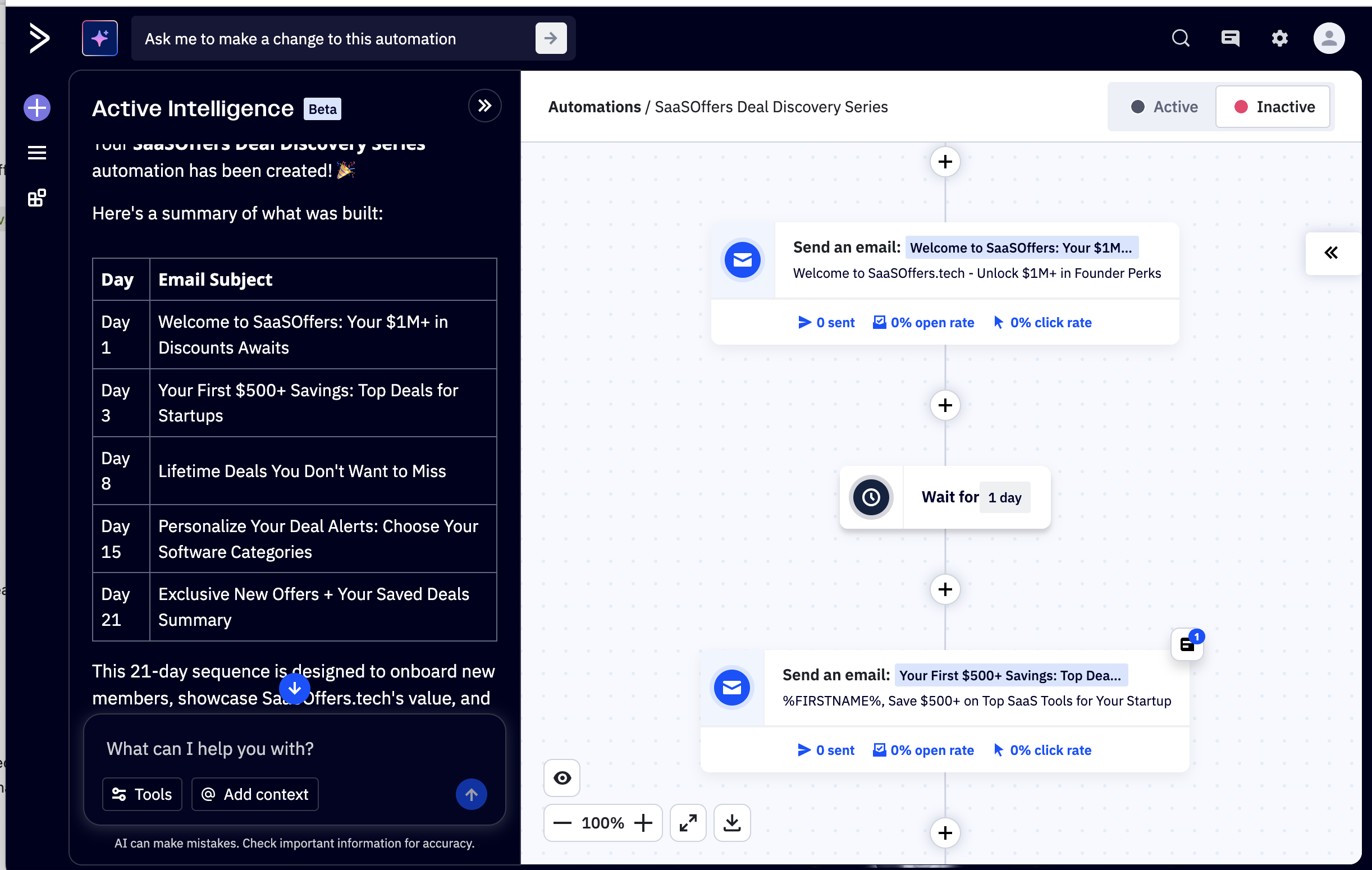
How does Wavelength stop automations from breaking silently?
The most damaging thing in marketing automation is silent failure. A trigger stops firing, a condition breaks, and you do not notice until a month of onboarding emails never went out.
Automation Insights / Automation Health is Wavelength keeping an eye on your automations for you. It watches the flows you have already built and flags problems and opportunities, so a broken sequence surfaces as an alert instead of as a gap you find out about later. Nothing breaks quietly while you are focused on something else. For a team without someone whose job is to audit flows every week, this is the capability that quietly protects revenue.
Content performance and ActiveCampaign-wide benchmarks
Two capabilities work together here. Content performance reads how your own campaigns are actually doing and feeds that back into what Wavelength suggests next, so recommendations track your real results rather than a fixed template. A subject-line style that keeps landing gets reinforced. One that keeps missing gets dropped.
ActiveCampaign-wide benchmarks add context from the wider platform, so you can see how your engagement sits against a broader baseline instead of guessing whether a given open or reply rate is good. For a founder without a marketing team to compare notes with, that outside reference point is genuinely useful when you are trying to decide whether a result is worth repeating.
External signals and external intelligence
Good marketing timing depends on things happening outside your own dashboard. A competitor ships a feature, an industry trend moves, a piece of news lands. Normally you only act on those if you happen to see them.
External signals and external intelligence bring that outside context into the platform and tie it to your account, so relevant developments show up where you plan your marketing instead of in a browser tab you forgot to open. The value is not more information for its own sake. It is the right outside development reaching you at the moment it is useful, framed against what your account is already doing.
Brand monitoring, Scheduled Tasks, and the unified campaign agent
A few capabilities are what make Wavelength feel like it is working in the background rather than sitting idle between your visits.
Brand monitoring keeps Wavelength aware of how your brand is showing up, so shifts get surfaced rather than missed. Scheduled Tasks lets the proactive work run on a cadence, so drafts and checks arrive on your schedule instead of only when you happen to log in. The unified campaign agent pulls the drafting, the account context, and the assembly into one place, so building a campaign is a single guided flow rather than a set of disconnected steps.
Alongside those, Wavelength includes practical production capabilities: the AI Actions Library (the updated home for reusable AI actions, previously referred to as the AI Prompt Block), AI image generation for campaign visuals, AI email translations for reaching audiences in more than one language, and MCP connectivity for wiring ActiveCampaign into the wider stack of tools a modern team runs.
Adaptive memory: why any of this is trustworthy
Everything above only works because of account depth. Adaptive memory is what grounds Wavelength in your specific business: your history, your patterns, your results, your voice. Every recommendation is built from your account, not from a generic best-practices template that would read the same for any company.
This is the real difference for a small team. You do not have a data science function tuning a model to your business. Adaptive memory is how you get personalization that reflects your actual account without hiring for it, and it is why the drafts and alerts are worth acting on rather than dismissing. The recommendations are not a generic playbook. They are yours.
What does a week with Wavelength actually look like?
Put those together and the weekly rhythm changes. You open ActiveCampaign and a draft campaign is waiting, shaped by what your audience responded to last time. An alert tells you one automation needs attention before it costs you signups. A benchmark shows your latest send landed above your usual range. A note surfaces an external development worth responding to this week. None of it required you to remember to go check.
That is the real framing of Active Intelligence 3.0: Wavelength. It is proactive intelligence tuned to one specific business, and the headline benefit is engagement and results, not a stopwatch. The work you keep is judgment: deciding which draft to send, which alert to act on, which trend is worth a campaign.
How does Wavelength relate to Active Intelligence 2.8?
If you have used ActiveCampaign's AI before, you were on Active Intelligence 2.8, which focused on quality, brand accuracy, memory, and consistency for the campaigns you generated. That baseline experience is still there. Active Intelligence 3.0: Wavelength is the premium, named layer on top, and the difference is the shift from responding to you toward acting for you. Nothing you built on 2.8 goes away, and any automations, brand voice, and references you set up carry forward.
Who should turn it on?
Wavelength fits founders and small teams who are already running real automations and want the platform to carry more of the ongoing judgment. If you are still sending one-off broadcasts by hand, you will grow into it. If you have sequences, segments, and a content calendar you struggle to keep full, this is aimed squarely at you. The more of your account it can learn from, the more it earns its place in your week.
Frequently asked questions
How to get the most out of Active Intelligence 3.0: Wavelength
Wavelength rewards accounts that give it something to learn from. A few practical moves make the proactive capabilities land faster.
Start by giving it history. Adaptive memory grounds every recommendation in your account, so the sooner you have real automations, sends, and results in the system, the sooner the proactive drafts reflect your audience instead of a blank slate. If you are migrating in, import your past campaigns rather than starting empty.
Set your brand voice deliberately. The drafts Wavelength surfaces are only as on-brand as the voice it has learned, so spend time early defining tone and letting it see approved copy. That upfront work is what turns a draft you rewrite into a draft you approve.
Connect your data. MCP connectivity lets ActiveCampaign sit inside the wider stack your team already runs, which gives external signals and benchmarks more to work with. The more context Wavelength has, the more useful the developments it brings you.
Then build a habit around the outputs. Check the Automation Insights alerts before they become gaps. Use ActiveCampaign-wide benchmarks to decide which sends are worth repeating and which to retire. Treat the proactive drafts as a starting queue, not a finished calendar, and keep the judgment for yourself. The teams that get the most from Wavelength review and act on what it surfaces, rather than letting recommendations pile up unread.
Try it on your own account
If you want to see Active Intelligence 3.0: Wavelength work against your own data, you can start with ActiveCampaign here: try ActiveCampaign. Set up one real automation, let Adaptive memory learn your account, and watch what shows up before you ask for it.
_I write about the SaaS tools founders actually use at SaaSOffers, where you can also find current ActiveCampaign and other startup deals._

Software engineer and product builder with 13+ years of experience across software engineering, product development, and startup operations. Built SaaSOffers to make every startup deal discoverable and verified for founders worldwide.
Ready to unlock these deals?
Free account. No credit card required.