Some links on this page are affiliate links: we may earn a commission if you sign up, at no extra cost to you. It never changes the deal you get. Learn more
Deel vs Papaya Global (2026): EOR, Global Payroll and Contractors Compared
Deel and Papaya Global both help you hire and pay people in other countries, and both publish starting prices. The difference is how you buy and who they are built for. Deel is self-serve: a five-person startup can sign up, send a contractor agreement and pay someone this afternoon, on month-to-month terms. Papaya Global sells through a quote for every product and is built around payroll and payments for finance teams.
Short verdict: if you are a startup that wants to start hiring today, run everything in one tool and avoid long contracts, pick Deel. If you are optimizing for the lowest price per seat, already run entities in several countries, and are happy to go through a sales quote, get a Papaya Global quote before you decide.
The rest of this page shows why, service by service.
Which one should you pick?
| Your situation | Pick |
|---|---|
| You want to hire a contractor or employee this week, without a sales call | Deel |
| You want HR, payroll, contractors, equipment and immigration in one self-serve tool | Deel |
| You want month-to-month terms with no deposit on EOR | Deel |
| You hire in many countries and want the provider to own the entity where your employee works | Deel |
| Your top priority is the lowest list price per contractor | Papaya Global (from $5 per contractor) |
| You already run your own entities in 3+ countries and want one payroll layer | Papaya Global (get a quote) |
| Your finance team wants payroll data, payments and FX in one system | Papaya Global (get a quote) |
Deel vs Papaya Global at a glance
| Deel | Papaya Global | |
|---|---|---|
| Best for | Startups and scale-ups that want to move fast | Finance-led companies, often with their own entities |
| How you buy | Self-serve sign-up for contractors; demo for EOR | "Get a quote" on every product |
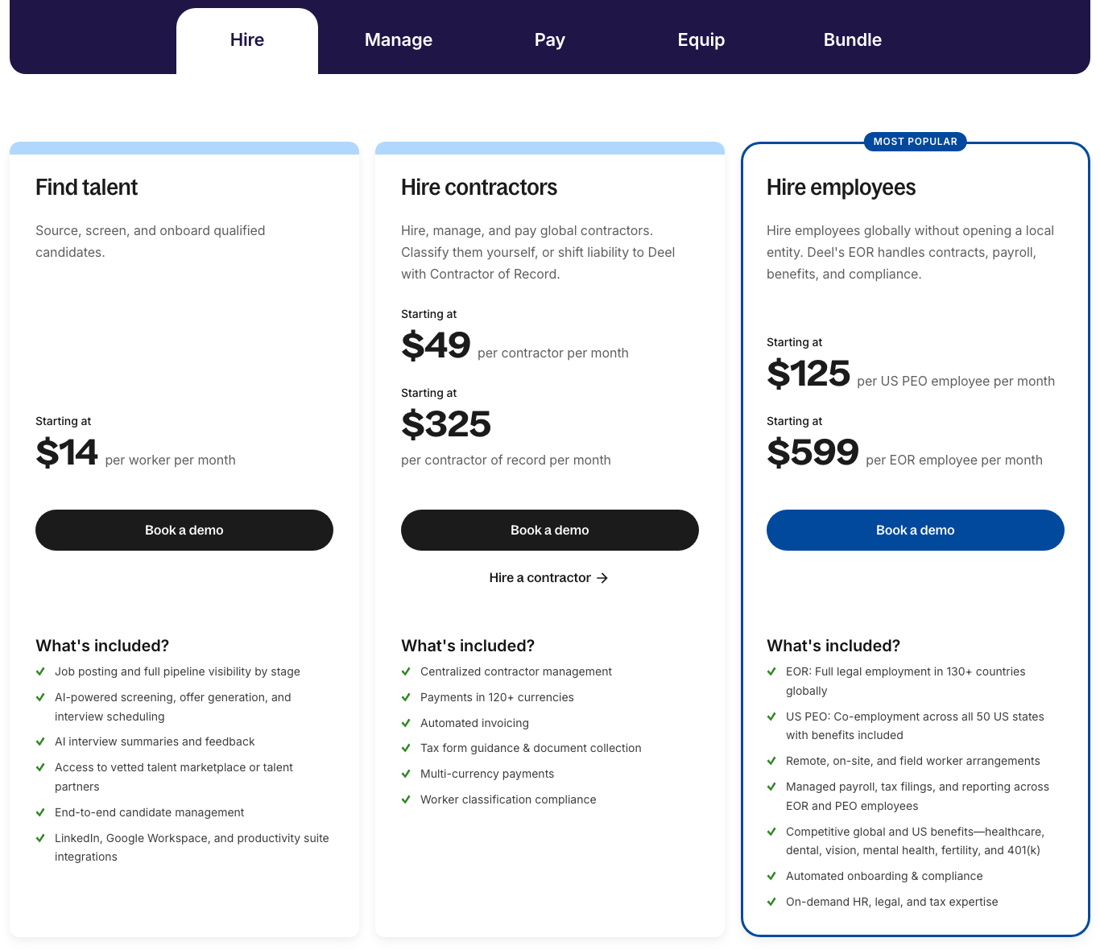
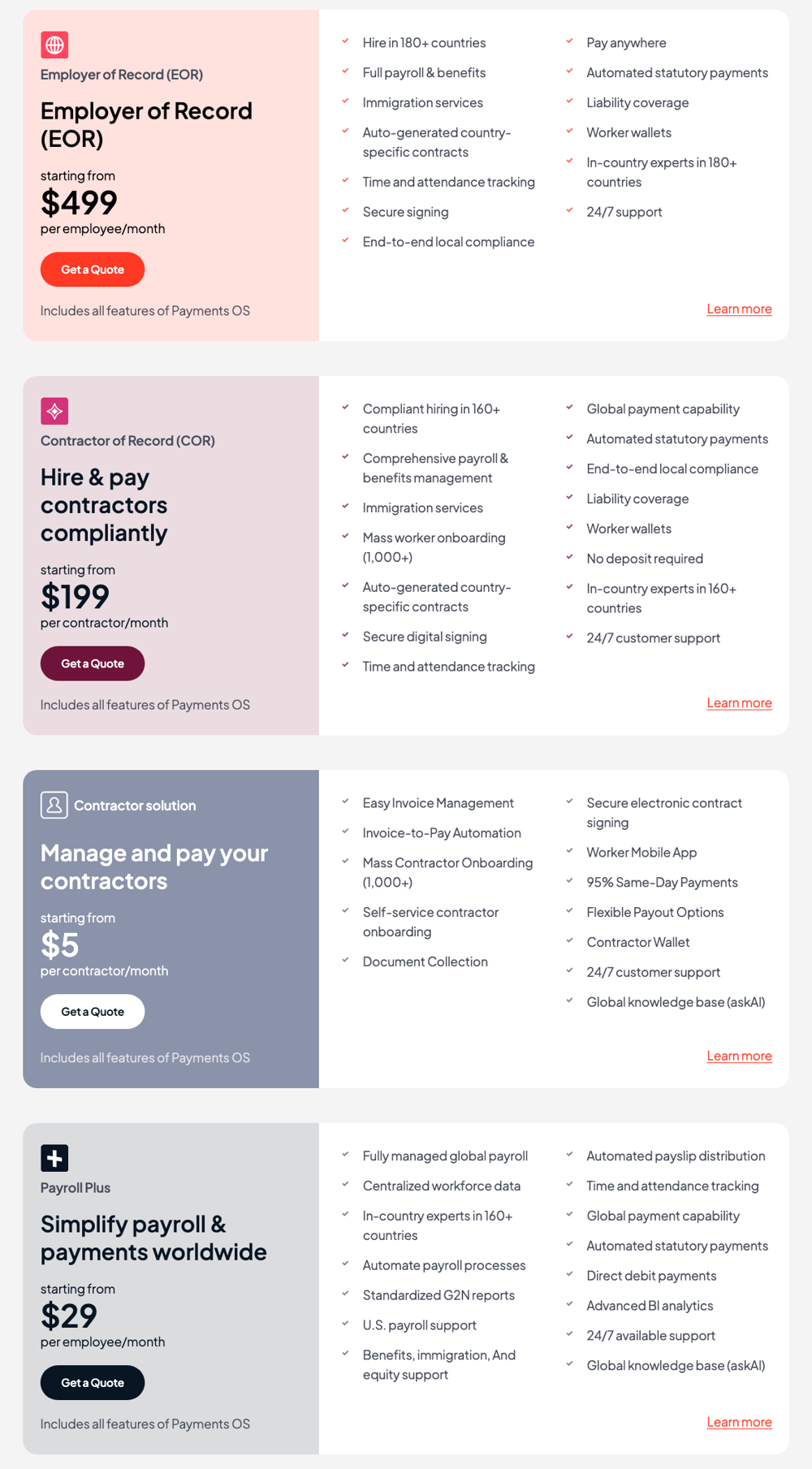
| EOR coverage | 130+ countries (Deel's pricing page) | 180+ countries (Papaya's pricing page) |
| How EOR is delivered | Mostly Deel-owned entities (Deel says 150+) | Mix of owned entities and in-country partners (Papaya says it owns entities in 80+ countries) |
| EOR price | From $599 per employee per month | From $499 per employee per month |
| Contractor management | From $49 per contractor per month | Contractor solution from $5 per contractor per month |
| Contractor of Record | From $325 per contractor per month | From $199 per contractor per month |
| Global payroll (your own entities) | Custom quote | PayrollPlus from $29 per employee per month |
| Payments | 15+ withdrawal methods for workers, including crypto, and early pay | OnePay with $0 platform fees and a free wallet for contractors |
| Immigration | In-house team | Included in EOR and Contractor of Record |
| Support | 24/7, in-house | 24/7 listed on EOR and contractor plans |
| Contract terms | Month-to-month on standard plans | Quote-based; reviewers report annual contracts and EOR deposits |
| Startup offer | $1,500 in credits through SaaSOffers | None published |
All prices are the "starting at" figures on each vendor's own pricing page in October 2026. Starting prices are the floor: your real price depends on the countries you hire in, so get a written quote from both before you sign.
The three services, and why the difference matters
The most common mistake is treating "global hiring" as one product. It is three different ones.
Employer of Record (EOR) is for hiring a full-time employee in a country where you have no company. The EOR provider is the legal employer. It runs local payroll, withholds taxes, provides statutory benefits and handles the employment contract. You direct the work. You pay a monthly fee per employee on top of their salary.
Global payroll is for countries where you already have your own entity. You are the employer. The provider runs payroll for you in each country and gives you one place to see and approve it.
Contractor management is for independent contractors, not employees. The provider handles contracts, invoices and payments. A "Contractor of Record" service goes further: the provider takes on the risk of the contractor being treated as an employee by local authorities.
If you only hire contractors today, you do not need an EOR yet. If you have entities in five countries, you need global payroll, not EOR. Choosing the right service saves more money than choosing the right vendor.
EOR: Deel vs Papaya Global
Deel EOR starts at $599 per employee per month and covers 130+ countries. Deel's main argument is that it owns the legal entity in most countries where it employs people, instead of renting a local partner's entity. Deel says it has more than 150 entities. In practice, an owned entity means fewer handoffs: the team setting up your employee's contract and payroll works for Deel, not for a third company. Deel also runs immigration and visa support in-house, and onboarding for an EOR hire can start as soon as you sign.
Papaya Global EOR starts at $499 per employee per month and covers 180+ countries, with immigration services, liability coverage and 24/7 support listed on the plan. Papaya historically delivered EOR mostly through in-country partners. Its CEO now says Papaya employs through its own entities in more than 80 countries and uses partners elsewhere. Independent reviewers in 2026 report that EOR quotes often come in above the starting price and that a security deposit of around two months of salary can apply, so ask about both.
Verdict on EOR: Papaya has the lower starting price and wider country list. Deel is easier to buy, owns more of its entities and, in most reviewer reports, has no deposit. For a startup hiring its first one to five employees abroad, Deel is the faster and more predictable choice. If you are hiring many employees in specific countries, the $100 per month difference in starting price adds up, and a side-by-side quote is worth an hour of your time.
Global payroll: Deel vs Papaya Global
This is where Papaya is strongest.
Papaya Global was built around payroll. PayrollPlus starts at $29 per employee per month and includes managed global payroll, standardized gross-to-net reports, automated statutory payments, BI analytics and in-country experts in 160+ countries. OnePay handles the money movement with $0 platform fees. Finance teams like this setup because payroll and payments sit in one system with one set of reports.
Deel also runs global payroll for companies with their own entities. Deel says it uses a single payroll engine across more than 50 countries, with real-time payroll calculations there, and that its payroll cutoffs are more flexible than the usual mid-month deadline. Deel does not publish a global payroll price; you get a quote.
Verdict on global payroll: if you already have entities in three or more countries and payroll is run by your finance team, Papaya is a serious option and often the better fit. If most of your international people are EOR employees or contractors, keeping payroll in Deel next to them is simpler.
Contractor management: Deel vs Papaya Global
Deel contractor management starts at $49 per contractor per month. You can sign up and hire a contractor yourself, without a sales call: send a contract, the contractor signs, and Deel handles invoices, tax forms and payments in 120+ currencies. Contractors can withdraw through 15+ methods, including bank transfer, digital wallets and crypto, and can get paid early. Deel's Contractor of Record service starts at $325 per contractor per month.
Papaya Global has the cheapest list price in this comparison: its Contractor solution starts at $5 per contractor per month and covers invoices, contract signing, onboarding, a worker mobile app and 95% same-day payments. Contractor of Record starts at $199 per contractor per month, with no deposit required and immigration services included. Both are sold through a quote.
Verdict on contractors: on price per contractor, Papaya wins clearly. Deel wins on speed and convenience: you can be paying a contractor today, and the payout options are wider, which matters when you hire people in countries where bank transfers are slow or expensive. If you have a handful of contractors and want to start now, Deel. If you have dozens and price is the deciding factor, get Papaya's quote.
What you will actually pay: a real example
Take a startup hiring two full-time employees through EOR (one in Germany, one in Brazil) and three contractors (in India, the Philippines and Poland). Platform fees only, salaries not included, using each vendor's published starting prices:
| Deel | Papaya Global | |
|---|---|---|
| 2 EOR employees | 2 × $599 = $1,198 | 2 × $499 = $998 |
| 3 contractors, managed | 3 × $49 = $147 | 3 × $5 = $15 |
| Monthly total | $1,345 | $1,013 |
| First year | $16,140 | $12,156 |
| Startup credit | minus $1,500 through SaaSOffers | none published |
| First year after credit | $14,640 | $12,156 |
| Deposit | none listed | reviewers report about 2 months of salary on EOR |
| How you start | sign up today | request a quote |
| Commitment | month-to-month | quote-based, often annual |
On published starting prices, Papaya is about $2,500 cheaper over the first year for this team. Two things narrow that gap in practice. First, starting prices are floors, and several 2026 reviews report Papaya EOR quotes landing between $650 and $770 per employee per month; at those numbers the first year comes to $15,780 to $18,660. Second, an EOR deposit of around two months of salary ties up cash that an early-stage startup may need elsewhere.
So the honest answer is: get both quotes for your countries. If Papaya's quote stays close to its starting prices and you are fine with the sales process and contract, it is the cheaper option. If you want to start this week, on month-to-month terms, with no deposit, Deel is worth the difference.
Through SaaSOffers, Deel gives new startups $1,500 in credits, which covers roughly two and a half months of one EOR employee. You can claim it through this Deel link, and the details are on our Deel deal page.
Support and day-to-day use
Deel offers 24/7 support through chat and other channels, staffed in-house, and reports a 4.8 out of 5 support rating on G2. Its platform covers a lot beyond hiring: a global HRIS, time off, equipment for remote employees, performance and compensation tools, and 120+ integrations, including Xero and QuickBooks.
Papaya Global lists 24/7 support on its EOR, contractor and payroll plans, plus an AI knowledge base. Its platform focuses on payroll operations, reporting, payments and FX, with Workforce OS for companies that want payroll and HR data in one place.
Who should choose Deel
- Startups that want to hire this week, without a sales call
- Companies hiring their first employees abroad without opening entities
- Teams that want month-to-month terms and no EOR deposit
- Anyone who wants contractors, EOR, immigration, HR and equipment in one tool
- Contractors in countries where flexible payout options matter
Who should choose Papaya Global
- Companies paying many contractors, where $5 versus $49 per contractor adds up
- Companies with their own entities in several countries that need one payroll layer
- Finance-led teams that care most about payroll data, payments and FX in one system
- Larger organizations comfortable with quotes and annual contracts
Final verdict
For most startups, Deel is the better choice. You can start the same day, pricing is public, there is no long contract, it owns most of its entities, and it covers contractors, EOR, immigration and HR in one place. Papaya Global has lower starting prices, especially for contractors, and a stronger payroll and payments product for finance teams with their own entities. If price per seat is your deciding factor, ask both for a quote on the same countries and compare the totals, including any deposit.
If you go with Deel, sign up through this link to get the $1,500 startup credit, or read the details on our Deel deal page. You can also compare Deel with Remote and Rippling.
FAQ

Software engineer and product builder with 13+ years of experience across software engineering, product development, and startup operations. Built SaaSOffers to make every startup deal discoverable and verified for founders worldwide.
Ready to unlock these deals?
Free account. No credit card required.