AI tools are now one of the biggest line items in an early startup's budget. Model APIs, writing tools, design tools, a research assistant and a dozen point solutions, and the monthly total climbs past what most founders expect. Almost none of it has to be paid at full price. The programs exist, they are just scattered and quietly under-claimed. Here is where the real savings are in 2026, with the actual numbers and how to get them.
The biggest bucket: cloud and AI infrastructure credits
If your product runs on the cloud or calls a model API, this is where the largest numbers live. The major providers all run startup programs, and in 2026 they compete hard for AI companies in particular.
| Program | Standard credits | AI or top tier | Best for |
|---|---|---|---|
| AWS Activate | up to $100,000 | $200,000+ on the invite-only AI track, plus extra Bedrock and Trainium credits | Teams already building on AWS |
| Google for Startups Cloud | up to $200,000 | up to $350,000 for AI-first startups | Startups selling AI as the product |
| Microsoft for Startups Founders Hub | up to $150,000 | includes Azure OpenAI models | Teams using OpenAI models through Azure |
| Anthropic, Claude for Startups | $1,000 to $5,000 | up to $100,000 with a VC or accelerator referral | Anyone building on Claude |
A few things worth knowing before you apply. The headline numbers are the ceiling, not the default. The self-serve tiers, roughly $1,000 to $5,000, usually need nothing more than a business email and a working website. The large amounts, $100,000 and up, almost always require that you are backed by a partner accelerator, angel or VC, so the provider can tie your application to an organization ID. You also generally need to have been founded within the last few years and to not have claimed the same program before.
The practical move is to stack them. A model-credit program on top of a cloud-credit program can cover most of your first year of AI infrastructure. Start with the provider you already use, then apply to a second as a fallback.
Model and API credits
Beyond the cloud giants, the model labs run their own programs. Anthropic's Claude for Startups gives API credits, priority rate limits and founder events, scaling from a small self-serve tier up to $100,000 for equity-funded companies. You apply directly at claude.com/programs/startups with a short form. OpenAI credits are most commonly reached through Azure OpenAI inside the Microsoft Founders Hub, or through an accelerator. If you are building on a model, claim these before you scale usage. They are far easier to get early than to backfill later.
Student and education discounts
If you or anyone on your team is a student, the savings are real and routinely missed. Plenty of AI tools run education pricing or hand students their paid tiers for free. We keep a running set of AI student discount guides covering Claude, ChatGPT, Cursor, Perplexity, GitHub Copilot and more, with the exact steps that work in 2026 instead of dead promo codes.
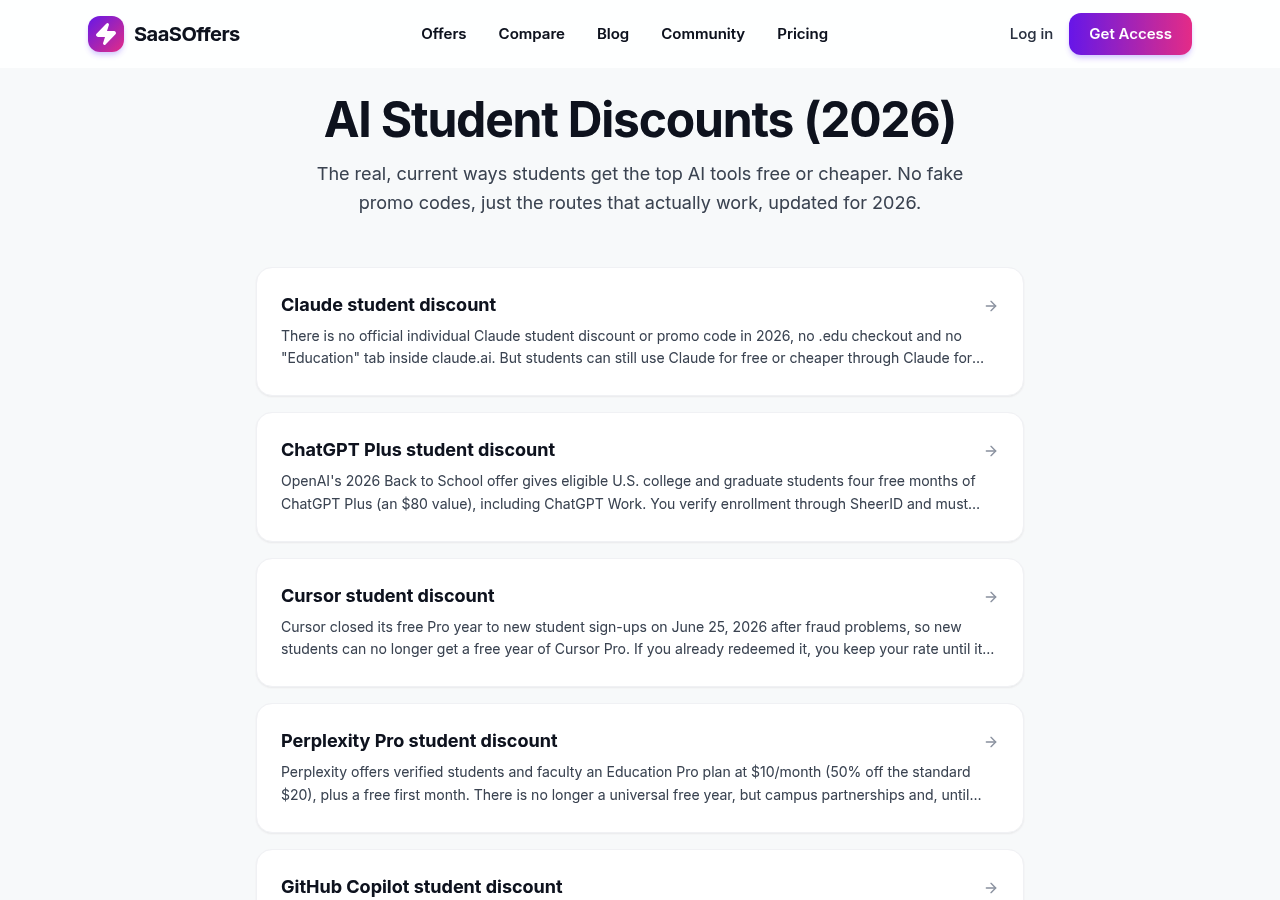
Our AI student discount guides cover the exact steps that work in 2026.
SaaS startup programs beyond AI
The tools around your AI product discount too. HubSpot for Startups runs up to 90% off in year one. Notion, Airtable and Slack all have startup plans that are free or heavily discounted for a year, often with no card required. Payroll and finance tools like Deel, Rippling and Brex add credits and discounts before your first hire. None of these are AI tools, but they sit in the same stack and come out of the same budget.
Read an honest review before you buy
Credits and discounts only matter if the tool is worth using. The AI space is crowded, and plenty of tools demo well and fall apart in daily use. For hands-on testing and rankings of individual AI tools, AIToolBlaze reviews and compares them with no paid placements, so you can see how a tool actually performs before you commit. Pairing an independent review with a live deal is the difference between a smart purchase and a subscription you cancel a month later.
Lifetime deals, used carefully
Newer AI tools often launch with one-time pricing instead of a subscription, usually on deal platforms. For a tool you already use and trust, a lifetime deal can pay for itself in a few months. The rule is simple: only buy lifetime on something you have already tested. Impulse lifetime buys are where the regret lives.
How to claim all this without losing a week
- 1List the tools and infrastructure you already pay for or plan to.
- 2For each one, check for a startup program, a student rate, or a current deal before you subscribe.
- 3Apply to the self-serve credit tiers first, since they need only basic verification.
- 4If you are backed by an accelerator or VC, use that referral to unlock the larger cloud and model tiers.
- 5Read a real review on anything you are unsure about, then claim the best available deal.
Keep it in one place
The hard part is not eligibility, it is the hunting. These programs live across 40 different pages with different rules and different forms. Instead of chasing each one, SaaSOffers lists 495 verified startup deals worth over $450,000 in credits, from AWS and Notion to Deel and Rippling, sorted by category and stage so you can claim what fits where you are.
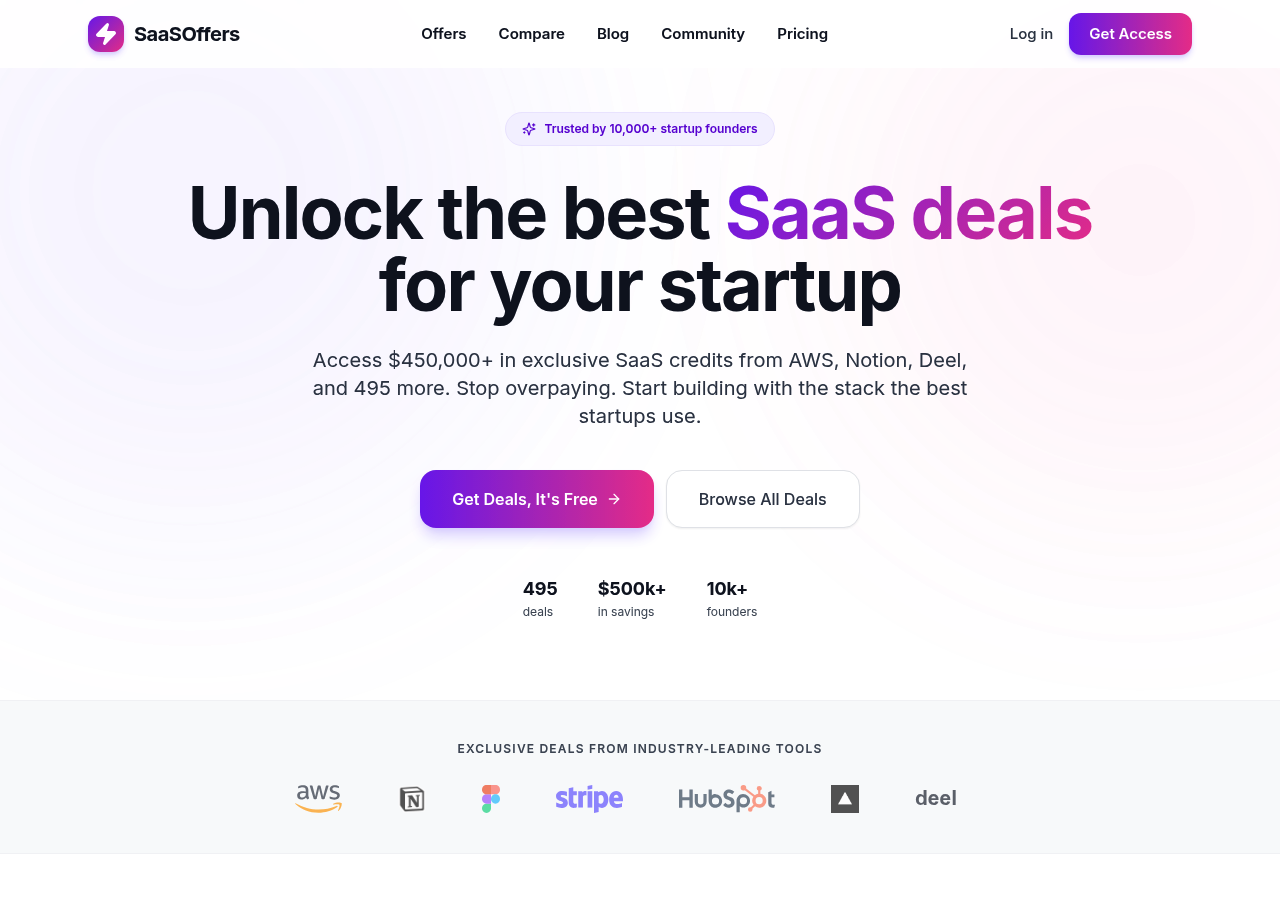
SaaSOffers keeps 495 verified startup deals and credits in one place, sorted by category and stage.
The founders who win here are not the ones who spend the most on software. They are the ones who check for a credit, confirm the tool is worth it, and claim the deal before paying list price. Ten minutes of that habit, repeated, turns into thousands of dollars of runway over a year. And that runway is time to build.

Software engineer and product builder with 13+ years of experience across software engineering, product development, and startup operations. Built SaaSOffers to make every startup deal discoverable and verified for founders worldwide.
Ready to unlock these deals?
Free account. No credit card required.