

Supabase vs MongoDB for Startups in 2026
Choosing between Supabase ($1,000 in credits) and MongoDB ($5,000 in credits) for your startup? This side-by-side comparison covers features, startup deals, pricing, and which tool fits your stack, with verified deals you can claim through SaaSOffers.
Quick Answer
Supabase offers $1,000 in credits and is best for startups needing developer & it. MongoDB offers $5,000 in credits and is best for developer & it. MongoDB provides a higher-value startup deal, but Supabase may be the better fit depending on your stack. You can claim both through SaaSOffers, there are no restrictions on using multiple startup deals.

Supabase
Get credits for the open-source Firebase alternative, managed PostgreSQL, auth, real-time, storage, and edge functions.

MongoDB
Get $5,000 in MongoDB Atlas credits. The leading developer data platform for building modern apps with flexible document databases.
What Is Supabase?
Supabase is the open-source Firebase alternative that gives developers a complete backend in minutes, managed PostgreSQL database, authentication, real-time subscriptions, file storage, edge functions, and vector embeddings. Used by over 700,000 developers in 2026, Supabase has become the default backend platform for startups building with React, Next.js, Flutter, and Swift who want production-grade infrastructure without managing servers.
Unlike Firebase (proprietary, NoSQL, Google lock-in), Supabase is built on PostgreSQL. The most trusted relational database in the world. Your data lives in standard Postgres, queryable with standard SQL, exportable at any time. No vendor lock-in by design.
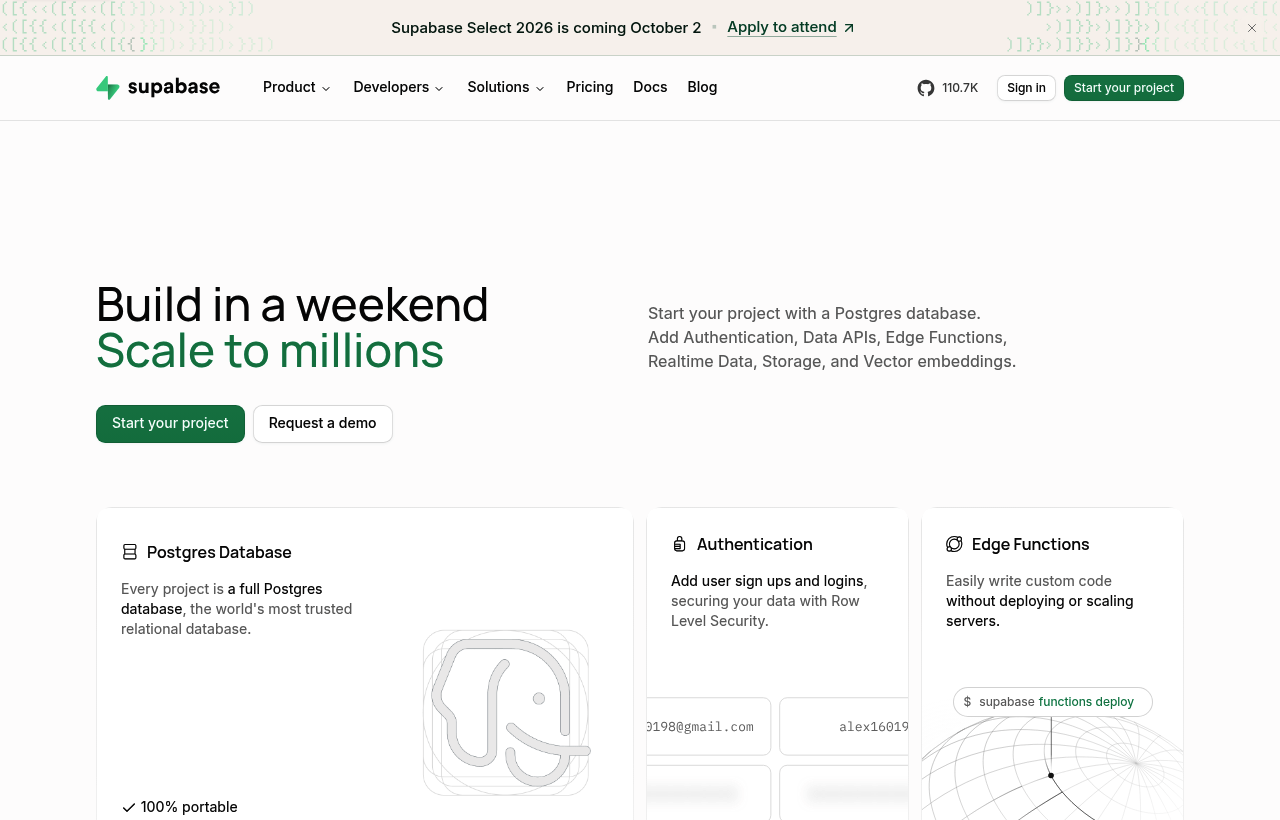
Key Features
- PostgreSQL. Not a Proprietary Database
- Authentication. Production-Ready in 5 Minutes
- Real-Time Subscriptions
- Edge Functions. Serverless at the Edge
- Vector Embeddings. AI-Native Database
What Is MongoDB?
MongoDB is the world's most popular NoSQL database, used by over 46,000 customers ranging from early-stage startups to Fortune 500 companies. At its core, MongoDB stores data as flexible JSON-like documents rather than rigid rows and columns. A design choice that makes it uniquely suited to the way modern applications are built.
Where relational databases like PostgreSQL require you to define a fixed schema upfront, MongoDB lets your data structure evolve as your product evolves. Add a new field to your user objects? It's there immediately, with no migration script required. Building a feature that needs nested arrays or variable-length data? MongoDB handles it natively without the complexity of joining multiple tables.
MongoDB Atlas is the cloud-hosted version of MongoDB. A fully managed database service running on AWS, Google Cloud, and Azure across 100+ global regions. In 2026, MongoDB Atlas has become the default choice for startups building applications with flexible, evolving data requirements, particularly those working on SaaS products, mobile apps, real-time features, and AI/ML data pipelines.
Key Features
- Flexible Document Model. Build Without Schema Migrations
- Atlas Serverless. Zero Infrastructure Cost at Zero Traffic
- Atlas Vector Search. Build AI Features on Your Existing Data
- Global Clusters. Data Close to Your Users
- Automated Backups and Point-in-Time Recovery
Supabase vs MongoDB, Detailed Comparison
What's Included in Each Startup Deal
Here is exactly what you get when claiming each deal through SaaSOffers:
SSupabase
- $1,000 in Supabase credits
- Managed PostgreSQL database
- Built-in authentication (50K MAU)
- Real-time subscriptions
- Edge Functions and file storage
MMongoDB
- $5,000 in MongoDB Atlas credits
- Managed database clusters on AWS/GCP/Azure
- Atlas Search (full-text search)
- Atlas Charts for data visualization
- Vector search for AI applications
Who Should Use Supabase vs MongoDB?
The right tool depends on what your startup actually needs day-to-day. Both Supabase and MongoDB serve different use cases, and many startups use tools from the same category for different purposes. Here is when each makes sense:
Choose Supabase if:
- You need developer & it as a core part of your product or operations
- $1,000 in credits in credits covers your usage for 6–12 months
- Your team has experience with Supabase or similar tools in its category
- You want a premium-tier deal with SaaSOffers Premium
Choose MongoDB if:
- You need developer & it as a core part of your product or operations
- $5,000 in credits in credits covers your usage for 6–12 months
- Your team has experience with MongoDB or similar tools in its category
- You want a premium-tier deal with SaaSOffers Premium
Can you use both? Yes, there are no restrictions on claiming multiple startup deals. Many startups use Supabase and MongoDB simultaneously for different needs. Claim both through SaaSOffers.
Startup Deal Comparison: Which Saves More?
Both Supabase and MongoDB offer startup deals through SaaSOffers. Here is how the deals compare for a typical early-stage startup in 2026:
Frequently Asked Questions
Common questions about Supabase vs MongoDB for startups.
What is the difference between Supabase and MongoDB?
Supabase offers $1,000 in credits and is categorized as Developer & IT. MongoDB offers $5,000 in credits and is categorized as Developer & IT. Both offer startup deals through SaaSOffers. The right choice depends on your specific needs, Supabase is best for teams needing developer & it, while MongoDB excels at developer & it.
Can I use both Supabase and MongoDB together?
Yes. There are no restrictions on claiming startup deals from multiple tools. Many startups use both Supabase and MongoDB simultaneously, each serving different needs. Claim both through SaaSOffers for maximum savings.
Which has a better startup deal, Supabase or MongoDB?
MongoDB offers $5,000 in credits, while Supabase offers $1,000 in credits. However, the "better" deal depends on which tool you actually need, a larger credit on a tool you won't use is worth less than a smaller credit on a tool that's essential to your stack.
Is Supabase free for startups?
Supabase offers $1,000 in credits through its startup program on SaaSOffers. The deal type is "premium", available to SaaSOffers Premium members ($79/year). Early-stage startup building on Supabase
Is MongoDB free for startups?
MongoDB offers $5,000 in credits through its startup program on SaaSOffers. The deal type is "premium", available to SaaSOffers Premium members ($79/year). Startup new to MongoDB Atlas paid tiers, pre-Series B
Is Supabase free for startups?
Supabase has a generous free tier (500MB database, 50K monthly active users for auth, 1GB file storage, 2 projects) that covers most startups for the first 3–6 months. The startup credit program provides $1,000 in credits for the Pro plan ($25/month), extending paid-tier access for 3+ years at base usage levels.
Is Supabase a good alternative to Firebase?
Yes — Supabase provides equivalent functionality (database, auth, real-time, storage, serverless functions) built on open-source PostgreSQL instead of proprietary Firestore. Supabase wins on database capability (relational SQL vs NoSQL), vendor independence (standard Postgres, exportable anytime), and developer experience for backend-heavy applications. Firebase wins on mobile SDK maturity and Google ecosystem integration.
Can Supabase handle production traffic?
Yes. Supabase's Pro and Team plans handle millions of requests per month with managed PostgreSQL, connection pooling via PgBouncer, and global CDN for storage. Companies serving thousands of concurrent users run production on Supabase. The platform auto-manages backups, failover, and scaling — you manage your schema and queries.
Is MongoDB Atlas free for startups?
MongoDB Atlas has a permanent free tier (M0) with generous but limited resources. This deal gives you $500 in credits to use on paid Atlas tiers — enabling production-grade dedicated clusters, serverless instances, or advanced features like Atlas Search. The credits supplement the free tier rather than replacing it.
How long does the MongoDB startup deal last?
The $500 in credits are valid for 12 months from activation. If you spend them before 12 months, standard Atlas pricing applies. If you haven't spent them all after 12 months, unused credits expire. Plan your usage so credits cover your peak development and early production period.
Can I combine this with other discounts?
The $500 MongoDB Startup credits cannot be stacked with other promotional Atlas credits. However, you can use your MongoDB Atlas database alongside any other startup deal — MongoDB works with any cloud provider and application stack.
The Bottom Line: Supabase vs MongoDB
Both Supabase and MongoDB offer genuine value for early-stage startups in 2026. The decision comes down to your specific needs:
Supabase provides $1,000 in credits and is the stronger choice for startups that need developer & it. The deal is accessible as a premium offer through SaaSOffers.
MongoDB provides $5,000 in credits and is the stronger choice for startups that need developer & it. The deal is accessible as a premium offer through SaaSOffers.
The best approach for most startups is to claim both deals, there are no restrictions, and each tool serves a different part of your stack. Start by claiming the tool you need first, then add the second when you need it.
We've helped 10,000+ startup founders unlock $500,000+ in SaaS credits and discounts. Every comparison is based on real deal data from our platform.