
Supabase Startup Credits: $1,000 in credits
Get credits for the open-source Firebase alternative, managed PostgreSQL, auth, real-time, storage, and edge functions.
Free · Opens in new tab
Already have an account? Log in
Deal Highlights
What Is Supabase?
Supabase is the open-source Firebase alternative that gives developers a complete backend in minutes, managed PostgreSQL database, authentication, real-time subscriptions, file storage, edge functions, and vector embeddings. Used by over 700,000 developers in 2026, Supabase has become the default backend platform for startups building with React, Next.js, Flutter, and Swift who want production-grade infrastructure without managing servers.
Unlike Firebase (proprietary, NoSQL, Google lock-in), Supabase is built on PostgreSQL. The most trusted relational database in the world. Your data lives in standard Postgres, queryable with standard SQL, exportable at any time. No vendor lock-in by design.
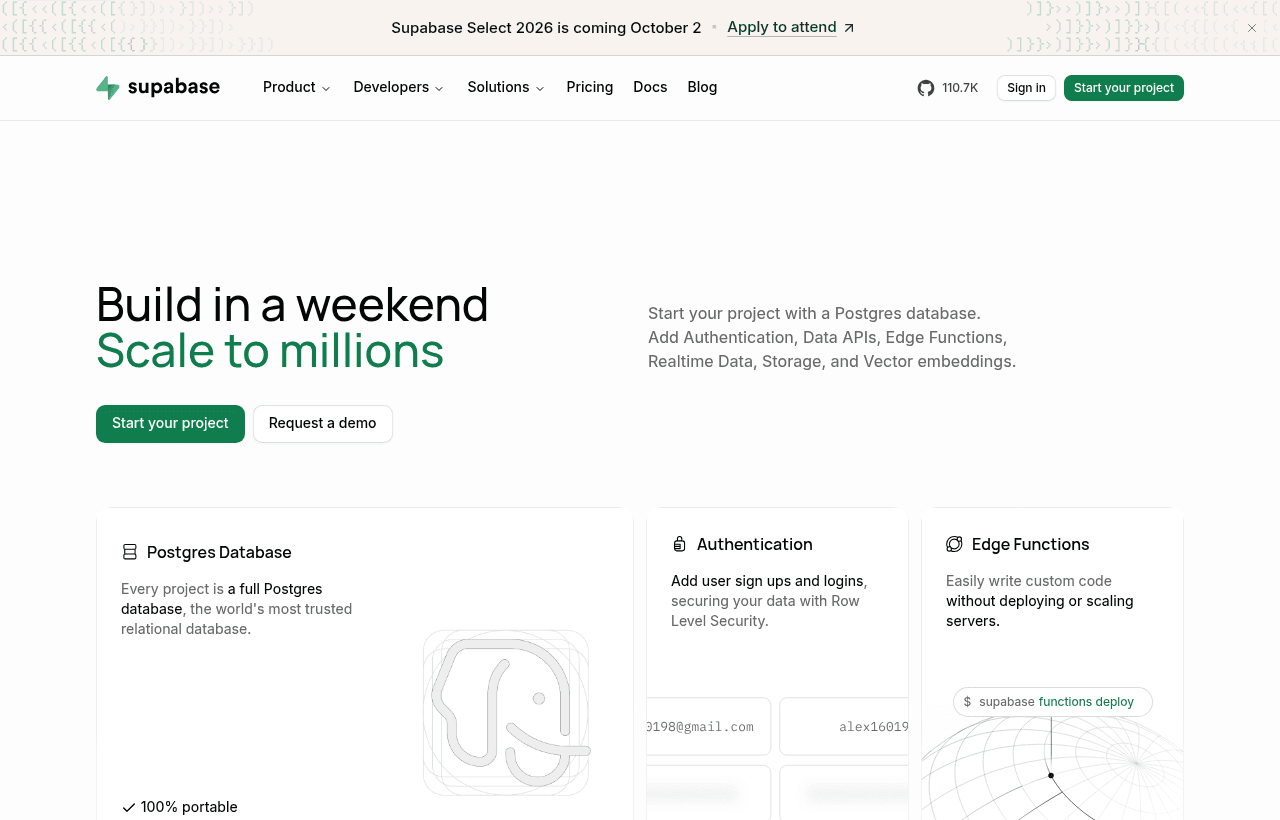
Supabase, one of the tools included in this startup deal.
Why This Deal Matters for Startups
Every startup needs a database, authentication, and file storage. Building these from scratch takes weeks. Configuring and securing them takes more weeks. Supabase provides all three plus real-time subscriptions and serverless functions. In a single service that deploys in under 2 minutes.
The $1,000 Supabase startup credit covers the Pro plan ($25/month) for over 3 years at base usage, or several months of heavy production usage with larger databases and higher traffic. For startups that would otherwise spend engineering time setting up PostgreSQL, configuring auth, and building file upload infrastructure, Supabase credits buy months of development time.
What's Included in the Supabase Startup Deal
Through SaaSOffers, qualifying startups receive:
- $1,000 in Supabase credits
- Managed PostgreSQL with automated backups and point-in-time recovery
- Authentication, email, phone, social OAuth, magic links, SSO
- Real-time subscriptions, push database changes to connected clients instantly
- Storage, file uploads with CDN delivery and image transformations
- Edge Functions, serverless Deno functions deployed globally
- Vector embeddings, pgvector for AI/ML similarity search
- Row Level Security, granular access control at the database level
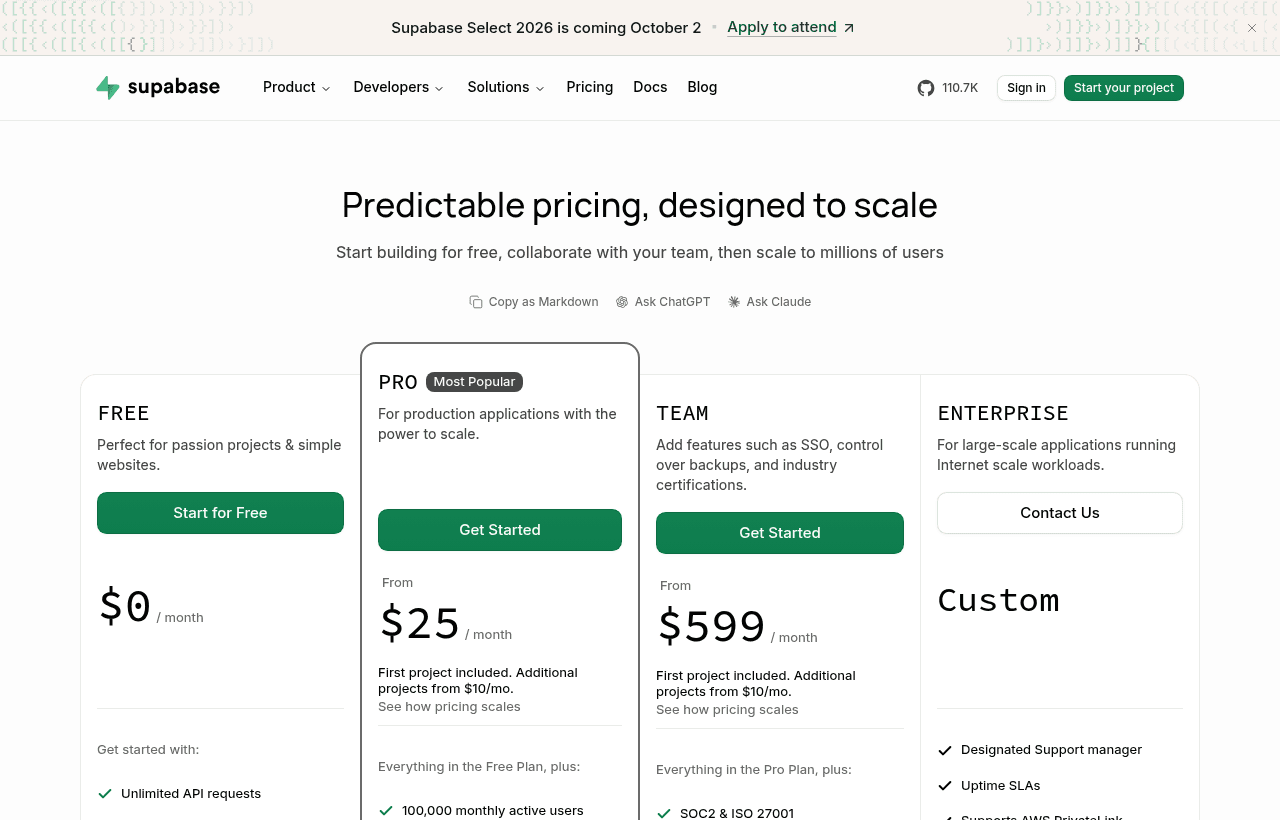
A look at Supabase before the discount, so you can see what the deal saves you.
Eligibility Requirements
- Early-stage startup building a product on Supabase
- New Supabase organization or existing free-tier account
- Applied through a qualifying startup platform
How to Claim This Supabase Deal. Step by Step
Step 1: Create a free account on SaaSOffers at saasoffers.tech and access the Supabase startup deal.
Step 2: Click "Get Deal" and follow the application link to Supabase's startup program.
Step 3: Create your Supabase account at supabase.com. Start a new project, choose your region (closest to your users), set your database password, and your PostgreSQL instance provisions in under 60 seconds.
Step 4: Set up authentication. Enable the auth providers you need, email/password, Google OAuth, GitHub OAuth, magic links. In the Supabase dashboard. Auth works out of the box with Supabase's client libraries for JavaScript, Flutter, Swift, and Python.
Step 5: Design your database schema using the Table Editor (visual) or SQL Editor (code). Supabase is PostgreSQL, use standard SQL, create relations, add indexes, and write functions exactly as you would on any Postgres database.
Step 6: Enable Row Level Security (RLS) on every table that stores user data. RLS policies control which rows each user can read, insert, update, and delete, enforced at the database level, not the application level.
Step 7: Connect your frontend using the Supabase client library. The JavaScript SDK provides methods for auth, database queries, real-time subscriptions, and file uploads, all from a single import.
Key Features of Supabase for Startups
PostgreSQL. Not a Proprietary Database
Supabase runs on standard PostgreSQL. Every feature, extension, and tool that works with Postgres works with Supabase. pg_dump, pgAdmin, Prisma, Drizzle, PostGIS, pgvector. The entire PostgreSQL ecosystem is available. If you ever leave Supabase, export your database with pg_dump and import it anywhere that runs Postgres.
Authentication. Production-Ready in 5 Minutes
Supabase Auth handles email/password registration, social OAuth (Google, GitHub, Apple, 20+ providers), magic links, phone OTP, and enterprise SSO. The auth system integrates with Row Level Security, authenticated users automatically have their user ID available in database policies, enabling per-user data access without custom middleware.
Real-Time Subscriptions
Subscribe to database changes and receive updates in real time via WebSockets. When a row is inserted, updated, or deleted, connected clients receive the change instantly. This powers collaborative features (shared documents, team dashboards), live feeds (activity streams, notifications), and multiplayer experiences without building WebSocket infrastructure.
Edge Functions. Serverless at the Edge
Supabase Edge Functions are serverless Deno functions deployed globally. Use them for webhook processing, scheduled jobs, custom API endpoints, and any server-side logic that doesn't belong in the database. Edge Functions have access to the Supabase client library, enabling database queries and auth checks from serverless code.
Vector Embeddings. AI-Native Database
Supabase includes pgvector. The PostgreSQL extension for vector similarity search. Store embeddings alongside your relational data and query both in a single SQL statement. This makes Supabase a natural fit for RAG (Retrieval-Augmented Generation) architectures where AI applications need to search a knowledge base stored in the same database as their application data.
Supabase vs Firebase vs AWS (RDS + Cognito + S3)
| Factor | Supabase | Firebase | AWS Stack |
|---|---|---|---|
| Database | PostgreSQL (relational) | Firestore (NoSQL) | RDS PostgreSQL |
| Auth | Built-in (20+ providers) | Built-in (10+ providers) | Cognito (separate) |
| Real-time | Built-in | Built-in | AppSync (separate) |
| Storage | Built-in | Built-in | S3 (separate) |
| Serverless | Edge Functions | Cloud Functions | Lambda (separate) |
| Vendor lock-in | None (standard Postgres) | High (proprietary) | Medium (AWS-specific) |
| Free tier | Generous (500MB, 50K MAU) | Generous | Complex pricing |
| Setup time | 2 minutes | 5 minutes | 2–4 hours |
| Startup credits | $1,000 | Via Google Cloud | Via AWS Activate |
Supabase wins on database quality (PostgreSQL vs NoSQL), vendor independence, and developer experience. Firebase wins on mobile SDKs and Google ecosystem integration. AWS wins on service breadth but requires configuring 4+ separate services to match what Supabase provides out of the box.
Who Is the Supabase Deal For?
Full-stack developers building web applications: Supabase provides the entire backend, database, auth, storage, real-time, serverless. In a single service. Combined with Vercel or Netlify for frontend hosting, Supabase creates a complete full-stack platform with zero server management.
AI startups needing vector search alongside relational data: pgvector in Supabase enables storing embeddings in the same database as application data. RAG architectures that query both structured data and vector similarity in a single request are simpler on Supabase than on separate vector and relational databases.
Mobile app startups: Supabase's Flutter, Swift, and Kotlin SDKs provide the same backend-as-a-service experience for mobile development that Firebase offers, but with PostgreSQL instead of Firestore, and without Google lock-in.
Real Startup Use Cases
TaskBoard (project management SaaS): TaskBoard built their entire backend on Supabase. PostgreSQL for project and task data, Auth for user login (Google OAuth + email), Real-time for live collaboration (multiple users editing the same board), and Storage for file attachments. Total backend development time: 2 weeks. Equivalent time to build on raw AWS: estimated 6–8 weeks.
AskBase (AI knowledge base): AskBase stores company documents in Supabase Storage, generates embeddings with OpenAI, stores vectors in pgvector, and uses a Supabase Edge Function to handle the RAG query pipeline. The entire AI search infrastructure runs on one platform. No separate vector database, no separate serverless platform, no separate file storage.
FitTrack (mobile fitness app): FitTrack built their Flutter app on Supabase. Auth for login, PostgreSQL for workout data, Real-time for live leaderboards, and Edge Functions for push notification scheduling. The Supabase Flutter SDK reduced mobile backend integration from 3 weeks to 4 days.
Tips to Maximize Your Supabase Credits
- Enable Row Level Security from day one. RLS is Supabase's security model. Every table with user data needs RLS policies before going to production. Adding RLS retroactively is harder and riskier than enabling it from the first migration.
- Use database functions for complex queries. PostgreSQL functions execute inside the database, avoiding round trips between your application and Supabase. For multi-step operations (insert + update + notification), a single database function is faster and more reliable than multiple API calls.
- Start on the free tier, upgrade when needed. The free tier (500MB database, 50K MAU auth, 1GB storage) covers most startups for the first 3–6 months. Apply credits to the Pro plan only when you hit free tier limits.
- Use Supabase CLI for local development. The Supabase CLI runs a local instance of your entire Supabase project, database, auth, storage, edge functions for offline development. Write and test migrations locally before applying them to production.
- Monitor database size and connection count. PostgreSQL performance degrades when the database approaches storage limits or connection pool capacity. Set alerts at 70% of your plan's limits and optimize before you hit the ceiling.
Supabase Alternatives
Looking for Supabase alternatives? While Supabase is a strong choice for cloud & infrastructure, it is not always the right fit for every team. Compare Supabase against the top alternatives in our category. Each with verified startup deals and credits. See all Supabase alternatives →
Many startups end up using a combination of tools, and there are no restrictions on claiming multiple deals through SaaSOffers. Whether you need a cheaper option, different features, or a better startup deal, there is an alternative worth considering.
One further consideration for a startup choosing a backend is speed to a working product, and this is where an integrated platform like Supabase is strongest: a small team can stand up a real application with a database, authentication, and file storage in a fraction of the time it would take to assemble and wire those services separately, which for a company racing to ship is a decisive advantage. The generous foundation means you are not trading that speed against capability, because the underlying database is a full, standard one you will not outgrow quickly, and that combination of fast start and real depth is exactly what makes it a sensible default for a new product.
The Speed-to-Ship Advantage
For an early-stage startup, the scarcest resource is time, and the strongest practical argument for an integrated backend is how much of it you save. Standing up authentication alone, done properly with secure sessions, password handling, and social login, is a real project; adding file storage, realtime updates, and a database on top is several more. A platform that provides all of these, working together out of the box, compresses what would be weeks of foundational plumbing into days, and every day not spent building undifferentiated infrastructure is a day spent on the product itself. That speed is why so many new products start here. The important nuance is that the speed does not come at the cost of a toy foundation, because the database underneath is a full, standard, powerful one, so you get to move fast now without building on something you will have to replace later, which is the combination that makes an integrated backend a genuine strategic choice rather than a shortcut you regret.
The final consideration for any team choosing where to build is the trajectory of the platform itself, and here Supabase's open-source foundation and its momentum both matter. Building on an actively developed platform with a large community means the tooling, documentation, and ecosystem around it keep improving, and problems you hit are likely ones others have already solved and written about, which for a small team is a meaningful reduction in the friction of building. The open-source core also means the platform is not a black box you are wholly dependent on, since the underlying pieces are inspectable and, in principle, self-hostable, which is a different risk profile from a fully proprietary backend. Taken together, the standard Postgres foundation, the integrated services that compress development time, and the open, well-supported ecosystem make it a sensible default for a new product, and the credit lets you build on it in earnest and confirm the fit for your specific application before the cost of scale arrives. For a startup weighing where to begin, the combination of a real database you will not outgrow, integrated services that get you to a working product in days, and an open, well-supported ecosystem is exactly the foundation that lets a small team move quickly today without building on something they will regret tomorrow, which is the balance every early infrastructure choice is really trying to strike.
Who Is This Deal For?
Early-Stage Startups
Seed and pre-seed companies looking to move fast without overspending on tools.
Growing SaaS Teams
Series A+ companies scaling their stack and optimizing software costs.
Solo Founders
Indie hackers and bootstrapped founders who need enterprise tools at startup prices.
Get $1,000 in credits off Supabase
Premium deal. Upgrade once, unlock everything.
Frequently Asked Questions
Everything you need to know about this startup deal.
Supabase has a generous free tier (500MB database, 50K monthly active users for auth, 1GB file storage, 2 projects) that covers most startups for the first 3–6 months. The startup credit program provides $1,000 in credits for the Pro plan ($25/month), extending paid-tier access for 3+ years at base usage levels.
Get the weekly deals digest
New verified startup deals every week. No spam, ever. Unsubscribe anytime.
Related Offers

Toggl Track
Used by 1,100 members
Free Plan
Simple and intuitive time tracking for teams with reporting and integrations.
View offer
Auth0
Used by 994 members
1 year of B2B Professional free
Get 1 year of the Auth0 B2B Professional plan free, with up to 100,000 monthly active users, SSO, enterprise MFA and SCIM.
View offer
Bugsnag
Used by 471 members
Free Plan
Error monitoring and stability management for web and mobile applications.
View offer
Turborepo
Used by 1,880 members
Free & Open Source
High-performance build system for JavaScript and TypeScript monorepos by Vercel.
View offer
Windmill
Used by 1,501 members
Free Plan
Open-source developer platform for building internal tools, workflows, and scripts.
View offer
Height
Used by 1,442 members
Free Plan
AI-powered project management tool with autonomous task management and workflows.
View offerDeal Summary
Looking for more startup deals?
Browse all offers