

Supabase vs Neon for Startups in 2026
Choosing between Supabase ($1,000 in credits) and Neon ($500 in credits) for your startup? This side-by-side comparison covers features, startup deals, pricing, and which tool fits your stack, with verified deals you can claim through SaaSOffers.
Quick Answer
Supabase offers $1,000 in credits and is best for startups needing developer & it. Neon offers $500 in credits and is best for developer & it. Supabase provides a higher-value startup deal, but Neon may be the better fit depending on your stack. You can claim both through SaaSOffers, there are no restrictions on using multiple startup deals.

Supabase
Get credits for the open-source Firebase alternative, managed PostgreSQL, auth, real-time, storage, and edge functions.

Neon
Serverless PostgreSQL with autoscaling, branching, and a generous free tier. The modern database for startups.
What Is Supabase?
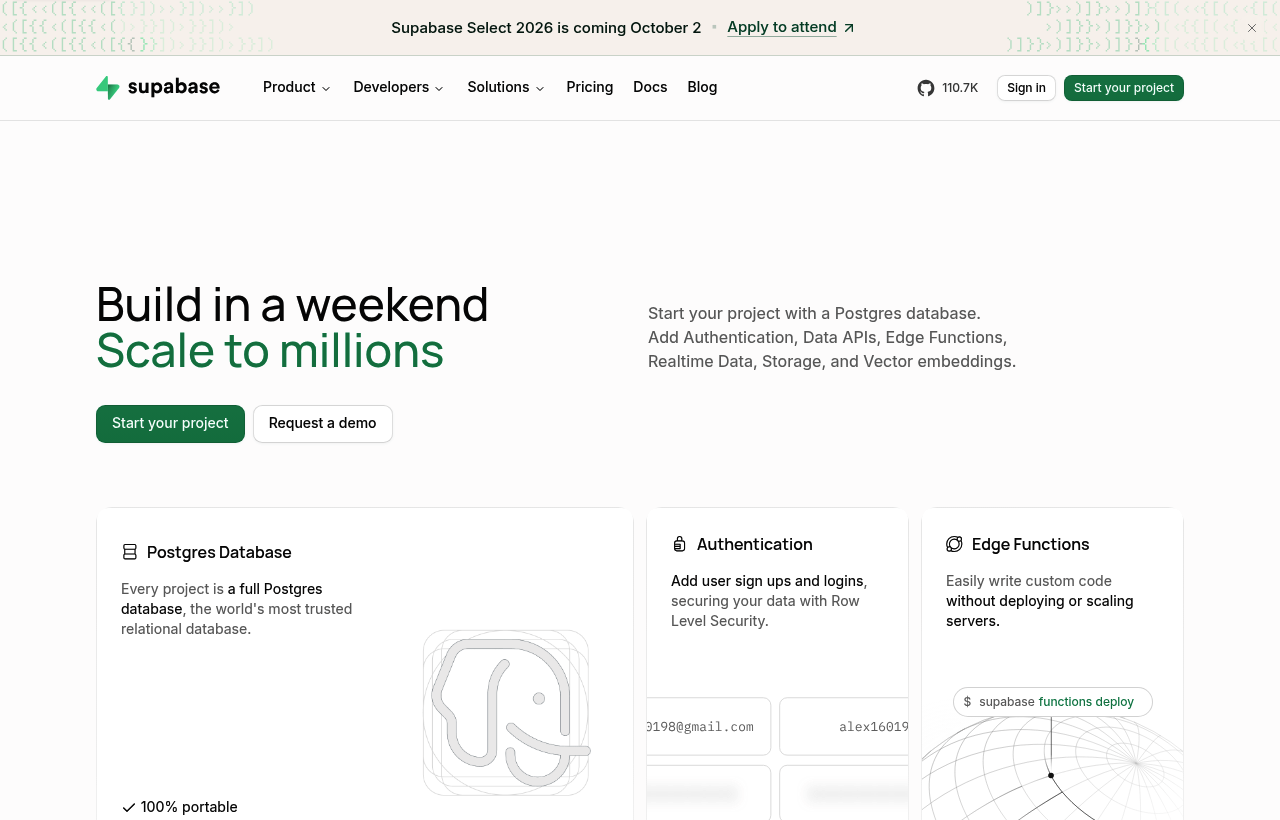
Supabase is the open-source Firebase alternative that gives developers a complete backend in minutes, managed PostgreSQL database, authentication, real-time subscriptions, file storage, edge functions, and vector embeddings. Used by over 700,000 developers in 2026, Supabase has become the default backend platform for startups building with React, Next.js, Flutter, and Swift who want production-grade infrastructure without managing servers.
Unlike Firebase (proprietary, NoSQL, Google lock-in), Supabase is built on PostgreSQL. The most trusted relational database in the world. Your data lives in standard Postgres, queryable with standard SQL, exportable at any time. No vendor lock-in by design.
Key Features
- PostgreSQL. Not a Proprietary Database
- Authentication. Production-Ready in 5 Minutes
- Real-Time Subscriptions
- Edge Functions. Serverless at the Edge
- Vector Embeddings. AI-Native Database
What Is Neon?
Neon is serverless PostgreSQL with autoscaling, branching, and a generous free tier, positioned as the modern database for startups, and this deal gives an early-stage startup building on PostgreSQL 500 dollars in credits. For a team standing up its data layer, that is a meaningful runway on a database that is designed around how startups actually work: unpredictable load, frequent changes, and a need to move fast without operating heavy infrastructure. Neon takes PostgreSQL, the database most engineers already know and trust, and delivers it in a serverless form that scales itself and branches like code.
The appeal is that you keep everything good about PostgreSQL, its reliability, its rich feature set, its huge ecosystem, and shed the operational weight that usually comes with running it. There is no server to provision, no capacity to guess at, no scaling to manage by hand. The database expands and contracts with demand, and it can branch so you can spin up an isolated copy of your data as easily as creating a git branch. The 500 dollars in credits let an early-stage team build and grow on this without an early bill getting in the way.
This article covers what Neon does, why serverless PostgreSQL fits a startup so well, how it compares to the alternatives, and how to make the 500 dollars in credits carry the team through its important early stretch.
Supabase vs Neon, Detailed Comparison
What's Included in Each Startup Deal
Here is exactly what you get when claiming each deal through SaaSOffers:
SSupabase
- $1,000 in Supabase credits
- Managed PostgreSQL database
- Built-in authentication (50K MAU)
- Real-time subscriptions
- Edge Functions and file storage
NNeon
- $500 in Neon credits
- Serverless PostgreSQL with auto-scaling
- Database branching for dev/staging
- Scale to zero when idle
- Compatible with all PostgreSQL tools
Who Should Use Supabase vs Neon?
The right tool depends on what your startup actually needs day-to-day. Both Supabase and Neon serve different use cases, and many startups use tools from the same category for different purposes. Here is when each makes sense:
Choose Supabase if:
- You need developer & it as a core part of your product or operations
- $1,000 in credits in credits covers your usage for 6–12 months
- Your team has experience with Supabase or similar tools in its category
- You want a premium-tier deal with SaaSOffers Premium
Choose Neon if:
- You need developer & it as a core part of your product or operations
- $500 in credits in credits covers your usage for 6–12 months
- Your team has experience with Neon or similar tools in its category
- You want a premium-tier deal with SaaSOffers Premium
Can you use both? Yes, there are no restrictions on claiming multiple startup deals. Many startups use Supabase and Neon simultaneously for different needs. Claim both through SaaSOffers.
Startup Deal Comparison: Which Saves More?
Both Supabase and Neon offer startup deals through SaaSOffers. Here is how the deals compare for a typical early-stage startup in 2026:
Frequently Asked Questions
Common questions about Supabase vs Neon for startups.
What is the difference between Supabase and Neon?
Supabase offers $1,000 in credits and is categorized as Developer & IT. Neon offers $500 in credits and is categorized as Developer & IT. Both offer startup deals through SaaSOffers. The right choice depends on your specific needs, Supabase is best for teams needing developer & it, while Neon excels at developer & it.
Can I use both Supabase and Neon together?
Yes. There are no restrictions on claiming startup deals from multiple tools. Many startups use both Supabase and Neon simultaneously, each serving different needs. Claim both through SaaSOffers for maximum savings.
Which has a better startup deal, Supabase or Neon?
Supabase offers $1,000 in credits, while Neon offers $500 in credits. However, the "better" deal depends on which tool you actually need, a larger credit on a tool you won't use is worth less than a smaller credit on a tool that's essential to your stack.
Is Supabase free for startups?
Supabase offers $1,000 in credits through its startup program on SaaSOffers. The deal type is "premium", available to SaaSOffers Premium members ($79/year). Early-stage startup building on Supabase
Is Neon free for startups?
Neon offers $500 in credits through its startup program on SaaSOffers. The deal type is "premium", available to SaaSOffers Premium members ($79/year). Early-stage startup building on PostgreSQL
Is Supabase free for startups?
Supabase has a generous free tier (500MB database, 50K monthly active users for auth, 1GB file storage, 2 projects) that covers most startups for the first 3–6 months. The startup credit program provides $1,000 in credits for the Pro plan ($25/month), extending paid-tier access for 3+ years at base usage levels.
Is Supabase a good alternative to Firebase?
Yes — Supabase provides equivalent functionality (database, auth, real-time, storage, serverless functions) built on open-source PostgreSQL instead of proprietary Firestore. Supabase wins on database capability (relational SQL vs NoSQL), vendor independence (standard Postgres, exportable anytime), and developer experience for backend-heavy applications. Firebase wins on mobile SDK maturity and Google ecosystem integration.
Can Supabase handle production traffic?
Yes. Supabase's Pro and Team plans handle millions of requests per month with managed PostgreSQL, connection pooling via PgBouncer, and global CDN for storage. Companies serving thousands of concurrent users run production on Supabase. The platform auto-manages backups, failover, and scaling — you manage your schema and queries.
What is serverless PostgreSQL?
Serverless PostgreSQL is a managed database that automatically scales compute up and down based on demand — including scaling to zero when there are no active queries. You pay only for actual usage, not for a running server. Neon is the leading serverless PostgreSQL provider, offering sub-second cold starts and automatic scaling.
How fast does Neon resume from zero?
Neon resumes from a suspended state in approximately 500 milliseconds on the first query. Subsequent queries during the active period have standard PostgreSQL latency. The cold start is fast enough for most web applications — users experience a barely perceptible delay on the first request after idle periods.
What is database branching?
Database branching creates an instant copy of your entire database (schema + data + indexes) using copy-on-write storage. Changes to the branch do not affect the original. Use branches for development environments, migration testing, and staging. Neon branches are created in under 1 second regardless of database size.
The Bottom Line: Supabase vs Neon
Both Supabase and Neon offer genuine value for early-stage startups in 2026. The decision comes down to your specific needs:
Supabase provides $1,000 in credits and is the stronger choice for startups that need developer & it. The deal is accessible as a premium offer through SaaSOffers.
Neon provides $500 in credits and is the stronger choice for startups that need developer & it. The deal is accessible as a premium offer through SaaSOffers.
The best approach for most startups is to claim both deals, there are no restrictions, and each tool serves a different part of your stack. Start by claiming the tool you need first, then add the second when you need it.
We've helped 10,000+ startup founders unlock $500,000+ in SaaS credits and discounts. Every comparison is based on real deal data from our platform.