
Ramp Startup Credits: $500 cashback bonus
Corporate card and spend management for startups, 1.5% cashback, real-time expense tracking, and automated accounting.
Free · Opens in new tab
Already have an account? Log in
Deal Highlights
What Ramp Gives a Startup
Ramp is a corporate card and spend management platform built for startups, offering cashback, real-time expense tracking, and automated accounting. This deal adds a $500 cashback bonus for a US-incorporated startup on top of the platform itself. For an early team that needs to spend money to operate but has no time or appetite for the mess that company spending usually creates, Ramp turns expense management from a recurring headache into something largely automatic, and this bonus rewards the team for getting started.
The value is that Ramp combines the card a company spends on with the system that manages that spending, so the two are no longer separate problems. In most companies, spending happens on cards and then someone has to laboriously reconcile it afterward, chasing receipts, categorizing transactions, and forcing it all into the accounting books. Ramp collapses that gap. Because the card and the software are one platform, spending is tracked in real time as it happens, categorized automatically, and fed into the accounting system without the manual reconciliation that eats so many hours.
For a startup, this means the finance back office runs with far less human effort. The founder is not spending evenings sorting receipts, and the books stay current instead of falling behind. On top of that, Ramp gives cashback on spending the company was going to do anyway, so money the startup spends partly comes back. Real-time visibility, automated bookkeeping, and cashback together make Ramp both a time-saver and a genuine source of savings for a lean team.
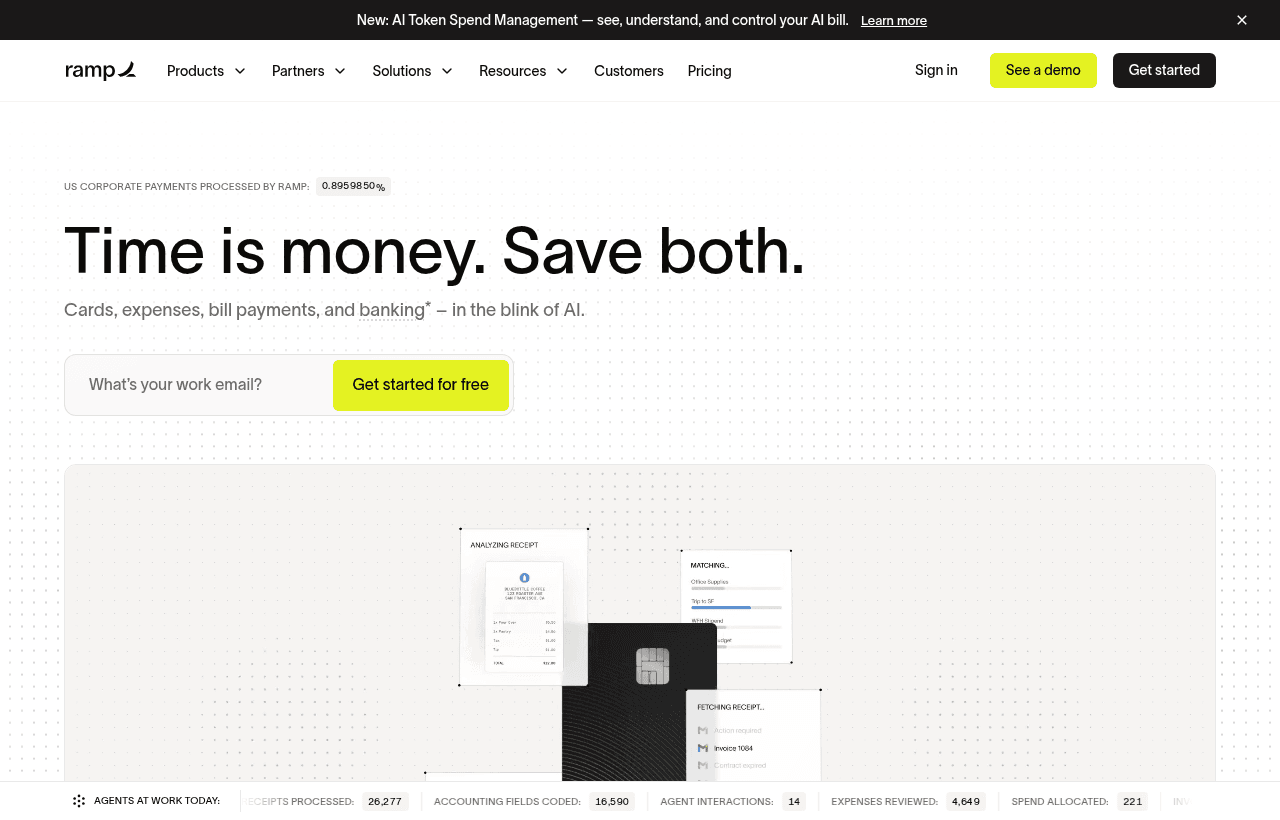
Ramp, one of the tools included in this startup deal.
Corporate Cards With Control Built In
The foundation of Ramp is the corporate card, but what makes it useful to a startup is the control that comes with it. Early companies need to let several people spend, on software, on services, on the countless small things a growing company buys, without handing everyone a blank check. Traditional approaches force a bad trade: either the founder is a bottleneck approving everything, or people spend loosely and the company loses control of its money.
Ramp lets a startup issue cards to the people who need them with limits and rules set by the company. Each person can have their own card with sensible constraints, so spending is distributed without becoming a free-for-all. The founder does not have to personally approve every purchase, and the company does not have to worry that a card will be misused, because the limits are built into the cards themselves. Control and delegation stop being opposites.
For a small team, this balance is exactly what is needed. The company can move fast, letting people buy what they need to do their jobs, while the founder retains visibility and guardrails. As the team grows and more people need spending ability, issuing controlled cards scales cleanly, so the company never has to choose between empowering its people and keeping its spending in check. That structure prevents the quiet overspending that hurts a young company with limited runway.
Real-Time Visibility Into Where Money Goes
One of the biggest problems with company spending is that it is usually invisible until after the fact. Traditional expense processes mean the founder finds out what was spent when the statement arrives or when someone finally files their expenses, which can be weeks after the money left. By then it is too late to catch a problem, and the company's understanding of its own spending is always out of date.
Ramp gives real-time expense tracking, so spending is visible the moment it happens. The founder can see what is being spent, on what, and by whom, as it occurs rather than weeks later. This immediate visibility changes the company's relationship with its own money. Problems get caught early, patterns are obvious, and the founder always has a current picture of where the company's cash is going instead of a stale one.
For a startup managing finite runway, this real-time view is genuinely valuable. Runway is the most important number a young company tracks, and it depends on knowing the actual rate of spending. Ramp keeps that picture current automatically, so the founder can make informed decisions about spending, hiring, and fundraising based on what is really happening now. Flying blind on spending is dangerous for a company with limited cash, and Ramp removes the blindfold.
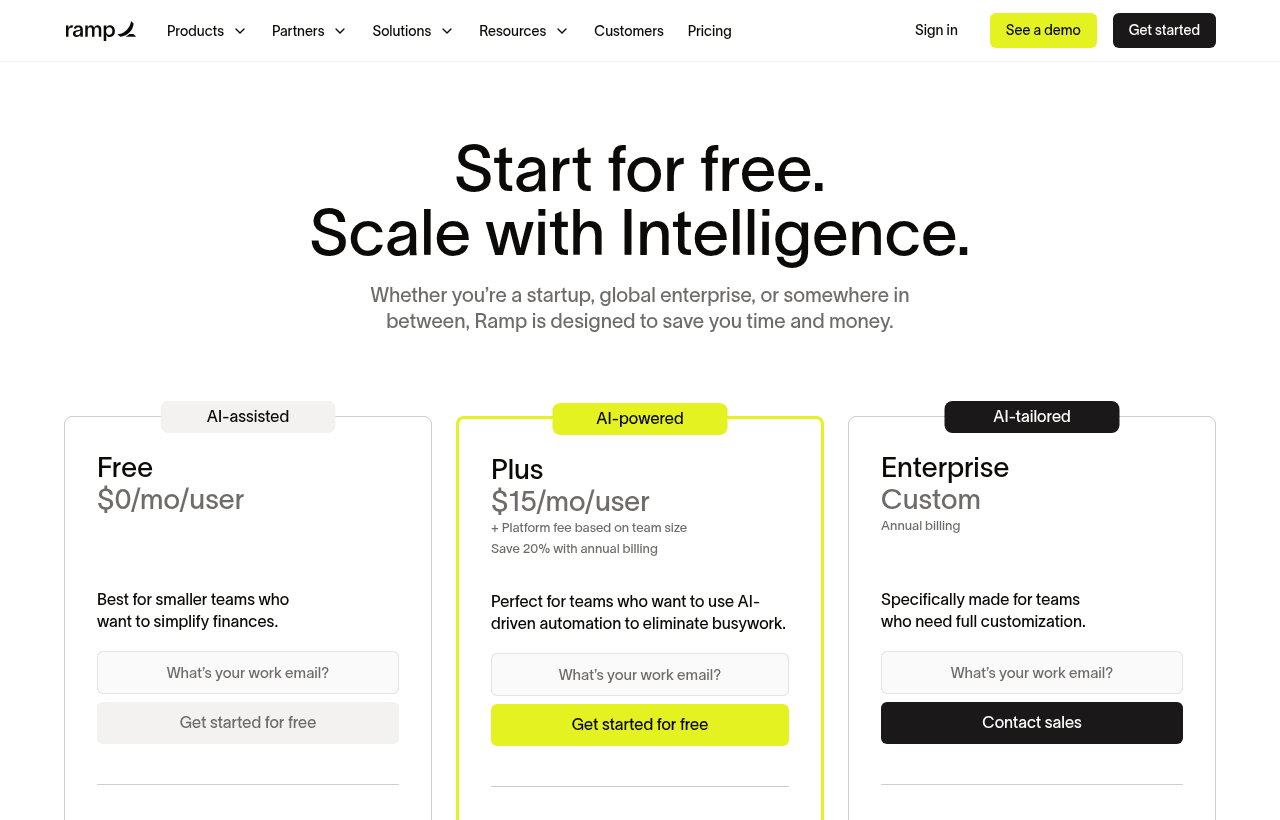
A look at Ramp before the discount, so you can see what the deal saves you.
Automated Accounting That Saves Real Hours
The work that comes after spending is where most of the pain lives. Every transaction has to be categorized, matched to a receipt, and recorded in the accounting system. Done manually, this is tedious, error-prone, and endless, and it usually falls on the founder or an early employee who has far better things to do. It is exactly the kind of undifferentiated back-office work that drains a small team.
Ramp automates this. Because it sees every transaction in real time and understands the context, it categorizes spending automatically and feeds it into the company's accounting. The manual reconciliation that would otherwise consume hours largely disappears. Receipts get matched to transactions, categories get applied, and the books stay current without a person grinding through the work by hand. The finance back office runs closer to on its own.
For a startup, the hours this returns are the real prize. The time a founder would have spent categorizing transactions and chasing receipts goes back into building and selling instead. And because the automation is more consistent than a tired human doing repetitive work late at night, the books are also more accurate. Keeping the accounting current and correct automatically means the company always has trustworthy financials, which pays off when it is time to plan, to raise, or to file taxes.
Cashback on Spending You Already Do
Ramp gives cashback on company spending, and for a startup this is found money. The company is going to spend on the things it needs to operate regardless, so getting a percentage of that spending back is pure upside. Nothing about how the company operates has to change to earn it. The spending that was going to happen anyway now returns a little, which adds up over the course of a year of operating expenses.
For a lean startup, every bit of returned money extends runway, and runway is time, and time is the company's most precious resource. Cashback is not going to transform the finances, but it is real savings on money that would otherwise leave the company entirely. Over a year of software subscriptions, services, and the many operating costs a growing company carries, a steady percentage back is a meaningful amount that the company simply would not have captured otherwise.
The $500 cashback bonus in this deal sits on top of that ongoing cashback. It is an immediate reward for a US-incorporated startup getting started on Ramp, added to the savings the platform generates from normal spending. Combined, the ongoing cashback and the signup bonus mean that adopting Ramp does not just save time on managing spending, it puts money back in the company's account, which is a rare combination for a tool a startup was going to need anyway.
Ramp Compared to a Bank Card and Separate Expense Software
A startup handling company spending without Ramp usually ends up with a bank-issued corporate card plus some separate expense management software, or worse, a personal card and a spreadsheet. Seeing why those combinations fall short shows where Ramp fits.
A plain bank corporate card handles the spending but does nothing to manage it. It offers little in the way of per-person controls, no real-time categorized visibility, no automated accounting, and often no meaningful cashback for a startup. The company still has to bolt on a separate process or tool to handle everything that happens after the swipe, and then it has to make two systems talk to each other. That gap between the card and the management is exactly where the manual work and the errors creep in.
Separate expense management software plus a card is better than a spreadsheet, but the card and the software being separate means they were never designed to work as one. Data has to flow between them, reconciliation is still required, and the seams show. Ramp's advantage is that the card and the spend management are a single platform built for startups, so spending is controlled, tracked, and booked in one integrated flow with no seams to reconcile. Add the cashback and the $500 bonus, and Ramp is not just more capable than the patchwork alternative, it costs the company less to use it.
Making the $500 Cashback Bonus Count
The offer is a $500 cashback bonus for a US-incorporated startup, on top of Ramp's ongoing cashback and its spend management. A team gets the most from it by adopting Ramp as its real spending platform rather than as a card it barely uses. The bonus rewards getting started, and the deeper reward is the time and money the platform saves once the company actually runs its spending through it.
Begin by moving your company's spending onto Ramp, issuing controlled cards to the people who need to spend so the whole team's spending flows through one system. Set sensible limits so spending is delegated without losing control. Let the real-time tracking and automated accounting do their work, so your books stay current and you reclaim the hours you would have spent reconciling. Lean into using Ramp for the operating expenses you already have, so the ongoing cashback accumulates on spending you were doing regardless.
Because Ramp is built for startups and combines the card with the management, adopting it fully is where the value lives. The $500 bonus is a strong reason to start, but the lasting payoff is a company that always knows where its money is going, keeps its books current automatically, and gets a slice of its spending back. Getting started to earn the bonus also puts all of that machinery in place, which is exactly the point.
How Ramp Grows With the Company
The concern with adopting a financial tool early is whether it keeps up as the company grows. Ramp is built to grow with a startup. The controlled cards that serve a founding team of a few extend naturally to a larger team, with the same limits and guardrails scaling to more people. The real-time visibility that mattered when spending was small matters even more as spending grows, because there is more to keep track of and more room for things to slip.
Automated accounting becomes more valuable, not less, as the company scales. More spending means more transactions, and the manual reconciliation that was merely tedious at a small size becomes genuinely unmanageable at a larger one. Because Ramp automates that work, the company can grow its spending without growing a pile of back-office labor to match. The finance function stays lean even as the numbers get bigger, which is exactly what a scaling startup needs.
The cashback also compounds with growth. As the company spends more to operate at a larger scale, the percentage returned grows with it, so the savings scale alongside the spending. A startup that adopts Ramp early builds its spending habits and its financial back office on a platform that keeps serving it as it grows, rather than one it will outgrow. Committing to Ramp now sets up a foundation for company spending that continues to pay off in saved time and returned money as the company gets bigger.
Who Should Claim This Deal
This deal is for US-incorporated startups that need to manage company spending, which is essentially every operating company. The requirement is being a US-incorporated startup, and the reward is a $500 cashback bonus on top of Ramp's corporate card, spend controls, real-time tracking, automated accounting, and ongoing cashback.
It is an especially strong fit for a founder who is tired of reconciling expenses and chasing receipts, because Ramp automates that work away. It fits teams that need to let several people spend without losing control, since controlled cards deliver exactly that balance. And it fits any startup that wants to actually see its spending in real time and keep its runway calculation honest, plus earn cashback on money it was going to spend anyway.
A startup that has felt the pain of a stale spending picture, hours lost to manual bookkeeping, or the awkwardness of company purchases on a founder's personal card will feel Ramp's value quickly. It brings the card and the spend management into one platform built for startups, it saves both time and money, and the $500 cashback bonus rewards a US-incorporated team for getting started. For a company that wants its spending handled and its runway clear, this deal is worth claiming today.
Who Is This Deal For?
Early-Stage Startups
Seed and pre-seed companies looking to move fast without overspending on tools.
Growing SaaS Teams
Series A+ companies scaling their stack and optimizing software costs.
Solo Founders
Indie hackers and bootstrapped founders who need enterprise tools at startup prices.
Get $500 cashback bonus off Ramp
Premium deal. Upgrade once, unlock everything.
!Eligibility Requirements
US-incorporated startup
Frequently Asked Questions
Everything you need to know about this startup deal.
Yes, completely free — no annual fees, card fees, or transaction fees.
Get the weekly deals digest
New verified startup deals every week. No spam, ever. Unsubscribe anytime.
Related Offers

Stripe Atlas
Used by 6,540 members
$500 off incorporation
Get $500 off Stripe Atlas and incorporate your startup as a US Delaware C-Corp in minutes. The legal foundation every investor expects.
View offer
TinCheck
Used by 75 members
First real-time check free
Real-time IRS TIN and name verification from Sovos. Catch a wrong contractor or vendor TIN before it becomes a stacked IRS penalty and a backup-withholding headache.
View offer
Navan
Used by 1,799 members
3 months free
Get 3 months of Navan free. The all-in-one travel and expense management platform that replaces your corporate card, expense reports, and travel booking.
View offer
doola
Used by 480 members
30% off first purchase
Get 30% off your first purchase, the all-in-one platform to form a US LLC or C-Corp, get an EIN, open a US bank account, and stay tax-compliant from anywhere in the world.
View offer
Expensify
Used by 2,178 members
3 months free Collect
Expense management and corporate cards, receipt scanning, approval workflows, and reimbursement automation.
View offer
Wave
Used by 1,458 members
Free forever
Free accounting and invoicing for small businesses. No monthly fees, ever. Revenue from payment processing.
View offerDeal Summary
Looking for more startup deals?
Browse all offers