
Freshbooks Promo Code: 6 months free Plus
Invoicing and accounting for service businesses, send invoices, track expenses, and manage projects.
Free · Opens in new tab
Free · No account required. Sign up to track your deals.
Deal Highlights
What Freshbooks Gives a Startup
Freshbooks is invoicing and accounting built for service businesses, letting a team send invoices, track expenses, and manage projects, and the deal on this page is six months free on the Plus plan. For a service-based startup or a freelancer, that combination is close to ideal. The people who sell their time and expertise have a specific set of money problems, getting invoices out, getting paid, tracking what they spend, and keeping the books clean enough to understand the business and file taxes. Freshbooks is shaped around exactly those problems, and six months free covers the stretch when a young service business can least afford another subscription.
The offer matters because six months is long enough to run a real business cycle through the tool, not just try it. A freelancer or a small service team can invoice actual clients, track actual expenses, and manage actual projects across half a year, which is enough time to see whether Freshbooks genuinely makes getting paid easier and the books clearer. By the time the free period ends, the tool is either woven into how the business runs or it is not, and that decision will have been made from real experience rather than a quick trial.
This deal is aimed at service-based startups and freelancers specifically, and that focus is a strength rather than a limitation. Accounting tools that try to serve every kind of business often serve none of them particularly well, burying a freelancer under features built for inventory-heavy product companies. Freshbooks concentrates on the way service businesses actually operate, billing for time and work rather than managing stock, which means the tool fits the reader's business naturally instead of forcing the business to adapt to it. For a startup that sells services, that fit is exactly what makes the tool worth adopting.
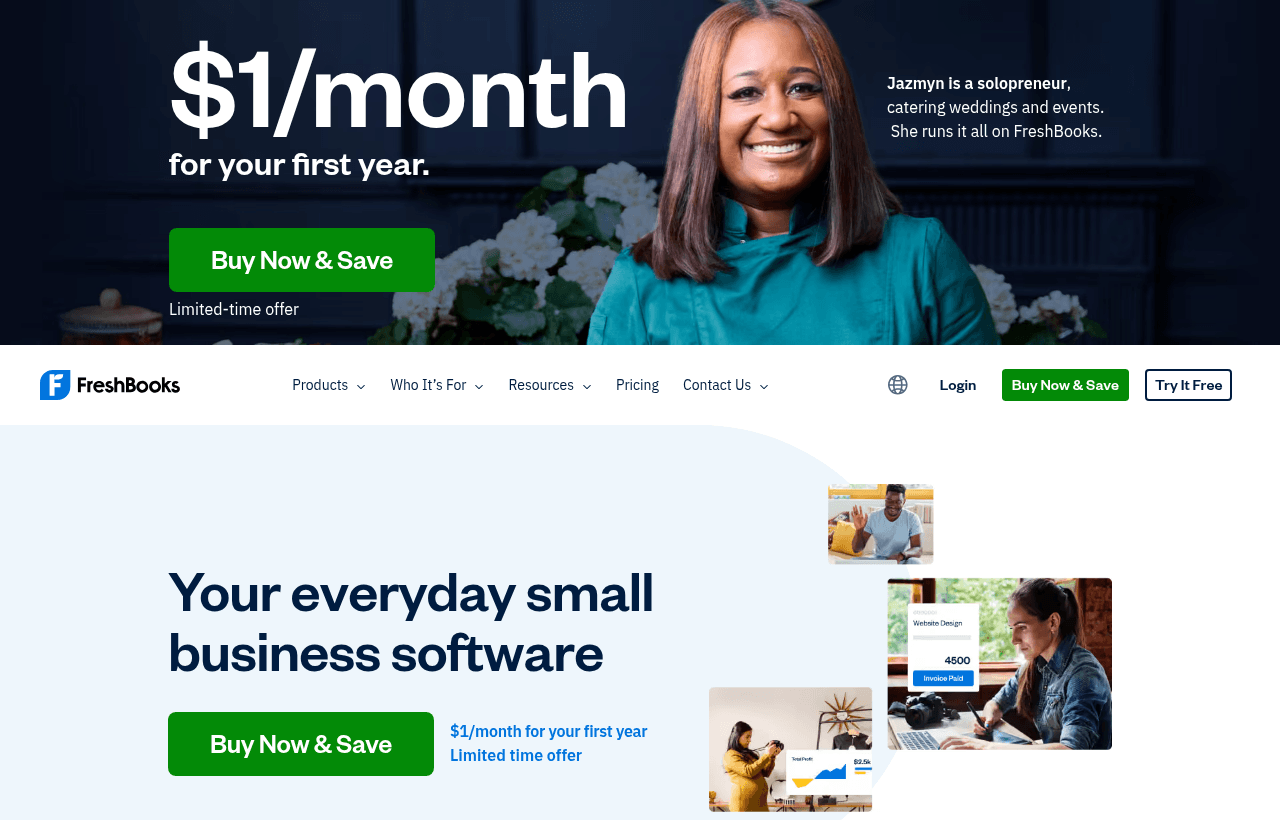
Freshbooks, one of the tools included in this startup deal.
Invoicing That Gets the Business Paid
The heart of Freshbooks is invoicing, and for a service business, invoicing is not a back-office chore, it is how money comes in. Freshbooks lets a team create professional invoices, send them to clients, and track whether they have been viewed and paid. For a freelancer or a small service startup, getting invoices out quickly and looking polished doing it directly affects cash flow, which is the thing that keeps an early business alive.
The professional presentation matters more than it seems. An invoice is a reflection of the business, and a clean, branded invoice signals a company that is organized and serious, while a rough one sent from a document template signals the opposite. For a young service business trying to be taken seriously by clients, having invoices that look the part supports the reputation the founder is working to build. Freshbooks makes that professional look the default, so even a solo freelancer sends invoices that look like they came from an established firm.
Getting paid faster is where invoicing turns into survival for an early service business. Freshbooks makes it easy for clients to pay, tracks which invoices are outstanding, and helps the team follow up on the ones that are late, which shortens the gap between doing the work and having the money in hand. For a startup or freelancer where a slow-paying client can create a genuine cash crunch, tightening that cycle is one of the most valuable things a tool can do. Freshbooks is built to keep the money moving, which is exactly what a service business needs.
Expense Tracking That Keeps the Books Clean
Freshbooks lets a service business track its expenses, capturing what the company spends so the books stay accurate and tax time is not a scramble. For a freelancer or small team, expense tracking is easy to neglect and painful to reconstruct later, and a tool that makes it a small ongoing habit rather than a year-end panic is worth a great deal. Every expense captured as it happens is one less receipt to hunt for and one more deduction the business does not lose.
For a service business, clean expense tracking is also what makes the true health of the company visible. Revenue alone does not tell a freelancer whether the business is actually profitable; the picture only becomes clear once expenses are subtracted. Freshbooks keeping expenses recorded alongside income means the founder can see what the business really earns, not just what it bills. For an early company making decisions about what to spend and what to charge, having that accurate picture is the difference between running the business on facts and running it on guesses.
Tracking expenses continuously also protects the business at tax time, which is where disorganized service businesses tend to lose money and sleep. A freelancer who has recorded expenses all year hands over clean numbers and claims every deduction they are entitled to, while one who has not spends the season reconstructing a year from scattered receipts and probably misses deductions worth real money. Freshbooks turning expense tracking into a routine part of running the business means tax season becomes a report to pull rather than a crisis to survive.
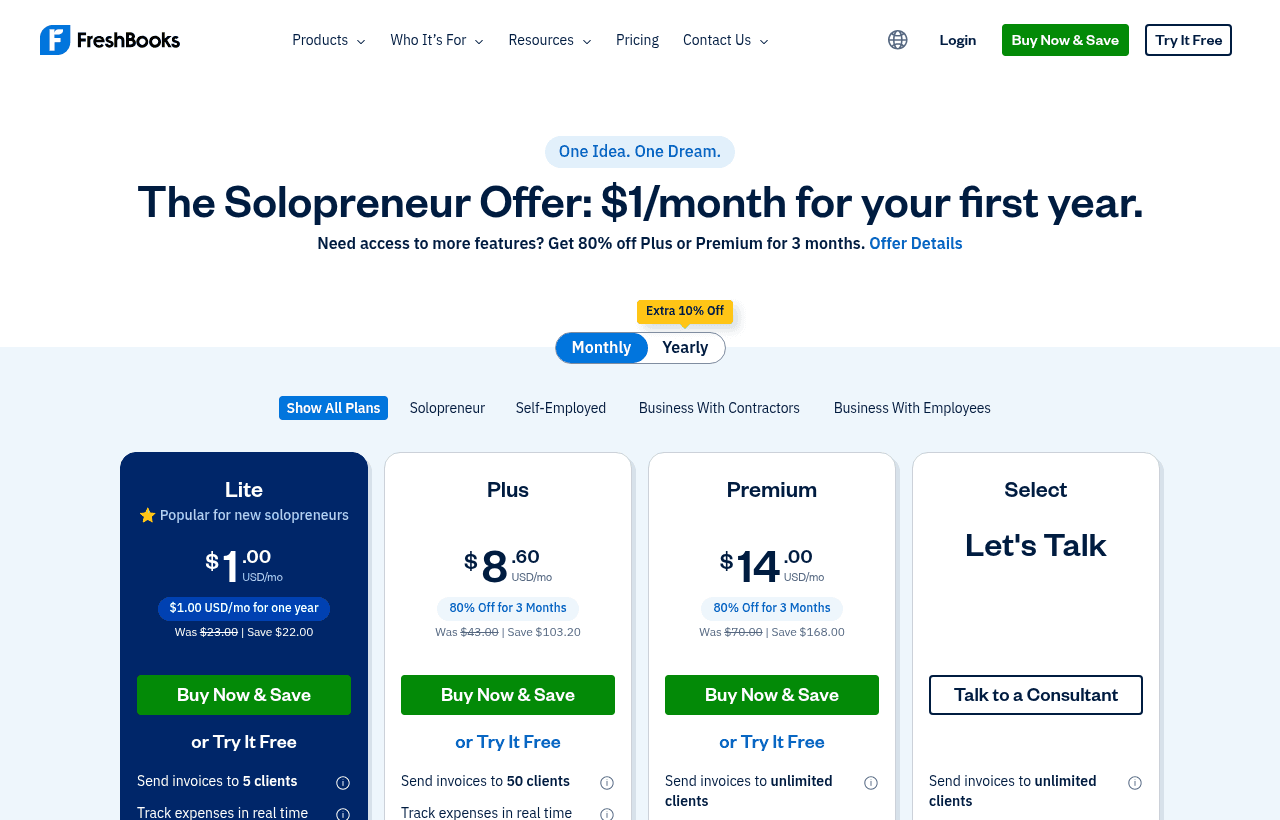
A look at Freshbooks before the discount, so you can see what the deal saves you.
Project Management Built for Billable Work
Freshbooks includes project management aimed at the way service businesses work, connecting the work being done to the money being billed for it. For a service startup or freelancer, this link is what keeps projects profitable. Being able to manage a project, track the time and effort going into it, and tie that back to invoicing means the business always knows whether a project is worth what the client is paying, which is a question service businesses too often answer too late.
This matters because the most common way a service business quietly loses money is undercharging for work that took longer than expected. Without tracking, a project that ballooned in scope looks the same as one that went smoothly, and the founder never learns which clients and which kinds of work actually pay. Freshbooks tying project work to billing surfaces that reality, so the team can see where its time really goes and price future work accordingly. For a freelancer whose only inventory is their hours, knowing which work is profitable is essential.
Managing projects in the same tool that handles invoicing and expenses also keeps the whole business in one place, which is exactly what a small service team needs. Rather than tracking projects in one app, hours in another, and invoices in a third, the team runs the connected pieces of its business from a single system. When a project is done, the work that was tracked flows into an invoice, and the expenses tied to it are already recorded. That integration removes the seams where information gets lost and time gets wasted, which is precisely the friction a lean service business wants to eliminate.
Accounting That a Non-Accountant Can Run
Freshbooks is accounting software, but it is built so that a freelancer or service founder who is not an accountant can actually run it. For an early service business, this accessibility is what makes proper bookkeeping happen at all. Traditional accounting tools assume the user speaks the language of accounting, and a founder who does not simply avoids them, keeping the books in a spreadsheet or not at all. Freshbooks meets service businesses where they are, so the books get kept properly by someone who never trained to keep them.
Having real accounting behind the business, rather than a makeshift spreadsheet, gives a startup reports it can actually use to make decisions. The founder can see income, expenses, outstanding invoices, and the overall shape of the business's finances without assembling it all by hand. For a young service company, that visibility turns money from a source of anxiety into information the team can act on, which is exactly what a founder needs to steer the business toward profitability rather than just hoping it gets there.
Proper accounting from the start also makes the business easier to hand to a professional when the time comes. A service business that keeps clean books in Freshbooks can give its accountant organized numbers at tax time or when it needs financial advice, rather than a shoebox of receipts and a messy spreadsheet. That saves money on professional fees and reduces the risk of costly mistakes. For a startup or freelancer that will eventually work with an accountant, having the books already in order is a quiet but real advantage that Freshbooks builds in from day one.
Freshbooks Compared to Spreadsheets and General Accounting Tools
The default for many freelancers and service startups is a spreadsheet, tracking invoices and expenses by hand in a grid that made sense when the business was tiny. This costs nothing but breaks down as the business grows. There is no way to see which invoices a client has viewed, no automatic follow-up on late payments, no clean link between projects and billing, and no real accounting behind the numbers. The spreadsheet turns into a fragile, manual system that eats time and hides the true state of the business.
Freshbooks replaces that spreadsheet with a system designed for exactly this kind of business. Invoices are professional and trackable, expenses are captured properly, projects connect to billing, and real accounting sits underneath it all. The service startup gets the organization it was faking in a spreadsheet, without the manual effort and the blind spots. With six months free on the Plus plan, making that upgrade costs nothing during the stretch when a young business is most protective of its budget.
Compared to general accounting platforms built for every kind of company, Freshbooks wins for service businesses through focus. A freelancer does not need inventory management, complex stock accounting, or the many features aimed at product companies, and being forced to navigate around them makes a general tool harder to use than it should be. Freshbooks concentrates on billing for time and work, which is what a service business actually does, so the tool feels tailored rather than generic. For a service-based startup or freelancer, that focus makes Freshbooks the more natural fit, and the deal makes it easy to adopt.
How Freshbooks Grows With a Service Business
A service business changes as it grows, and Freshbooks is built to grow with it. A freelancer might start by simply invoicing a few clients, then add expense tracking as the business gets more complex, then lean on project management as jobs get bigger and teams get involved. The tool supports each stage without the founder switching systems, so the business that started as one person invoicing clients can become a small agency running multiple projects on the same platform it began with.
This continuity is valuable because switching financial tools is painful and risky, exactly the kind of disruption a growing business wants to avoid. Financial history, client records, and established habits do not move cleanly between systems, and a mid-growth migration is a distraction a busy service business can hardly afford. By starting on a tool designed to scale from freelancer to small firm, the startup avoids that migration and keeps its financial history intact as it grows. The Plus plan the deal provides is a substantial tier, room the business can grow into rather than out of.
The habits Freshbooks encourages also compound as the business scales. A freelancer who learns to invoice promptly, track every expense, and tie projects to billing carries those disciplines into a larger operation, where they matter even more. The clean books that were easy to maintain as a solo operator become the foundation for making bigger financial decisions with confidence. Starting these practices early on a tool built to support them means the business is well organized precisely when good organization becomes essential rather than optional.
Making the Six Months Free Count
To get real value from the six months free on the Plus plan, a service startup or freelancer should move its actual billing into Freshbooks from the start rather than testing on the side. Send real invoices to real clients, track the real expenses of the business, and manage a real project through the tool. The offer is long enough to run the genuine operation of the business through Freshbooks, and that is the only way to know whether it truly makes getting paid and keeping the books easier.
Use the free period to build the habits that make the tool pay off. Get every invoice out through Freshbooks and use its tracking to follow up on late payers, record expenses as they happen rather than saving them for later, and connect project work to billing so the business learns which work is actually profitable. Six months is enough time for these to become second nature, and the point of the deal is to come out the other side with the business running on solid financial habits, not just to have tried a tool.
Watch what changes over the free period, because that is where the decision gets made. Notice whether invoices get paid faster, whether the books are clearer, whether tax time looks less frightening, and whether the founder finally understands the true financial shape of the business. A service startup or freelancer that runs its real finances through Freshbooks for six months will know from experience whether the tool has become essential. If getting paid is easier and the books are clean, keeping Freshbooks after the free period is an easy call.
Who Should Claim This Deal
This deal fits a service-based startup or a freelancer that wants to get paid faster and keep clean books without becoming an accountant. If the business bills clients for time and work, needs professional invoices that get paid, wants expenses tracked properly for tax time, and would benefit from tying projects to billing, Freshbooks is built for exactly that kind of company. The six months free on the Plus plan cover the business through a real operating stretch at no cost, which is precisely when a young service company most needs the room.
It is an especially strong match for a freelancer moving off spreadsheets, a small agency or consultancy that wants its billing and books in one focused system, and any service founder who wants to understand the true financial health of the business without hiring help too early. Note that the deal is intended for service-based startups and freelancers, which is exactly the audience Freshbooks serves best. Claim the six months free, move real invoicing and expense tracking into Freshbooks, and run the business through it. By the end, the team will know whether Freshbooks is the financial backbone of the company, and finding out will have cost nothing.
Who Is This Deal For?
Early-Stage Startups
Seed and pre-seed companies looking to move fast without overspending on tools.
Growing SaaS Teams
Series A+ companies scaling their stack and optimizing software costs.
Solo Founders
Indie hackers and bootstrapped founders who need enterprise tools at startup prices.
Get 6 months free Plus off Freshbooks
Free for all startups. Claim instantly.
!Eligibility Requirements
Service-based startup or freelancer
Frequently Asked Questions
Everything you need to know about this startup deal.
FreshBooks does not have a permanent free plan. The Lite plan starts at $17/month (5 clients). The Plus plan ($30/month) adds unlimited clients and proposals. The 6-month deal saves $102–$180 depending on plan.
Get the weekly deals digest
New verified startup deals every week. No spam, ever. Unsubscribe anytime.
Related Offers

Stripe Atlas
Used by 6,540 members
$500 off incorporation
Get $500 off Stripe Atlas and incorporate your startup as a US Delaware C-Corp in minutes. The legal foundation every investor expects.
View offer
TinCheck
Used by 75 members
First real-time check free
Real-time IRS TIN and name verification from Sovos. Catch a wrong contractor or vendor TIN before it becomes a stacked IRS penalty and a backup-withholding headache.
View offer
Navan
Used by 1,799 members
3 months free
Get 3 months of Navan free. The all-in-one travel and expense management platform that replaces your corporate card, expense reports, and travel booking.
View offer
Ramp
Used by 877 members
$500 cashback bonus
Corporate card and spend management for startups, 1.5% cashback, real-time expense tracking, and automated accounting.
View offer
doola
Used by 480 members
30% off first purchase
Get 30% off your first purchase, the all-in-one platform to form a US LLC or C-Corp, get an EIN, open a US bank account, and stay tax-compliant from anywhere in the world.
View offer
Expensify
Used by 2,178 members
3 months free Collect
Expense management and corporate cards, receipt scanning, approval workflows, and reimbursement automation.
View offerDeal Summary
Looking for more startup deals?
Browse all offers