
Pendo Startup Credits: $2,000 in credits
Product analytics and in-app guidance platform, understand user behavior and guide users without code changes.
Free · Opens in new tab
Already have an account? Log in
Deal Highlights
What Pendo Gives a Startup
Pendo is a product analytics and in-app guidance platform, and this deal comes with $2,000 in credits to put it to work. Pendo does two big jobs at once. It shows a startup exactly how people use its product, and it lets the team guide those users with in-app messages, walkthroughs, and tooltips without shipping new code for every change. The credits give a SaaS startup room to run that engine on real usage before it ever becomes a line item.
The requirement is straightforward. This is for a SaaS startup with active users, which is the exact stage where Pendo pays off. Analytics only matter when there is behavior to measure, and in-app guidance only helps when there are users moving through the product. A team with live users and real questions about what those users do is precisely who Pendo is built for.
The combination of analytics and guidance in one platform is the point. Most startups measure behavior in one tool and try to change it with another, and the two never quite connect. Pendo closes that loop. The team sees where users struggle, then guides them through that exact spot, then measures whether the guidance worked, all in the same system. That tight loop is how a small team improves a product without guessing.
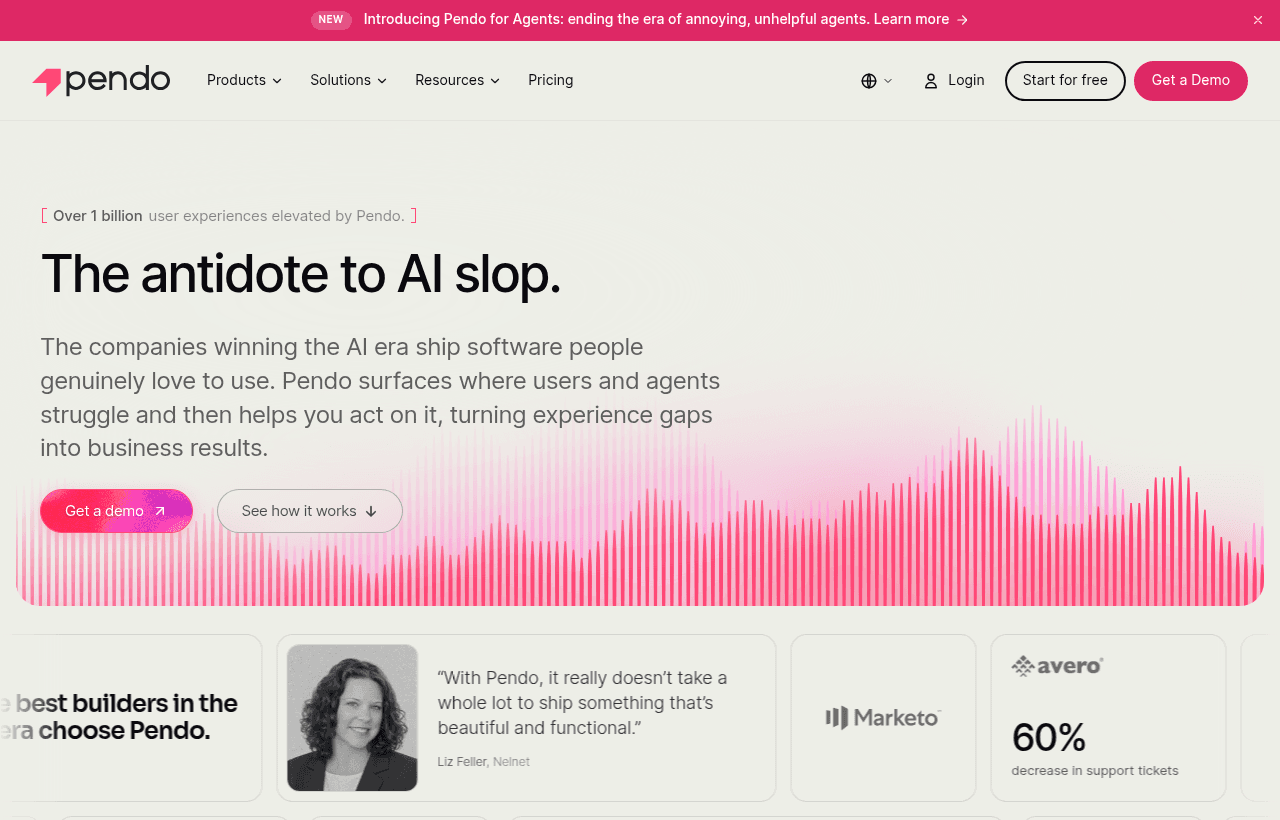
Pendo, one of the tools included in this startup deal.
Understanding How Users Actually Behave
Pendo captures how users move through a product, which features they touch, where they linger, and where they drop off. For a startup, that visibility replaces opinion with evidence. Founders tend to have strong beliefs about what users do, and those beliefs are often wrong in ways that cost months. Pendo shows the actual paths people take instead of the paths the team assumes they take.
A crucial detail is that Pendo can track feature usage without the team instrumenting every click by hand. That matters because engineering time is the scarcest resource in an early company. When product managers can define and analyze usage without filing a ticket for every new event, the pace of learning speeds up. The team asks a question about behavior and gets an answer the same day, not after the next sprint.
This behavioral data drives better decisions across the company. Product prioritizes the features people actually use and reconsiders the ones nobody touches. Design finds the screens where users get stuck. Leadership sees which parts of the product create value and which are dead weight. A startup that grounds these calls in real usage data avoids the expensive mistake of building for an imagined user instead of the real one.
Guiding Users Without Shipping Code
The second half of Pendo is in-app guidance. A team can build onboarding flows, feature announcements, tooltips, and walkthroughs that appear inside the product, and it can do this without an engineer writing and deploying code for each one. That decoupling is powerful for a startup, because it means the people closest to the user, product and success teams, can act on what they learn immediately.
The speed advantage is real. When a startup notices users struggling with a step, the traditional fix is to design a change, get it into the engineering backlog, wait for a deploy, and hope it helped. With Pendo, the product team can publish a guide that walks users through the tricky step that afternoon and watch whether it moves the numbers. The distance between spotting a problem and addressing it collapses from weeks to hours.
In-app guidance also improves the two moments that most shape whether users stick. Onboarding is where new users either reach value or churn, and a well-built walkthrough gets more of them to the aha moment. Feature adoption is where existing users either discover what the team built or ignore it, and targeted in-app announcements put new capabilities in front of the exact users who would benefit. Both levers directly affect retention, which is the metric that decides whether a SaaS startup survives.

A look at Pendo before the discount, so you can see what the deal saves you.
Closing the Loop Between Insight and Action
The reason to have analytics and guidance in one platform is the loop between them. A startup sees, in the analytics, that users drop off at a particular step. It builds an in-app guide to help them through that step. Then it measures, again in the analytics, whether the guide reduced the drop-off. Same tool, same data, one continuous cycle of learning and improving.
That loop is hard to run when the pieces live in separate systems. Stitching analytics from one vendor to guidance from another means reconciling different definitions of a user, a session, and a conversion, and the friction usually means the loop never actually closes. Teams measure, or they guide, but rarely both in a way that connects. Pendo makes the connected version the default, which is how a small team gets compounding improvement instead of one-off experiments.
For a startup, this compounding is the whole strategy. Each cycle teaches the team something and leaves the product a little better at converting and retaining users. Run that loop weekly and the gains stack. The $2,000 in credits is meant to fund the early cycles, the ones that establish the habit and prove the value, before the platform becomes a permanent part of how the company works.
Turning Data Into Retention
Retention is the number that matters most for a SaaS startup, because acquiring users is expensive and losing them quietly undoes all of it. Pendo attacks retention from both directions. Its analytics reveal why users leave, by showing where engagement fades and which behaviors separate the users who stay from the ones who go. Its guidance intervenes before they leave, by nudging at-risk users toward the actions that correlate with sticking around.
Identifying the behaviors that predict retention is genuinely valuable intelligence. If users who adopt a particular feature in their first week retain far better, the entire company should be pushing new users toward that feature. Pendo surfaces that pattern, and then its in-app guidance is the tool to act on it, steering fresh users to the sticky feature during onboarding. The insight and the intervention live in the same place.
This focus on retention changes the economics of the business. A startup that lifts retention gets more revenue from the same acquisition spend, a longer customer lifetime, and healthier growth that does not depend on ever-increasing marketing budgets. For a company watching runway, improving how many users stay is often a higher-leverage move than chasing more users to sign up. Pendo gives a team the data and the tools to make that improvement deliberate rather than accidental.
Collecting User Feedback in Context
Beyond behavior and guidance, Pendo lets a startup gather feedback from users inside the product, at the moment that matters. Rather than emailing a survey and hoping for replies, the team can ask a targeted question right where a user just took an action, when the experience is fresh and the response is honest. Contextual feedback is far more useful than feedback collected days later out of context.
This closes a different kind of gap for a startup. Analytics tell the team what users do, but not always why. A user who abandons a flow leaves a data point, not an explanation. In-product feedback fills that in, letting the team ask the abandoning user what stopped them. Pairing the quantitative what with the qualitative why gives a fuller picture than either alone, and it does so without adding a separate research tool to the stack.
For an early team, that combined view shortens the path to good decisions. The team stops debating why users behave a certain way and starts asking them directly, in the product, at scale. The answers guide the roadmap with confidence. A startup that listens to users at the exact point of friction builds a product that fits them, and it does it faster than a team relying on guesswork or occasional customer calls.
Pendo Compared to Piecing It Together Yourself
The alternative to Pendo is assembling the same capabilities from separate tools. A product analytics tool for behavior, a separate onboarding or tour tool for guidance, a survey tool for feedback, and glue code to hold them together. Each piece works on its own. The problem is that they do not share a definition of the user or the session, so the connected view Pendo provides never fully materializes.
The integration cost is the hidden expense. Every separate tool is another SDK, another data model, another billing relationship, and another thing that breaks when the product changes. Engineers spend time keeping the pieces in sync instead of building product. For a startup with a small team, that maintenance drag is exactly the kind of work that should be avoided. One platform that does analytics, guidance, and feedback together removes it.
There are also cheaper single-purpose tools, and for a very early product they can be enough. Pendo's advantage shows up as the product and the questions get more sophisticated, when a startup wants to connect what it sees to what it does and measure the result in one place. The $2,000 in credits is the low-risk way to find out whether that integrated approach fits, using the startup's own active users as the test rather than a demo dataset.
Making the $2,000 in Credits Count
Credits are most valuable when a team spends them on questions that matter rather than spreading them thin. Before installing Pendo, a startup should name the one or two behaviors it most wants to understand, usually something tied to onboarding completion or the adoption of a core feature. Pointing the platform at a specific question from day one produces answers worth acting on, rather than a dashboard nobody reads.
A good early plan is to run the full loop at least once during the credit period. Instrument the product, find a real drop-off in the analytics, build an in-app guide to address it, and measure whether the guide moved the number. Completing that cycle proves the platform's value in concrete terms, a retention or conversion improvement the team can see, which makes the decision to continue easy to justify to a co-founder or a board.
The credits also buy time to build the habit. The teams that get the most from Pendo treat it as a weekly practice, checking behavior, shipping a guide, gathering feedback, and iterating. Using the credit window to establish that rhythm means that by the time the credits run out, the platform is woven into how the company improves its product. A startup that treats the credits as a trial of a permanent practice, not a one-time experiment, gets far more from them.
Who Should Claim This Deal
This deal fits a SaaS startup with active users that wants to understand and improve how those users behave. The requirement is exactly that, active users, because Pendo's value depends on having real behavior to measure and real people to guide. A team past the launch stage, with users in the product and open questions about what they do, is the ideal fit.
It fits teams focused on retention and adoption rather than only acquisition. If a startup is spending to bring users in but losing too many before they reach value, Pendo's combination of analytics and in-app guidance targets that exact leak. The platform helps the team see where users fall away and act to keep them, which is often the highest-leverage work an early SaaS company can do.
It also fits product-led teams that want to move without waiting on engineering for every change. Pendo lets product and success teams analyze behavior, guide users, and collect feedback without shipping code each time, which suits a small company where engineering bandwidth is precious. A startup that fits the active-user requirement and wants to run a real cycle of insight and improvement should claim the $2,000 in credits, point the platform at its most important behavioral question, and complete at least one full loop before the credits run out.
Who Is This Deal For?
Early-Stage Startups
Seed and pre-seed companies looking to move fast without overspending on tools.
Growing SaaS Teams
Series A+ companies scaling their stack and optimizing software costs.
Solo Founders
Indie hackers and bootstrapped founders who need enterprise tools at startup prices.
Get $2,000 in credits off Pendo
Premium deal. Upgrade once, unlock everything.
!Eligibility Requirements
SaaS startup with active users
Frequently Asked Questions
Everything you need to know about this startup deal.
Pendo combines analytics + in-app guidance in one platform. Mixpanel focuses on analytics alone (deeper event analysis). Choose Pendo if you want analytics + user guidance together. Choose Mixpanel for the deepest product analytics.
Get the weekly deals digest
New verified startup deals every week. No spam, ever. Unsubscribe anytime.
Related Offers

Higgsfield
55% off annual Business plan
55% off an annual Higgsfield Business plan. Higgsfield is an AI video and image studio with Seedance, Kling, Veo and more in one account.
View offer
Seedance
55% off annual Business plan
55% off an annual Higgsfield Business plan with Seedance included. Seedance is ByteDance's AI video model for text, image and reference-driven clips.
View offerChromaDB
Used by 306 members
Free & Open Source
Open-source embedding database for building AI applications with semantic search.
View offer
Laxis
Used by 2,176 members
Free Plan
AI meeting assistant that records, transcribes, and generates actionable meeting notes.
View offer
Pictory
Used by 659 members
Free Trial
AI-powered video creation tool, turn text, scripts, and blogs into videos.
View offer
Segment
Used by 2,293 members
$25,000 in credits
Collect, clean, and route customer data to every tool in your stack with the leading customer data platform.
View offerDeal Summary
Looking for more startup deals?
Browse all offers