
Together AI Startup Credits: $1,000 in credits
Run and fine-tune open-source LLMs. Llama, Mistral, and custom models on scalable GPU infrastructure.
Free · Opens in new tab
Already have an account? Log in
Deal Highlights
Running an open model like Llama or DeepSeek in production means either renting GPUs and managing infrastructure yourself, or paying a host to do it. Together AI is the second option done well: you call open models through an API, pay per token, and never touch a GPU. For a startup that wants the control and cost of open models without the operational burden of serving them, it is one of the cleanest ways to do it.
The category has real competition and the prices move constantly, so the honest framing is about the pricing model, not a snapshot of rates. This covers how Together charges, how to keep the bill sane, and where it fits against the alternatives.
What Is Together AI?
Together AI is an inference platform for open models. It hosts a large catalog of open-weight large language models and serves them through an API, so you send a request and get a completion without provisioning hardware, loading weights, or managing scaling.
It offers several ways to consume that. Serverless inference is pay-per-token: you call a model, Together runs it, you pay for the tokens processed, and there is no idle cost. Dedicated endpoints give you a reserved GPU by the hour for steady, high-volume workloads. GPU clusters rent raw compute for training or custom serving. And fine-tuning lets you adapt an open model to your data.
The strategic appeal is access to open models with the convenience of a managed API. You get the things open models are chosen for, no per-model vendor lock-in, the option to move to self-hosting later, transparency about which model you are running, without having to operate the serving infrastructure yourself.
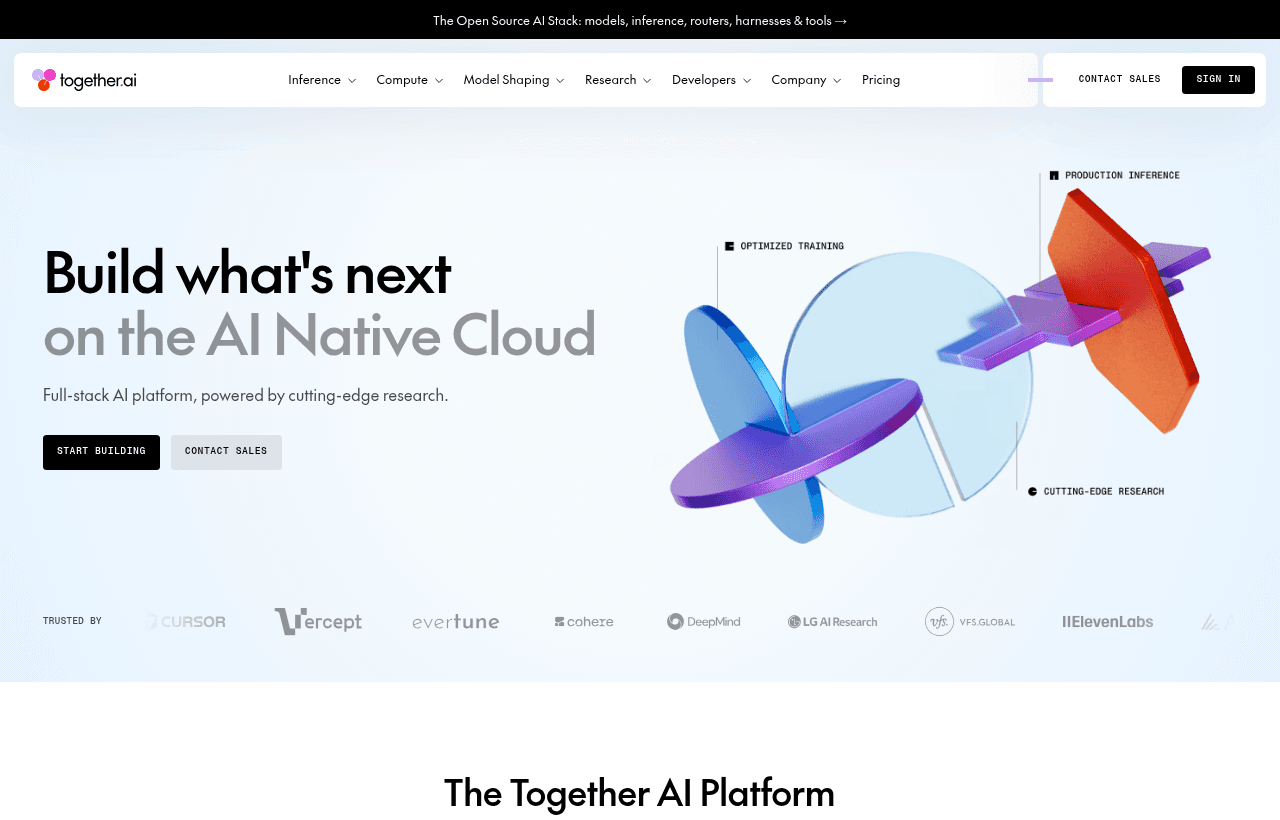
Together AI, one of the tools included in this startup deal.
What's Included in This Deal
- Serverless API access to the open-model catalog
- Pay-per-token inference with no idle GPU cost
- Dedicated endpoints for steady high-volume workloads
- Fine-tuning to adapt models to your use case
- GPU cluster access for training and custom serving
The credits let you build and benchmark against real open models before committing spend, which is the right way to decide whether an open model at Together's price delivers the quality your product needs.
Together AI Pricing: Four Models, One Decision
Together charges four different ways, and picking the right one for your workload is the whole cost decision.
| Product | Billing | Best for |
|---|---|---|
| Serverless | per million tokens | Variable or low-to-mid volume, no idle cost |
| Dedicated endpoint | per GPU-hour | Steady, high-volume, predictable traffic |
| GPU cluster | per GPU-hour | Training and custom serving |
| Fine-tuning | per million training tokens | Adapting a model to your data |
Serverless per-token pricing spans a wide range depending on model size, from cents to several dollars per million tokens, and it is the right default for most startups because you pay only for what you use with no idle charge. Dedicated GPU endpoints bill by the hour whether or not you are using them, which becomes cheaper than per-token only above a high, steady volume where the GPU stays busy.
The core decision is serverless versus dedicated, and it turns on utilization. If your traffic is bursty or modest, serverless wins because a dedicated GPU sitting idle still bills every hour. If you are running enough steady volume to keep a GPU genuinely busy around the clock, a dedicated endpoint can be cheaper per token. The crossover point is a real calculation worth doing once your volume is known, rather than guessing.
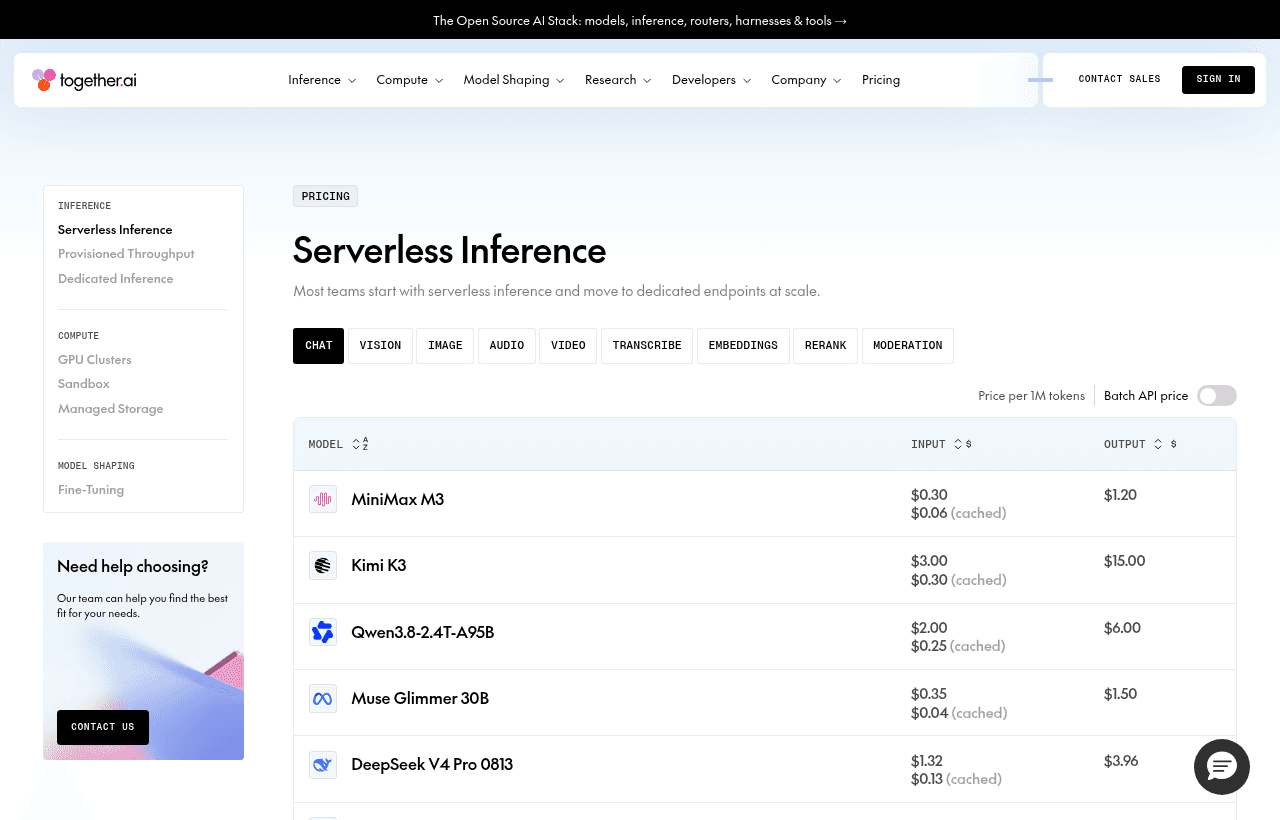
A look at Together AI before the discount, so you can see what the deal saves you.
Keeping the Inference Bill Under Control
Open-model inference is cheaper than premium closed APIs, but the same disciplines that control any AI bill apply, and they compound.
Match the model to the task. Open catalogs span tiny, cheap models to enormous ones. A small model handles classification, extraction, and routing at a fraction of the cost of a large one, and defaulting everything to the biggest model wastes the main advantage of having a range. Route the easy majority to a small model and reserve the large one for genuinely hard tasks.
Cap output tokens. Output costs more than input across every model. Concise-answer instructions, token limits, and structured formats cut the expensive half of each call directly.
Do the serverless-versus-dedicated math before scaling. The most common overspend here is renting a dedicated GPU that sits underused, billing full price for idle time. Stay serverless until your steady utilization genuinely justifies a reserved endpoint.
Monitor from day one. Set spending alerts before a retry-loop bug generates thousands of calls overnight. The largest surprise bills are almost never organic growth.
Stacked together, these routinely move an inference bill by a large factor, and on open models the savings compound with the lower base price.
Together AI vs Fireworks vs Replicate
The open-model hosting space has a few serious players, and they differ more in shape than in headline price.
| Platform | Strength | Shape |
|---|---|---|
| Together AI | Broad catalog, serverless plus dedicated plus raw GPU clusters | Full range from per-token to rented compute |
| Fireworks | Fast serverless per-token inference, competitive rates | Per-token focused, strong for steady text generation |
| Replicate | Run almost any model, strong for multimodal | GPU-second billing, broad model variety |
Together AI and Fireworks are the two main neutral open-model hosts, and they price within a few cents of each other on most popular models. The practical difference is breadth: Together offers the full ladder from serverless per-token up through dedicated endpoints and raw GPU clusters, which matters if you expect to move from prototype to high-volume serving to eventually renting your own compute. Fireworks is strongest as a per-token serverless host for steady text workloads.
Replicate's distinction is running almost any model, including image, video, and audio, with per-GPU-second billing. It shines for multimodal and experimental work, while the per-token hosts are cleaner for high-volume text.
The honest read: for text inference at startup scale, Together and Fireworks are close enough that the decision often comes down to which has the specific model you want and which pricing shape fits your volume. Together's advantage is the growth path from serverless to dedicated to clusters under one roof.
Open Models vs the Closed APIs
Worth being clear about the larger choice, because hosting open models is a strategy, not just a vendor pick.
Open models on a host like Together give you transparency about exactly which model you run, freedom from a single vendor's roadmap, the option to self-host later using the same weights, and often lower cost. The trade is that the very top of the quality benchmark still tends to belong to the closed frontier labs, so for tasks needing the hardest reasoning, a closed premium model may still win.
The pattern many startups settle on is a mix: open models on Together for the high-volume, cost-sensitive majority of calls, and a closed premium model reserved for the minority of tasks that genuinely need frontier capability. Together's per-token pricing makes the open half of that architecture cheap, and keeping model calls behind an abstraction lets you route between them freely.
Latency, Throughput, and the Metrics That Matter
Cost is one axis; performance is the other, and open-model hosts differ on it in ways that affect the user experience directly.
Time to first token is what a user feels as responsiveness. In a chat or streaming interface, how quickly the first word appears matters more to perceived speed than the total generation time. Hosts optimize this differently, and it is worth measuring on your actual model rather than trusting a marketing number.
Throughput, or tokens per second, determines how fast a full response completes and how many concurrent requests you can serve. For a high-volume product, throughput affects both experience and cost, because faster serving means fewer GPU-seconds per response on dedicated setups.
Cold starts apply to some serving modes: a model that has not been called recently may take longer on the first request while it loads. For latency-sensitive products, understanding whether your chosen tier has cold-start behavior is important, and dedicated endpoints avoid it by keeping the model warm.
Consistency under load is the metric benchmarks hide. A host that is fast when idle but degrades badly under concurrent traffic will disappoint exactly when your product is succeeding. Test at realistic concurrency, not with single sequential requests.
The practical guidance is to benchmark the specific model you will use, on inputs shaped like your real traffic, at the concurrency you expect. Published aggregate numbers rarely predict what you will see, and the differences between hosts on your particular workload can outweigh small per-token price gaps.
Who Should Use Together AI?
Use it if you want to run open models in production without operating GPU infrastructure, and you value the transparency and flexibility open weights provide.
Use it if your workload is variable or mid-volume, where serverless per-token billing with no idle cost fits far better than renting dedicated hardware.
Use it if you expect to grow into high-volume serving or training, where having serverless, dedicated endpoints, and GPU clusters under one provider smooths the path.
Look elsewhere, or use selectively, if your product depends on frontier reasoning that the top closed models still lead, where a premium API may be the better choice for those specific calls.
Real Startup Use Cases
A SaaS product running a high volume of summarization and classification moved that workload to a mid-size open model on Together's serverless tier, cutting cost sharply against a premium closed API with no meaningful quality loss, because the task never needed frontier reasoning.
An AI startup prototyped on serverless while traffic was low and unpredictable, then moved its steadiest, highest-volume endpoint to a dedicated GPU once utilization was high enough to make the hourly rate cheaper per token. Same provider, no migration, just a billing change matched to volume.
A team fine-tuning an open model on their own data used Together's fine-tuning and then served the result through the same platform, keeping the whole open-model workflow, adaptation and serving, in one place rather than stitching together separate tools.
How to Claim the Credits
- Follow the link on this page to Together AI and create an account.
- Apply the credits and confirm the balance.
- Benchmark a few open models against your real task, comparing quality and cost on your actual inputs.
- Start on serverless, since it has no idle cost and suits variable volume.
- Route by difficulty: a small model for the easy majority of calls, a larger one only where the task needs it.
- Move to a dedicated endpoint only once steady utilization makes the hourly rate cheaper per token than serverless.
Tips to Get Value
- Default to serverless. No idle cost and pay-per-use fits most startup volume. Only rent dedicated GPUs when utilization genuinely justifies it.
- Do the crossover math. The serverless-to-dedicated switch is a real calculation. An idle dedicated GPU is the most common overspend on this platform.
- Match model size to task. Small models for high-volume simple work, large ones only for hard tasks. The range is the point.
- Cap output length. Output tokens dominate cost. Concise, structured responses cut the expensive half of every call.
- Abstract your model calls. Keeping calls behind an interface lets you route between open and closed models and switch providers without a refactor.
- Set spend alerts on day one. The biggest inference bills come from loops, not growth. Catch them with alerts before the invoice does.
- Benchmark at real concurrency. A host that is fast when idle can degrade under load. Test with traffic shaped like your production, not single sequential calls, before you commit a product to it.
- Keep fine-tuning data portable. If you fine-tune, retain your training data and configuration so the adapted model can be rebuilt or moved. The open-weight ecosystem is the reason you can, and it is worth preserving that freedom.
Who Is This Deal For?
Early-Stage Startups
Seed and pre-seed companies looking to move fast without overspending on tools.
Growing SaaS Teams
Series A+ companies scaling their stack and optimizing software costs.
Solo Founders
Indie hackers and bootstrapped founders who need enterprise tools at startup prices.
Get $1,000 in credits off Together AI
Premium deal. Upgrade once, unlock everything.
!Eligibility Requirements
AI startup using open-source models
Frequently Asked Questions
Everything you need to know about this startup deal.
Free credits for new users. Pay-per-token after.
Get the weekly deals digest
New verified startup deals every week. No spam, ever. Unsubscribe anytime.
Related Offers

Higgsfield
55% off annual Business plan
55% off an annual Higgsfield Business plan. Higgsfield is an AI video and image studio with Seedance, Kling, Veo and more in one account.
View offer
Seedance
55% off annual Business plan
55% off an annual Higgsfield Business plan with Seedance included. Seedance is ByteDance's AI video model for text, image and reference-driven clips.
View offerChromaDB
Used by 306 members
Free & Open Source
Open-source embedding database for building AI applications with semantic search.
View offer
Laxis
Used by 2,176 members
Free Plan
AI meeting assistant that records, transcribes, and generates actionable meeting notes.
View offer
Pictory
Used by 659 members
Free Trial
AI-powered video creation tool, turn text, scripts, and blogs into videos.
View offer
Segment
Used by 2,293 members
$25,000 in credits
Collect, clean, and route customer data to every tool in your stack with the leading customer data platform.
View offerDeal Summary
Looking for more startup deals?
Browse all offers