
Upstash Startup Credits: $500 in credits
Serverless Redis and Kafka with pay-per-request pricing. The data infrastructure that scales to zero.
Premium: $79/year for unlimited deals
Already have an account? Log in
Deal Highlights
What Upstash Gives a Startup
Upstash is serverless Redis and Kafka with pay-per-request pricing, data infrastructure that scales to zero, giving a startup fast data infrastructure without managing servers and without paying for idle capacity. Redis is a fast in-memory data store used for caching, sessions, and real-time data, and Kafka is used for event streaming, and Upstash provides both serverless, so a startup gets this infrastructure with usage-based pricing that costs nothing when idle. The startup deal is $500 in credits, covering an early-stage startup on a new Upstash account during the stage when building data infrastructure matters.
The reason this matters is that applications often need fast data infrastructure like Redis for caching and real-time data or Kafka for event streaming, but running these traditionally means managing servers and paying for capacity whether or not it is used, which is burdensome and wasteful for a startup. A startup that needs this infrastructure would rather not operate servers or pay for idle capacity, especially at the unpredictable, often low early usage. Upstash providing serverless Redis and Kafka with pay-per-request pricing means a startup gets the infrastructure without managing servers and pays only for what it uses, which suits startup economics. The $500 in credits supports this during the early stage.
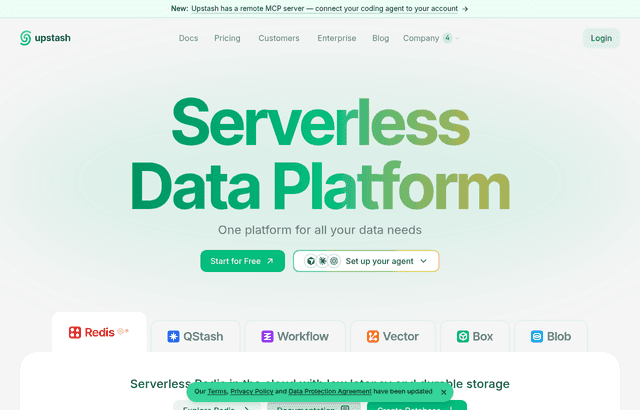
Upstash, one of the tools included in this startup deal.
Serverless Data Infrastructure Without Managing Servers
The core value of Upstash is providing Redis and Kafka serverless, so a startup gets this data infrastructure without managing the servers it traditionally requires. Running Redis or Kafka traditionally means provisioning, operating, and scaling servers, which is operational work a startup would rather avoid, whereas serverless means the infrastructure is managed and the team just uses it. Upstash providing serverless Redis and Kafka means a startup gets the data infrastructure without the operational burden of managing servers, which frees the team from that work.
For a startup, this matters because managing data infrastructure is operational effort a small team would rather not spend, and serverless removes that burden by handling the servers, so the team just uses the infrastructure. When Upstash manages the Redis and Kafka, the team gets the fast data store and event streaming it needs without operating and scaling servers, which keeps its effort on the product. Upstash providing serverless data infrastructure means a startup gets Redis and Kafka without the operational burden, which is a large part of its value. The $500 in credits lets a startup use serverless data infrastructure during the early stage.
Pay-Per-Request Pricing That Scales to Zero
Upstash's pay-per-request pricing, where the infrastructure scales to zero, fits startup economics because the startup pays only for the requests it makes and nothing when the infrastructure is idle. Traditional data infrastructure requires paying for provisioned capacity whether or not it is used, which is wasteful for a startup with low or unpredictable early usage, whereas pay-per-request pricing means the cost aligns with usage and drops to zero when idle. Upstash providing this pricing means a startup pays only for what it uses, which is efficient and suits the unpredictable early usage.
For a startup, this matters because paying for idle capacity is wasteful, especially early when usage is low and unpredictable, and pay-per-request pricing that scales to zero means the startup pays only for actual usage. When the infrastructure scales to zero and charges per request, the startup is not paying for idle capacity, and the cost grows only with actual usage, which is exactly the economics a startup wants. Upstash providing pay-per-request pricing means a startup gets the data infrastructure with costs aligned to usage, which is efficient for an early company. This pricing model, combined with the serverless management, means Upstash suits startup economics well, and the credits cover the early usage.

A look at Upstash before the discount, so you can see what the deal saves you.
Redis for Caching and Real-Time Data
Upstash's serverless Redis gives a startup a fast in-memory data store for caching, sessions, and real-time data, which are common needs that Redis serves well. Redis is used to cache data for fast access, store session data, and handle real-time data, all of which improve application performance and enable real-time features. Upstash providing serverless Redis means a startup can use Redis for these purposes without managing a Redis server, which is valuable for applications that need fast data access or real-time features.
For a startup, this matters because caching and real-time data are common needs that improve application performance and enable features, and Redis serves them well, so having it available serverless is useful. When the application can use Redis for caching, it performs faster, and for real-time data, it can enable real-time features, both of which improve the product. Upstash providing serverless Redis means a startup can use Redis for these purposes without the operational burden, which is valuable for building a performant application. This serverless Redis is a large part of Upstash's value, and the credits let a startup use it during the early stage.
Kafka for Event Streaming
Upstash's serverless Kafka gives a startup event streaming infrastructure for applications that need to handle streams of events, which is a common need for certain applications and architectures. Kafka handles streams of events, letting an application process, route, and react to events at scale, which is used in event-driven architectures and applications that handle high volumes of events. Upstash providing serverless Kafka means a startup can use event streaming without managing Kafka infrastructure, which is valuable for applications that need it.
For a startup, this matters because event streaming is a common need for event-driven applications, and Kafka serves it well, but running Kafka is operationally complex, so having it serverless removes that burden. When the application needs event streaming, Upstash providing serverless Kafka means the startup can use it without operating the complex Kafka infrastructure, which makes event streaming accessible. Upstash providing serverless Kafka alongside Redis means a startup can use both the fast data store and event streaming serverless, which covers common data infrastructure needs. The credits let a startup use serverless Kafka during the early stage.
Upstash Compared to Managing It Yourself
Against running Redis and Kafka yourself, Upstash's advantage is that it provides them serverless, removing the operational burden of managing servers and the cost of idle capacity, which self-managed infrastructure carries. Running Redis and Kafka traditionally means operating and scaling servers and paying for provisioned capacity, which is operational effort and wasteful spending, whereas Upstash provides them serverless with pay-per-request pricing. For a startup that needs this infrastructure but would rather not manage servers or pay for idle capacity, serverless is a clear advantage.
Against other serverless data providers, Upstash's distinguishing features are its serverless Redis and Kafka with pay-per-request pricing that scales to zero, which make it appealing for startups wanting this infrastructure with usage-based costs. The judgment for a startup is that if it needs Redis or Kafka, getting them serverless with usage-based pricing is efficient, and Upstash provides that. The $500 in credits lets a startup use Upstash's serverless data infrastructure, which is the way to get Redis and Kafka without the operational burden or idle costs. For a startup that needs fast data infrastructure with startup-friendly economics, serverless Redis and Kafka is exactly the kind of infrastructure that fits.
Making the Credits Count
The way to get value from the $500 in credits is to build the startup's data infrastructure on Upstash, using serverless Redis for caching and real-time data and serverless Kafka for event streaming where the application needs them, with the usage-based pricing keeping costs aligned to actual use. Use the infrastructure the application needs, taking advantage of the serverless management and the pay-per-request pricing, so the data infrastructure is handled without the operational burden or idle costs. Using the credits this way turns Upstash into the data infrastructure the application needs, without managing servers.
For a startup, the strategic value is getting fast data infrastructure with startup-friendly economics, without managing servers or paying for idle capacity, which lets a small team use Redis and Kafka efficiently. A team that builds its data infrastructure on Upstash gets serverless Redis and Kafka with usage-based pricing, which provides the infrastructure without the operational burden and with costs aligned to usage. The $500 in credits lowers the cost of building on that infrastructure during the stage when the application's data infrastructure is being built, which is exactly when serverless data infrastructure with usage-based pricing delivers the most value. For a startup, Upstash provides the data infrastructure its application needs, efficiently.
Who Should Claim This Deal
The Upstash deal fits any early-stage startup whose application needs fast data infrastructure, Redis for caching and real-time data or Kafka for event streaming, and wants it serverless with usage-based pricing rather than managing servers and paying for idle capacity. If a team needs this infrastructure and wants it without the operational burden and with costs that scale to zero when idle, the $500 in credits is a clean way to build on serverless Redis and Kafka. For a company that needs fast data infrastructure with startup-friendly economics, serverless data infrastructure that scales to zero is exactly the kind of foundation worth building on while the credits cover it.
Infrastructure That Matches Startup Uncertainty
A deeper benefit of Upstash's scale-to-zero, pay-per-request model is that it matches the uncertainty of an early startup, where usage is unpredictable and could grow slowly or suddenly, without requiring the team to guess at and provision capacity. Traditional infrastructure requires provisioning for expected usage, which means guessing, and a startup's usage is genuinely hard to predict, so it either over-provisions and wastes money or under-provisions and hits limits. Upstash scaling with usage absorbs that uncertainty, staying cheap if growth is gradual and scaling up smoothly if usage takes off, without the team having to guess.
For a startup, this matters because the uncertainty of early usage makes provisioning traditional infrastructure a gamble, and infrastructure that absorbs that uncertainty removes the gamble. When the infrastructure scales with actual usage, the startup does not have to predict its usage and provision for it, which avoids both wasting money on over-provisioning and hitting limits from under-provisioning. Upstash matching the startup's uncertainty with its scale-to-zero model means a startup gets infrastructure that fits its unpredictable early usage without the guessing, which is exactly the economics an early company wants. The credits lower the cost further during the stage when usage is most uncertain.
Focusing on the Product, Not the Infrastructure
The recurring theme in Upstash's value is that it lets a startup focus on its product rather than on operating data infrastructure, which is exactly what a small team should do with its scarce effort. Operating Redis and Kafka is infrastructure work that does not differentiate the product, and a small team that spends its effort on that is not spending it on what makes the product valuable, so offloading the infrastructure to a serverless service frees that effort for the product. Upstash handling the data infrastructure means the team builds the product rather than operating servers, which is the leverage a small team needs.
For a startup, this focus matters because the team's effort is its scarcest resource and best spent on the product, and having the data infrastructure handled by a serverless service is what enables that focus. When Upstash manages the Redis and Kafka, the team uses the infrastructure without operating it, which keeps its effort on building the product rather than on undifferentiated infrastructure work. Upstash providing the data infrastructure serverless means a startup can focus on its product, which is the strategic value. The $500 in credits lowers the cost of that infrastructure during the stage when focusing effort on the product matters most, which is exactly when offloading the infrastructure delivers the most value.
Data Infrastructure That Grows With the Product
The lasting value of building on Upstash is that the serverless data infrastructure grows with the product, scaling from an early low-usage application to one serving real load on the same infrastructure, without the team rebuilding or re-provisioning as it grows. A successful application grows, and having data infrastructure that scales with usage means it keeps working as the product grows, rather than requiring the team to provision more servers or migrate. Upstash providing serverless Redis and Kafka that scale with usage means a startup's data infrastructure grows with the product smoothly, and the credits lower the cost of building on that scalable foundation during the early stage, so it is ready to support the application as it grows.
Who Is This Deal For?
Early-Stage Startups
Seed and pre-seed companies looking to move fast without overspending on tools.
Growing SaaS Teams
Series A+ companies scaling their stack and optimizing software costs.
Solo Founders
Indie hackers and bootstrapped founders who need enterprise tools at startup prices.
Get $500 in credits off Upstash
Premium deal. Upgrade once, unlock everything.
!Eligibility Requirements
Early-stage startup, new Upstash account
Frequently Asked Questions
Everything you need to know about this startup deal.
Yes, 10K commands/day and 256MB free.
Get the weekly deals digest
New verified startup deals every week. No spam, ever. Unsubscribe anytime.
Related Offers

Toggl Track
Used by 1,100 members
Free Plan
Simple and intuitive time tracking for teams with reporting and integrations.
View offer
Auth0
Used by 994 members
1 year of B2B Professional free
Get 1 year of the Auth0 B2B Professional plan free, with up to 100,000 monthly active users, SSO, enterprise MFA and SCIM.
View offer
Bugsnag
Used by 471 members
Free Plan
Error monitoring and stability management for web and mobile applications.
View offer
Turborepo
Used by 1,880 members
Free & Open Source
High-performance build system for JavaScript and TypeScript monorepos by Vercel.
View offer
Windmill
Used by 1,501 members
Free Plan
Open-source developer platform for building internal tools, workflows, and scripts.
View offer
Height
Used by 1,442 members
Free Plan
AI-powered project management tool with autonomous task management and workflows.
View offerDeal Summary
Looking for more startup deals?
Browse all offers