

Railway vs Vercel for Startups in 2026
Choosing between Railway (No deal right now) and Vercel ($30,000 in credits) for your startup? This side-by-side comparison covers features, startup deals, pricing, and which tool fits your stack, with verified deals you can claim through SaaSOffers.
Quick Answer
Railway: No deal right now (Early-stage startup, new Railway account). Vercel: $30,000 in credits (Early-stage startup, new Vercel account via Vercel for Startups).

Railway
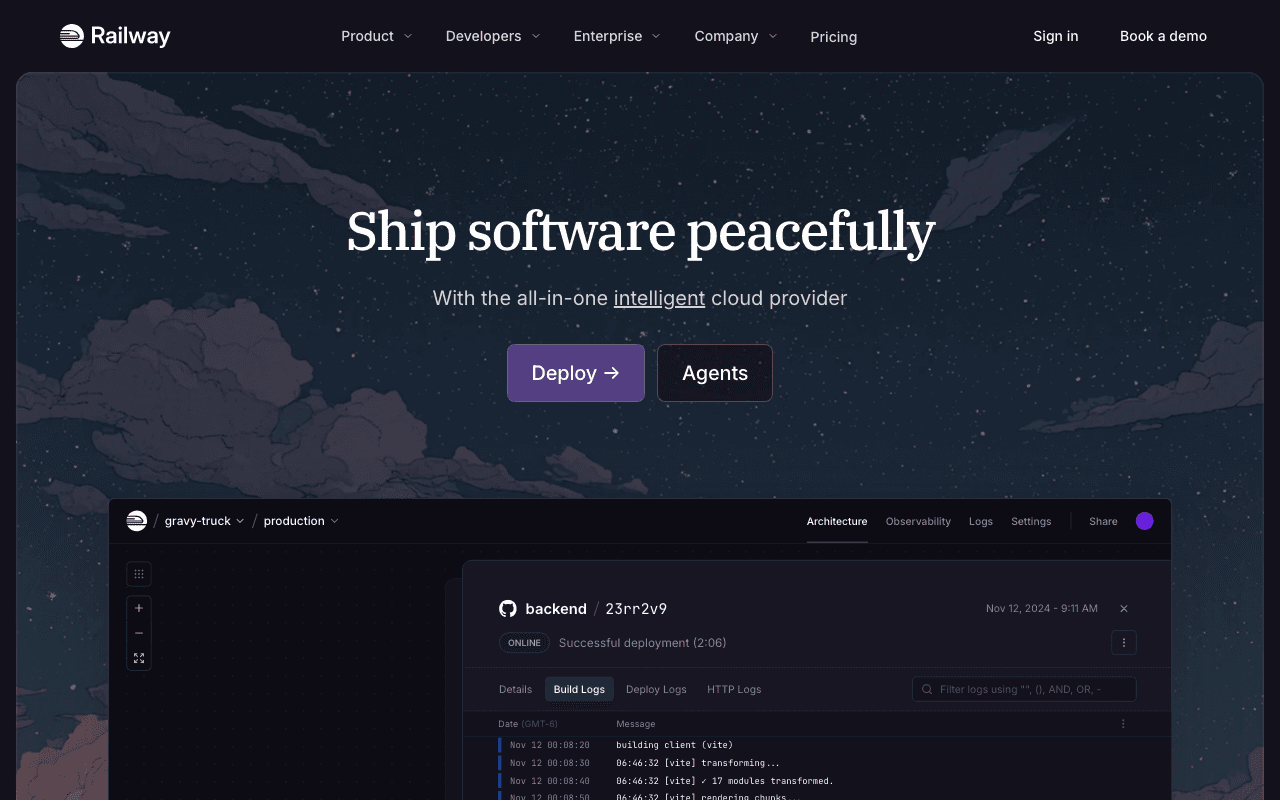
There is currently no promo code for this product. Deploy backend services and databases instantly from your GitHub repo. The fastest path from code to production.

Vercel
Get up to $30,000 in Vercel credits. The frontend cloud built for Next.js, with a global edge network, preview deployments, and zero-config hosting.
Railway vs Vercel, Detailed Comparison
What's Included in Each Startup Deal
Here is exactly what you get when claiming each deal through SaaSOffers:
RRailway
- $500 in Railway credits
- One-click deploy from GitHub
- Managed PostgreSQL, MySQL, Redis
- Auto-scaling and monitoring
- Team collaboration and environments
VVercel
- Up to $30,000 in Vercel credits
- Deploy Next.js and frontend frameworks
- Global edge network and CDN
- Preview deployment per pull request
- Serverless and edge functions
The short answer
Pick Railway if your product is a backend: an API, a worker, a websocket server or a database that has to stay up all day. Pick Vercel if your product is a Next.js or other frontend app and you want previews, a global CDN and functions with no server to manage. Railway runs long-lived containers on hardware it owns and bills each second of CPU and memory. Vercel runs your server code as functions, now with a beta container runtime, and bills seats, CDN capacity and function time. A common split is the frontend on Vercel and the database and workers on Railway, as in Example 1.
Our deals for Railway and Vercel
- Railway deal: $500 in credits. Requirements: Early-stage startup, new Railway account.
- Vercel deal: $30,000 in credits. Requirements: Early-stage startup, new Vercel account via Vercel for Startups.
We checked both tools' plans and prices against their official pricing and help pages in November 2026.
Neither vendor confirms our exact offer on its own site, so treat both as "apply and confirm". Railway's pricing page mentions no startup program, railway.com/startups returns a 404, and its credits docs say credits apply to new signups. Our listing says $500; confirm the amount and expiry when you redeem. Vercel's startups page offers up to $30,000 in Flexible Commitment Amount plus Enterprise-tier access to "eligible teams" without listing criteria. A Vercel staff member wrote on the Vercel Community forum in September 2025 that the program runs through Vercel's venture and accelerator partners, so ask your investor or accelerator first.
Railway vs Vercel at a glance
| Dimension | Railway | Vercel |
|---|---|---|
| Runtime model | Long-running containers, no cold starts on always-on services | Functions; container runtime in beta on all plans |
| Free option | Free Trial: $5 one-time credit for 30 days; Free plan: $1 of usage a month | Hobby: $0, non-commercial use only |
| Paid entry price | Hobby $5/month, includes $5 of usage | Pro $20/month, includes 1 deploying seat and $20 credit |
| Seat pricing | Pro: unlimited seats included | $20/month per extra deploying seat, viewers free |
| Compute billing | $0.00000772 per vCPU-second (about $20 per vCPU-month) | Active CPU from $0.128/hour, invocations from $0.60 per 1M |
| Memory billing | $0.00000386 per GB-second (about $10 per GB-month) | Provisioned memory from $0.0106 per GB-hour |
| Max size | Pro: up to 1,000 vCPU and 1 TB RAM per service, 42 replicas | Functions up to 4 GB memory, 800 seconds max on Pro (1,800 s in beta) |
| Bandwidth | Egress $0.05/GB | Flat Rate CDN: 1M requests and 1 TB included on Pro |
| Databases | One-click Postgres, MySQL, Redis, MongoDB and more, with backups and PITR | Marketplace providers (Postgres, Redis); Blob storage at $0.023/GB |
| Persistent storage | Volumes: 5 GB on Hobby, up to 1,000 GB on Pro | No persistent disks for functions |
| Preview environments | Per-PR environments | Preview deployment for every push and pull request |
| Compliance | SOC 2 Type II and SOC 3; HIPAA BAA add-on above a spend threshold | SOC 2 Type 2, ISO 27001; HIPAA BAA $350/month on Pro |
Pricing side by side
| Plan | Billed yearly | Billed monthly | Key limits |
|---|---|---|---|
| Railway Free Trial | n/a | $0 | $5 one-time credit, 30 days, 2 vCPU / 1 GB per service |
| Railway Free | n/a | $0 | $1 usage a month, 1 vCPU / 0.5 GB, 1 member |
| Railway Hobby | not listed | $5 (counts toward usage) | 48 vCPU / 48 GB, 6 replicas, 5 GB volume, 7-day logs |
| Railway Pro | not listed | $20 per workspace (counts toward usage) | 1,000 vCPU / 1 TB, 42 replicas, 1,000 GB volume, 30-day logs, unlimited seats |
| Vercel Hobby | n/a | $0 | 1 seat, 100 GB transfer, 1M invocations, personal use only |
| Vercel Pro | not listed | $20 + $20 per extra deploying seat | $20 credit, Flat Rate CDN 1M requests and 1 TB |
| Vercel Flat Rate CDN tiers | n/a | $20 / $100 / $300 | 10M / 50M / 150M requests, 50 TB transfer each |
| Enterprise (both) | custom | custom | Contracts, SLAs, HIPAA terms |
Railway's subscription fee is not on top of usage. Its plan docs say the fee "goes towards your usage-costs", so a Hobby service that uses $3 of resources costs $5 and one that uses $12 costs $12. Vercel works the other way: seats and any paid Flat Rate CDN tier are fixed fees. We assume the $20 credit covers only function and storage meters, because Vercel does not say whether it pays for a CDN tier. New Pro teams get Flat Rate CDN on by default since it reached general availability on September 8, 2026. A team whose monthly usage passes its tier moves up a tier at the start of the next cycle, and a one-day spike does not trigger the move.
Example 1: 2 developers, one app and a Postgres database
Assume an app that averages 0.5 vCPU and 1 GB of RAM, a Postgres database at 0.25 vCPU, 0.5 GB and a 5 GB volume, 300 GB of traffic and 3M requests a month. On Vercel, assume 1M function invocations at 30 ms of CPU, 100 ms wall time and 2 GB, 20 GB of origin transfer, and the database kept on Railway with 10 GB of egress to Vercel.
- All on Railway Hobby: CPU 0.75 x $20.01 = $15.01. RAM 1.5 x $10.01 = $15.01. Volume 5 x $0.156 = $0.78. Egress 300 x $0.05 = $15.00. Total $45.79 a month, $549.52 a year. The $5 fee is inside that number.
- Vercel Pro plus a Railway database: Seats $20 + $20 = $40. 3M requests is over the 1M included tier, so the $20 Flat Rate tier applies. Functions: $0.60 invocations + $1.07 CPU + $0.59 memory + $1.20 origin transfer = $3.46, inside the $20 credit. Railway database on Hobby: $5.00 CPU + $5.00 RAM + $0.78 volume + $0.50 egress = $11.28. Total $71.28 a month, $855.39 a year.
- With our deals: If our $500 Railway credit applies to this account, it covers about 10.9 months of the all-Railway bill. If Vercel approves you for its startup program, its credit would absorb the Vercel share many times over; confirm with Vercel whether the Flexible Commitment Amount applies to Pro charges.
Example 2: 8 developers, two web replicas, a worker and Postgres
Assume two web replicas at 0.5 vCPU and 1.5 GB each, a background worker at 0.25 vCPU and 0.5 GB, Postgres at 0.5 vCPU, 2 GB and a 20 GB volume, 1.5 TB of traffic and 20M requests. On Vercel, assume 8M function invocations with the same profile as above, 80 GB of origin transfer, and the worker and database on Railway Pro with 50 GB of egress.
- All on Railway Pro: CPU 1.75 x $20.01 = $35.02. RAM 5.5 x $10.01 = $55.03. Volume 20 x $0.156 = $3.11. Egress 1,500 x $0.05 = $75.00. Total $168.16 a month, $2,017.88 a year, with all 8 seats included. Minus $500 if our credit applies: $1,517.88.
- Vercel Pro plus Railway for the worker and database: Seats $20 + 7 x $20 = $160. 20M requests needs the $100 Flat Rate tier; 1.5 TB fits its 50 TB. Functions: $4.80 + $8.53 + $4.71 + $4.80 = $22.84, minus the $20 credit = $2.84. Railway Pro: $15.01 CPU + $25.01 RAM + $3.11 volume + $2.50 egress = $45.63. Total $308.48 a month, $3,701.70 a year.
Seats are $160 of the Vercel bill at this size. On Railway, egress is the biggest single line.
Servers versus functions
Railway's own comparison page puts the core difference plainly: Railway code runs on long-running servers with no execution time limit and no cold starts, while Vercel runs server code as functions on AWS. That matters for websockets, live dashboards, chat, queue consumers and anything that holds a connection open. Railway's page lists persistent connections as unsupported on Vercel.
Vercel has narrowed the gap. Its Railway migration guide says Dockerfile apps can deploy through the Container runtime, which is in beta on all plans, billed under Functions pricing, and scales in after 5 idle minutes in production. Always-on workers can move to Vercel Daemons, also in beta, which run a fixed instance count without autoscaling and cannot be reached over HTTP or TCP.
Railway does offer scale to zero. Its Serverless setting puts a service to sleep 5 to 10 minutes after it stops sending outbound packets. The first request wakes it and may return a 502, and database connections count as outbound traffic, so a service with an open pool never sleeps.
Frontend delivery and previews
Vercel builds Next.js, and App Router, ISR and image optimization work on deploy without an adapter. Every push and pull request gets a preview URL. The Flat Rate CDN covers CDN requests, Fast Data Transfer and Blob data transfer inside a fixed tier, so a launch day does not change that month's bill. Vercel's docs exclude bulk file distribution and media-heavy delivery from Flat Rate CDN and may move such projects to its Flex CDN.
Railway serves your app from the region you deploy in: US West, US East, EU West or Southeast Asia. Services can add replicas in more than one region, and every gigabyte out costs $0.05. A static marketing site or a global audience fits Vercel better. An API that a few thousand users call from one continent fits Railway fine.
Databases and state
Railway provisions Postgres, MySQL, Redis and MongoDB in one click, plus ClickHouse, Timescale, Chroma and others from templates, with backups and point-in-time recovery for Postgres and MySQL. The database is billed like any other service: CPU, RAM and about $0.156 per GB-month of volume. A 20 GB Postgres volume costs $3.11 a month.
Vercel has no managed database of its own. Postgres and Redis come from Marketplace providers on their own price lists, and Vercel Blob stores files at $0.023 per GB. Functions have no persistent disk, so uploads must go to object storage. Vercel's migration guide says you can keep Railway Postgres if the app uses its public endpoint, because Railway's private *.railway.internal addresses only work inside Railway.
Team size and billing risk
Railway Pro includes unlimited seats for $20 a month, and that fee counts toward usage. Vercel charges $20 per deploying seat; 15 developers cost $300 a month before any usage. Viewer seats on Vercel are free.
Both vendors cap spend. Railway sends alerts at 75%, 90% and 100% of a usage limit, and a hard limit takes workloads offline, with a $10 minimum. Vercel's Spend Management is free on Pro and can pause production deployments when an on-demand budget is reached. Railway bills per second for the CPU and memory a service actually uses, so an idle service still pays for the RAM it holds (about $10 per GB a month) unless Serverless puts it to sleep.
Pick Railway if
- You run an API, worker, cron job or websocket server that must stay up.
- You want Postgres, Redis and your app on one bill and one private network.
- Your team is growing and you want unlimited seats on a $20 plan.
- You deploy from a Dockerfile and don't want a beta container runtime.
- You need persistent volumes up to 1,000 GB.
- Your users sit in one region and traffic is modest.
Pick Vercel if
- Your app is Next.js and you want every framework feature on day one.
- You want a preview URL on every pull request with zero config.
- Traffic is global and you want a CDN priced in fixed tiers.
- Your backend is mostly request and response, with work under 800 seconds.
- You need a self-serve HIPAA BAA ($350 a month on Pro).
- An investor or accelerator in Vercel's partner network can refer you to Vercel for Startups.
Switching between them
Railway documents a Vercel migration on its compare page. Create a Railway account, choose "Deploy from GitHub repo" and select the repository, add environment variables in the Variables tab or paste a .env file into the Raw Editor, then generate a .up.railway.app domain or add your custom domain under Settings, Networking.
Vercel publishes a "How to migrate from Railway to Vercel" guide, plus separate guides for Python APIs and for moving Railway workers to Daemons. Apps that Railway built with Railpack or Nixpacks can often deploy through framework detection. Dockerfile apps can use the Container preset, or a Dockerfile.vercel to force it. Railway volume data does not move, preDeployCommand migrations move into your CI pipeline, and cron jobs become HTTP GET handlers scheduled in vercel.json. The guide warns that Vercel Cron can start a new run before the last one ends, while Railway skips overlapping runs, so add a lock if that matters. Keep Railway running until the new deployment is stable.
For another backend host compared with Railway, see Render vs Railway.
Final take
Railway hosts the database and workers; Vercel hosts the frontend. Railway is the cheaper and simpler home for backends, databases and anything long-running, with unlimited seats on Pro. Vercel is the better frontend platform, with fixed CDN tiers and the best Next.js support, and its startup credit is far larger if you can get a partner referral.
Frequently Asked Questions
Common questions about Railway vs Vercel for startups.
Can I use both Railway and Vercel together?
Yes. There are no restrictions on claiming startup deals from multiple tools. Many startups use both Railway and Vercel simultaneously, each serving different needs. Claim both through SaaSOffers for maximum savings.
Which has a better startup deal, Railway or Vercel?
Vercel offers $30,000 in credits, while Railway offers No deal right now. However, the "better" deal depends on which tool you actually need, a larger credit on a tool you won't use is worth less than a smaller credit on a tool that's essential to your stack.
Is Railway free for startups?
Railway offers No deal right now through its startup program on SaaSOffers. The deal type is "premium", available to SaaSOffers Premium members ($79/year). Early-stage startup, new Railway account
Is Vercel free for startups?
Vercel offers $30,000 in credits through its startup program on SaaSOffers. The deal type is "premium", available to SaaSOffers Premium members ($79/year). Early-stage startup, new Vercel account via Vercel for Startups
How does Railway pricing work?
You pay a plan fee that counts toward usage, plus metered resources. Hobby is $5 a month with $5 of usage included, and Pro is $20 a month with $20 included. Memory is $10 per GB per month, CPU is $20 per vCPU per month, egress is $0.05 per GB and volumes are $0.15 per GB per month. Railway does not list a yearly price.
Does Railway have a free plan?
Yes, with limits. New accounts get a trial of up to 30 days with a one-time $5 credit. After that the Free plan gives $1 of credit a month with 1 vCPU and 0.5 GB of RAM per service, 1 project, 3 services, a 0.5 GB volume, no custom domains and 3 days of logs.
Is the $500 credit confirmed on Railway's website?
No. Railway's pricing page and docs do not mention a $500 startup credit. Its credits page says promotions apply only to new signups who use a unique link, then upgrade to Hobby and add a credit card. The $500 is our listing's term, so confirm it in Workspace Settings, Billing.
How much are the Vercel startup credits?
Our listing shows $30,000 in credits. Vercel's startups page describes the program as up to $30,000 in Flexible Commitment Amount, plus Enterprise-tier access and startup-focused support. The exact amount is set by Vercel for each approved team.
Who is eligible for Vercel for Startups?
Vercel's startups page refers to "eligible teams" but does not list the criteria. A Vercel staff member wrote on the official Vercel Community forum in September 2025 that the program is for venture-backed companies in the portfolio of a Vercel venture or accelerator partner, and that the application is usually found on the investor's or accelerator's website.
Can a startup use the free Vercel Hobby plan?
Only for non-commercial work. Vercel's fair use guidelines restrict Hobby to personal, non-commercial use. Taking payments, advertising a product, running ads or being paid to build the site all count as commercial use and need Pro or Enterprise.
We've helped 10,000+ startup founders unlock $500,000+ in SaaS credits and discounts. Every comparison is based on real deal data from our platform.