Dorik Coupon: Free Plan
No-code website builder with AI generation, CMS, and white-label features.
Premium: $79/year for unlimited deals
Already have an account? Log in
Deal Highlights
Does Dorik have a Black Friday deal?
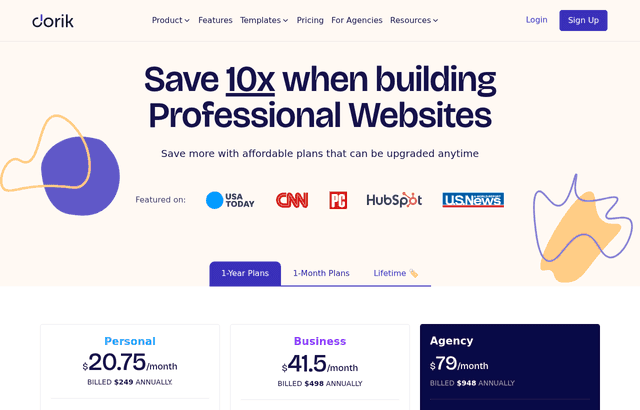
Dorik hasn't announced its Black Friday 2026 deal yet. Last year it offered 2 years for the price of 1 (Personal $249, Business $498), no code (Nov 15 - Dec 1, 2025). We add the 2026 offer as soon as it's announced. See all Black Friday SaaS deals.
What Dorik Gives a Startup
Dorik is a no-code website builder with AI generation, a built-in CMS, and white-label features. This deal gives a startup access to a free plan, which means a team can put a real website online without writing code and without spending money to get started. For a young company that needs a landing page, a marketing site, or a client-facing web presence quickly, that removes both the technical barrier and the cost barrier at the same time.
Most startups need a website before they can afford a designer or a developer to build one. The choices usually come down to wrestling with a heavy website platform, paying an agency, or asking an engineer to stop building the product to build a marketing page instead. Dorik offers a fourth path: a visual builder where anyone on the team can assemble and ship a site, with AI to generate a starting point and a CMS to manage content over time. The free plan lets a startup take that path without committing budget before it knows what it needs.
Dorik's combination of AI generation, content management, and white-label capability makes it useful across several situations. A founder can spin up a landing page for a launch, a team can run its blog and content marketing through the CMS, and an agency or freelancer can build and hand off sites under their own brand. The free plan is the entry point to all of it.
Building a Site Without Writing Code
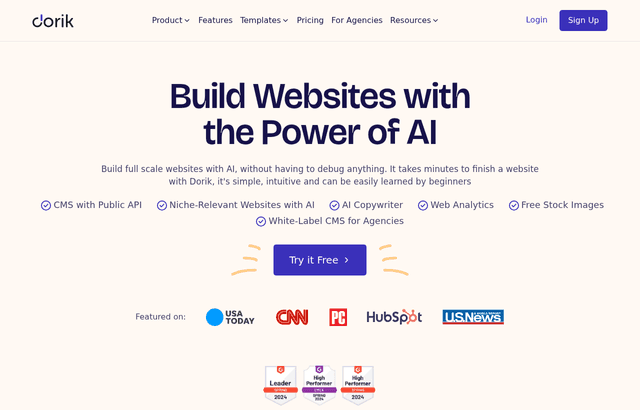
The heart of Dorik is that it is a no-code builder. A startup assembles pages visually, arranging sections and components on a canvas rather than editing HTML and CSS. This means the person building the site does not have to be an engineer. A founder, a marketer, or an operations person can create and update pages directly, which changes the economics of having a web presence.
For a startup, the value is independence. When the website requires code, every change becomes a request that goes into an engineer's queue, and the marketing team waits. That queue is a constant source of friction, because the people who know what the site should say are not the people who can change it. A no-code builder puts control in the hands of the people closest to the message, so a copy change or a new landing page ships in minutes instead of waiting for a sprint.
The reason this matters early is that startups iterate constantly on their positioning. The homepage message this month may be wrong next month as the company learns what resonates. Being able to change the site freely, without booking developer time, means the website keeps pace with a fast-moving company instead of lagging behind it.
AI Generation to Get a First Draft Fast
Dorik includes AI generation, which helps a team get from a blank page to a working draft quickly. Instead of staring at an empty canvas, a founder can describe what the site is for and get a generated starting point to refine. This shortcuts the hardest part of building a site, which is often just getting the first version to exist.
For a startup, speed to a first draft is what matters. The goal in the early days is rarely a perfect site; it is a credible, live site that lets the company start collecting signups, sharing a link, or supporting a launch. AI generation compresses the time between deciding to have a website and actually having one. A team can go from idea to a shareable draft in a single sitting, then iterate from there using the visual builder.
The generated starting point also lowers the skill barrier further. A person who would freeze at an empty builder can react to and edit a draft far more easily than they can create one from nothing. AI gives them something to push against, which makes the whole tool more accessible to non-designers.
Managing Content With the Built-In CMS
Dorik includes a CMS, which turns the tool from a static page builder into a system for managing ongoing content. A startup can run a blog, a resource library, a changelog, or any collection of structured content through the CMS, editing and publishing entries without touching the underlying site structure.
Content is one of the main ways early startups earn attention and trust. A blog that answers customer questions, publishes product updates, or shares the company's perspective is a durable marketing asset that compounds over time. But content only works if publishing is easy. If every new post requires developer involvement, the blog dies from neglect. A built-in CMS means a marketer or founder can write and publish on their own schedule, which is what keeps a content effort alive.
The CMS also keeps content organized as it grows. Rather than a pile of one-off pages, the team gets a structured system where posts share a template and new entries slot into an existing design. For a startup planning to invest in content marketing, having that structure from the start avoids a painful reorganization later.
White-Label Features for Agencies and Client Work
Dorik offers white-label features, which matter for a specific and valuable audience: agencies, freelancers, and startups that build websites for clients or partners. White-labeling means the sites and the experience can carry your brand rather than Dorik's, so the tool disappears into the background and your business is what the client sees.
For a startup whose business involves delivering websites to others, this is central. An agency that builds client sites needs the work to look like its own, not like it came from a third-party builder. White-label capability lets a small studio deliver professional sites under its own name, use Dorik as its production engine, and keep the client relationship clean. The free plan lets such a business test whether Dorik fits its workflow before committing.
Even for a product startup, white-label features can matter if the company offers websites or landing pages as part of its own product. Being able to present the builder and its output under your brand opens up embedding Dorik's capability into a larger offering. The reason this is worth having early is that it changes what kind of business Dorik can support: not just your own site, but sites you deliver to others.
Dorik Compared to Other Website Approaches
Compared to hand-coding a site, Dorik trades maximum flexibility for speed and accessibility. A custom-coded site can do anything, but it requires an engineer to build and maintain, and it turns every change into a development task. For most startups, a marketing site does not need bespoke code; it needs to look good, load fast, and change easily. Dorik covers that need without consuming engineering time, which is almost always the scarcer resource in a young company.
Compared to heavier all-in-one website platforms, Dorik leans toward simplicity and a cleaner no-code experience, with AI generation to speed up the start and white-label features that many mainstream builders reserve for higher tiers or do not offer at all. A startup that wants a straightforward path to a good-looking site, plus the option to run client work under its own brand, will find Dorik's mix well suited.
Compared to hiring an agency to build the site, Dorik keeps control and cost in-house. An agency delivers a polished result but locks the startup into a slow, paid cycle for every future change. Building on Dorik means the team owns the site and can change it whenever it wants, which fits the pace of a company still figuring out its message.
Making the Free Plan Count
The way to get the most from Dorik's free plan is to actually ship something real with it rather than treating it as a sandbox. Use the AI generation to produce a first draft of the site, refine it in the visual builder until it credibly represents the company, and put it online. A live site that collects signups or supports a launch is worth far more than a perfect design that never leaves draft status.
A practical starting sequence is to build the core pages first: a homepage that states clearly what the company does, a page or two that explain the product, and a way for visitors to get in touch or sign up. Then set up the CMS if content marketing is part of the plan, so the blog infrastructure is ready before the first post. If the startup does client work, test the white-label features on a sample project to confirm the workflow fits before taking on real clients.
Because the free plan costs nothing, it is the ideal way to learn what the company actually needs from a website tool before spending. A team can use it to validate that no-code building fits its workflow, that the CMS handles its content, and that the output meets its bar for quality. That knowledge makes any future decision about upgrading an informed one rather than a guess.
How Dorik Grows With the Company
Dorik fits a startup because it supports the site through several stages of growth. In the beginning, the need is a simple landing page, and the AI generation and visual builder get that live fast. As the company matures, the site grows into a fuller marketing presence with multiple pages, and the no-code editor keeps every part of it editable by the team. When content marketing becomes a priority, the CMS is already there to run the blog and resource library.
For teams whose business is building sites for others, the white-label features mean Dorik can scale from a single internal site to a production tool for client delivery. The same platform that built the company's own homepage can become the engine behind a web design practice. This range means a startup is unlikely to outgrow Dorik quickly, because the tool covers both the simple early need and the more involved uses that come later.
The continuity matters because re-platforming a website is disruptive and costly. Adopting a tool that can carry the site from a first landing page through a mature content operation avoids the migration that comes from choosing something too limited at the start.
Common Ways Startups Use Dorik
The practical uses of Dorik tend to cluster around a few needs, and seeing them concretely helps a team decide where to start. A launch landing page is the most common: a single, focused page that explains one product or campaign and captures signups, built and shipped in a day. A full marketing site is the next step up, with a homepage, product pages, pricing, and an about section that together present the company to the world. A content hub built on the CMS runs the blog and resource library that fuel search traffic and thought leadership over time.
Beyond the company's own presence, agencies and freelancers use Dorik as a production tool for client sites, leaning on the white-label features to deliver under their own brand. A startup might also use it for microsites: dedicated pages for an event, a partnership, or a specific campaign that do not belong on the main site. Each of these fits within the free plan as a way to test the workflow, and each represents a real business need that Dorik can meet without code. Knowing which of these the team needs first makes the free plan easy to put to immediate use.
Who Should Claim This Deal
This deal is for any startup that needs a website and would rather not spend engineering time or agency money to get one. Dorik's free plan lets a non-technical founder, marketer, or operator build and ship a real site using a visual builder, with AI generation to get moving fast and a CMS to manage content over time. If a team needs a landing page for a launch, a marketing site, or a blog and wants control over it without writing code, this is a strong fit.
It is an especially good match for agencies and freelancers who build sites for clients, because Dorik's white-label features let them deliver professional work under their own brand and use the free plan to test the fit before committing. It also suits early companies that expect to iterate heavily on their positioning and want a site they can change freely rather than one locked behind a development queue.
The teams that get the most from this are the ones who use the free plan to ship something real, whether that is their own homepage or a client project, and learn what they need before spending a dollar. If a startup wants a fast, no-code path to a credible web presence, this is the deal to claim.
Who Is This Deal For?
Early-Stage Startups
Seed and pre-seed companies looking to move fast without overspending on tools.
Growing SaaS Teams
Series A+ companies scaling their stack and optimizing software costs.
Solo Founders
Indie hackers and bootstrapped founders who need enterprise tools at startup prices.
Get Free Plan off Dorik
Premium deal. Upgrade once, unlock everything.
How to get the Dorik deal
- The offer: Free Plan.
- Create a free SaaSOffers account, then upgrade to Premium ($79 a year, or $250 once for lifetime access). Premium unlocks every Premium deal on the site.
- Open the Dorik claim page from this deal. It shows the partner link, any promo code and the exact steps Dorik asks for.
- Apply or sign up through that link before you pay Dorik directly, since most startup offers only apply to new accounts.
Frequently Asked Questions
Everything you need to know about this startup deal.
Get the weekly deals digest
New verified startup deals every week. No spam, ever. Unsubscribe anytime.
Related Offers

ZoomInfo
Used by 2,014 members
Free Trial
B2B data platform for sales and marketing intelligence with contact databases.
View offer
Chore
15% off your first month
Chore runs your startup's back office for you: payroll, HR, bookkeeping, compliance and equity, inside the tools you already use. 15% off your first month through SaaSOffers.
View offer
OmniSEO
Used by 1,361 members
Free Trial
All-in-one SEO platform for keyword research, rank tracking, and site optimization.
View offerDeal Summary
Looking for more startup deals?
Browse all offers