
Lattice Discount Code: $1,000 off first year
People management platform, performance reviews, OKRs, engagement surveys, and compensation management.
Premium: $79/year for unlimited deals
Already have an account? Log in
Deal Highlights
What Lattice Gives a Startup
Lattice is a people management platform covering performance reviews, OKRs, engagement surveys, and compensation management, and this deal takes $1,000 off the first year. For a startup that has grown past ten employees, that discount lands at exactly the moment the team starts needing real structure around how it manages its people. Lattice gives that structure in one platform instead of a pile of spreadsheets and good intentions.
The reason this matters is that people management does not scale on informality. When a startup is five people, everyone knows how everyone is doing, goals are understood without being written down, and feedback happens in the hallway. Past ten people, that breaks. Performance becomes uneven because there is no consistent way to review it, goals drift because nobody is tracking them, and problems with morale go unnoticed until someone quits. Lattice gives a growing startup the tools to manage performance, align on goals, understand engagement, and handle compensation deliberately, and the $1,000 off makes adopting it easier at the stage where it starts to count.
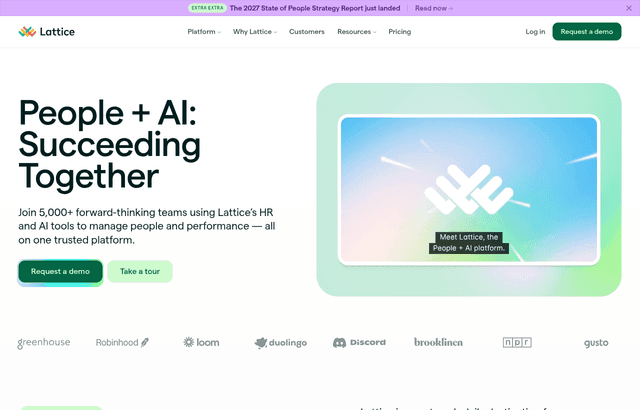
Lattice, one of the tools included in this startup deal.
Performance Reviews That Are Fair and Consistent
The first thing Lattice brings to a growing startup is a real system for performance reviews. In a small company, feedback is ad hoc, delivered whenever a founder happens to think of it, in whatever form feels natural at the time. That works when there are a handful of people and one manager who knows everyone. It stops working as the team grows, because ad hoc feedback becomes inconsistent feedback, and inconsistent feedback is unfair. Some people get lots of guidance, others get almost none, and nobody has a clear picture of how they are doing.
Lattice replaces that with a consistent process. Reviews happen on a defined cadence, follow a structure, and give every employee the same opportunity to understand their performance and grow. That consistency is important for two reasons. It is fairer, because everyone is evaluated on comparable terms rather than on how much attention they happen to get. And it is more useful, because a structured review surfaces the feedback people actually need to improve, rather than leaving it to chance.
For a startup, getting this right early shapes the culture. A company that establishes fair, regular performance conversations while it is small carries that practice as it grows. A company that lets performance management stay informal too long ends up with resentment, uneven development, and the sense that success depends on politics rather than work. Lattice gives a growing team the structure to avoid that outcome from the start.
OKRs That Keep a Growing Team Aligned
As a startup grows past ten people, keeping everyone pointed in the same direction gets harder. When the team was small, the goals lived in everyone's head and alignment was automatic. With more people, more functions, and more work happening in parallel, that shared understanding erodes. People end up working hard on things that do not add up to the company's priorities, simply because the priorities were never made explicit and tracked.
Lattice provides OKRs, a structured way to set objectives and the measurable results that define them, and to keep them visible across the team. This gives a growing startup a shared map of what matters. Everyone can see the company's goals, understand how their own work connects to them, and track progress against them. That visibility is what keeps a larger team aligned, because alignment stops being something the founder holds in their head and becomes something the whole team can see and steer by.
The value compounds as the team grows further. OKRs create a rhythm of setting goals, working toward them, and reviewing progress that scales in a way that informal alignment never can. For a startup, building this habit at the ten-person stage means that when the team is fifty people across several functions, the practice of aligning around clear goals is already established rather than something the company has to impose belatedly on a team that has learned to work without it.
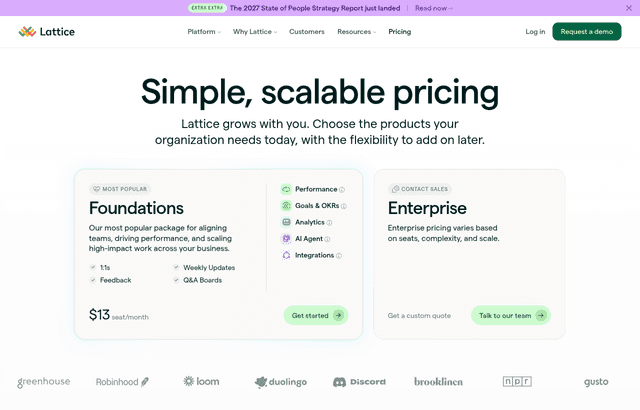
A look at Lattice before the discount, so you can see what the deal saves you.
Engagement Surveys That Reveal What You Cannot See
One of the quietest risks in a growing startup is losing touch with how the team actually feels. When the company was tiny, the founder could read the room. As it grows, that becomes impossible. Morale problems, frustrations, and early signs that someone is thinking about leaving all become invisible, until they surface as a resignation or a drop in output that seems to come from nowhere.
Lattice includes engagement surveys, which give a growing startup a way to hear from its people systematically. Instead of guessing at morale, the team can actually measure it, spot problems while they are still fixable, and understand what is working and what is not. That visibility is worth a great deal, because the cost of losing a good employee at an early startup is enormous. Every departure is a serious loss of knowledge, momentum, and often morale, and many departures are preventable if the warning signs are caught early.
Engagement data also helps a startup build a better culture deliberately rather than by accident. Seeing what the team values, where it is frustrated, and how sentiment changes over time lets the founders make informed decisions about how to lead. For a young company still forming its culture, that feedback loop is a way to shape the culture on purpose, guided by what the team actually experiences rather than by assumptions.
Compensation Management Done With Structure
Compensation is one of the hardest things a growing startup has to get right, and one of the easiest to get wrong. Early on, pay is often set through individual negotiation, one deal at a time, with no consistent framework. That leads to inequities that become serious problems as the team grows and people inevitably learn what their peers earn. Nothing damages trust faster than the sense that compensation is arbitrary or unfair.
Lattice provides compensation management, which gives a startup structure around how it pays people. Instead of one-off decisions, the team can manage compensation deliberately, with a framework that supports fairness and consistency. This matters because compensation decisions carry enormous weight for both the company's finances and its people's sense of being valued. Getting them wrong is expensive in money and in morale. Getting them right, with a clear and consistent approach, builds the trust that keeps good people around.
Bringing compensation into the same platform as performance and goals is a further advantage. It lets a startup connect how people are rewarded to how they perform and contribute, in a coherent way, rather than treating pay as a disconnected negotiation. For a growing team, that coherence is part of building a fair and understandable culture, where people can see that reward relates to contribution rather than to who negotiated hardest.
Lattice Compared to Spreadsheets and Good Intentions
The realistic alternative to Lattice for a growing startup is a patchwork of spreadsheets, documents, and informal habits. Reviews get done in a shared doc if they get done at all. Goals live in a spreadsheet nobody looks at after the first week. Engagement is a gut feeling. Compensation is a set of individual memories. This patchwork technically covers the functions, but it does none of them well, and it does not scale. Every function that should be a consistent system is instead a fragile, manual effort that depends on someone remembering to do it.
Lattice replaces that patchwork with one integrated platform where performance, goals, engagement, and compensation connect. The consistency alone is a major upgrade, because these are exactly the functions where inconsistency causes real harm, unfair reviews, drifting goals, unseen morale problems, and inequitable pay. A startup gets a real people management system built by people who focus on this problem, rather than a collection of workarounds that break as the team grows.
The $1,000 off the first year makes adopting that system easier at the stage where it starts to matter. A startup crossing ten employees is exactly when the informal approach stops working and the structured approach starts paying off. The discount lowers the barrier to making that transition at the right time, rather than putting it off until the lack of structure has already caused damage.
Making the $1,000 Off the First Year Count
A discount on the first year rewards a startup that puts the platform to real use, so the goal is to adopt Lattice meaningfully rather than signing up and letting it sit. The strongest move is to actually run your people processes through it. Use it for real performance reviews on a real cadence, set genuine OKRs the whole team can see, run engagement surveys and act on what they show, and bring compensation into a consistent framework. The value comes from using the platform, not owning it.
Start with the functions that hurt most right now. If performance feedback has become inconsistent as the team grew, begin there. If people are working on misaligned priorities, start with OKRs. If you sense morale is slipping but cannot tell, run an engagement survey. Adopting the platform where the pain is sharpest gives an immediate return and builds momentum for using the rest. The point is to solve real problems the growing team is already feeling.
Treat the first year as the time to establish these practices as part of how the company operates, so they are habits by the time the discount period ends. A startup that builds fair reviews, clear goals, regular engagement checks, and structured compensation into its normal rhythm during the first year will carry those practices forward. Continuing on the platform then becomes a natural decision backed by real value, rather than a cost the team questions.
Getting Started Without Overwhelming the Team
The right way into Lattice is to introduce it in a way the team can absorb, not to switch on every feature at once. Start with one people process, run it through Lattice, and let the team get comfortable with it before adding the next. A growing startup adopting structure for the first time needs that structure to feel like help, not bureaucracy, and introducing it gradually is how you keep it feeling that way.
Bring the team along as you go. Explain why the structure exists, that fair reviews, clear goals, and honest engagement checks are there to help everyone, not to add process for its own sake. A growing startup's people are often wary of anything that feels like corporate overhead, so framing these tools as ways to make the company fairer and more aligned matters. When the team understands the purpose, adoption is far smoother and the platform becomes something people value rather than tolerate.
Keep the processes lightweight enough to be sustainable. The goal is consistency, not heaviness. A regular but manageable review cadence, a focused set of OKRs, and periodic engagement surveys deliver most of the value without burying a small team in process. Lattice supports doing these things well without doing them excessively, and a startup that keeps the practices right-sized gets the benefits of structure without the drag of bureaucracy.
Who Should Claim This Deal
This deal fits a startup that has crossed ten employees, which is exactly the requirement and exactly the stage where people management stops working informally. If the team has grown to the point where reviews are inconsistent, goals are drifting, morale is hard to read, or compensation feels ad hoc, Lattice gives it the structure to manage all of that deliberately in one place. The $1,000 off the first year makes adopting that structure easier right when the need appears.
It is an especially strong fit for a startup that is growing quickly and feels the informality starting to strain, where the founders can sense that the way they managed five people will not work for twenty. Teams that care about building a fair, aligned, and healthy culture, and want to do it on purpose rather than by accident, get the most from bringing performance, goals, engagement, and compensation into a coherent system early. Doing this while the team is still forming its habits is far easier than fixing it after problems have set in.
The startups that will get less from this are those still small enough that informal management genuinely works, below the ten-employee threshold the deal targets. But for a growing startup at or past that point, Lattice with $1,000 off the first year is a well-timed way to put real structure around its people. Claim it, start with the process that hurts most, and give a growing team the fair reviews, clear goals, honest engagement, and consistent compensation that a company needs to grow well.
Who Is This Deal For?
Early-Stage Startups
Seed and pre-seed companies looking to move fast without overspending on tools.
Growing SaaS Teams
Series A+ companies scaling their stack and optimizing software costs.
Solo Founders
Indie hackers and bootstrapped founders who need enterprise tools at startup prices.
Get $1,000 off first year off Lattice
Premium deal. Upgrade once, unlock everything.
!Eligibility Requirements
Startup with 10+ employees
Frequently Asked Questions
Everything you need to know about this startup deal.
Lattice provides value starting at 15–20 employees — when performance management, goal tracking, and engagement measurement become too important for informal processes. Below 15 employees, BambooHR or simple tools suffice.
Get the weekly deals digest
New verified startup deals every week. No spam, ever. Unsubscribe anytime.
Related Offers

Vestwell
Used by 290 members
14-day free trial
Get a 14-day free trial of Vestwell, the modern 401(k) and retirement benefits platform that powers small business plans, IRAs, and pooled employer plans with API-first technology.
View offer
Assembly
Used by 2,457 members
Free Plan
Employee recognition and engagement platform with rewards, surveys, and team building.
View offer
Oyster HR
Used by 1,316 members
$1,000 off first year
Get $1,000 off Oyster. The global employment platform for hiring, paying, and managing remote employees and contractors in 180+ countries.
View offer
ADP
Used by 2,527 members
Free Quote
Enterprise payroll, HR, and workforce management solutions for businesses of all sizes.
View offer
Justworks
Used by 1,773 members
Free Demo
PEO and payroll platform for startups, payroll, benefits, HR, and compliance in one place.
View offer
Gusto
Used by 2,125 members
6 months free Simple
Modern payroll, benefits, and HR for US-based startups, run your first payroll in minutes, not days.
View offerDeal Summary
Looking for more startup deals?
Browse all offers