Gusto Promo Code: 6 months free Simple
Modern payroll, benefits, and HR for US-based startups, run your first payroll in minutes, not days.
Free · Opens in new tab
Free · No account required. Sign up to track your deals.
Deal Highlights
What Gusto Handles for a Startup
Gusto is modern payroll, benefits, and HR built for US-based small companies, and its whole promise is that a founder can run payroll in minutes rather than days. For an early-stage startup with its first employees, payroll is one of those things that looks simple and turns out to be a maze of federal, state, and local tax filings, withholdings, and deadlines that carry real penalties if you get them wrong. Gusto takes that maze and turns it into a few clicks, calculating the taxes, filing them with the right agencies, and paying employees on schedule without the founder needing to become a payroll expert.
The startup deal gives six months free on the Simple plan, a value of around $500, for US-based startups that have employees or are about to hire. That window covers exactly the period when a company is making its first hires and setting up payroll for the first time, which is when getting it right matters most and when the founder has the least spare attention to give it. Having payroll handled correctly from the first paycheck, at no cost for six months, removes a source of risk and distraction during a stage crowded with both.
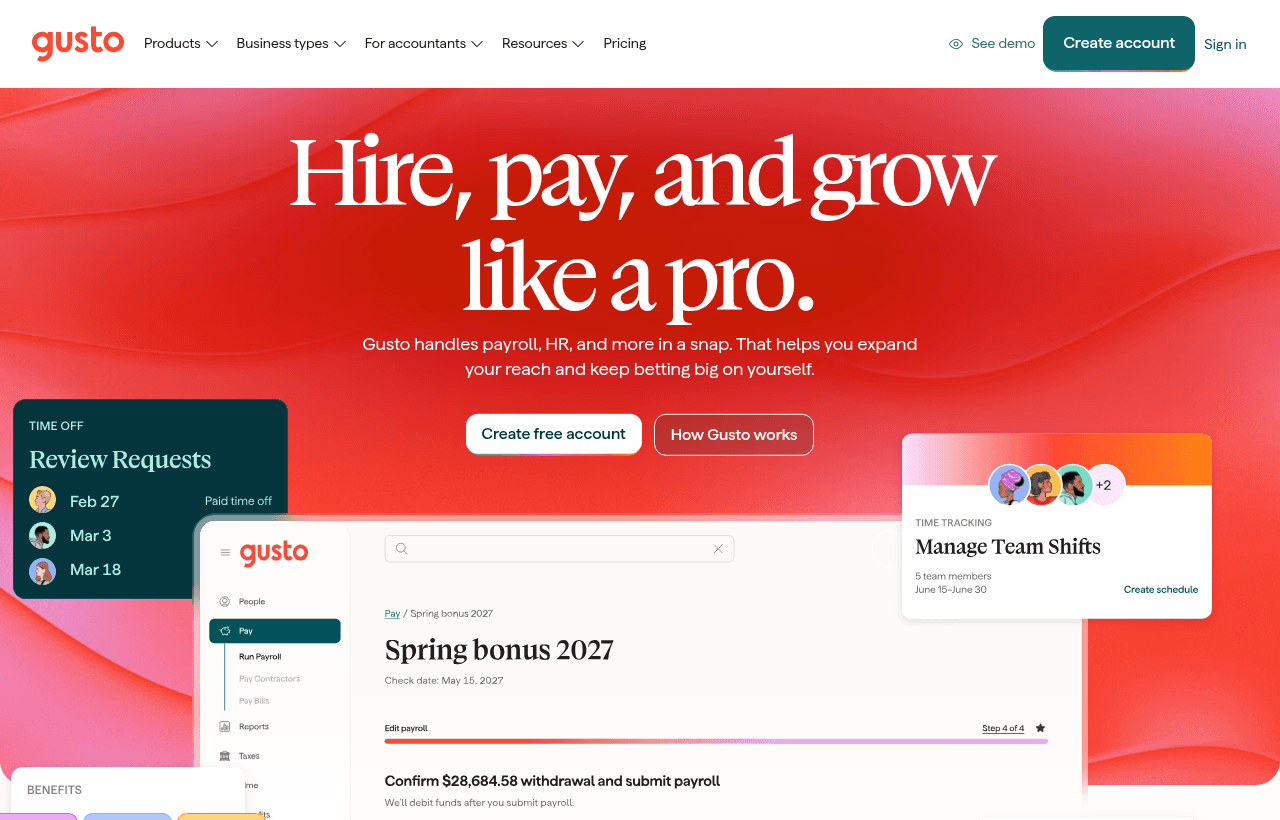
Gusto, one of the tools included in this startup deal.
Payroll Without Becoming a Payroll Expert
The core of Gusto is automated payroll, and the value is in everything the founder does not have to learn. When you run payroll, Gusto calculates gross-to-net for each employee, withholds the right federal, state, and local taxes, and then actually files and pays those taxes to the agencies on the correct schedule. Payroll tax filing is the part founders most often underestimate, because it is not one filing but many, on different cadences, to different authorities, and a missed or wrong filing generates penalties and notices that are painful to untangle. Gusto handling this end to end is the difference between payroll being a background process and being a recurring source of anxiety.
For a startup this matters because the founder's attention is the scarcest resource in the company, and payroll is exactly the kind of task that consumes disproportionate attention for zero competitive advantage. Nobody wins because the founder personally mastered state unemployment tax filing. Automating it away frees that attention for the work that actually moves the company, while ensuring the employees, whose trust matters enormously at an early startup, get paid correctly and on time every single period.
Onboarding and Employee Self-Service
Gusto handles the paperwork of bringing on a new employee, which is more than it sounds. A new hire in the US means collecting tax withholding forms, work eligibility verification, direct deposit details, and the various pieces of information payroll and compliance require, and Gusto turns that into a self-service flow the employee completes themselves. Instead of the founder chasing forms and re-keying data, the new hire enters their own information, and it flows straight into payroll. That both saves the founder time and reduces the errors that come from manual data entry.
The self-service extends past onboarding. Employees get their own accounts where they can see their pay stubs, access their year-end tax documents, and update their own details, which removes a whole category of small requests that would otherwise land on the founder. At an early startup where there is no HR person, every routine request an employee can answer themselves is time the founder gets back. Giving employees a clean, self-service experience also signals that the company is run professionally, which matters for retention and for how early employees feel about the place they took a risk to join.

A closer look at Gusto.
Benefits and Compliance in One Place
Gusto is not only payroll but also a place to manage benefits and the compliance that comes with employing people. As a startup grows past its first hires, it starts needing to offer health insurance and other benefits to attract and keep talent, and Gusto lets a company set up and administer those benefits integrated with payroll, so deductions and contributions flow through automatically rather than being tracked by hand. Keeping benefits and payroll in one system avoids the reconciliation headaches that come from running them separately.
The compliance side is quieter but just as valuable. Employing people in the US brings a set of obligations, year-end tax forms for employees and contractors, new-hire reporting, and various filings that must happen on time, and Gusto handles these as part of running payroll. For a founder who did not start a company to become an expert in employment compliance, having the system take care of the filings and generate the right forms at year end removes a source of risk that is easy to overlook until it becomes a problem. Getting these foundations right early also means the company is not scrambling to fix compliance gaps later when it has grown and the stakes are higher.
Gusto Compared to ADP and Justworks
The traditional payroll incumbents like ADP and Paychex are built for a broad range of company sizes and carry the complexity and sales-driven pricing that come with serving large enterprises. For a small startup they often feel heavy and opaque, with pricing that is hard to pin down and interfaces built for dedicated payroll administrators rather than a founder doing it between other tasks. Gusto's advantage for an early company is that it is built specifically for small businesses, with clear pricing and an interface a non-expert can actually use, which is why it has become a default for startups.
Justworks is the other common comparison, and it operates as a professional employer organization, bundling payroll with benefits and HR under a co-employment model. That model suits some companies, particularly those that want richer benefits access early, but it comes at a higher per-employee cost and a different structure than straightforward payroll. Gusto sits at the point that fits most early startups: full-featured payroll with benefits and compliance available as the company grows, at a price and simplicity built for small teams. The six-month free window lets a startup settle onto that foundation without cost during the stage when it is first figuring out how it wants to handle payroll and people.
Making the Six Months Count
To get the most from the deal, use the free window to set payroll up properly from the first hire rather than treating it as a stopgap. Get employees onboarded through Gusto's self-service flow so their data is clean from the start, run the first payrolls and confirm the tax filings are flowing correctly, and set up any benefits the company is ready to offer so they integrate with payroll from the beginning. Establishing these foundations while the deal covers the cost means that when the six months end, the company has a payroll and HR operation that simply works.
That foundation is worth more than the $500 the plan would otherwise cost, because payroll done wrong is expensive in both money and trust. Penalties from botched tax filings cost real money, and employees who get paid late or incorrectly lose confidence in a company at exactly the stage when their belief in it matters most. A startup that uses the free window to get payroll right from the first paycheck avoids both, and buys itself the ability to hire and grow without payroll becoming a recurring fire drill. For a US-based startup making its first hires, that is exactly the kind of foundation worth building while someone else covers the cost.
Who Should Claim This Deal
The Gusto deal fits any US-based startup that has employees or is about to make its first hires and wants payroll, benefits, and compliance handled correctly without hiring a payroll specialist or wrestling with a system built for large enterprises. If a founder is staring down their first payroll run and the tangle of tax filings that comes with it, six months free on Gusto Simple is a clean way to get that entire burden handled properly during the stage when the budget is tightest and the cost of getting it wrong is highest.
Paying Contractors Alongside Employees
Most early startups are a mix of full-time employees and contractors, and Gusto handles both in the same place. Contractors have different tax treatment than employees, they get paid without withholding and receive a year-end 1099 rather than a W-2, and keeping that straight manually is another small source of error and year-end scramble. Gusto lets a startup pay contractors through the same system it uses for employees, tracks what each was paid, and generates the correct year-end tax forms automatically, so the founder does not have to run two parallel processes or reconstruct contractor payments in January.
This matters more than it first appears because misclassifying or mishandling contractor payments is a common way small companies create problems for themselves. Getting the tax forms right, filing them on time, and keeping clean records of who was paid what is exactly the kind of administrative correctness that is easy to let slide when a founder is busy and painful to fix after the fact. Having one system that handles employees and contractors together, and produces the right documents for each at year end, removes a whole category of the small compliance mistakes that accumulate quietly at a growing startup until they become a mess to untangle.
Time, Time Off, and the Rest of HR
As a startup grows, payroll stops being the only people-operations need, and Gusto extends into the surrounding HR tasks a small company starts to require. Tracking paid time off, managing time for hourly workers, storing employee documents, and handling the basic HR record-keeping that a growing team needs are all part of the platform, so the company does not have to add a separate HR tool the moment it grows past a few people. Keeping these in the same system as payroll means time off and hours flow into pay automatically rather than being tracked separately and reconciled by hand.
For a founder without an HR person, having these pieces in one place is what keeps people operations manageable as the headcount climbs. The alternative is a spreadsheet for time off, another system for documents, and manual coordination to make sure it all lines up with payroll, which is exactly the kind of busywork that consumes a founder's time for no strategic gain. Gusto consolidating the routine HR alongside payroll means the company can grow its team without the administrative overhead of people operations growing just as fast, which is the difference between hiring being something the company can do smoothly and something that adds a new layer of manual work each time.
Why Getting This Right Early Pays Off
The deeper reason to set payroll and HR up properly early is that the cost of doing it badly compounds. Tax filing mistakes generate notices and penalties that take time and money to resolve, and they tend to surface at the worst moments. Employees who experience late or incorrect pay lose trust in a company at the exact stage when their belief in it is a large part of what keeps them there. Messy records make every subsequent step, an audit, a financing round's due diligence, a benefits setup, harder than it needed to be. Each of these is cheaper to prevent than to fix.
A startup that establishes clean payroll, correct tax filing, proper contractor handling, and basic HR record-keeping from its first hires avoids accumulating that hidden debt. When the company later raises money, brings on more people, or gets examined by any authority, the foundation is already solid rather than something that has to be reconstructed under pressure. Using the six-month free window to build that foundation properly is worth far more than the plan's cost, because it prevents the class of problems that are quiet and cheap early but loud and expensive once the company has grown around them.
A Foundation the Company Can Grow On
Payroll and HR are not glamorous, but they are the kind of foundation that either quietly supports a growing company or quietly undermines it. Gusto's role for a startup is to make sure it is the former: that every employee and contractor gets paid correctly and on time, that every tax filing happens when it should, and that the records the company will eventually need are clean and complete. Getting that right from the first hire, while the six-month deal covers the cost, is one of the least visible and most worthwhile investments an early startup can make in its own stability.
Who Is This Deal For?
Early-Stage Startups
Seed and pre-seed companies looking to move fast without overspending on tools.
Growing SaaS Teams
Series A+ companies scaling their stack and optimizing software costs.
Solo Founders
Indie hackers and bootstrapped founders who need enterprise tools at startup prices.
Get 6 months free Simple off Gusto
Free for all startups. Claim instantly.
!Eligibility Requirements
US-based startup with employees or planning to hire
Frequently Asked Questions
Everything you need to know about this startup deal.
Gusto supports US-based payroll for W-2 employees and contractor payments to US and international contractors. For full international employee payroll, Deel or Oyster HR are better options. Gusto is best for US-based startups with US employees.
Get the weekly deals digest
New verified startup deals every week. No spam, ever. Unsubscribe anytime.
Related Offers

Vestwell
Used by 290 members
14-day free trial
Get a 14-day free trial of Vestwell, the modern 401(k) and retirement benefits platform that powers small business plans, IRAs, and pooled employer plans with API-first technology.
View offer
Assembly
Used by 2,457 members
Free Plan
Employee recognition and engagement platform with rewards, surveys, and team building.
View offer
Oyster HR
Used by 1,316 members
$1,000 off first year
Get $1,000 off Oyster. The global employment platform for hiring, paying, and managing remote employees and contractors in 180+ countries.
View offer
ADP
Used by 2,527 members
Free Quote
Enterprise payroll, HR, and workforce management solutions for businesses of all sizes.
View offer
Justworks
Used by 1,773 members
Free Demo
PEO and payroll platform for startups, payroll, benefits, HR, and compliance in one place.
View offer
Lattice
Used by 1,885 members
$1,000 off first year
People management platform, performance reviews, OKRs, engagement surveys, and compensation management.
View offerDeal Summary
Looking for more startup deals?
Browse all offers