
Replicate Startup Credits: $500 in credits
Run open-source ML models in the cloud, deploy Llama, Stable Diffusion, and custom models via API without GPU management.
Premium: $79/year for unlimited deals
Already have an account? Log in
Deal Highlights
What Replicate Gives a Startup
Replicate lets a team run open-source machine learning models in the cloud through an API, deploying models like Llama and Stable Diffusion and custom models without managing GPUs. The deal is $500 in credits for AI startups using open-source models, which covers real inference while the team builds and validates its product. For a startup putting AI at the center of what it does, that is runway spent directly on the models, without the team having to become GPU infrastructure operators to get there.
The problem Replicate solves is that running modern ML models is hard in a way that has nothing to do with the product. Models need GPUs, and GPUs need provisioning, drivers, scaling, and careful cost management. Getting a model to run reliably behind an API is real infrastructure work. Replicate turns that into an API call: the team sends input, the model runs in the cloud, and the result comes back, with the GPU management handled by the platform. The $500 in credits lets a startup do this from the start without paying for inference before the product earns its keep.
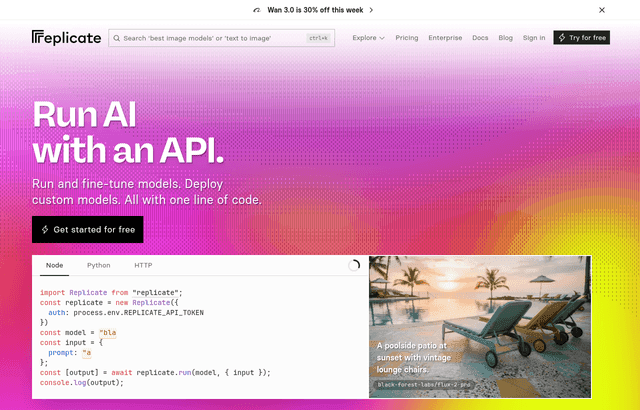
Replicate, one of the tools included in this startup deal.
Running Open-Source Models Through an API
The core capability Replicate offers is running open-source models through a simple API, and for a startup that is a direct shortcut to building with AI. The open-source model world is rich, with strong models for language, image generation, audio, and more, but using them normally means downloading weights, setting up the runtime, securing the right hardware, and keeping it all running. Replicate collapses that into an API call, so the team consumes models the way it consumes any other web service.
For an early team, this changes what is feasible. Instead of an ML engineer spending weeks getting a model to serve reliably, an engineer integrates an API and starts building the feature. Models like Llama for language and Stable Diffusion for images become available through the same straightforward interface, so the team can experiment with different models and capabilities quickly. The barrier between an idea for an AI feature and a working prototype drops dramatically.
This matters because speed of experimentation is how an AI startup finds what works. The team that can try a model in an afternoon learns faster than the one that needs a week of setup per experiment. Replicate making models accessible through an API means the team spends its time on the product and the prompts and the user experience, not on the machinery of serving models. For a small team, that is exactly the leverage that lets it build serious AI features without a serious infrastructure team.
No GPU Management to Own
The phrase that carries the most weight in Replicate's description is without GPU management, because GPU management is precisely the burden that stops many small teams from building with AI. GPUs are expensive, scarce, and finicky. Provisioning them, keeping them utilized, scaling them with demand, and controlling the cost is specialist work, and getting it wrong means either a huge bill for idle hardware or an outage when demand spikes. Replicate takes that entire concern off the team's plate.
For a startup, not owning GPU management is both a cost saving and a focus saving. On cost, the team pays for inference it actually uses rather than for GPUs sitting idle between requests, which matters enormously when usage is unpredictable in the early days. On focus, the team avoids becoming part-time infrastructure operators, keeping its attention on the product. Neither of these is a small thing when the team is a handful of people trying to build something ambitious with limited resources.
There is also a scaling benefit. When a feature suddenly gets used more, the demand for inference rises, and handling that spike by managing GPUs yourself is genuinely hard. Replicate absorbing the scaling means the team's AI features can handle growth without the team engineering for it. For an AI startup, whose whole product may depend on models running reliably at whatever demand shows up, having a platform own the GPU layer is what makes building on AI viable without a large team.
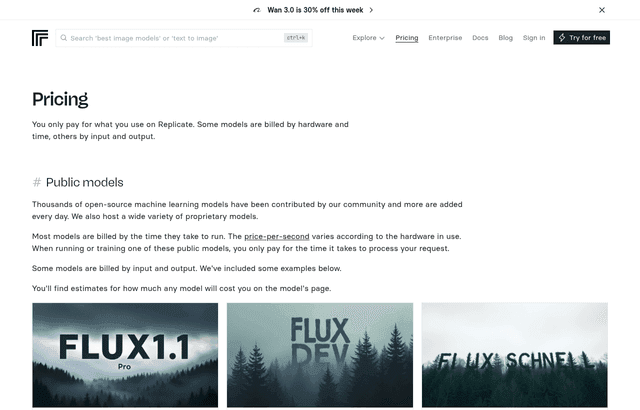
A look at Replicate before the discount, so you can see what the deal saves you.
Deploying Custom Models Too
Replicate is not limited to popular pre-existing models. A team can deploy its own custom models on the platform and run them through the same API, which matters for a startup whose edge comes from a model it has trained or fine-tuned. This means the same infrastructure that serves off-the-shelf open-source models can serve the team's proprietary ones, so there is no separate system to build when the product moves from generic models to custom ones.
For an AI startup, this is an important growth path. Many teams start by building on existing open-source models to validate the product, then develop custom or fine-tuned models as they find what specifically works for their use case. If deploying a custom model meant building GPU infrastructure from scratch, that transition would be a major project. Replicate letting custom models run through the same platform means the team can evolve from generic to proprietary models without changing how it serves them.
This continuity protects the team's investment. The integration work done to call Replicate's API for an open-source model largely carries over to calling the team's own model, so the product's AI layer stays stable even as the models behind it change. For a startup whose differentiation may ultimately rest on a custom model, having a platform that handles both off-the-shelf and custom deployment through one interface is exactly the kind of flexibility that supports the long game.
The $500 in Credits and What They Buy
The $500 in credits is the concrete value here, and its worth is in timing and in what inference costs. Running models, especially image generation and large language models, consumes real compute, and that compute costs money per request. Early on, when the team is experimenting heavily and revenue is thin, those costs can add up fast and discourage exactly the experimentation the team needs to do. The credits remove that friction during the phase when it matters most.
With $500 in credits, an AI startup can run real inference, test different models, build and refine features, and put the product in front of users without an inference bill weighing on every decision. This freedom to experiment is precisely what an early AI team needs, because finding the right model, the right prompt, and the right feature takes iteration, and iteration means running the models many times. The credits let the team do that iteration without counting every call.
The requirement, an AI startup using open-source models, aims the credits at the teams they are meant for: companies building their product on the open-source model ecosystem. For a team that fits, the credits are runway applied directly to the core of the product, the models, at the stage where preserving cash for everything else is most important. That is a clean, high-value use of a startup's scarce early resources.
Replicate Compared to Managing Your Own Inference
The alternative to Replicate is running inference yourself: renting or buying GPUs, setting up the serving stack, loading models, and managing scaling and cost directly. This route offers maximum control and can be more cost-efficient at very large, steady scale, but for an early-stage AI startup it usually means pouring scarce engineering time into infrastructure instead of the product, and taking on the exact GPU management burden that is hardest to get right.
The hidden difficulty of self-managed inference is that it is never done. GPUs have to be kept utilized to justify their cost but available to handle spikes, which is a genuine engineering challenge. Model serving has to be reliable, scaling has to be handled, and costs have to be watched constantly. A small team that goes this route often finds an engineer becoming a full-time inference operator, which is capacity taken straight out of building the actual product. Early on, few AI startups have that capacity to spare.
Replicate's case is that a platform handling the GPU layer lets a startup build serious AI features without a serious infrastructure team. The team trades some control and some per-unit cost at extreme scale for a large gain in speed, simplicity, and focus, which is usually the right trade while the product is still being found. For an early AI team weighing where its limited engineering hours go, offloading inference to Replicate keeps those hours on the product, and the $500 in credits makes testing that trade essentially free.
Making the $500 in Credits Count
Credits deliver the most value when they fund building a real AI feature rather than idle poking, so the way to use them well is to put a model to work inside the actual product. The goal during the credit period is to get an AI feature running against real inputs and real users, so the team learns how the model performs on its own problem and how Replicate fits the workload.
Start by picking the model that fits the product's core AI need, whether that is a language model for text, an image model for generation, or something else, and integrate it through Replicate's API into a real feature. Run real inputs through it, put it in front of users, and see how it behaves. This focused build shows the team the quality of the output, the latency, and the cost per use, which are the numbers that decide whether the feature is viable.
While doing this, the team should experiment across models, because part of the value of Replicate is easy access to many of them, and the best model for a use case is often not the first one tried. If the product will eventually use a custom or fine-tuned model, testing a deployment of one during the credit period shows how that path works. By the time the credits are spent, the team should have a working AI feature, a clear read on the economics of running it, and confidence in whether Replicate is the right platform to build the product's AI on.
How Replicate Fits an AI Startup's Stack
An AI startup's product usually has an AI layer sitting inside a normal application: a web or mobile frontend, a backend, and somewhere in there, calls to models. Replicate fits that shape by being an API the backend calls, which means the AI capability slots into the existing architecture without reshaping it. The team's application talks to Replicate the way it talks to any other service, sending inputs and receiving outputs, so adding AI is an integration rather than a rebuild.
This clean fit matters because it keeps the AI layer decoupled from the rest of the system. The product's architecture does not have to bend around GPU infrastructure, because that infrastructure lives on Replicate's side of the API. The team can change models, upgrade to better ones as the open-source ecosystem evolves, or swap in a custom model, all without touching the surrounding application, because the interface stays the same. For a startup building in a fast-moving field, that flexibility to change the model behind a stable API is genuinely valuable.
For a small team, this also means the AI expertise required to ship is lower than it would otherwise be. An engineer who knows how to call an API can integrate powerful models, without needing deep infrastructure or MLOps skills to serve them. That lowers the bar for what the team can build and who on the team can build it, which is exactly the kind of accessibility an early AI startup needs to move fast with a small crew.
Who Should Claim This Deal
This deal is built for AI startups building their product on open-source models, which is precisely the requirement attached to it. If the team's product depends on running models like Llama or Stable Diffusion, or on custom models the team develops, and the team wants to do that without managing GPUs, Replicate plus $500 in credits fits that need directly and covers real inference while the product is validated.
It is especially valuable for small AI teams without infrastructure specialists. Because Replicate handles the GPU layer, engineers who know how to call an API can ship powerful AI features, and the credits pay for the inference while the product is still finding its footing. That combination lets a lean team build serious AI capabilities it would otherwise need extra hands and budget to run.
Teams operating at very large, steady inference scale, where owning the infrastructure becomes more economical, or teams building on closed models outside the open-source ecosystem, may find this deal less suited to them. But for an early-stage AI startup building on open-source models and wanting to move fast without a GPU operations burden, this deal is a strong fit. Claim the credits, ship a real AI feature, and let the results and the economics show whether Replicate is the right foundation for the product's AI.
Who Is This Deal For?
Early-Stage Startups
Seed and pre-seed companies looking to move fast without overspending on tools.
Growing SaaS Teams
Series A+ companies scaling their stack and optimizing software costs.
Solo Founders
Indie hackers and bootstrapped founders who need enterprise tools at startup prices.
Get $500 in credits off Replicate
Premium deal. Upgrade once, unlock everything.
!Eligibility Requirements
AI startup using open-source models
Frequently Asked Questions
Everything you need to know about this startup deal.
Pay per-second of compute, no subscription. Startup credits give $500 free.
Get the weekly deals digest
New verified startup deals every week. No spam, ever. Unsubscribe anytime.
Related Offers

Higgsfield
55% off annual Business plan
55% off an annual Higgsfield Business plan. Higgsfield is an AI video and image studio with Seedance, Kling, Veo and more in one account.
View offer
Seedance
55% off annual Business plan
55% off an annual Higgsfield Business plan with Seedance included. Seedance is ByteDance's AI video model for text, image and reference-driven clips.
View offerChromaDB
Used by 306 members
Free & Open Source
Open-source embedding database for building AI applications with semantic search.
View offer
Laxis
Used by 2,176 members
Free Plan
AI meeting assistant that records, transcribes, and generates actionable meeting notes.
View offer
Pictory
Used by 659 members
Free Trial
AI-powered video creation tool, turn text, scripts, and blogs into videos.
View offer
Segment
Used by 2,293 members
$25,000 in credits
Collect, clean, and route customer data to every tool in your stack with the leading customer data platform.
View offerDeal Summary
Looking for more startup deals?
Browse all offers