

Vercel vs Render for Startups in 2026
Choosing between Vercel (Free Pro plan (1 year)) and Render ($500 in credits) for your startup? This side-by-side comparison covers features, startup deals, pricing, and which tool fits your stack, with verified deals you can claim through SaaSOffers.
Quick Answer
Vercel offers Free Pro plan (1 year) and is best for startups needing developer & it. Render offers $500 in credits and is best for developer & it. Render provides a higher-value startup deal, but Vercel may be the better fit depending on your stack. You can claim both through SaaSOffers, there are no restrictions on using multiple startup deals.

Vercel
Deploy frontend applications with zero configuration on the platform built for Next.js, free Pro plan for startups.

Render
Deploy web services, databases, and cron jobs with zero DevOps, modern cloud hosting for startups.
What Is Vercel?
Vercel is a platform for deploying frontend applications with zero configuration, built by the team behind Next.js and tuned for it above all. The offer is a free Pro plan for a full year, aimed at early-stage startups with a new Vercel account. That is a substantial gift. The Pro plan is what small teams actually build on, and getting it free for a year means a startup can run its production frontend on serious infrastructure through the crucial early stretch without paying for hosting. A year is long enough to launch, grow, and find traction before the bill ever arrives.
The core promise is zero-configuration deployment. A startup connects its repository, and Vercel builds and deploys the application automatically, handling the plumbing that would otherwise consume an engineer's time. There is no server to provision, no build pipeline to assemble, no deployment scripts to maintain. Push code, and it goes live. For a small team whose scarcest resource is engineering hours, removing the entire category of deployment work is a direct and immediate benefit. The team spends its time on the product, not on the machinery that ships it.
Because Vercel is built by the makers of Next.js, the fit for a Next.js application is unusually tight. Every feature of the framework is supported first-class, and the platform is optimized for exactly the way Next.js apps are built and run. A startup building on Next.js, which is a common and sensible choice, gets a hosting platform that understands its framework completely. That alignment means fewer surprises, better performance, and a smoother path from code to production than a generic host could offer. The free Pro year lets a team enjoy that fit without the cost during the period it matters most.
What Is Render?
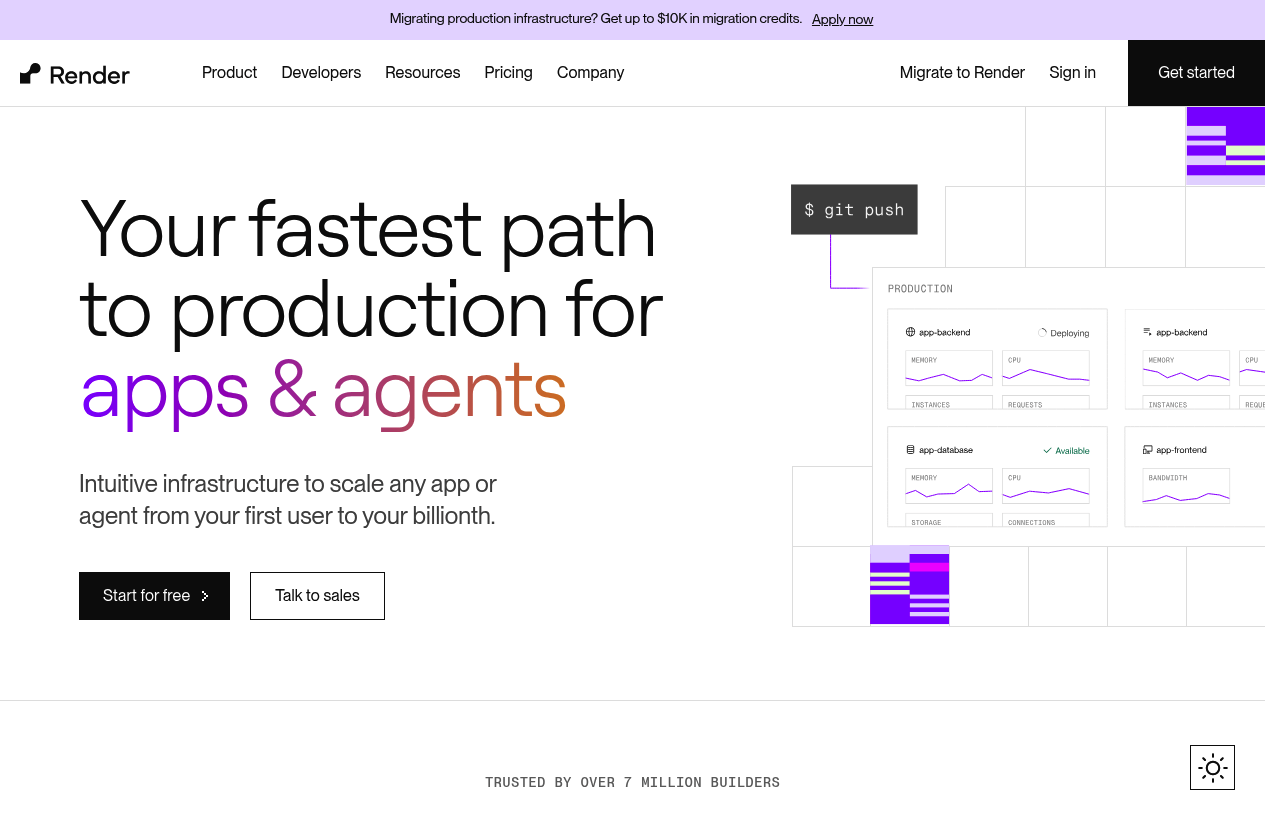
Render is modern cloud hosting that lets a team deploy web services, databases, and cron jobs with zero DevOps. The deal is $500 in credits, available to early-stage startups opening a new Render account, which gives a young team real hosting to run its product without the bill arriving before there is revenue. For a startup, that is runway applied directly to infrastructure, and infrastructure the team does not have to hire a specialist to operate.
The core idea behind Render is that a small team should not need a dedicated operations engineer to run its application in the cloud. Deploying a service, attaching a database, and scheduling background jobs are things Render aims to make straightforward, so the people building the product can also ship and run it. The $500 in credits lets a startup do exactly that from day one, covering the hosting costs while the team validates the product and the traffic is still small.
Vercel vs Render, Detailed Comparison
What's Included in Each Startup Deal
Here is exactly what you get when claiming each deal through SaaSOffers:
VVercel
- 1 year of Vercel Pro plan
- Unlimited deployments and preview URLs
- 1TB bandwidth per month
- Team collaboration features
- Serverless and edge function support
RRender
- $500 in Render credits
- Auto-deploy from Git
- Managed PostgreSQL databases
- Background workers and cron jobs
- Free SSL and global CDN
Who Should Use Vercel vs Render?
The right tool depends on what your startup actually needs day-to-day. Both Vercel and Render serve different use cases, and many startups use tools from the same category for different purposes. Here is when each makes sense:
Choose Vercel if:
- You need developer & it as a core part of your product or operations
- Free Pro plan (1 year) in credits covers your usage for 6–12 months
- Your team has experience with Vercel or similar tools in its category
- You want a premium-tier deal with SaaSOffers Premium
Choose Render if:
- You need developer & it as a core part of your product or operations
- $500 in credits in credits covers your usage for 6–12 months
- Your team has experience with Render or similar tools in its category
- You want a premium-tier deal with SaaSOffers Premium
Can you use both? Yes, there are no restrictions on claiming multiple startup deals. Many startups use Vercel and Render simultaneously for different needs. Claim both through SaaSOffers.
Startup Deal Comparison: Which Saves More?
Both Vercel and Render offer startup deals through SaaSOffers. Here is how the deals compare for a typical early-stage startup in 2026:
Frequently Asked Questions
Common questions about Vercel vs Render for startups.
What is the difference between Vercel and Render?
Vercel offers Free Pro plan (1 year) and is categorized as Developer & IT. Render offers $500 in credits and is categorized as Developer & IT. Both offer startup deals through SaaSOffers. The right choice depends on your specific needs, Vercel is best for teams needing developer & it, while Render excels at developer & it.
Can I use both Vercel and Render together?
Yes. There are no restrictions on claiming startup deals from multiple tools. Many startups use both Vercel and Render simultaneously, each serving different needs. Claim both through SaaSOffers for maximum savings.
Which has a better startup deal, Vercel or Render?
Render offers $500 in credits, while Vercel offers Free Pro plan (1 year). However, the "better" deal depends on which tool you actually need, a larger credit on a tool you won't use is worth less than a smaller credit on a tool that's essential to your stack.
Is Vercel free for startups?
Vercel offers Free Pro plan (1 year) through its startup program on SaaSOffers. The deal type is "premium", available to SaaSOffers Premium members ($79/year). Early-stage startup, new Vercel account
Is Render free for startups?
Render offers $500 in credits through its startup program on SaaSOffers. The deal type is "premium", available to SaaSOffers Premium members ($79/year). Early-stage startup, new Render account
Is Vercel free for startups?
Vercel has a free Hobby plan that supports personal projects with 100GB bandwidth and limited team features. The startup deal provides the Pro plan free for 12 months, which adds team collaboration, 1TB bandwidth, advanced analytics, and higher serverless function limits — the features growing startup teams need.
Can I use Vercel with frameworks other than Next.js?
Yes. Vercel supports React, Svelte, Vue, Nuxt, Astro, Remix, and any framework that produces static or server-rendered output. However, Next.js receives the deepest integration and optimization since Vercel maintains Next.js. For non-Next.js projects, Vercel is still excellent — just not uniquely advantaged.
How does Vercel compare to hosting on AWS?
Vercel abstracts away the infrastructure layer. On AWS, you configure EC2/ECS, load balancers, CDN, SSL, and CI/CD pipelines. On Vercel, you push to Git and get all of that automatically. Vercel is simpler and faster; AWS is more flexible and cheaper at very high scale. Most startups choose Vercel for frontend and AWS for backend services.
How does Render compare to AWS?
Render provides a simpler deployment experience — Git push instead of configuring ECS, load balancers, and CI/CD pipelines. AWS provides broader services and more flexibility. For startups with 2–10 engineers and standard web application architectures, Render saves weeks of DevOps configuration. For complex architectures requiring 10+ AWS services, AWS is more appropriate.
Is Render good for production workloads?
Yes. Render hosts production applications with auto-scaling, managed databases with daily backups, HTTPS, and global CDN. The platform handles thousands of production applications. For early-to-mid stage startups, Render's reliability is comparable to AWS for standard web application workloads.
How much does Render cost after credits?
Render pricing: web services start at $7/month, PostgreSQL databases at $7/month, Redis at $7/month, background workers at $7/month. A typical startup stack (web service + database + Redis) costs $21–$50/month. The $500 credit covers 10–24 months at this usage level.
The Bottom Line: Vercel vs Render
Both Vercel and Render offer genuine value for early-stage startups in 2026. The decision comes down to your specific needs:
Vercel provides Free Pro plan (1 year) and is the stronger choice for startups that need developer & it. The deal is accessible as a premium offer through SaaSOffers.
Render provides $500 in credits and is the stronger choice for startups that need developer & it. The deal is accessible as a premium offer through SaaSOffers.
The best approach for most startups is to claim both deals, there are no restrictions, and each tool serves a different part of your stack. Start by claiming the tool you need first, then add the second when you need it.
We've helped 10,000+ startup founders unlock $500,000+ in SaaS credits and discounts. Every comparison is based on real deal data from our platform.