
7 Best GitHub Alternatives & Competitors in 2026
Looking for tools like GitHub? We compared 7 alternatives on price, free plan and limits, using each vendor's own pricing page.
Looking for a discount? See the GitHub promo code and deal: 20 free Enterprise seats for 1 year.
The 7 best GitHub alternatives
- 1.GitLab: best for one platform covering code, CI/CD and security
- 2.Bitbucket: best for teams that already use Jira
- 3.Azure DevOps: best for small teams that want a bundled toolset
- 4.Gitea: best for teams that want to host it themselves
- 5.Codeberg: best for open-source projects
- 6.SourceHut: best for maintainers who want a lean toolset
- 7.CircleCI: best if Actions minutes are your real problem

GitLab
#1 AlternativeGet GitLab Ultimate free for 1 year. The complete DevSecOps platform with source code, CI/CD, security scanning, and more in one application.

CircleCI
#2 AlternativeContinuous integration and delivery platform, automate testing and deployment for every code change.
GitHub alternatives compared
By Ilyas Lemzouri, founder of SaaSOffers. Updated November 2026.
How we checked: we list a tool only after talking with its team and trying it. Every price and limit below comes from each vendor's own pricing page, checked in November 2026.
The best GitHub alternatives are GitLab for teams that want source control and CI/CD in one product, Bitbucket for teams that already run Jira, and Azure DevOps for teams of 5 or fewer, who pay nothing. The cheapest option is Codeberg or a self-hosted Gitea, both $0 in software fees. The best free hosted option for private team work is Azure DevOps (5 users, 1,800 pipeline minutes), and for open-source projects it is Codeberg. If you want to run your own server, Gitea and Forgejo are open source.
Why teams look for GitHub alternatives
GitHub is the default, but its pricing page gives teams several concrete reasons to compare.
- Big jump between paid tiers. Team costs $4 per user per month. Enterprise costs $21 per user per month. SAML single sign-on, SCIM, the audit log API and data residency only start on Enterprise, so a 20 person team that needs SSO goes from $80 to $420 a month.
- Small CI allowance. Free includes 2,000 CI/CD minutes a month and 500 MB of Packages storage. Team raises that to 3,000 minutes and 2 GB. Teams that build on every commit use that up quickly.
- Free is limited for private work. Required reviewers, code owners, Pages and Wikis are listed under Team, not Free.
- Add-ons are billed separately. Codespaces starts at $0.18 per hour of compute and $0.07 per GB of storage. Git Large File Storage is $5 per month for 50 GB of bandwidth and 50 GB of storage.
GitHub alternatives at a glance
| Tool | Starting price | Free plan | Main difference from GitHub | Best for |
|---|---|---|---|---|
| GitHub | Team $4 per user per month | Yes: unlimited repos, 2,000 CI minutes | Large public developer network | Open source and general use |
| GitLab | Premium $29 per user per month, billed annually | Yes: 5 users per group, 400 compute minutes | CI/CD, security and planning in one product | Teams that want one DevOps platform |
| Bitbucket | Standard $3.65 per user per month | Yes: up to 5 users, 50 build minutes | Native Jira integration | Teams already on Jira |
| Azure DevOps | Basic $6 per user per month after 5 free users | Yes: 5 users, 1,800 Microsoft-hosted minutes | Boards, Repos, Pipelines and Artifacts bundled | Microsoft shops and small teams |
| Gitea | Enterprise $9.50 per user per month (listed at $19), 1 year commitment | Yes: open source, self-hosted | Self-hosted, MIT license | Teams that want their own server |
| Codeberg | $0 | Yes | Non-profit host built on Forgejo | Open-source projects |
| SourceHut | $4, $8 or $12 per month per hosting account | Hosting optional to pay during alpha; builds paid | Minimal, email-driven workflow | Maintainers who want a lean toolset |
| CircleCI | Performance from $15 per month | Yes: 6,000 build minutes, 5 active users | CI/CD only, works with GitHub | Teams that outgrow GitHub Actions |
1. GitLab: best for one platform covering code, CI/CD and security

Price: Premium $29 per user per month, billed annually; Ultimate on request | Free plan: $0, 5 users per top-level group, 400 compute minutes a month, 10 GiB storage
GitLab is the closest like for like replacement. Source control, CI/CD, issue boards and static application security testing are in the same product. Premium adds 10,000 compute minutes a month, and Ultimate adds 50,000 plus supply chain security and compliance tools. Extra compute is $10 per 1,000 minutes.
It costs far more per seat than GitHub Team at $4, and its free tier gives 400 minutes compared with GitHub's 2,000. The Free plan is also capped at 5 users per group.
Pick GitLab if you want CI/CD, security scanning and planning in one tool and can pay $29 per seat. See the GitLab offer.
2. Bitbucket: best for teams that already use Jira
Price: Standard $3.65 per user per month, Premium $8 per user per month | Free plan: Up to 5 users, unlimited public and private repos, 1 GB LFS storage, 50 build minutes
Bitbucket Standard undercuts GitHub Team by 35 cents a seat. Its main advantage is Jira integration. Premium adds enforced merge checks, IP allowlisting, deployment permissions and required two-step verification.
The free plan stops at 5 users and includes only 50 build minutes, far below GitHub's 2,000. The network of public projects is also much smaller.
Pick Bitbucket if your tickets already live in Jira and your team has fewer than 10 developers.
3. Azure DevOps: best for small teams that want a bundled toolset
Price: Basic $6 per user per month after the first 5 users | Free plan: First 5 users free, unlimited private Git repos, 2 GiB Artifacts
Azure DevOps bundles Boards, Repos, Pipelines and Artifacts. Each organization gets one Microsoft-hosted pipeline job with 1,800 minutes a month and one self-hosted job with unlimited minutes. Extra parallel jobs cost $40 (Microsoft-hosted) or $15 (self-hosted). Stakeholders, who only view and comment, are free.
It is weaker on community. Few open-source projects live there, and the interface is built around Microsoft workflows. Visual Studio subscribers get access at no added cost.
Pick Azure DevOps if you have 5 or fewer developers, or you already have Visual Studio subscriptions or GitHub Enterprise.
4. Gitea: best for teams that want to host it themselves
Price: Enterprise $9.50 per user per month (listed at $19), 1 year commitment for online payment | Free plan: Open source under MIT, unlimited users and repos when self-hosted
Gitea gives you code hosting, issue tracking, pull requests, project management, built-in CI/CD (Gitea Actions) and packages on your own server. Enterprise adds SAML SSO, audit logs, Kubernetes autoscaling runners and an SLA.
You carry the hosting, backups and upgrades. There is no hosted free tier. Enterprise offers a 30 day free trial.
Pick Gitea if you have someone who can run a server and want zero per-seat fees.
5. Codeberg: best for open-source projects
Price: $0 | Free plan: Free for all users, no stated user cap
Codeberg is run by a non-profit and uses Forgejo. It suits free and open-source work. Private repositories are allowed only in small amounts: up to 100 MB for contributors to free software. It asks you to get in touch before using more than 750 MiB of Git storage.
It is not built for commercial closed-source teams. Content without a free and open-source license may be refused.
Pick Codeberg if your project is open source and you want to leave a corporate host.
6. SourceHut: best for maintainers who want a lean toolset
Price: $4, $8 or $12 per month; all tiers include every service | Free plan: Git and Mercurial hosting are optional to pay for during the public alpha; builds require payment
SourceHut offers git and Mercurial hosting, mailing lists, bug tracking and CI builds, all open source. Only people who host their own projects pay, and the tier is a choice of how much to contribute, not a feature level. Builds require a paid account.
The workflow is email-driven and plain. There are no GitHub style pull requests, so reviewers used to a web interface need time to adjust.
Pick SourceHut if you value a small, fast, open-source stack over a polished interface.
7. CircleCI: best if Actions minutes are your real problem
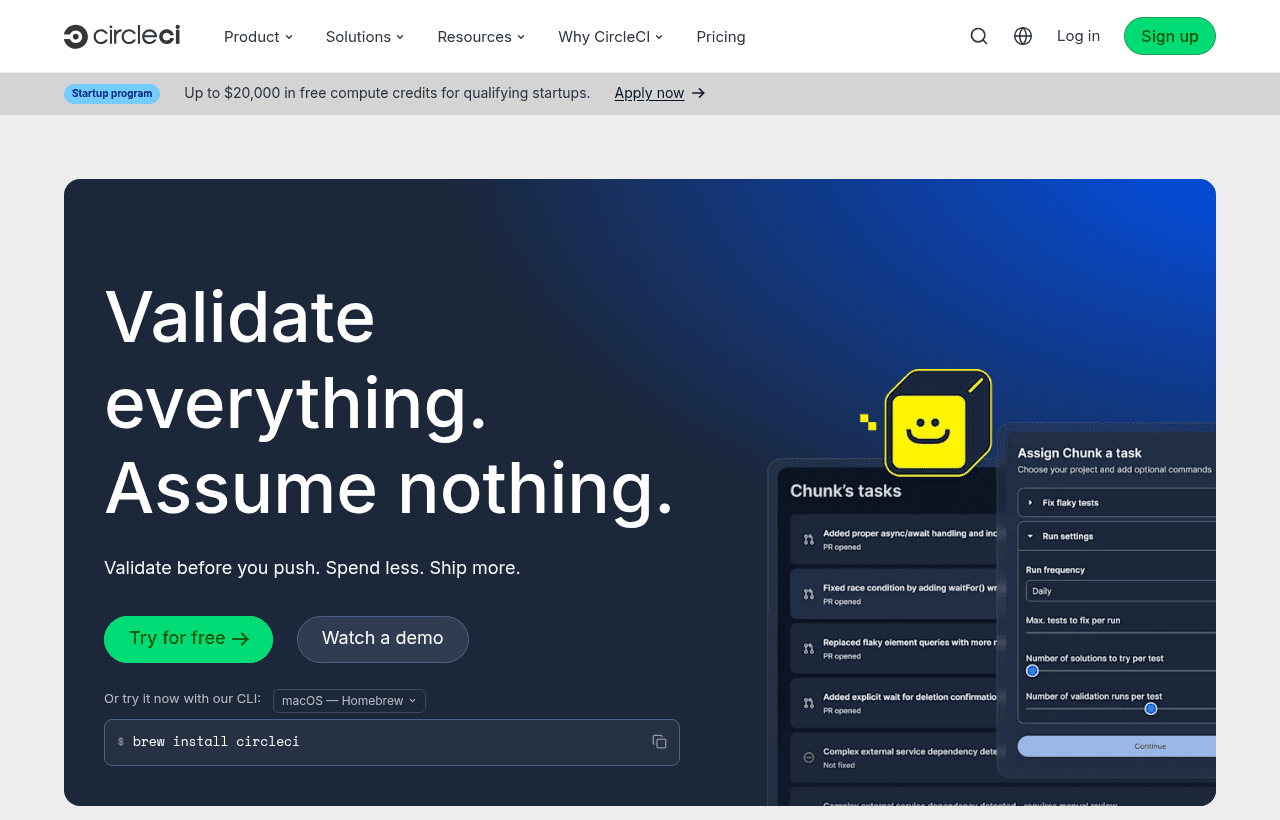
Price: Performance from $15 per month, Scale on request | Free plan: Up to 6,000 build minutes a month (small Docker), up to 5 active users
CircleCI replaces GitHub Actions, not GitHub itself. It connects to GitHub, GitLab and Bitbucket. The free plan offers 6,000 build minutes against GitHub Free's 2,000. Performance adds larger resource classes and more concurrency. Extra users are $15 per month.
You pay for a second tool and keep a separate configuration format. Usage is billed in credits.
Pick CircleCI if your code can stay on GitHub but your pipelines keep running out of minutes. See the CircleCI offer.
Free GitHub alternatives
- Bitbucket Free: up to 5 users, unlimited public and private repos, 1 GB LFS storage and 50 build minutes.
- Azure DevOps: first 5 users free, 1,800 Microsoft-hosted pipeline minutes a month, 2 GiB of Artifacts.
- GitLab Free: 5 users per top-level group, 400 compute minutes and 10 GiB storage.
- Codeberg: free for open-source projects, with 100 MB of private content for contributors.
- Gitea: free to self-host under the MIT license, no user limit.
- CircleCI Free: 6,000 build minutes and 5 active users, CI only.
GitHub Free is also $0. It includes unlimited public and private repositories, 2,000 CI/CD minutes and 500 MB of Packages.
Cheapest GitHub alternative for a small team
Take a 10 person engineering team that needs private repos, pull request reviews and basic CI.
| Option | Monthly | Yearly |
|---|---|---|
| Gitea or Forgejo, self-hosted | $0 plus your server | $0 plus your server |
| Azure DevOps Basic (5 free, 5 x $6) | $30 | $360 |
| Bitbucket Standard (10 x $3.65) | $36.50 | $438 |
| GitHub Team (10 x $4) | $40 | $480 |
| Gitea Enterprise (10 x $9.50) | $95 | $1,140 |
| GitLab Premium (10 x $29, billed annually) | $290 | $3,480 |
Azure DevOps is the cheapest hosted paid option. GitHub Team costs only $10 a month more than Azure DevOps and $3.50 more than Bitbucket, so for most small teams the gap alone is not a reason to move.
How to choose
- Need CI/CD, security scanning and boards in one tool: pick GitLab.
- Already on Jira with fewer than 10 people: pick Bitbucket.
- 5 developers or fewer and a tight budget: pick Azure DevOps and pay nothing.
- Need full control of your data and have a person to run a server: pick Gitea.
- Open-source project that wants a non-corporate host: pick Codeberg.
- Happy with GitHub but running out of minutes: add CircleCI.
FAQ
What is the best free alternative to GitHub?
For private team work, Bitbucket Free and Azure DevOps both cover 5 users at no cost. For open-source projects, Codeberg is free and run by a non-profit. Gitea is free if you host it yourself.
What is cheaper than GitHub?
Bitbucket Standard is $3.65 per user per month, against $4 for GitHub Team. Azure DevOps charges $6 per user per month but the first 5 users are free, so a team of 10 pays $30 a month. Self-hosted Gitea has no license fee.
Who are GitHub's main competitors?
GitLab, Bitbucket and Azure DevOps are the main commercial competitors. Gitea, Forgejo (the software behind Codeberg) and SourceHut are the open-source options. CircleCI competes with GitHub Actions.
Is there an open-source alternative to GitHub?
Yes. Gitea is MIT licensed and self-hostable. Codeberg runs Forgejo and offers hosting for free software. SourceHut is also fully open source and can be self-hosted.
What is better than GitHub for CI/CD?
GitLab bundles CI/CD with source control and gives 10,000 compute minutes on Premium. CircleCI offers 6,000 free build minutes against GitHub Free's 2,000.
Prices checked on each vendor's pricing page in November 2026.
Still considering GitHub?
Claim the GitHub startup deal through SaaSOffers. Verified and free to access.
Claim GitHub deal