
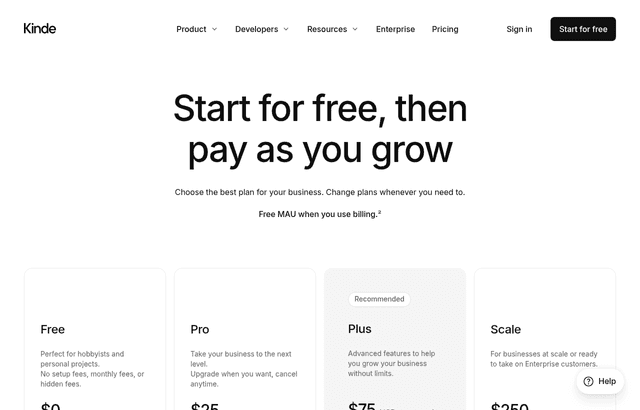
Kinde Coupon: Free Plan
Authentication and user management platform built for developers with feature flags.
Premium: $79/year for unlimited deals
Already have an account? Log in
Deal Highlights
What Kinde Gives a Startup
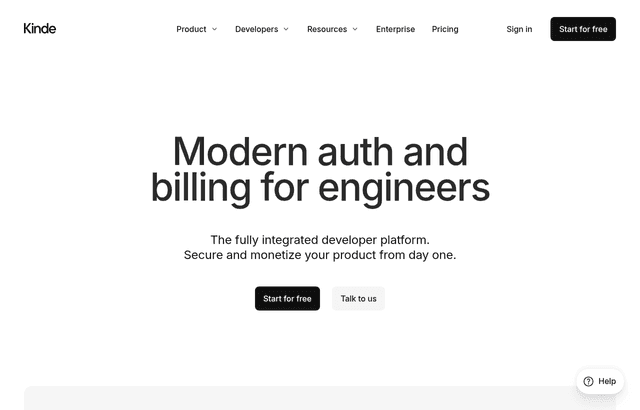
Kinde is an authentication and user management platform built for developers, and this deal opens the door with a Free Plan. That means a startup can wire up sign-up, login, and user management without paying for the privilege of letting people into the product. For an early team, authentication is one of those problems that looks small on the roadmap and turns into weeks of work once you start building it yourself. Kinde takes that whole surface off your plate and hands you a production-grade identity layer plus feature flags in the same package.
The value here is not just "login works." It is that a startup gets a system built by people who treat auth as their entire job. Password resets, email verification, social sign-in, session handling, and the security edge cases that come with all of them are already solved. On the Free Plan, a team can ship a real product with real users and only start thinking about paid tiers once growth makes that a good problem to have.
Authentication That Developers Actually Want to Use
The first thing a startup notices about Kinde is that it was designed for the person writing the code, not for a procurement committee. The SDKs are clean, the documentation is direct, and the flow from "empty project" to "users can log in" is short. That matters because the fastest way to lose momentum on a new product is to spend your first sprint fighting an identity provider instead of building the thing customers came for.
Kinde handles the standard authentication methods a modern app needs. Email and password, passwordless flows, and social login through the providers your users already have accounts with. Each of these is a small feature on paper and a security minefield in practice. Storing passwords correctly, rate-limiting login attempts, rotating tokens, and expiring sessions are all places where a homegrown system quietly leaks risk. Kinde gives a startup the version that has already been hardened, so the team ships with confidence instead of hoping nobody probes the edges.
For a startup, the practical win is speed with a safety net. You get users into the product on day one, and you do not carry the long tail of security maintenance that a custom auth stack demands for the rest of the company's life.
User Management Without Building an Admin Panel
Getting people logged in is only half the job. Once users exist, someone has to manage them, and that is where a lot of early products stall. Kinde comes with user management built in, so a startup does not have to build an internal admin panel just to see who signed up, deactivate a bad actor, or reset someone's access.
This becomes more valuable as the product grows. When a startup lands its first few business customers, those customers often want their own teams organized inside the product. Kinde supports organizations, so a single account can represent a company with many users under it. That is the difference between a tool that works for hobby users and one that works for paying teams. Building multi-tenant user structures from scratch is a serious engineering project. Having it available from the platform means a startup can sell to companies far earlier than it otherwise could.
User management also touches support. When a customer emails to say they cannot get in, the team needs a fast way to look up that user, check their status, and fix it. Kinde gives support and engineering a shared source of truth instead of a database query and a prayer. The team spends its time helping customers, not reverse-engineering its own auth data.
Feature Flags in the Same Platform
Kinde bundles feature flags alongside authentication, and that pairing is more useful than it first appears. Feature flags let a startup turn functionality on and off without shipping new code. You wrap a new feature in a flag, deploy it dark, and flip it on for a small group before rolling it out to everyone.
For a small team, this changes how you release. Instead of the all-or-nothing deploy where a bug reaches every user at once, a startup can expose a feature to internal accounts first, then to a handful of friendly customers, then to the whole base. If something breaks, you turn the flag off and the problem disappears without an emergency deploy. That is a calmer way to ship, and calm is worth a lot when the team is three engineers and there is no on-call rotation to catch a bad night.
Because the flags live in the same platform as your users and organizations, a startup can target features by user or by organization. You can give a specific enterprise customer early access to something they asked for, or run a limited test with a segment of your base, all without custom plumbing. That tight link between identity and feature control is something teams usually assemble from two separate tools. Kinde gives a startup both in one place.
Security and Compliance You Do Not Have to Reinvent
Identity is the front door to everything a startup builds. If that door is weak, nothing behind it is safe. The problem is that doing authentication security correctly is a specialist discipline, and most early teams do not have a security specialist. Kinde closes that gap by making the secure path the default path.
Token handling, session expiry, secure storage of credentials, and protection against common attacks are all managed by the platform. A startup inherits these protections instead of learning about them the hard way after an incident. That is not a small thing. A single auth breach can end a young company's credibility with customers, and identity platforms exist precisely so that small teams do not have to carry that risk alone.
There is also a forward-looking benefit. As a startup starts selling to larger customers, those buyers begin asking security questions during procurement. Having a real identity platform underneath your product is a much stronger answer than "we built login ourselves." Kinde gives the team a foundation that holds up to scrutiny when the deals get bigger and the questions get harder.
Kinde Compared to Rolling Your Own Auth
The most honest comparison for Kinde is not against another vendor. It is against the tempting idea of building authentication in-house. On paper, auth looks like a weekend project. In reality, it is a system that never stops needing attention. New attack patterns appear, session bugs surface, users lose access in creative ways, and every one of those becomes an engineering interruption.
A startup that builds its own auth pays for it twice. Once to build it, and then continuously to maintain it, secure it, and extend it as the product grows into organizations, roles, and enterprise requirements. Every hour spent on that is an hour not spent on the product that actually differentiates the company. Kinde takes that entire category of work and turns it into an integration.
Compared to heavier enterprise identity platforms, Kinde leans toward the developer experience and toward getting a small team productive quickly. The Free Plan reinforces that. A startup can adopt Kinde before it has revenue, prove the product, and grow into the platform rather than committing to a large contract before there is a business to justify it. That order of operations, adopt first and pay as you scale, is exactly what an early team needs.
Making the Free Plan Count
A free plan is only valuable if a startup actually builds on it, so the goal is to make Kinde load-bearing early rather than treating it as a trial you will revisit later. The best move is to put Kinde at the center of the product's identity from the first commit. Use it as the single source of truth for who your users are, and route every authenticated action through it rather than caching identity in half-built side systems.
Lean on the pieces that save the most time. Turn on social login so users do not have to create yet another password. Set up organizations early, even if your first customers are individuals, because retrofitting multi-tenancy later is painful and doing it now is nearly free. Start using feature flags from your first real release so that shipping safely becomes a habit instead of a project you adopt after your first bad deploy.
Treat the Free Plan as the foundation you will grow on, not a stopgap. A startup that designs its auth and feature-flag workflow around Kinde now will not face a migration later. When usage grows past the free tier, moving to a paid plan is a billing change, not a rebuild. That continuity is the real prize. The team keeps its architecture and simply scales the plan underneath it.
How Kinde Scales With the Team
Early on, a startup needs authentication that gets out of the way. Later, it needs authentication that can carry weight. Kinde is built to cover both ends of that journey, which is why adopting it early is a sound bet rather than a temporary convenience.
As the user base grows, the same platform that handled your first hundred sign-ups handles your first hundred thousand. As customers get larger, organizations and user structures let you model real companies inside the product. As the team matures its release process, feature flags let you run gradual rollouts and experiments that would have been reckless with a simple deploy button. Each of these needs shows up at a different stage of growth, and Kinde already has an answer waiting when the startup reaches it.
That continuity is worth planning around. The tools a startup picks in its first year tend to stick, because ripping out authentication once real customers depend on it is one of the riskiest migrations a company can attempt. Choosing a platform that already spans the whole growth curve means the team avoids that migration entirely.
Getting Started the Right Way
The path into Kinde is short, and a startup should treat the first setup as an investment rather than a quick checkbox. Create the account, install the SDK for your stack, and get a basic login flow working end to end before you add anything fancy. Confirm that sign-up, login, logout, and password reset all behave the way you expect. Those four flows are the spine of the experience, and getting them solid first makes everything after easier.
From there, layer in the pieces that match your product. Add the social providers your audience actually uses. Configure organizations if you plan to sell to teams. Wrap your next new feature in a flag so your very first use of feature flags is real rather than a demo. Each step builds on a working foundation, so the team is never far from a state that ships.
Document the setup as you go. Even a short internal note about how auth is configured saves the next engineer hours and prevents the kind of tribal knowledge that becomes a liability when the team grows. A startup that treats its identity layer as a deliberate part of the architecture, rather than something bolted on in a hurry, gets a system that stays clean as the company scales.
Who Should Claim This Deal
This deal fits any startup that needs users to log in, which in practice means almost every software startup. If the team is about to build authentication, stop and adopt Kinde instead. The Free Plan removes the cost objection entirely, and the developer-focused design removes the friction that makes teams dread auth work in the first place.
It is an especially strong fit for a startup that expects to sell to teams and companies rather than only to individual users. The built-in organizations and user management mean the product can support multi-user customers from an early stage, which opens up bigger deals sooner. Teams that want to ship carefully, using feature flags to control rollouts, will also get outsized value because that capability is included rather than bolted on from a separate tool.
The startups that will not get much from this are the ones with no user accounts at all, or teams already deeply committed to another identity platform with no appetite to move. For everyone else building a product where people log in, Kinde on the Free Plan is a fast, secure, and low-risk way to get identity right from the beginning. Claim it before you write a single line of custom auth, and let the platform carry a problem your team should not have to solve twice.
Who Is This Deal For?
Early-Stage Startups
Seed and pre-seed companies looking to move fast without overspending on tools.
Growing SaaS Teams
Series A+ companies scaling their stack and optimizing software costs.
Solo Founders
Indie hackers and bootstrapped founders who need enterprise tools at startup prices.
Get Free Plan off Kinde
Premium deal. Upgrade once, unlock everything.
How to get the Kinde deal
- The offer: Free Plan.
- Create a free SaaSOffers account, then upgrade to Premium ($79 a year, or $250 once for lifetime access). Premium unlocks every Premium deal on the site.
- Open the Kinde claim page from this deal. It shows the partner link, any promo code and the exact steps Kinde asks for.
- Apply or sign up through that link before you pay Kinde directly, since most startup offers only apply to new accounts.
Frequently Asked Questions
Everything you need to know about this startup deal.
Get the weekly deals digest
New verified startup deals every week. No spam, ever. Unsubscribe anytime.
Related Offers

Replicate
Used by 1,772 members
$500 in credits
Run open-source ML models in the cloud, deploy Llama, Stable Diffusion, and custom models via API without GPU management.
View offer
ZoomInfo
Used by 2,014 members
Free Trial
B2B data platform for sales and marketing intelligence with contact databases.
View offer
Chore
15% off your first month
Chore runs your startup's back office for you: payroll, HR, bookkeeping, compliance and equity, inside the tools you already use. 15% off your first month through SaaSOffers.
View offerDeal Summary
Looking for more startup deals?
Browse all offers