
Mapbox Startup Credits: $1,000 in credits
Custom maps, geocoding, navigation, and location search APIs for building location-aware applications.
Premium: $79/year for unlimited deals
Already have an account? Log in
Deal Highlights
Our Mapbox listing: $1,000 in credits
Offer: $1,000 in credits. Our listing's requirement is "Startup building location features." There is no promo code, and the listing carries no SaaSOffers tracking link, so you go to Mapbox directly.
We checked these plans and prices against Mapbox's official pricing and help pages in November 2026.
Mapbox sells map, search and routing APIs and SDKs. You pay per use, and most products have a monthly free tier. Note: Mapbox's public pricing page and documentation do not mention a startup program or startup credits. We found nothing on mapbox.com that confirms the $1,000 in our listing. So treat it as our listing's term, and ask Mapbox to confirm the amount, the expiry and the eligibility rules when you redeem it. Everywhere below that the math uses the credit, it says "if it applies."
the free tiers are large enough that many early products pay nothing. The credit only matters once you pass them.
What you pay nothing for each month
Mapbox's pricing page lists a free tier per product. These are the ones a typical map product touches:
| Product | Free each month |
|---|---|
| Mapbox GL JS map loads | 50,000 loads |
| Maps SDKs for Mobile | 25,000 monthly active users |
| Static Images API | 50,000 requests |
| Temporary Geocoding API | 100,000 requests |
| Directions API | 100,000 requests |
| Matrix API | 100,000 elements |
| Isochrone, Map Matching, Optimization APIs | 100,000 requests each |
| Search Box API (standard) | 25,000 requests and 2,500 sessions |
| Address Autofill | 1,000 sessions |
| Tilequery API | 100,000 requests |
| Vector Tiles API | 200,000 requests |
| Navigation SDK (metered) | 100 MAU and 1,000 trips |
The Mapbox docs say the MAU period follows your billing period, which is probably not a calendar month. A map load is one session, and the docs state it counts as one load "regardless of how much the user interacts with the map." The pages we read give no explicit statement of when the free tiers reset, but the pricing tables are labelled with a monthly cost, so we treat them as monthly allowances.
Map loads cost $5 per 1,000, then step down
Past the 50,000 free loads, the GL JS rates per 1,000 loads are:
| Loads in the month | Price per 1,000 |
|---|---|
| Up to 50,000 | Free |
| 50,001 to 100,000 | $5.00 |
| 100,001 to 200,000 | $4.00 |
| 200,001 to 1 million | $3.00 |
| 1 million to 5 million | $2.50 |
| Over 5 million | Contact sales |
We read these as marginal tiers, where each band is priced at its own rate. The page's table layout is ambiguous, so confirm with Mapbox's calculator before you budget.
Mapbox GL JS also has a separate "Map Seats" meter that bills by monthly active users rather than loads. The first 3 seats are free. Seats 4 to 125 cost $4.00 each, 126 to 250 cost $3.20, and 251 to 1,250 cost $2.40.
For mobile apps the meter is monthly active users. 25,000 are free. Then it is $4.00 per 1,000 MAU up to 125,000, $3.20 up to 250,000 and $2.40 up to 1.25 million.
Geocoding is cheap if you can accept temporary results
Mapbox has two geocoding products, and the price gap is large.
Temporary geocoding is the default. The first 100,000 requests a month are free. Then it is $0.75 per 1,000 up to 500,000, $0.60 up to 1 million and $0.45 up to 5 million. The docs say temporary results are not allowed to be cached.
Permanent geocoding has no free tier. It costs $5.00 per 1,000 requests up to 500,000 and $4.00 up to 1 million. You get it by setting the permanent parameter to true, and the docs say it requires a valid credit card on file or an enterprise contract. Permanent results can be stored indefinitely, but the pricing page says they cannot be used for distribution or sublicense.
This matters if your app geocodes addresses once and saves the coordinates, such as a store locator or a delivery database. That is a permanent use, and it costs about 6.7 times the temporary rate at the first paid tier ($5.00 against $0.75).
Autocomplete has a cost trap too. The geocoding docs say every keystroke counts as a separate request, so typing "Cali" is four requests. Waiting for a few characters before you call the API cuts the bill. The newer Search Box API groups a typing session into one billed unit instead: a session covers up to 50 suggest calls and 1 retrieve call.
The geocoding API's default rate limit is 1,000 requests per minute, and exceeding it returns HTTP 429.
Search Box and Address Autofill have their own meters
Search Box (the place and address search UI) is billed in two ways, and the page lists a standard price and an "introductory preview" price. Pick one per project.
Standard, per request: 25,000 free, then $1.70 per 1,000 up to 100,000, $1.50 up to 500,000 and $1.25 up to 1 million.
Standard, per session: 2,500 free, then $11.50 per 1,000 up to 100,000, $10.00 up to 200,000, $8.40 up to 500,000 and $6.60 up to 1 million.
Introductory preview, per request: 50,000 free, then $1.00 per 1,000 up to 500,000. Introductory preview, per session: 500 free, then $3.00 per 1,000 up to 100,000.
Address Autofill, for checkout and signup forms, is the pricey one: 1,000 sessions free, then $12.50 per 1,000 sessions up to 25,000 and $10.00 up to 100,000. If you only need a checkout address field, compare it against Search Box before you pick.
Directions, Matrix and Optimization share one rate card
The navigation APIs use the same per-1,000 rates:
| Requests in the month | Price per 1,000 |
|---|---|
| Up to 100,000 | Free |
| 100,001 to 500,000 | $2.00 |
| 500,001 to 1 million | $1.60 |
| 1 million to 5 million | $1.20 |
| Over 5 million | Contact sales |
That table covers Directions, Map Matching, Optimization and Isochrone by request, and Matrix by element. Matrix counts elements, so a 10 by 10 matrix is 100 elements, not 1 request.
Rate limits from the Mapbox API guide, per access token and per minute: Directions 300 requests, Isochrone 300, Map Matching 300, Optimization 300 and Matrix 60 (30 for the driving-traffic profile). Directions accepts up to 25 coordinates per request. Optimization accepts 12.
For turn-by-turn in your own app, the Navigation SDK is metered separately. The first 100 MAU and 1,000 trips are free. After that it is $0.30 per MAU, or $0.08 per trip from 1,001 to 50,000 trips. Flat-rate unlimited trips is sales-only, with 10 MAU free.
Tiles, tilesets and your own data
If you upload your own data, there are three meters. Tileset processing by file size is free up to 10,000 MB, then $0.007 per MB. Processing by compute units is free up to 20 CUs, then $0.90 per CU up to 1,000. The page says typical jobs use 0.3 to 5 CUs. Tileset hosting is free up to 750 tileset-days, which Mapbox describes as about 25 tilesets for 30 days, then $0.0137 per tileset-day up to 3,000. Mapbox's own default tilesets are exempt from hosting charges.
What the free tier does not include
- Permanent geocoding. No free tier at all, and it needs a card on file.
- Caching temporary geocodes. Not allowed under the temporary product.
- Unlimited anything. Every product has a cap and a paid band after it.
- Indoor maps. 10,000 free requests, then $7.00 per 1,000 up to 250,000.
- Boundaries, traffic and movement data. License required.
- Navigation without per-user fees. Flat-rate unlimited trips is contact-sales only.
- Support. Mapbox lists Individual support at $50 a month. Business support is 10% of monthly spend with a $500 monthly minimum, and the page also shows $6,000 a year. Premium is custom.
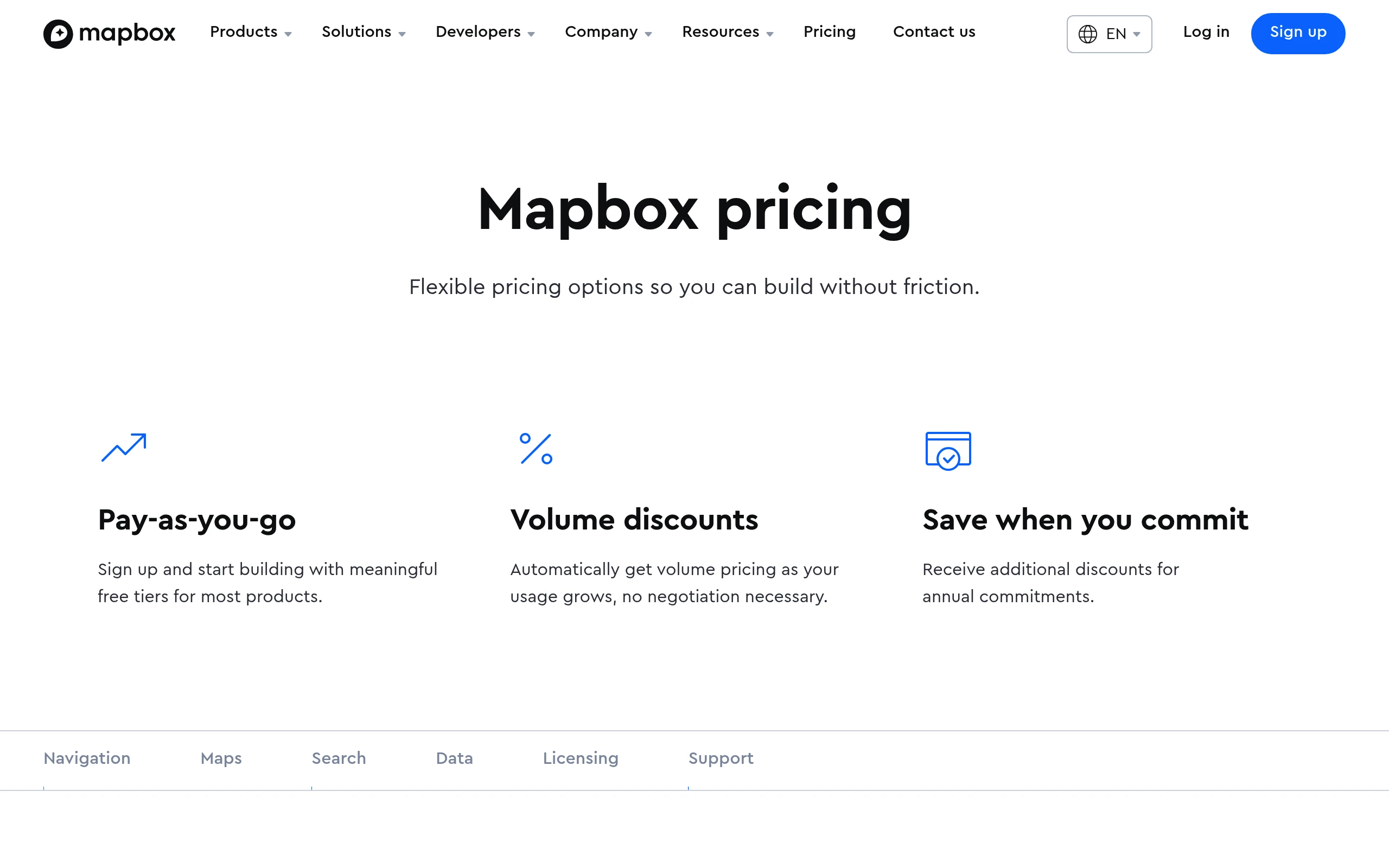
The pricing page describes metered pay-as-you-go billing with free tiers for most products, and lists no free trial. Volume discounts apply automatically as usage grows, and annual commitments earn "additional discounts" with no figures given.
Worked math: what $1,000 covers, if it applies
All numbers below use the pricing page rates above and our marginal-tier reading. They are one month of usage.
A small launch: $0
A product with 30,000 map loads, 40,000 geocoding requests and 20,000 directions requests stays inside every free tier. The bill is $0. The credit sits unused. This is the case for many prototypes, and it is why the credit is not the main reason to choose Mapbox.
A growing app: $800 a month
Take 150,000 GL JS map loads, 300,000 temporary geocoding requests and 200,000 directions requests.
- Map loads: 50,000 free. 50,000 loads at $5.00 per 1,000 is $250. Another 50,000 at $4.00 per 1,000 is $200. Subtotal $450.
- Geocoding: 100,000 free. 200,000 at $0.75 per 1,000 is $150.
- Directions: 100,000 free. 100,000 at $2.00 per 1,000 is $200.
Total $800 a month. If the $1,000 credit applies, it covers the first month and leaves $200 toward the second. From the second month you would pay roughly $600 out of pocket, assuming the same usage.
Map loads alone
Spending the whole $1,000 on GL JS loads, the first 50,000 are free. The next 50,000 cost $250, bringing the total to $250. The next 100,000 cost $400, bringing it to $650. The last $350 buys 116,666 loads at $3.00 per 1,000. That is about 316,666 loads in one month, 266,666 of them paid.
Directions alone
100,000 free. Then 400,000 at $2.00 per 1,000 is $800. The last $200 buys 125,000 requests at $1.60 per 1,000. That is 625,000 requests in the month.
Geocoding alone
100,000 free. Then 400,000 at $0.75 per 1,000 is $300. The next 500,000 at $0.60 is another $300, at 1 million. The last $400 buys about 888,888 requests at $0.45. Roughly 1.89 million temporary geocodes.
With permanent geocoding the same $1,000 buys far less: 200,000 requests at $5.00 per 1,000.
How Mapbox compares with Google Maps Platform
Google Maps Platform is the obvious alternative. Its Google Cloud startup program is covered on our Google Cloud page, which also mentions separate Maps credits through a different application.
Google's pricing page, in the 0 to 100,000 band, lists these:
| Item | Mapbox | Google Maps Platform |
|---|---|---|
| Free tier, map loads | 50,000 GL JS loads | 10,000 Dynamic Maps |
| Price per 1,000 after free, first paid band | $5.00 | $7.00 |
| Free tier, geocoding | 100,000 temporary | 10,000 |
| Geocoding per 1,000, first paid band | $0.75 temporary | $5.00 |
| Free tier, directions | 100,000 | 10,000 (Compute Routes Essentials) |
| Directions per 1,000, first paid band | $2.00 | $5.00 |
Units are not identical. A GL JS map load and a Dynamic Maps request are counted differently, and Google's geocoding has no temporary or permanent split in the page we read. Use the table as a rough guide.
Redo the growing-app example on Google rates. 150,000 Dynamic Maps requests is 90,000 at $7.00 ($630) plus 50,000 at $5.60 ($280), so $910. 300,000 geocodes is 90,000 at $5.00 ($450) plus 200,000 at $4.00 ($800), so $1,250. Those two lines are $2,160 against $600 for the same lines on Mapbox. We did not price Google's directions in this example, because the Compute Routes SKUs have several tiers.
Our AWS Activate page covers AWS credits, which could also pay for AWS's own location service.
Where Mapbox fits best
- A delivery, logistics or field-service product that needs routes. Directions and Matrix share one rate card, and the free tier is 100,000 each.
- A store locator or real-estate site that needs a map plus address search on one bill.
- A mobile app with under 25,000 monthly users. The Maps SDK for Mobile is free at that scale.
- A team that geocodes at a high volume and can use temporary results. $0.75 per 1,000 is low.
When Mapbox is the wrong pick
- A team that needs to store geocoded results long term but wants the low price. Permanent geocoding is $5.00 per 1,000 and has no free tier.
- An app with a very large autocomplete load. Per-keystroke billing will punish it unless you debounce, or use Search Box sessions.
- A company that needs a contract-backed uptime promise. Mapbox's SLA promises 99.9% monthly uptime, but only to customers with an executed order.
Tips for your first weeks on Mapbox
- Estimate your monthly bill before you ship. Billing is automatic: Mapbox charges the card on file, or uses prepaid credit first, when the invoice is finalized.
- Use one access token per app. Rate limits are counted per token, not per account.
- Debounce autocomplete, or use Search Box sessions so a typing session is a single billed unit.
- Decide permanent against temporary geocoding before you write code, because the storage rule is part of the terms.
- Check the MAU period in your billing settings. The docs say it follows your billing period, not the calendar.
How to get the Mapbox offer
- Go to mapbox.com and create an account. Our listing has no SaaSOffers link for this offer, and no promo code.
- Build your first map and check which free tiers you use in the account's usage view.
- Contact Mapbox sales or support and say you are a startup building location features. Ask them to confirm the $1,000 credit, its expiry date and any eligibility rules, since their public pages do not describe a startup program.
- If they confirm it, get the terms in writing and note whether the credit is applied to invoices automatically.
- If they do not, you still have the free tiers above, which are worth using on their own.
Who Is This Deal For?
Early-Stage Startups
Seed and pre-seed companies looking to move fast without overspending on tools.
Growing SaaS Teams
Series A+ companies scaling their stack and optimizing software costs.
Solo Founders
Indie hackers and bootstrapped founders who need enterprise tools at startup prices.
Get $1,000 in credits off Mapbox
Premium deal. Upgrade once, unlock everything.
!Eligibility Requirements
Startup building location features
Frequently Asked Questions
Everything you need to know about this startup deal.
Get the weekly deals digest
New verified startup deals every week. No spam, ever. Unsubscribe anytime.
Related Offers

Retool
Used by 1,559 members
1 year free, up to $60K
Build internal tools 10x faster with the low-code platform used by companies like Amazon, DoorDash, and Mercedes-Benz.
View offer
ZoomInfo
Used by 2,014 members
Free Trial
B2B data platform for sales and marketing intelligence with contact databases.
View offer
Chore
15% off your first month
Chore runs your startup's back office for you: payroll, HR, bookkeeping, compliance and equity, inside the tools you already use. 15% off your first month through SaaSOffers.
View offerDeal Summary
Looking for more startup deals?
Browse all offers