
Descope Coupon: Free Plan
Drag-and-drop authentication and user management with passwordless flows.
Premium: $79/year for unlimited deals
Already have an account? Log in
Deal Highlights
What Descope Gives a Startup
Descope is an authentication and user management platform. It lets a team build login flows with a drag-and-drop interface, supports passwordless authentication, and handles the whole job of managing users, all without the team writing and maintaining authentication code itself. The offer is a free plan, which lets a startup add real, secure authentication to its product without paying for the platform while the user base is still growing.
Authentication is one of those parts of a product that every application needs, that is genuinely hard to get right, and that provides no competitive advantage when done well. Users expect to sign up, log in, reset passwords, and manage their accounts, and they expect all of it to be secure and smooth. Behind that expectation sits a pile of complexity: password hashing, session management, multi-factor authentication, social logins, passwordless flows, account recovery, and the constant risk that a mistake becomes a security breach. Building all of this in-house consumes a lot of engineering time and carries real risk. Descope handles it, so a startup can offer strong authentication without becoming an authentication company. This article covers what Descope does, why each part matters to a small team, how it compares to building auth yourself, and how to get the most out of the free plan.
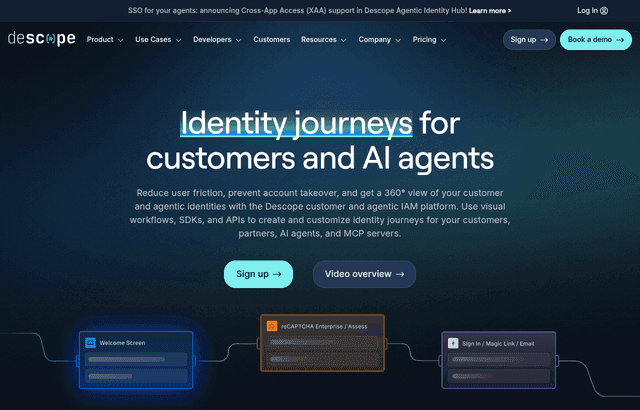
Descope, one of the tools included in this startup deal.
Login Flows Built by Drag and Drop
The signature feature of Descope is its drag-and-drop flow builder. Authentication flows, the steps a user goes through to sign up, log in, verify their identity, or recover an account, are built visually rather than coded by hand. A team assembles a flow from building blocks: collect an email, send a verification code, check a password, prompt for a second factor, and so on, arranging the steps to match what the product needs.
For a startup, this visual approach changes who can build and change authentication. Instead of every auth change being a delicate coding task, flows can be assembled and adjusted in the builder. Want to add a step, change the order, or introduce a new verification method? That is a change in the flow builder, not a rewrite of security-critical code. This makes authentication faster to build and far easier to evolve as the product's needs change.
It also lowers the risk of getting authentication wrong. Hand-coded auth is where subtle, dangerous bugs hide, the kind that lead to breaches. Building flows from tested building blocks in a purpose-made tool reduces the chances of introducing those bugs. For a small team without security specialists, having the risky parts handled by proven components rather than bespoke code is a meaningful safety improvement.
Passwordless Authentication
Descope supports passwordless authentication, letting users sign in with methods like magic links, one-time codes, or biometric and passkey-based approaches instead of a traditional password. For a startup, offering passwordless is both a security win and a user-experience win.
Passwords are a problem for everyone. Users reuse them, forget them, and choose weak ones, and every stored password is a liability if the database is ever breached. Passwordless authentication sidesteps much of this. There is no password for a user to forget or reuse, and no password database to leak. A user signs in with a link sent to their email, a code, or a passkey, which is often both easier for them and safer for the company.
For a young product trying to make a good first impression, a smooth passwordless sign-in removes friction at the exact moment a new user is deciding whether the product is worth their time. Fewer users abandon sign-up when they do not have to invent and remember yet another password. Descope makes offering these modern, low-friction methods straightforward, so a startup can give users a better sign-in experience than the tired password form without building the underlying machinery itself.
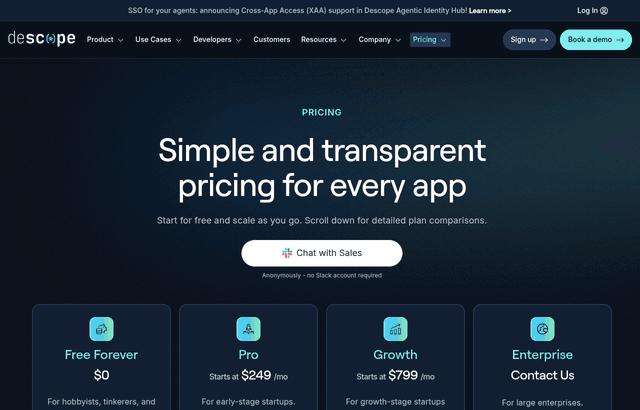
A look at Descope before the discount, so you can see what the deal saves you.
Complete User Management
Beyond login, Descope handles user management: storing user accounts, managing their profiles and attributes, handling roles and permissions, and providing the tools to administer users. Authentication is only half the job. Once users exist, the product needs to manage them, and Descope covers that side too.
For a startup, having user management handled means not building an admin system for users from scratch. The team gets a place where user accounts live, where their attributes and permissions are managed, and where support or admin staff can look up and manage users when needed. This is a whole subsystem that every product needs and that takes real effort to build well, and Descope provides it as part of the platform.
Good user management also underpins other features. Roles and permissions determine what different users can do, which matters the moment a product has more than one type of user. Profiles and attributes drive personalization and access control. By handling user management properly, Descope gives a startup a solid foundation to build the rest of the product's user-facing behavior on, rather than a hasty user table that causes problems later.
Security Handled by Specialists
Authentication is a security-critical system, and getting it wrong has serious consequences. Descope's entire purpose is to handle authentication securely, which means a team building on it inherits security practices built by people who specialize in this domain, rather than having to become authentication security experts themselves.
For a startup, this is one of the biggest reasons to use a platform like Descope rather than rolling its own. The team behind an auth platform lives and breathes the details, secure session handling, proper credential storage, protection against common attacks, keeping up with evolving standards and threats. A small product team building auth on the side cannot match that depth, and the gap is exactly where breaches happen. Offloading authentication to specialists shrinks that risk substantially.
This also frees the team from an ongoing burden. Authentication is not a build-once-and-forget system. Threats evolve, standards change, and best practices shift, which means home-grown auth needs continual maintenance to stay secure. By using Descope, a startup lets someone else carry that ongoing responsibility, so the team can keep its attention on the product rather than on staying current with authentication security.
Standard Protocols and Integrations
Descope supports the standard authentication protocols and integrations that products need, such as single sign-on and social logins, so a team can offer users the sign-in methods they expect and integrate with the identity systems its customers use. For a startup, supporting these standards out of the box removes a lot of individually painful integration work.
Social login, letting users sign in with an existing account they already have, reduces sign-up friction and is something many users now expect. Single sign-on becomes important as a product starts selling to larger customers who require it. Building each of these integrations by hand is finicky and error-prone. Descope providing them as supported capabilities means a startup can offer the sign-in methods its users and customers want without each one becoming its own project. That readiness matters especially as a startup moves upmarket and enterprise requirements like SSO start to appear in deals.
Descope Compared to Building Auth Yourself
The alternative is to build authentication in-house, and plenty of startups start there. Early on it can feel manageable: a sign-up form, a login form, password storage, a session. For the simplest case, it is not much code.
The trouble is that authentication never stays simple. Soon the product needs password reset, then multi-factor authentication, then social login, then account recovery, then maybe passwordless, then single sign-on for a big customer. Each addition is more security-critical code to write, test, and maintain forever. And the whole thing has to be correct, because a mistake in authentication is not a bug, it is a potential breach. The in-house path quietly turns into a substantial, ongoing engineering commitment in an area where the team probably lacks deep expertise and where the downside of errors is severe.
Descope replaces that commitment with a platform built for the job. The flows are visual, the methods are ready, user management is included, and the security is handled by specialists. For a startup, this is almost always the better trade: authentication is essential but undifferentiated, so building it yourself spends scarce engineering effort and takes on real risk for something that will never set the product apart. Letting a platform handle it frees the team to work on what actually makes the product distinctive.
The consideration on the other side is that using an auth platform means depending on it and integrating with it. But that integration is far smaller than building and maintaining authentication in-house, and the free plan lets a startup try it with no financial commitment.
Making the Free Plan Count
The free plan lets a startup add real authentication without cost while its user base grows. Getting the most from it comes down to setting up authentication well from the start.
Begin by designing the login flows the product actually needs rather than copying a generic setup. Use the flow builder to create the sign-up and sign-in experience that fits the product, deciding deliberately which methods to offer, whether to go passwordless, and what verification to require. Because the builder makes this easy to change, the team can start simple and refine the flows as it learns what works for its users.
Take advantage of passwordless methods early, since they improve both security and the sign-up experience. Offering a smooth, password-free sign-in from the start gives new users a better first impression and spares the team the liabilities that come with storing passwords. This is a case where the modern approach is also the easier one, so there is little reason not to adopt it.
Set up user management and roles thoughtfully as the product takes shape. Defining sensible roles and permissions early, while the user model is still simple, is far easier than retrofitting them onto a product that grew without them. Descope makes this foundation available on the free plan, so a startup can get the structure right while it is small.
How Descope Scales With the Product
The authentication foundation a startup builds on the free plan scales as the product and user base grow. The flows built in the builder handle more users without change. The user management structure established early accommodates more accounts, more roles, and more complex permissions as the product matures. And as the startup starts selling to larger customers, the standard protocols and single sign-on support are already there to meet enterprise requirements.
This readiness matters because authentication requirements tend to grow in exactly the moments a team is busiest. A big customer demands single sign-on during a deal. A compliance requirement calls for stronger multi-factor authentication. Building on Descope means these needs are met by extending existing flows and enabling supported capabilities rather than by scrambling to build security-critical features under deadline pressure. The platform grows with the product, which is what a scaling company needs from something as foundational as authentication.
Getting Started
Getting going with Descope follows a clear path. Create an account and set up the first authentication flow in the drag-and-drop builder, choosing the sign-up and sign-in methods the product needs. Integrate the flow into the application so users can actually sign up and log in. Configure user management, defining the attributes and roles the product uses. Add the extra methods that matter, passwordless options, social login, and any others, by extending the flows rather than writing new code. From there, the team refines the experience as it learns how real users behave.
The first flow usually takes an afternoon to stand up, because the building blocks are already there and the security is already handled. That quick path from nothing to working authentication is a large part of Descope's appeal for a small team that wants to add login without a long project.
Who Should Claim This Deal
Descope fits any startup building a product that needs users to sign up and log in, which is nearly every product. If the team is about to build authentication, or is tired of maintaining home-grown auth, and would rather not spend scarce engineering effort on a security-critical system that does not differentiate the product, Descope is aimed squarely at that situation.
It is an especially strong fit for a team that wants modern authentication, passwordless methods, social login, and single sign-on, without building each one by hand, and that values having security handled by specialists. The free plan lets a startup add secure, flexible authentication today, with the flows, passwordless options, and user management it needs, at no cost while the product grows. For a team that wants strong authentication without becoming an authentication company, this is a deal worth claiming.
Who Is This Deal For?
Early-Stage Startups
Seed and pre-seed companies looking to move fast without overspending on tools.
Growing SaaS Teams
Series A+ companies scaling their stack and optimizing software costs.
Solo Founders
Indie hackers and bootstrapped founders who need enterprise tools at startup prices.
Get Free Plan off Descope
Premium deal. Upgrade once, unlock everything.
Frequently Asked Questions
Everything you need to know about this startup deal.
Yes. Free for up to 7,500 monthly active users with all authentication methods.
Get the weekly deals digest
New verified startup deals every week. No spam, ever. Unsubscribe anytime.
Related Offers

Toggl Track
Used by 1,100 members
Free Plan
Simple and intuitive time tracking for teams with reporting and integrations.
View offer
Auth0
Used by 994 members
1 year of B2B Professional free
Get 1 year of the Auth0 B2B Professional plan free, with up to 100,000 monthly active users, SSO, enterprise MFA and SCIM.
View offer
Bugsnag
Used by 471 members
Free Plan
Error monitoring and stability management for web and mobile applications.
View offer
Turborepo
Used by 1,880 members
Free & Open Source
High-performance build system for JavaScript and TypeScript monorepos by Vercel.
View offer
Windmill
Used by 1,501 members
Free Plan
Open-source developer platform for building internal tools, workflows, and scripts.
View offer
Height
Used by 1,442 members
Free Plan
AI-powered project management tool with autonomous task management and workflows.
View offerDeal Summary
Looking for more startup deals?
Browse all offers