
Featurebase Coupon: Free Plan
Product feedback and changelog tool with voting boards and roadmaps.
Free · Opens in new tab
Already have an account? Log in
Deal Highlights
What Featurebase Gives a Startup
Featurebase is a product feedback and changelog tool with voting boards and roadmaps, and the deal on this page is a free plan. For a startup, that combination solves a problem that gets worse the more successful the product becomes. As soon as a company has users, it has opinions, requests, complaints, and ideas arriving through every channel at once, and without a place to collect and organize them, that feedback becomes noise the team cannot act on. Featurebase turns the noise into a structured signal the team can prioritize.
The free plan matters because feedback tooling is something a startup should adopt early, before the flood starts, not after it has already lost track of what users want. Being able to stand up a feedback board, a public roadmap, and a changelog without paying anything up front means the team can put the system in place while it is still cheap and easy to do. By the time the product has enough users to make feedback overwhelming, the structure to handle it is already running.
What Featurebase really gives a startup is a single home for the relationship between what users ask for and what the team builds. Requests come in and get collected in one place. Users vote so the team can see what matters most. The roadmap shows what is planned. The changelog announces what shipped. That loop, from request to release to announcement, is the core of building a product people actually want, and Featurebase makes the whole loop visible in one tool.
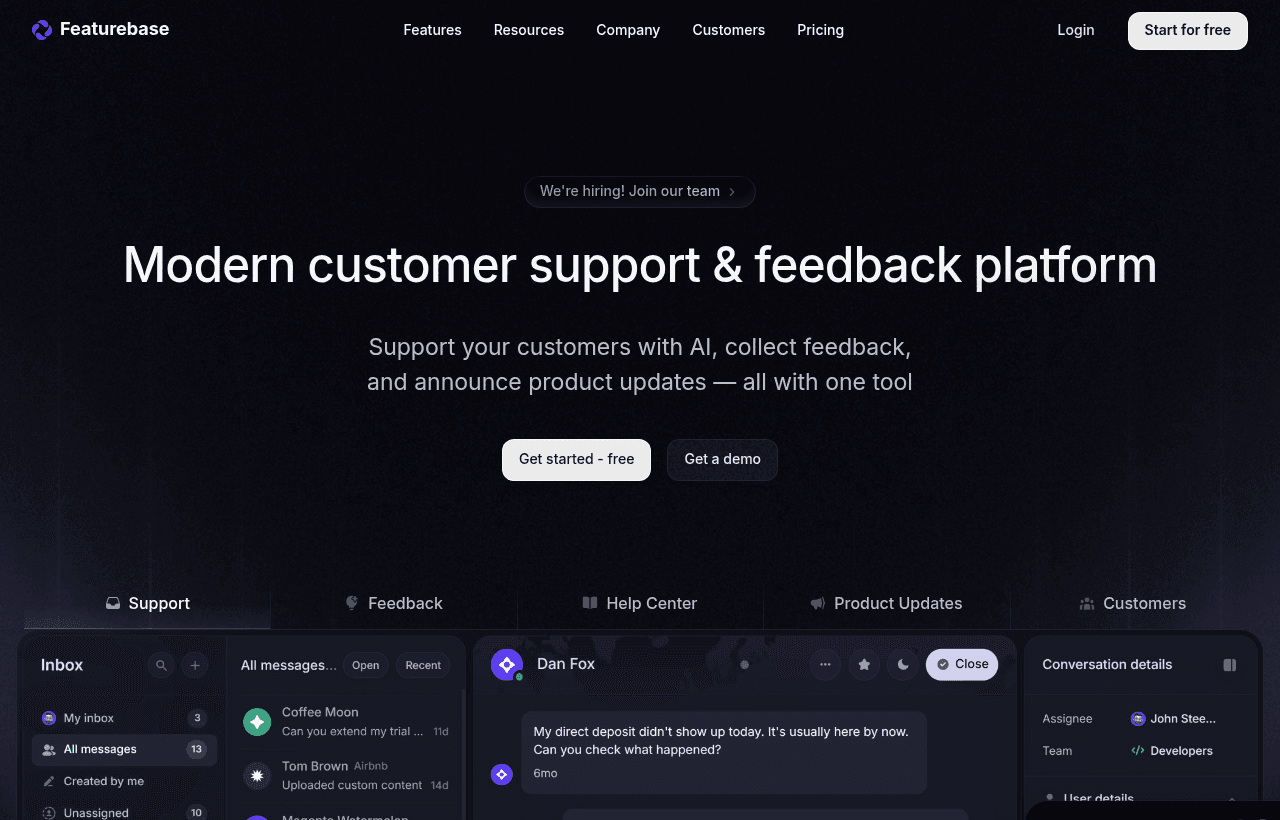
Featurebase, one of the tools included in this startup deal.
Voting Boards That Reveal What Users Actually Want
The heart of Featurebase is the voting board, where users submit feature requests and vote on the ones they care about. For a startup, this changes how prioritization decisions get made. Instead of guessing which requests represent widespread demand and which came from a single loud voice, the team sees the votes. Demand becomes measurable, and the roadmap can follow evidence rather than intuition.
This is a genuine advantage for an early team with limited engineering hours. Every feature a startup builds is a bet, and building the wrong ones is how small companies waste the runway they cannot get back. When users vote openly on a board, the team gets a ranked list of what the market is asking for, which makes each bet better informed. The loudest customer no longer automatically wins; the customers as a whole set the priorities.
Voting boards also reduce duplicate work for the team. When a user wants to request something, they first see whether it already exists on the board and add their vote instead of opening a new item. That keeps the feedback consolidated, so the team reads one well-supported request rather than twenty scattered versions of the same idea. The signal stays clean, and the effort of triaging it stays small.
Public Roadmaps That Build Trust
Featurebase lets a startup publish a roadmap that shows users what is planned, what is in progress, and what has shipped. A public roadmap does something subtle but important for an early company. It tells users that their feedback goes somewhere, that the team is listening, and that the product has a direction. That visibility builds trust, and trust is what keeps early users patient while the product is still filling in.
For a startup, a roadmap is also a communication tool that saves the team time. Instead of answering the same question about whether a feature is coming, the team points to the roadmap. Users who see their requested feature marked as planned feel heard and stay engaged. Users who see honest progress understand that the team is executing. The roadmap turns a stream of individual conversations into one shared, always-current picture that everyone can check.
Connecting the roadmap to the voting board closes an important gap. Users can see not just what is planned, but that what is planned reflects what they voted for. That connection between their input and the team's output is exactly what makes a community feel invested in a product. A startup that shows its users their requests turning into roadmap items and then into shipped features earns a loyalty that is hard to buy any other way.

A closer look at Featurebase.
Changelogs That Announce Progress
Featurebase includes a changelog, so a startup can announce what it shipped in a place users actually see. This matters more than early teams assume. A company can build steadily for months and still feel stagnant to its users if nobody tells them what changed. The changelog fixes that by turning quiet progress into visible momentum, which keeps users engaged and reminds them the product is alive and improving.
For a startup, a good changelog is also a retention tool. Users who see regular improvements, especially improvements they asked for, have a reason to keep paying attention and keep using the product. Each changelog entry is a small signal that the company is investing in the thing they rely on. Over time, those signals add up to the sense that the product is getting better, which is one of the strongest reasons a user stays.
The changelog closes the feedback loop that the voting board and roadmap open. A user requests something, votes on it, watches it move across the roadmap, and finally reads in the changelog that it shipped. Completing that loop, and letting the user see it complete, is deeply satisfying and turns casual users into advocates. Featurebase makes running the whole loop something a small team can do without stitching together separate tools.
One Place Instead of Scattered Feedback
Before adopting a tool like Featurebase, most startups collect feedback in a scatter of places. Requests arrive in support conversations, in social media replies, in sales calls, in a spreadsheet someone started, and in the memory of whichever founder happened to hear them. That scatter is where good ideas go to die, because no single person can hold all of it and nothing gets prioritized against everything else. Featurebase consolidates the feedback into one board the whole team works from.
For an early team, this consolidation is the difference between reacting and planning. When feedback lives in one place with votes attached, the team can look at the whole picture and decide what to build next with real information. When it is scattered, the team builds whatever was mentioned most recently or most loudly, which is a poor way to spend limited engineering time. A single source of truth for feedback makes the roadmap a deliberate document rather than a reaction to the last conversation.
Consolidation also means feedback survives personnel changes and busy weeks. A request captured on the board is still there next month, still gathering votes, still visible to the team. A request mentioned in a hallway conversation is gone the moment everyone gets busy. For a startup where people wear many hats and context switches constantly, having feedback recorded in a durable, shared place is worth far more than it costs to set up.
Featurebase Compared to Spreadsheets and Scattered Tools
The default alternative for a startup is a homemade system, usually a spreadsheet of requests plus a manual changelog posted somewhere and a roadmap that lives in a founder's head. That approach costs nothing and works for a little while, but it breaks down exactly when the product succeeds and the feedback volume grows. The spreadsheet has no voting, so priority is guesswork. The changelog is easy to forget. The roadmap is invisible to users. Each piece is disconnected from the others.
Featurebase replaces that patchwork with an integrated system where the board, the roadmap, and the changelog reference the same underlying items. A request voted on by users becomes a roadmap entry becomes a changelog announcement, all connected. The startup gets the loop that a spreadsheet can never provide, and it gets it without building and maintaining a homemade tool that nobody has time to improve. The free plan makes this upgrade cost nothing to try.
Compared to heavier product-management suites, Featurebase is focused on the specific job of collecting feedback and communicating progress, which suits a startup that wants the outcome without the overhead of a complex platform. The team gets voting boards, roadmaps, and changelogs that work together, without configuring a system that assumes a large product organization. For an early company, that focus is a feature, because the tool does the job and then gets out of the way.
How Featurebase Fits the Whole Team
Featurebase is not only a tool for the product manager. Support sees which reported issues have the most votes and can tell users that a fix is on the roadmap. Sales sees what prospects are asking for and whether it is planned. Engineering sees a prioritized list grounded in real demand. Leadership sees the shape of what users want. One tool serves several parts of the company because feedback touches all of them.
For a startup where roles overlap and the same few people cover multiple functions, this shared visibility is especially valuable. Everyone works from the same board instead of maintaining private lists that contradict each other. When a customer asks support about a feature, support gives the same answer the roadmap shows. When sales promises something is coming, it is because they saw it on the roadmap, not because they guessed. The alignment that Featurebase creates keeps a small team consistent in front of its users.
That consistency compounds as the company grows. New team members can look at the board, the roadmap, and the changelog and immediately understand what users want, what is planned, and what has shipped. The context that used to live only in a founder's head becomes a shared resource anyone can read. For a startup that is hiring and needs new people productive quickly, having the product's feedback history documented in one place shortens the ramp considerably.
Making the Free Plan Count
To get real value from the free plan, a startup should launch the feedback board to real users rather than keeping it internal. Feedback tooling only works when the people who use the product can reach it, so put the board somewhere users can find it, invite them to submit and vote, and start treating the results as real input into the roadmap. An empty board does nothing; a board users actually use becomes the team's best source of direction.
Set up all three pieces during the evaluation, not just one. Publish a roadmap so users see the team is listening, and post at least a few changelog entries so users learn that the product is improving. Running the full loop, from request to vote to roadmap to changelog, is the only way to see how the pieces reinforce each other. A startup that uses just the board misses most of what makes Featurebase valuable.
Build the habit of closing the loop publicly. When the team ships something users asked for, announce it in the changelog and point back to the request that inspired it. That visible follow-through is what turns a feedback tool into a community, because users learn that their input leads to real change. A startup that establishes this habit on the free plan will find its users becoming more engaged, more patient, and more willing to keep telling the team what they need.
Who Should Claim This Deal
This deal fits a startup that has users, or expects to soon, and wants a structured way to collect feedback, prioritize it, and communicate progress. If the team is tired of feedback scattered across support tickets, spreadsheets, and memory, and wants users to feel heard while the roadmap follows real demand, Featurebase is built for exactly that. The free plan lets the team put the whole system in place before the feedback volume becomes overwhelming.
It is an especially strong match for an early product-led company that wants to build the right features rather than the loudest-requested ones, a small team where support, sales, and product need to share one view of what is planned, and any startup that wants to turn quiet progress into visible momentum. Claim the free plan, launch the board to real users, publish a roadmap, and start posting changelog entries. By the end, the team will have a working feedback loop and a more engaged user base, and setting it up will have cost nothing.
Who Is This Deal For?
Early-Stage Startups
Seed and pre-seed companies looking to move fast without overspending on tools.
Growing SaaS Teams
Series A+ companies scaling their stack and optimizing software costs.
Solo Founders
Indie hackers and bootstrapped founders who need enterprise tools at startup prices.
Get Free Plan off Featurebase
Premium deal. Upgrade once, unlock everything.
Frequently Asked Questions
Everything you need to know about this startup deal.
Yes. Free plan includes unlimited posts, voters, and a changelog.
Get the weekly deals digest
New verified startup deals every week. No spam, ever. Unsubscribe anytime.
Related Offers

Toggl Track
Used by 1,100 members
Free Plan
Simple and intuitive time tracking for teams with reporting and integrations.
View offer
Auth0
Used by 994 members
1 year of B2B Professional free
Get 1 year of the Auth0 B2B Professional plan free, with up to 100,000 monthly active users, SSO, enterprise MFA and SCIM.
View offer
Bugsnag
Used by 471 members
Free Plan
Error monitoring and stability management for web and mobile applications.
View offer
Turborepo
Used by 1,880 members
Free & Open Source
High-performance build system for JavaScript and TypeScript monorepos by Vercel.
View offer
Windmill
Used by 1,501 members
Free Plan
Open-source developer platform for building internal tools, workflows, and scripts.
View offer
Height
Used by 1,442 members
Free Plan
AI-powered project management tool with autonomous task management and workflows.
View offerDeal Summary
Looking for more startup deals?
Browse all offers