Modal Startup Credits: Free Credits
Serverless cloud for AI/ML, run any code on GPU or CPU without managing infrastructure.
Premium deal
Already have an account? Log in
Deal Highlights
The SaaSOffers Modal deal
Offer: Free Credits.
Requirements: our listing sets no extra requirements and has no promo code. You sign up through the SaaSOffers link.
We checked these plans and prices against Modal's official pricing and help pages in November 2026.
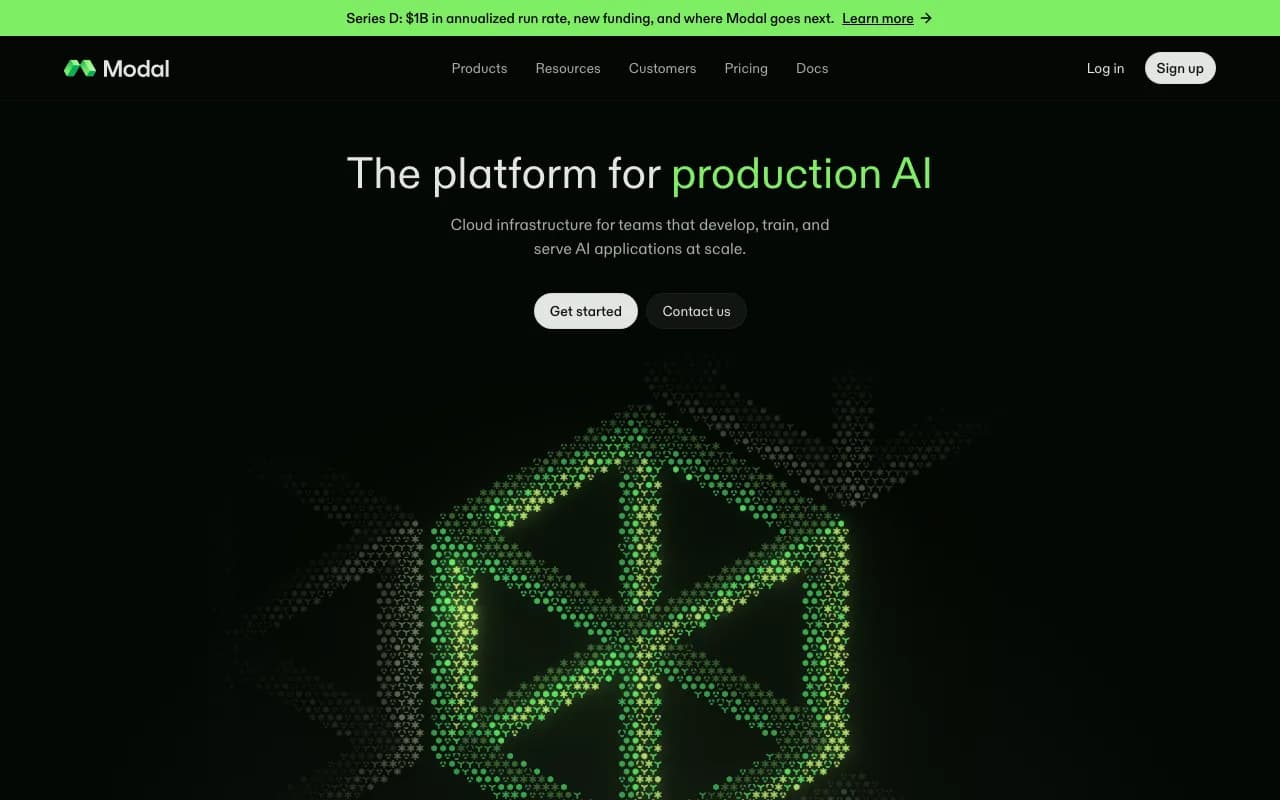
Modal is a serverless cloud for Python. You decorate a function, pick a GPU or CPU size, and Modal builds the container, runs it, and bills you by the second while it runs. Once containers scale to zero, the compute bill stops.
Our listing does not state a credit amount. Modal's own site does: every Starter workspace gets $30 of free compute each month, and every Team workspace gets $100 each month. Anyone can get those amounts by signing up directly. Modal also runs a separate startup program with larger one-time grants, but it has funding requirements (covered below). Our listing says "Free Credits"; confirm the exact amount you receive when you redeem, and treat the $30 monthly Starter credit as the number you can count on.
Free compute is monthly, startup credits are one-time
Monthly plan credits. Starter includes $30 of compute per month. Team includes $100 per month. These reset every month. Budgets and spend limits are measured around them: Modal's docs say a $100 usage limit with $30 in credits gives a $70 default spend limit.
Modal for Startups. Modal's startups page offers "thousands of free GPU credits" without naming a fixed figure. Eligibility for the Seed to Series A tier is either (a) any amount of VC funding from a fund in Modal's VC partner network, or (b) more than $1m raised from any fund. A second tier, Scaling and Series B+, needs more than $30m raised or a post-Series B round, and the VC must be in the partner network. Logos on the page include Y Combinator, a16z, Sequoia Capital, Khosla Ventures, Neo, HF0, Pear VC and Lux Capital. Credits are a one-time grant, and you cannot reapply for a tier you already received. Modal's resource page adds that eligible AWS Activate participants may qualify for additional Modal credits, with no amount given.
Modal for Academics. Graduate students, labs and researchers can apply for up to $10,000 in credits.
If you are a bootstrapped company with no VC money, the startup program is not open to you. The $30 monthly credit still is.
One practical note: Modal's GPU guide says "Using a GPU requires having a valid payment method on file." Plan to add a card before your first GPU run, even if credits will cover it.
Modal plans and limits
Modal has three plans. The platform fee is separate from compute, which is billed per second on every plan.
| Plan | Price billed yearly | Billed monthly | Key limits |
|---|---|---|---|
| Starter | No annual option listed | $0 + compute, $30 free credits a month | 3 seats, 100 containers, 10 GPU concurrency, 200 deployed apps, 5 deployed cron jobs, 1 day log retention, 1 TiB free egress |
| Team | No annual option listed | $250 + compute, $100 free credits a month | Unlimited seats, 5,000 containers, 50 GPU concurrency, 1,000 deployed apps, unlimited cron jobs, 30 day log retention, 10 TiB free egress |
| Enterprise | Custom, with volume discounts | Custom | Custom containers, higher GPU concurrency, 100 TiB free egress, Okta SSO, audit logs, HIPAA |
Team adds custom domains, a static IP proxy, deployment rollbacks (3 versions), environment-level budgets and RBAC. Starter has none of those. Enterprise adds private Slack support with embedded ML engineers and lets you spend committed AWS or GCP marketplace dollars on Modal.
What Starter doesn't include
- Custom domains for web endpoints
- A static IP proxy, which matters if a customer or database allowlists your IP
- Deployment rollbacks
- Environment budgets and role-based access control
- Logs older than 1 day
- More than 3 seats, 10 concurrent GPUs or 5 deployed cron jobs
- SSO, audit logs and HIPAA (Enterprise only)
- Support beyond the community Slack
Per-second GPU and CPU prices
Every function bills for three meters while it runs: GPU, CPU and memory. The GPU price does not include the CPU and memory your container also reserves.
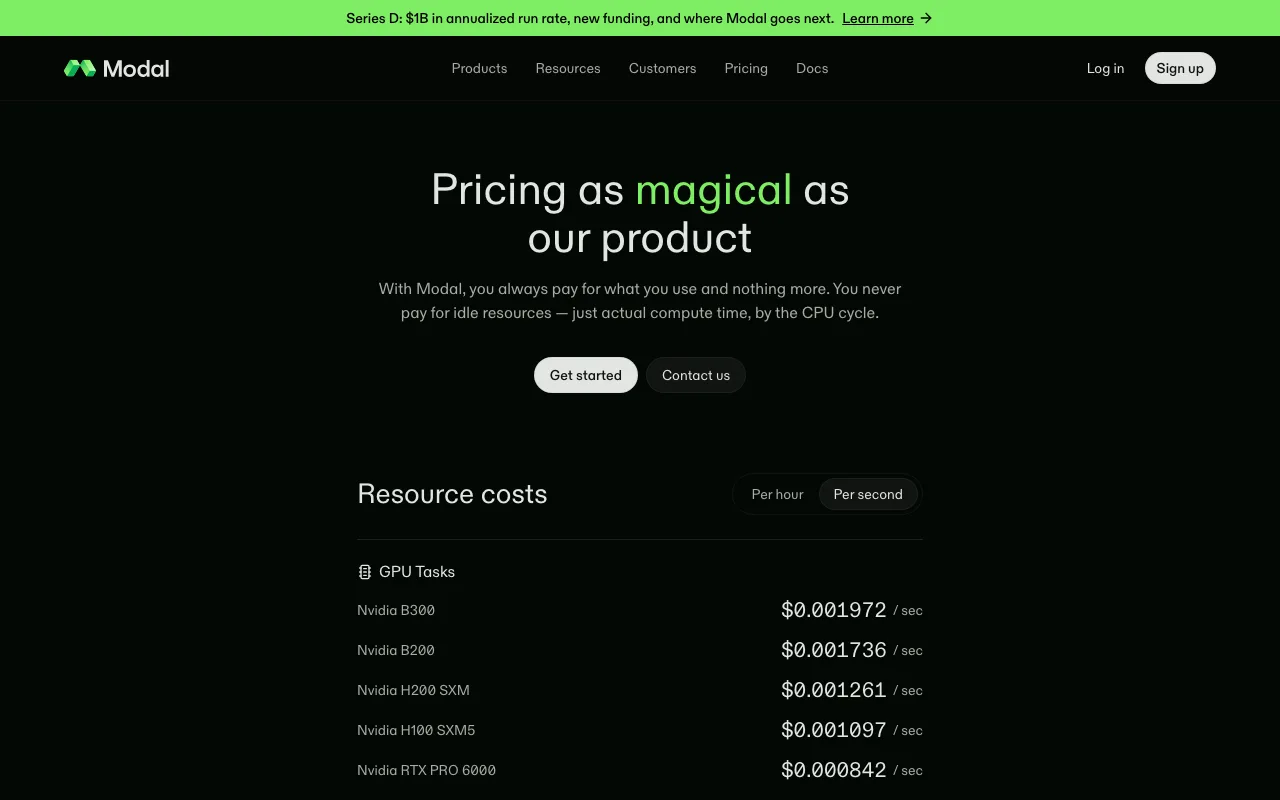
| GPU | Per second | Per hour (our math) | Hours on $30 credit |
|---|---|---|---|
| Nvidia B300 | $0.001972 | $7.10 | 4.2 |
| Nvidia B200 | $0.001736 | $6.25 | 4.8 |
| Nvidia H200 SXM | $0.001261 | $4.54 | 6.6 |
| Nvidia H100 SXM5 | $0.001097 | $3.95 | 7.6 |
| Nvidia RTX PRO 6000 | $0.000842 | $3.03 | 9.9 |
| Nvidia A100, 80 GB | $0.000694 | $2.50 | 12.0 |
| Nvidia A100, 40 GB | $0.000583 | $2.10 | 14.3 |
| Nvidia L40S | $0.000542 | $1.95 | 15.4 |
| Nvidia A10 | $0.000306 | $1.10 | 27.2 |
| Nvidia L4 | $0.000222 | $0.80 | 37.5 |
| Nvidia T4 | $0.000164 | $0.59 | 50.8 |
The hours column counts GPU time only. Add CPU and memory and the hours drop.
Other meters:
- CPU: $0.0000131 per physical core per second. One physical core equals 2 vCPUs. The minimum is 0.125 cores per container.
- Memory: $0.00000222 per GiB per second.
- Volumes: $0.09 per GiB per month, with 1 TiB per month free.
- Network egress: $0.04 per GiB after the plan's free allowance.
- Idle window: containers stay up 60 seconds after the last input by default, and that time is billed. You can shorten it.
- Shared Endpoints: billed per token from the first request. The monthly free credit does not cover them.
- Region selection: 1.15x to 1.75x base prices.
- Non-preemptible execution: 3x base prices.
- Sandboxes: billed at non-preemptible rates. CPU is $0.00003942 per core per second and memory $0.00000667 per GiB per second. GPUs in sandboxes use standard GPU pricing.
A small always-on CPU service shows how the CPU meter adds up. One physical core running 24 hours a day for 30 days costs 2,592,000 seconds x $0.0000131 = $33.96. Two GiB of memory for the same month adds 2,592,000 x 2 x $0.00000222 = $11.51. That is $45.47 a month, which already exceeds the $30 Starter credit. Modal fits work that runs in bursts and then scales to zero, because idle time costs nothing once containers shut down.
Two worked examples
Example 1: a solo founder testing a model on Starter
You run an image model on an L40S container with 4 physical cores and 16 GiB of memory.
- GPU: $0.000542 per second
- CPU: 4 x $0.0000131 = $0.0000524 per second
- Memory: 16 x $0.00000222 = $0.00003552 per second
- Total: $0.00062992 per second, or $2.27 per hour
The $30 monthly Starter credit covers $30 / $2.27 = 13.2 hours of that container each month. At 30 minutes of testing a day, 15 hours a month, you would use 15 x $2.2677 = $34.02 minus the $30 credit, so $4.02. The platform fee on Starter is $0.
If our listing's Free Credits come on top of the standard $30, they extend that runway. If they are the standard $30, you get the same thing any direct signup gets.
Example 2: a 5-person team serving an H100 endpoint on Team
A 5-person team needs more than Starter's 3 seats, so it moves to Team. It serves a model on one H100 with 2 physical cores and 32 GiB of memory, 8 hours a day for 22 working days.
- Running time: 8 x 3,600 x 22 = 633,600 seconds
- GPU: 633,600 x $0.001097 = $695.06
- CPU: 633,600 x 2 x $0.0000131 = $16.60
- Memory: 633,600 x 32 x $0.00000222 = $45.01
- Compute total: $756.67
- Team credit: minus $100, so $656.67
- Platform fee: plus $250
- Monthly bill: $906.67, or $10,880.04 over 12 months
The Team plan's $100 credit offsets 40% of its own $250 fee. A team that only needs 3 seats and 10 GPUs could stay on Starter and pay $756.67 minus $30 = $726.67 for the same compute. That saves $180 a month, but loses 30-day logs, rollbacks and custom domains.
Modal does not publish its startup grant size, only "thousands of free GPU credits". Whether our listing adds to that is something to confirm when you redeem.
Who Modal fits
- Python teams running inference behind an API. You expose a function as a web endpoint and Modal scales containers up for traffic and down to zero after it.
- Batch jobs that need many GPUs for a short time. Fine-tuning runs, embeddings over a large dataset, or video processing. Starter allows 10 GPUs at once; Team allows 50.
- Scheduled pipelines. Cron jobs for nightly ETL or retraining. Starter caps you at 5 deployed crons; Team removes the cap.
- Agent and code-execution products. Sandboxes run untrusted code in isolated containers, billed at the 3x non-preemptible rate.
- Multi-GPU work on one node. The GPU guide lists up to 8 GPUs per container for B300, B200, H200, H100, A100, L4, T4 and L40S, and up to 4 for A10.
When Modal is the wrong pick
- Teams that need GPUs running 24/7. One H100 around the clock for 30 days is 2,592,000 x $0.001097 = $2,843.42 in GPU time alone. A reserved or dedicated instance elsewhere may cost less at that utilization.
- Non-Python stacks. Modal's SDK and decorators are Python first.
- Anyone who needs multi-node training today. Modal's docs say multi-node training is in private beta.
- Bootstrapped founders counting on a big credit grant. The startup program wants VC funding. Plan around $30 a month.
Modal vs Replicate and Hugging Face
| Modal | Replicate | Hugging Face | |
|---|---|---|---|
| Free allowance | $30 compute a month on Starter | Limited free runs on some models, then billing | Free Hub account, no included credits; PRO is $9 a month with $2 of credits |
| L40S | $0.000542 per second ($1.95 an hour, GPU only) | $3.51 an hour | $1.80 an hour on Inference Endpoints |
| H100 | $0.001097 per second ($3.95 an hour, GPU only) | $5.49 an hour | $4.50 an hour on Inference Endpoints |
| T4 | $0.000164 per second ($0.59 an hour, GPU only) | $0.81 an hour | $0.50 an hour on Inference Endpoints |
| Billing unit | Per second, GPU plus CPU plus memory | Per second for hardware, or per output on official models | Per hour per running endpoint |
| Startup credits | Program for VC-backed startups, amount not published | No public startup program found | Not covered here |
Replicate's hourly prices include a bundled CPU and RAM allotment, and Hugging Face prices a whole endpoint instance. Modal's GPU figures exclude CPU and memory, so add those before you compare. In Example 1 the extra meters added $0.32 an hour to an L40S, bringing it to $2.27.
Pick Replicate if you want to call a hosted model by API and pay per image or per token without writing infrastructure code. Pick Hugging Face if your model already lives on the Hub and you want a managed endpoint. Pick Modal if you want to run your own Python code on GPUs with per-second billing and scale to zero.
Getting set up on Modal
- Set a workspace budget on day one. Modal's budget caps total usage before credits. The spend limit caps out-of-pocket charges after credits. Owners and Managers set both on the Usage & Billing page.
- Use GPU fallbacks. You can pass a list such as
["H100", "A100-40GB:2"]and Modal tries each in order. This cuts waiting when one type is scarce. - Know the automatic upgrades. Modal may run an
A100request on an 80 GB card at no extra cost.H100may be upgraded to H200; useH100!to stop that.B200+can land on a B300 and still bill as B200. - Keep requests to 1 or 2 GPUs while testing. The guide says requests for more than 2 GPUs usually wait longer.
- Store weights in a Volume. Volumes cost $0.09 per GiB per month after the free 1 TiB, and save you from downloading a model on every cold start.
- Stay in the default region unless you must. Region pinning multiplies prices by 1.15x to 1.75x.
- Watch the 1-day log window on Starter. Export anything you need to keep, or move to Team for 30 days.
Steps to get the Modal deal
- Open the Modal deal on SaaSOffers and click through the SaaSOffers link.
- Create your Modal workspace. No promo code is needed and none exists for this listing.
- Check the Usage & Billing page for the credit balance applied to your workspace. Starter shows $30 of monthly credit by default.
- Add a payment method before running GPU functions, as Modal's GPU guide requires.
- If you raised VC money, also apply to Modal for Startups from modal.com/startups. Those credits are a one-time grant per tier.
- Set a budget and a spend limit before your first long run.
Who Is This Deal For?
Early-Stage Startups
Seed and pre-seed companies looking to move fast without overspending on tools.
Growing SaaS Teams
Series A+ companies scaling their stack and optimizing software costs.
Solo Founders
Indie hackers and bootstrapped founders who need enterprise tools at startup prices.
Get Free Credits off Modal
Premium deal. Upgrade once, unlock everything.
How to get the Modal deal
- The offer: Free Credits.
- Create a free SaaSOffers account, then upgrade to Premium ($79 a year, or $250 once for lifetime access). Premium unlocks every Premium deal on the site.
- Open the Modal claim page from this deal. It shows the partner link, any promo code and the exact steps Modal asks for.
- Apply or sign up through that link before you pay Modal directly, since most startup offers only apply to new accounts.
Frequently Asked Questions
Everything you need to know about this startup deal.
Get the weekly deals digest
New verified startup deals every week. No spam, ever. Unsubscribe anytime.
Related Offers

Replicate
Used by 1,772 members
$500 in credits
Run open-source ML models in the cloud, deploy Llama, Stable Diffusion, and custom models via API without GPU management.
View offer
Consensus
Used by 1,544 members
Free Plan
AI-powered research platform that finds, summarizes, and synthesizes scientific papers.
View offer
Laxis
Used by 2,176 members
Free Plan
AI meeting assistant that records, transcribes, and generates actionable meeting notes.
View offer
ZoomInfo
Used by 2,014 members
Free Trial
B2B data platform for sales and marketing intelligence with contact databases.
View offerDeal Summary
Looking for more startup deals?
Browse all offers