
PropelAuth Coupon: Free Plan
Authentication and user management for B2B SaaS with organizations and roles.
Premium: $79/year for unlimited deals
Already have an account? Log in
Deal Highlights
What PropelAuth Gives a Startup
PropelAuth is authentication and user management built specifically for B2B SaaS, with organizations and roles at its core. This deal is the Free Plan, which lets a startup put a real, production-grade login system in front of its product without paying for it. For a company selling software to other businesses, that removes one of the most deceptively hard problems in the whole build, and it removes it early, when the team has the least time to spend reinventing it.
The value is sharper than generic authentication. Consumer login is about individual users. B2B login is about companies. Customers sign up as organizations, they invite their coworkers, they expect an admin who can manage the account, and they expect roles that decide who can do what. Building all of that correctly is a large amount of unglamorous work that has nothing to do with the product a startup is actually trying to sell. PropelAuth ships it as a ready system so the team can point its energy at the thing customers pay for.
The result is that a startup gets the login, signup, organization structure, and role management that B2B buyers expect, on day one, for free. Instead of spending weeks building account plumbing and then months maintaining it, the team wires PropelAuth in and moves on. The identity layer, which every single feature sits behind, becomes something handled rather than something to worry about.
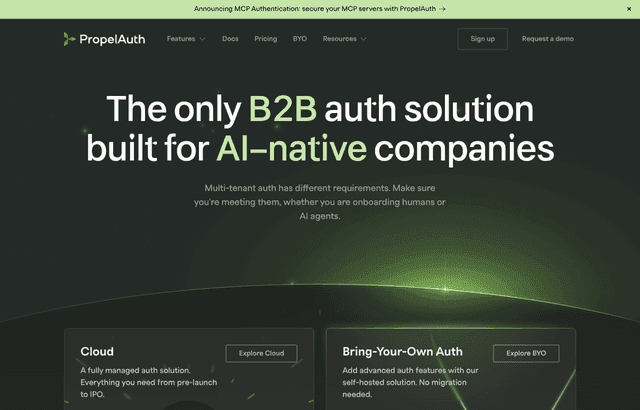
PropelAuth, one of the tools included in this startup deal.
Organizations, Not Just Users
The defining feature of PropelAuth is that it models organizations, not just individual users, and this is exactly what B2B SaaS needs. When a company buys software, the unit that matters is the company. Multiple people from the same customer share an account, they belong to the same organization, and they need to be managed together. Consumer-style authentication, where every user is an island, simply does not fit this shape.
PropelAuth builds organizations in from the start. A customer signs up and creates an organization. Their coworkers join that same organization. Data, permissions, and billing all attach to the organization rather than to scattered individuals. This mirrors how the business customer actually thinks about the product, which means the software behaves the way buyers expect instead of forcing them into an awkward model.
For a startup, getting this right early avoids a painful rebuild later. Teams that start with plain user accounts and only add organizations once a customer demands it face a hard migration, because the organization concept touches nearly everything. PropelAuth puts organizations at the foundation, so the product is structured correctly from the first customer and never has to be torn apart to add them.
Roles That Match How Companies Work
Inside every business customer there is a hierarchy. Some people are administrators who manage the account, add and remove coworkers, and control settings. Others are regular members who use the product but should not touch account-level controls. B2B buyers expect this distinction, and they will ask for it almost immediately, because handing every employee full administrative power is not acceptable to them.
PropelAuth provides roles so a startup can express exactly this. The organization has admins and members, with different permissions attached to each, and the product can check those roles to decide what each person is allowed to do. The customer's own administrator gets to manage their team without the startup being involved, which is both what the customer wants and less work for the startup's support.
This role structure is the kind of feature that looks small on a roadmap and is large in reality. Building a correct, flexible permission system by hand is error-prone, and permission bugs are security bugs. PropelAuth gives the team a tested foundation for roles, so access control is something the product can rely on rather than something the team has to get exactly right on its own under deadline pressure.
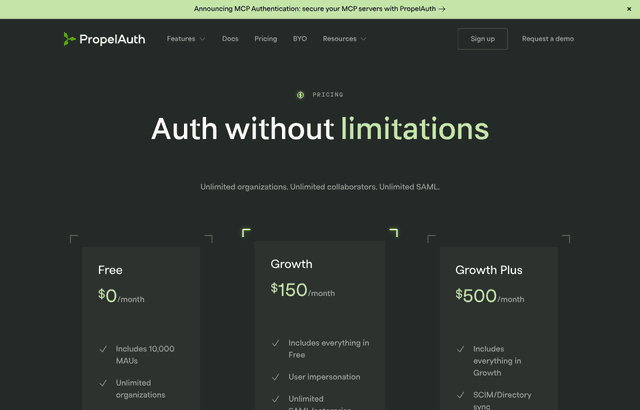
A look at PropelAuth before the discount, so you can see what the deal saves you.
Self-Service That Saves the Team's Time
One of the quiet benefits of PropelAuth is how much support work it prevents. B2B customers constantly need to manage their own accounts. Someone joins the customer's company and needs access. Someone leaves and needs to be removed. An admin wants to change a coworker's role. If the product does not let customers do these things themselves, every one of those requests lands on the startup's small team.
PropelAuth gives customers self-service management. The customer's administrator can invite coworkers, remove them, and adjust roles directly, without contacting the startup at all. Every one of those interactions that the customer handles themselves is one the founding team does not have to handle by hand over email, which at early scale is a meaningful drain that PropelAuth simply removes.
This matters more as the customer base grows. A handful of customers generating occasional account requests is manageable. Dozens or hundreds of customers each with their own team churn is not, if every change requires the startup to intervene. Self-service management keeps that work with the people who should own it, the customers themselves, and lets the startup's team stay focused on building rather than on account administration.
Security Handled by People Who Do It Full Time
Authentication is one of the highest-stakes parts of any application, because a mistake in it is not a bug, it is a breach. Password handling, session management, token security, and the constant stream of edge cases around login are difficult to get right, and the cost of getting them wrong is severe. A small startup team building this itself is taking on real risk in an area where it has little margin for error.
PropelAuth is built and maintained by a team whose entire job is doing authentication correctly and keeping it correct as threats evolve. When a startup uses it, that expertise comes along. The hard security details are handled by specialists, and they stay handled as the landscape changes, without the startup having to track every new vulnerability and best practice on its own.
For a startup selling to other businesses, this also helps with trust. B2B buyers, especially larger ones, ask hard questions about how their data is protected and how identity is managed. Building on a dedicated authentication platform gives the startup a stronger, more credible answer than a homegrown login system assembled under time pressure. Security done properly becomes a point of confidence rather than a liability waiting to surface.
Faster Time From Idea to First Customer
Speed is the resource a startup cannot buy back. The faster a team can get a working product in front of paying customers, the sooner it learns whether the idea works and the longer its runway lasts. Authentication sits directly in the critical path, because there is no product to show until users can sign up and log in securely. Every week spent building login is a week the product is not in front of anyone.
PropelAuth collapses that time. Instead of weeks building account systems, the team integrates a ready platform and gets straight to the features that actually differentiate the product. The founder's scarce engineering hours go toward what customers are paying for rather than toward reimplementing a solved problem that every SaaS company needs and none of them win on.
This trade is almost always correct for an early team. Authentication is necessary but not a competitive advantage. No customer chooses a product because it built its own login. By handing that undifferentiated work to PropelAuth, the startup spends its limited time where it can actually create an edge, which is exactly how a small team beats larger, slower competitors.
PropelAuth Compared to Building It Yourself
The main alternative to PropelAuth is building authentication in-house, and it is worth being clear-eyed about what that path costs. Building it yourself looks cheaper because there is no line item, but the real cost is enormous. It is weeks of initial work, then indefinite maintenance, then the ongoing security burden of keeping it safe, then the eventual rebuild when the simple user model fails to handle organizations and roles.
Homegrown authentication also tends to be incomplete in exactly the ways B2B customers care about. It handles the happy path of one user logging in and skips the harder parts: organization management, role hierarchies, admin self-service, invitations, and the many edge cases around sessions and tokens. Those gaps surface as customer complaints and emergency fixes at the worst times. PropelAuth includes them from the start because they are the whole point of the product.
There are also general-purpose authentication tools that are not built specifically for B2B. They can handle login, but they often leave the organization and role modeling for the team to construct on top. PropelAuth's focus on B2B SaaS means the concepts a business product needs are native rather than bolted on. For a startup whose customers are companies, that focus removes work that a more generic tool would leave behind. And the Free Plan means the correct choice does not even cost anything to start.
Making the Free Plan Count
The Free Plan gives a startup room to build and launch a real B2B product on PropelAuth without paying, and the team gets the most from it by adopting the platform properly rather than treating it as a temporary stand-in. The teams that benefit most integrate it early and build their product around its organization and role model from the beginning.
Start by putting PropelAuth in front of the product before there is much product to protect, so authentication is right from the first line rather than retrofitted later. Model your customers as organizations from the outset, so the structure matches how businesses buy and you never have to rebuild it. Use the roles PropelAuth provides for your permission logic instead of inventing a parallel system, so access control stays consistent and trustworthy.
Lean on the self-service management as soon as you have customers, so account administration never becomes a manual support queue. Let customer admins invite and manage their own teams, and keep your own team focused on the product. Each of these choices takes little effort at integration time and saves large amounts of work and risk down the line.
Because the plan is free, there is no cost to starting properly and no reason to cut corners on the identity layer. The team can build the real thing, launch it, and put actual customers on it without spending anything on authentication, which is exactly the position an early startup wants to be in for a problem this important and this undifferentiated.
How PropelAuth Scales With the Company
The concern with adopting an identity platform early is whether it holds up as the company grows into larger, more demanding customers. PropelAuth is built for that trajectory. The organization and role model that fits the first small customer is the same model that fits an enterprise buyer with hundreds of employees and complex internal structure. Because those concepts are native to the platform, growing into bigger accounts does not force the team to rework its foundation.
Larger B2B customers also raise the bar on identity in specific ways. They ask about single sign-on so their employees can log in through the company's own identity provider. They ask about stricter access controls and clearer audit of who can do what. PropelAuth is designed with these B2B expectations in mind, so the startup has a credible path to meeting enterprise requirements as it moves upmarket, rather than hitting a wall the first time a serious buyer asks a hard question about identity.
That forward path is part of why committing to PropelAuth early is a sound decision. The work the team does integrating it during the free period is not throwaway effort that gets replaced when the company gets bigger. The same platform carries the startup from its first small customer to its first large one, which spares the team a disruptive identity migration exactly when it is trying to close its most important deals.
Who Should Claim This Deal
This deal is for any startup building B2B SaaS, meaning software sold to other businesses rather than to individual consumers. If your customers are companies whose employees will share an account, expect an admin, and need roles, PropelAuth's Free Plan is built for exactly your situation.
It is an especially strong fit for an early team that has not yet built authentication and wants to avoid sinking weeks into it, because PropelAuth hands over a complete, production-grade system immediately. It fits teams that know their product needs organizations and roles but do not want to construct and maintain that themselves. And it fits any founder who would rather spend scarce engineering time on the features customers actually pay for than on reimplementing login, which no customer ever chose a product for.
A startup that is about to build its own account system, or that has one and is already feeling the strain of organization management and admin requests, will feel PropelAuth's value quickly. It removes a hard, high-stakes, undifferentiated problem from the team's plate, it fits the B2B model natively, and the Free Plan means it costs nothing to start. For a company building software for other businesses, this deal is worth claiming today.
Who Is This Deal For?
Early-Stage Startups
Seed and pre-seed companies looking to move fast without overspending on tools.
Growing SaaS Teams
Series A+ companies scaling their stack and optimizing software costs.
Solo Founders
Indie hackers and bootstrapped founders who need enterprise tools at startup prices.
Get Free Plan off PropelAuth
Premium deal. Upgrade once, unlock everything.
Frequently Asked Questions
Everything you need to know about this startup deal.
Yes. Free for up to 10,000 monthly active users.
Get the weekly deals digest
New verified startup deals every week. No spam, ever. Unsubscribe anytime.
Related Offers

Toggl Track
Used by 1,100 members
Free Plan
Simple and intuitive time tracking for teams with reporting and integrations.
View offer
Auth0
Used by 994 members
1 year of B2B Professional free
Get 1 year of the Auth0 B2B Professional plan free, with up to 100,000 monthly active users, SSO, enterprise MFA and SCIM.
View offer
Bugsnag
Used by 471 members
Free Plan
Error monitoring and stability management for web and mobile applications.
View offer
Turborepo
Used by 1,880 members
Free & Open Source
High-performance build system for JavaScript and TypeScript monorepos by Vercel.
View offer
Windmill
Used by 1,501 members
Free Plan
Open-source developer platform for building internal tools, workflows, and scripts.
View offer
Height
Used by 1,442 members
Free Plan
AI-powered project management tool with autonomous task management and workflows.
View offerDeal Summary
Looking for more startup deals?
Browse all offers