Remix: Free and Open Source Web Framework
Full-stack web framework built on React Router with server-side rendering and nested routes.
Free. No credit card required
Free · No account required.
Deal Highlights
The SaaSOffers Remix deal
Offer: Free & Open Source.
Who qualifies: anyone. There are no requirements and no promo code. You install the remix package from npm and use it.
We checked versions, docs and hosting prices against Remix's site, docs, blog, npm and each host's pricing page in November 2026.
This is not an exclusive discount. Remix is released under the MIT License, copyright Shopify Inc., and it costs the same $0 for everyone. Your real costs are hosting, a database and your team's time.
Remix v2, the React framework, has been end of life since June 17, 2026. Remix today means Remix 3, which does not use React. If you want the React version, use React Router.
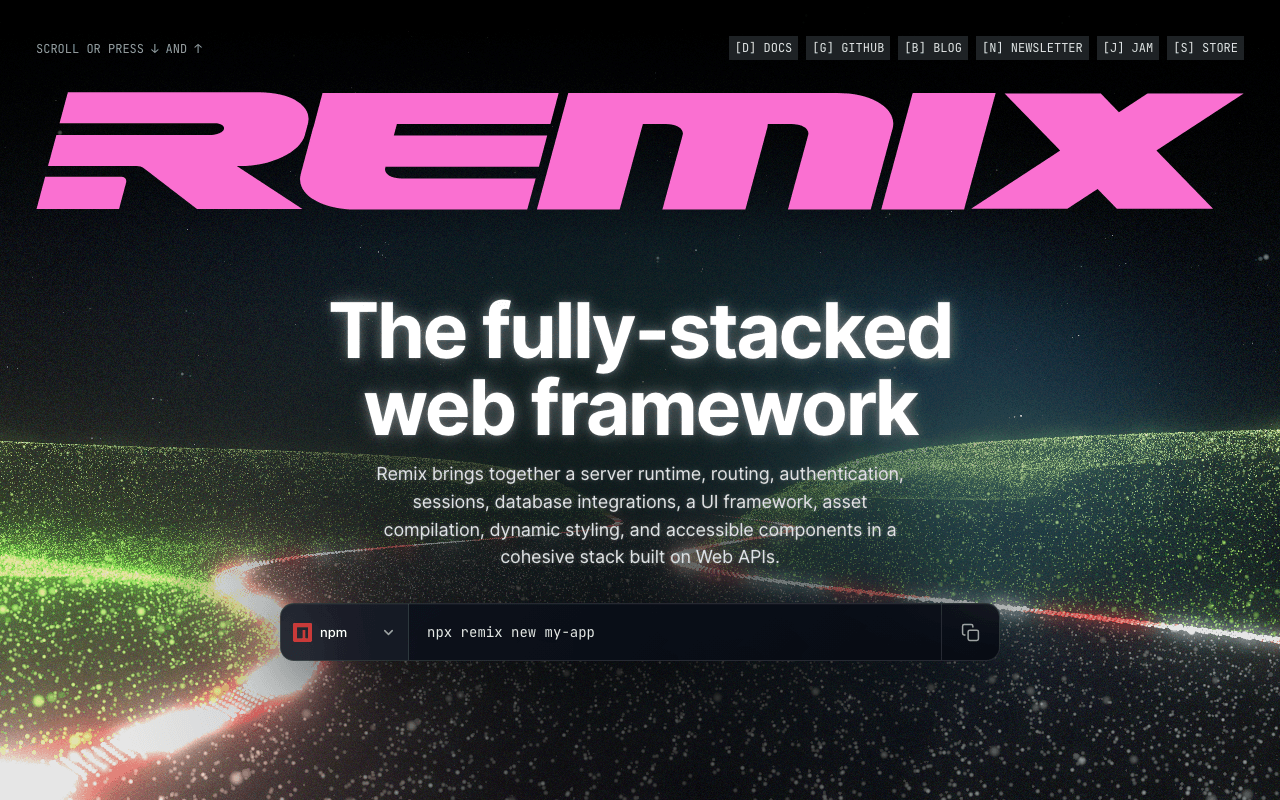
Which Remix you get in November 2026
Remix has split into two lines, and the old one is closed.
- Remix v2 was a React framework. On May 15, 2024 the team announced it would merge Remix into React Router. React Router v7 shipped on November 22, 2024 and brought the Remix v2 features into React Router "framework mode". The last Remix v2 release, 2.17.5, came out on June 1, 2026.
- React Router v8 shipped on June 17, 2026. In that post the team marked React Router v6 and Remix v2 as End of Life. They no longer get security updates. React Router v7 still gets security fixes. The team calls React Router its React meta-framework and says "If you need something battle-tested, stick with React Router."
- Remix 3 is a new full-stack framework that does not use React. The beta preview came out on April 30, 2026 and the first release candidate on August 31, 2026. Version 3.0.0 went to npm on October 1, 2026, and 3.1.0 on October 23, 2026. The docs site shows Remix v3.1.0.
So the listing line "built on React Router" describes Remix v2, which is end of life. If you want the React version of this stack today, you want React Router. If you want Remix itself, you get Remix 3, which has its own component runtime.
Usage numbers show where most teams are. In the week of October 26 to November 1, 2026, npm counted 74,857 downloads of remix, 849,766 of the old @remix-run/react package and 73,416,002 of react-router. The remix-run/remix GitHub repo had 33,441 stars and remix-run/react-router had 56,632 on November 3, 2026.
What Remix 3 includes
Remix 3 calls itself a full-stack TypeScript framework built on web standards. The getting-started guide says that for most web apps, remix can be the only runtime dependency in package.json. The repo lists 47 packages, and the remix package bundles them under subpath imports such as remix/node-fetch-server. You can also use most of them on their own.
The README lists 6 design principles: model-first development, build on Web APIs, "religiously runtime", avoid dependencies, demand composition and distribute cohesively. In practice that means no bundler at the center, no type generation step and code that runs as plain runtime JavaScript.
Server, routing and middleware
A route gets a standard Request and returns a standard Response for HTML, JSON, redirects, files or streams. Routing runs through typed middleware and controllers. The same typed route definitions match incoming requests and generate URLs for links, redirects and forms. The remix routes command prints each method, pattern and owner, with --table and --json output.
The repo ships middleware packages for compression, CORS, CSRF, cross-origin protection, form data, logging, method override, sessions, static files and async context. The README says the packages work across Node.js, Bun, Deno and Cloudflare Workers, using Web Streams, Uint8Array, Web Crypto, Blob and File instead of Node-only APIs.
Data, auth and sessions
remix/data-table is a typed relational query toolkit with adapters for SQLite, PostgreSQL and MySQL. remix/data-schema handles validation. The RC post lists migrations, seeding, status checks, resets, wipes and rollbacks built into the CLI. You can swap in Zod or Drizzle if you prefer them. The RC post says Zod is compatible with data-schema.
The auth packages cover browser login, OAuth and OIDC, with middleware that resolves each request to a typed identity. Session middleware keeps data on the server behind a signed cookie, with Redis and Memcache storage packages. File storage works on disk, in memory or in S3 through file-storage-s3.
The UI runtime
Remix 3 drops React. Components are JSX, but they run on remix/component, not React. A component runs setup once, then returns a function that renders JSX. State lives in ordinary JavaScript variables, objects or classes instead of hooks. Your code calls handle.update() when it wants the UI to re-render. Mixins attach events, styles, refs and accessibility behavior to an element without a wrapper component.
You choose which components hydrate in the browser. <Frame> updates regions of a page with server-rendered HTML from ordinary routes. @remix-run/ui adds unstyled, accessible primitives with focus, keyboard navigation and ARIA handling, plus animation mixins. The RC post says you can swap the render middleware for a React-based one, but React is not the default.
Assets, tooling and tests
There is no application build step. TypeScript, JSX and CSS compile when requested, in development and production, and are served as native browser modules. Each module caches on its own instead of invalidating one big bundle. The RC post adds full-stack hot module replacement and a remix.json file for databases, assets and tests.
The CLI covers remix new, remix routes, remix doctor (with --json, --strict and --fix), remix test and shell completion for bash and zsh. The remix/test package gives a test runner with node:assert-compatible helpers. Type checking stays a separate tsc --noEmit step because runtime transforms do not check types.
Remix also ships an agent skill. Apps created with npx remix new include it, and the remix package ships its guides as Markdown in node_modules/remix so coding agents read the current docs, not memories of v2.

What it costs to run a Remix app
Remix itself has no paid tier. The table shows the framework next to hosting plans a Remix 3 app can run on. Remix 3's starter is a Node server, and the remix package requires Node 24.3.0 or newer. Hosting prices come from each host's official pricing page, checked November 2 and 3, 2026.
| Item | Price billed yearly | Price billed monthly | Key limits |
|---|---|---|---|
| Remix framework (MIT) | $0 | $0 | No usage limits, no seats, no license key |
| Cloudflare Workers Paid | No annual price listed ($60 a year at the monthly rate) | $5/month minimum | 10M requests and 30M CPU ms included, then $0.30 per 1M requests |
| Railway Hobby | No annual price listed ($60 a year) | $5/month, includes $5 of usage | 48 vCPU / 48 GB limits, 7-day logs, 3 members per project |
| Render web service | No annual price listed ($84 a year) | $7/month for 0.5 CPU, 512 MB | Hobby workspace $0 with 1 seat; Pro workspace $25/month plus compute |
| Vercel Pro | No annual price listed ($240 a year per seat) | $20/month per developer seat | $20 usage credit; Hobby is non-commercial only |
Cloudflare's free Workers tier allows 100,000 requests a day with 10 ms of CPU per request. Render's free instance has 512 MB. A Render Postgres database starts at $6 a month. Remix's production guide is still marked unfinished, so check your host's support for a Node 24 Fetch server before you commit.
What the free framework does not include
Remix is free, but these pieces are on you:
- Hosting. Remix provides no hosting, no deploy service and no managed database.
- Support. There is no paid support plan. Help comes from GitHub issues and the docs.
- Finished docs. On November 3, 2026, the Production and CLI chapters were still marked "unfinished" and outlined topics instead of full guides.
- React. Remix 3 does not run React components by default. Existing React component libraries will not drop in.
- Old-version security fixes. Remix v2 gets no security updates after June 17, 2026.
- Metrics backend. The production guide says Remix supplies request logging and error hooks, not a metrics backend. You add health routes, tracing and logs yourself.
Worked examples
These use the hosting prices in the table. Remix adds $0 in both.
Example 1: a solo founder on Cloudflare Workers
One person runs a Remix app with 3 million requests a month and about 5 ms of CPU per request.
- Requests: 3,000,000 / 30 days = 100,000 a day. That sits right at the free tier's 100,000 daily cap, with no room for spikes.
- On Workers Paid: 3M requests is under the 10M included. CPU is 3M x 5 ms = 15M CPU ms, under the 30M included. The bill is the $5 minimum.
- Yearly: $5 x 12 = $60. Remix: $0. Total: $60 a year.
The same app on Vercel Pro with 1 seat costs $20 a month for the seat. 3M requests a month is over the 1M CDN requests included with Pro, so Flat Rate CDN moves you to the $20 tier: $40 a month, or $480 a year. Workers saves $420 a year here, if your Remix 3 app runs on the Workers runtime. Vercel does not say whether the $20 usage credit covers the CDN tier. If it does, Vercel is $240 a year and Workers saves $180.
Example 2: a 4-person team on Render
Four developers run 1 web service at 1 CPU and 2 GB plus a small Postgres database.
- Pro workspace (unlimited seats): $25 a month.
- Web service 1 CPU, 2 GB: $25 a month.
- Postgres 0.5 CPU, 1 GB: $19 a month.
- Monthly: $25 + $25 + $19 = $69. Yearly: $69 x 12 = $828.
On Vercel Pro the seats alone are 4 x $20 = $80 a month, or $960 a year, before a database. Remix adds $0 in both cases.
Who Remix is for
- Teams that want one dependency for server, routing, data, auth, sessions, UI and tests, and like Web APIs over framework magic.
- Developers who use coding agents heavily. Remix 3 ships an agent skill and installs its docs as Markdown inside
node_modules. - Projects that can start fresh. A new internal tool, a content site with forms or a server-rendered SaaS dashboard fits well.
- Teams that want to avoid a bundler. Remix serves source as native modules with no build step.
Who Remix is not for
- Teams with a React codebase or a React component library. Use React Router v7 or v8 framework mode, which is where Remix v2's features went.
- Anyone still on Remix v2. It is end of life. Plan the upgrade to React Router v7, which the team calls a non-breaking path from Remix v2.
- Teams that need years of production track record, wide hosting templates and a large hiring pool. Remix 3 reached 3.0.0 on October 1, 2026.
- Projects stuck on older Node. Remix 3 needs Node 24.3.0+.
Remix vs alternatives
Versions, licenses and Node minimums come from each project's npm package on November 3, 2026. Downloads are npm counts for October 26 to November 1, 2026.
| Framework | Latest version | License | UI layer | Node minimum | Weekly npm downloads |
|---|---|---|---|---|---|
| Remix | 3.1.0 | MIT | Own runtime (remix/component) | 24.3.0 | 74,857 |
| React Router | 8.5.1 | MIT | React 19.2.7+ | 22.22.0 | 73,416,002 |
| Astro | 7.4.5 | MIT | Islands, any UI library | 22.23.4 | 10,746,270 |
| SvelteKit | 3.1.1 | MIT | Svelte | 22.17 | 4,503,568 |
| Nuxt | 4.6.4 | MIT | Vue | 22.22.3 or 24.15.0 | 3,285,990 |
All five are free. React Router is the safe choice if you know React and want what Remix v2 offered. React Router v8 needs React 19.2.7+, Vite 7+ and is ESM-only, and the team moved to a yearly major release schedule. Astro suits content-heavy sites. SvelteKit and Nuxt suit teams already on Svelte or Vue. Remix 3 is the choice when you want the whole server stack, including database and auth packages, from one project.
Getting set up on Remix
- Check Node first:
node -vmust show 24.3.0 or newer. - Run
npx remix new my-app, thennpm installandnpm run dev. The CLI also works with pnpm, Yarn, Bun and Deno. - Open
package.jsonand confirmremixis the one runtime dependency. - Run
remix doctorearly. Add--strictin CI so warnings fail the build. - Add
tsc --noEmitto CI. Runtime TypeScript transforms do not check types. - Use shared storage in production. The production guide warns that memory sessions, process caches and local upload folders do not work across replicas. Use Redis, Memcache, a database or S3.
- Only enable
trustProxywhen every request comes through a proxy that overwrites forwarded headers. - Point your coding agent at the bundled skill and
node_modules/remix/INDEX.mdso it does not write Remix v2 code.
Claiming the Remix offer, step by step
- Open the Remix deal on SaaSOffers.
- Go to remix.run or run
npx remix new my-app. There is no account, sign-up or code. - Install with your package manager. The license is MIT, so commercial use is allowed.
- If you want React, install
react-routerinstead and follow the React Router framework mode docs. - Pick a host from the table above and check its Node 24 support before launch.
Who Is This Deal For?
Early-Stage Startups
Seed and pre-seed companies looking to move fast without overspending on tools.
Growing SaaS Teams
Series A+ companies scaling their stack and optimizing software costs.
Solo Founders
Indie hackers and bootstrapped founders who need enterprise tools at startup prices.
Get Free & Open Source off Remix
Free for all startups. Claim instantly.
Frequently Asked Questions
Everything you need to know about this startup deal.
Get the weekly deals digest
New verified startup deals every week. No spam, ever. Unsubscribe anytime.
Related Offers

Retool
Used by 1,559 members
1 year free, up to $60K
Build internal tools 10x faster with the low-code platform used by companies like Amazon, DoorDash, and Mercedes-Benz.
View offer
Replicate
Used by 1,772 members
$500 in credits
Run open-source ML models in the cloud, deploy Llama, Stable Diffusion, and custom models via API without GPU management.
View offer
ZoomInfo
Used by 2,014 members
Free Trial
B2B data platform for sales and marketing intelligence with contact databases.
View offer
Chore
15% off your first month
Chore runs your startup's back office for you: payroll, HR, bookkeeping, compliance and equity, inside the tools you already use. 15% off your first month through SaaSOffers.
View offerDeal Summary
Looking for more startup deals?
Browse all offers