
RudderStack Coupon: Free Plan
Open-source customer data platform, warehouse-first alternative to Segment.
Premium: $79/year for unlimited deals
Already have an account? Log in
Deal Highlights
The SaaSOffers RudderStack listing
Offer: Free Plan. This is RudderStack Cloud's Free plan, which processes up to 250K events a month at $0.
Requirements: none listed. You sign up through the SaaSOffers listing and there is no promo code.
We checked these plans and prices against RudderStack's official pricing and help pages in November 2026.
RudderStack offers this Free plan to anyone who signs up on rudderstack.com, so our listing does not add volume or a discount. RudderStack also gives every new signup with a business email a 30-day Growth trial, capped at 25M cumulative events. Some older pages, including our previous version of this listing, said the Free plan covered 500K events. RudderStack's current pricing page and billing docs both say 250K.
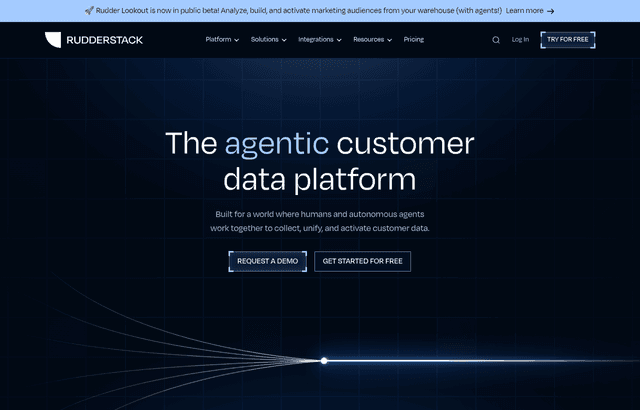
RudderStack is a customer data platform built around your data warehouse. You install its SDKs in your website, apps and servers, it collects events once, and it sends them to analytics, marketing and ad tools and to warehouses such as Snowflake, BigQuery or Redshift. It also runs Reverse ETL, which moves rows from the warehouse back into business tools. RudderStack describes itself as warehouse-native and says it does not store customer data, and it publishes its self-hosted code under the Elastic License 2.0.
The 250K event ceiling and what sits under it
The Free plan is described as "free forever." Here is what it includes, from the pricing page and the plan comparison docs:
- 250K events a month. RudderStack defines an event as "a data point generated by a website, app, server, or cloud application." Billing counts collected and activated events together.
- 16+ SDK sources, 200+ cloud destinations and 10+ warehouse and data lake destinations.
- Reverse ETL with 10 connections and 8+ warehouse and data lake sources.
- 5 JavaScript transformations. Transformations let you edit, filter or enrich events in code before they reach a destination.
- 1 tracking plan with 5 events. A tracking plan defines which events and properties are valid.
- Event blocking for 2 events and 2 custom property types.
- 10 team members and a production workspace only.
- Warehouse syncs every 3 hours.
- Bot management in detect-only mode.
- Alerts by email, webhook, Slack, Microsoft Teams, PagerDuty and incident.io.
- Support through the community Slack only.
- Rolling 7-day event retention in RudderStack's cloud storage.
What the Free plan leaves out
- No dev workspace. Growth adds a separate Dev and Prod workspace, so on Free you test in production.
- No email support. Growth adds email support. Dedicated Slack support and a technical account manager are Enterprise.
- Slower warehouse loads. 3 hours on Free, 30 minutes on Growth, 5 minutes on Enterprise.
- No Python transformations. Free is JavaScript only. RudderStack's transformation docs say Python transformations are available on Growth and Enterprise.
- No Profiles. Identity resolution, the customer 360 table, audience builder and propensity scores are part of Enterprise.
- No SSO, HIPAA BAA, SSH tunnel or VPC deployment. These are Enterprise.

Growth plan prices by event tier
Growth is the self-serve paid plan. You pick a volume tier, and annual billing is 15% cheaper. The billing docs publish the full ladder.
| Plan and tier | Price billed yearly | Billed monthly | Key limits |
|---|---|---|---|
| Free | $0 | $0 | 250K events/month, 10 team members, 5 transformations, 3-hour syncs |
| Growth 1M | $225/month ($2,700/year) | $265/month | 1M events/month, unlimited team members, 25 transformations, 30-minute syncs |
| Growth 3M | $625/month ($7,500/year) | $735/month | 3M events/month, same features |
| Growth 5M | $845/month ($10,140/year) | $995/month | 5M events/month, same features |
| Growth 7M | $1,015/month ($12,180/year) | $1,195/month | 7M events/month, same features |
| Growth 10M | $1,420/month ($17,040/year) | $1,675/month | 10M events/month, same features |
| Growth 25M | $2,335/month ($28,020/year) | $2,750/month | 25M events/month, same features |
| Enterprise | Custom | Custom | Above 25M events, 5-minute syncs, Profiles, SSO, HIPAA |
Growth also raises the caps that bite first on Free: 25 Reverse ETL connections, 75 tracking plan events, 10 custom property types, unlimited tracking plans and unlimited event blocking. Bot management moves from detect only to detect and act.
The billing cycle resets on the 1st of each month. When you upgrade, the new plan starts right after payment and you pay a prorated amount for the rest of the month. If you cancel Growth, you keep it until the end of the billing period and then drop back to Free with its 250K limit.
Overages: Free stops, Growth bills
The two plans handle extra volume differently.
On Free, RudderStack stops processing data after your second consecutive month over 250K events. One bad month is tolerated. Two in a row and events stop flowing until you upgrade.
On Growth, RudderStack bills the overage at the cost per million events of your current tier. The docs give an example: on the 1M tier at $265, a month with 1.5M events adds a $132.50 overage, for a $397.50 total.
A legacy Starter plan still appears in the FAQ. It is closed to new signups, and its overage rule is different: you pay the gap between your tier and the next tier.
Two worked examples
The Free plan is the same with or without our listing. These examples show what staying on Free saves and what the first paid step costs, using RudderStack's published prices.
Example 1: a seed-stage SaaS app sending 200K events a month
A 5-person team tracks page views, signups and a dozen product events. It sends about 200K events a month to a warehouse and two tools.
- 200K is under the 250K limit, so Free covers it at $0.
- The smallest Growth tier would cost $2,700 a year on annual billing or $265 x 12 = $3,180 on monthly billing.
- Staying on Free saves $2,700 to $3,180 a year.
- What the team gives up: email support, a dev workspace and 30-minute warehouse syncs. Its data lands in the warehouse up to 3 hours after the event.
- Headroom: 250K - 200K = 50K events, or 20% of the limit. A launch week can use that quickly. Two months in a row over the limit stops processing.
Example 2: the same app after growth at 1.5M events
A year later the app sends 1.5M events a month.
- Option A, stay on Growth 1M and pay overage. $265 + $132.50 = $397.50 a month, or $397.50 x 12 = $4,770 a year.
- Option B, move to Growth 3M on monthly billing. $735 x 12 = $8,820 a year.
- Option C, move to Growth 3M on annual billing. $7,500 a year.
- At 1.5M events, Option A is the lowest of the three: $7,500 - $4,770 = $2,730 a year below the annual 3M tier.
- The overage rate on the 1M tier works out to $265 per million. At 2.5M events the 1M tier with overage would be $265 + (1.5 x $265) = $662.50 a month. That is above the $625 annual 3M rate but still below the $735 monthly 3M rate. On monthly billing, overage stays cheaper until about 2.77M events ($735 / $265).
Sizing your volume before you pick a tier
Estimate monthly events as active users x events per user per day x 30. A B2B tool with 800 daily active users who each trigger 10 events sends 800 x 10 x 30 = 240,000 events a month, just under the Free limit. Add one more tracked event per user per day and it reaches 264,000, which is over. Count server-side and Reverse ETL activations too, because RudderStack bills collected and activated events together.
Where RudderStack fits best
- Startups that already have a warehouse, or plan one, and want events to land there in their own schema.
- Teams sending data to several tools. If the same event needs to reach an analytics tool, an email tool and an ad platform, one SDK replaces three.
- Engineers who want code-level control. JavaScript transformations let you drop PII, rename properties or filter bots before data leaves.
- Companies with under 250K events a month. A B2B app with a few thousand active users often fits.
- Teams moving off Segment whose bill grows with visitors. RudderStack's free tier and paid tiers are counted in events, not visitors.
Who RudderStack is not for
- Teams that want analytics charts, not a pipeline. RudderStack collects and routes data. You still need a tool such as Amplitude, Mixpanel or PostHog to look at it.
- Consumer apps with heavy traffic. A mobile app with 50K daily users and 10 events each sends 500K events a day, far past 250K a month.
- Teams without anyone who can maintain tracking. Tracking plans, transformations and warehouse schemas need an owner.
- Anyone needing HIPAA, SSO or VPC on a small budget. Those are Enterprise only.
RudderStack compared with Segment and PostHog
| RudderStack | Segment | PostHog | |
|---|---|---|---|
| What it is | Warehouse-native customer data pipeline | Customer data platform | Product analytics suite with a data pipeline |
| Billing unit | Events per month | Monthly tracked visitors | Events, recordings, flag requests, survey responses |
| Free plan | 250K events/month, 10 team members | 1,000 visitors/month, 2 sources, 1 warehouse destination, 10 seats | 1M events, 5,000 recordings a month |
| First paid tier | Growth, $265/month for 1M events ($225 on annual) | Team, from $120/month for 10,000 visitors | Pay-as-you-go, $0 base |
| Trial | 30-day Growth trial, 25M events | 14-day Team trial | Free tier resets monthly |
| Self-hosting | Self-hosted code under Elastic 2.0 | No | MIT-licensed deploy, officially unsupported |
The billing unit decides the comparison. Segment counts visitors, so an app with few users who generate many events can be cheaper there. RudderStack counts events, so an app with many light visitors can be cheaper here. PostHog is analytics first, with a pipeline attached. Teams that want a single tool often pick PostHog, while teams that want a warehouse at the center pick RudderStack or Segment.
Security and compliance
RudderStack's security and DPA pages say it holds SOC 2 Type II, validated yearly by a third-party auditor, and that SOC 2 reports are available on request under confidentiality terms. Its DPA covers GDPR, UK GDPR and Swiss revFADP. RudderStack says it can sign a HIPAA Business Associate Agreement, which the pricing page lists under Enterprise. A RudderStack blog post on its compliance toolkit says data can be processed in the US or Europe. Data in transit uses TLS.
Setting up RudderStack well
- Start the Growth trial on purpose. New signups with a business email get 30 days of Growth, capped at 25M cumulative events. Use it to test the Dev workspace and 30-minute syncs, then decide whether Free is enough.
- Count your events before launch. Multiply daily active users by events per user by 30. If the result is near 250K, plan for Growth.
- Spend your 5 transformations carefully. Use one to strip PII and one to filter internal traffic. The rest go fast.
- Write the tracking plan first. Free allows 1 tracking plan with 5 events. Put your 5 most important events in it, such as signup, activation and purchase.
- Block noisy events. Free lets you block 2 events. Block the highest-volume events you don't analyze, like heartbeat or scroll events.
- Set alerts on day one. Route them to Slack or email so you see a broken source before your warehouse goes stale.
- Check usage before the 2nd overage month. On Free, a second consecutive month over 250K stops processing.
Steps to get the RudderStack deal
- Open the RudderStack listing on SaaSOffers and click the claim button. It takes you to RudderStack's signup page.
- Sign up. Use a business email if you want the 30-day Growth trial. No promo code is needed and none exists for this listing.
- Add your first source, such as the JavaScript SDK, and paste the write key into your site.
- Add a destination: a warehouse, an analytics tool or both.
- At the end of the trial, choose a Growth tier or move to the Free plan with 250K events a month.
Who Is This Deal For?
Early-Stage Startups
Seed and pre-seed companies looking to move fast without overspending on tools.
Growing SaaS Teams
Series A+ companies scaling their stack and optimizing software costs.
Solo Founders
Indie hackers and bootstrapped founders who need enterprise tools at startup prices.
Get Free Plan off RudderStack
Premium deal. Upgrade once, unlock everything.
How to get the RudderStack deal
- The offer: Free Plan.
- Create a free SaaSOffers account, then upgrade to Premium ($79 a year, or $250 once for lifetime access). Premium unlocks every Premium deal on the site.
- Open the RudderStack claim page from this deal. It shows the partner link, any promo code and the exact steps RudderStack asks for.
- Apply or sign up through that link before you pay RudderStack directly, since most startup offers only apply to new accounts.
Frequently Asked Questions
Everything you need to know about this startup deal.
Get the weekly deals digest
New verified startup deals every week. No spam, ever. Unsubscribe anytime.
Related Offers

Replicate
Used by 1,772 members
$500 in credits
Run open-source ML models in the cloud, deploy Llama, Stable Diffusion, and custom models via API without GPU management.
View offer
Consensus
Used by 1,544 members
Free Plan
AI-powered research platform that finds, summarizes, and synthesizes scientific papers.
View offer
Laxis
Used by 2,176 members
Free Plan
AI meeting assistant that records, transcribes, and generates actionable meeting notes.
View offer
ZoomInfo
Used by 2,014 members
Free Trial
B2B data platform for sales and marketing intelligence with contact databases.
View offerDeal Summary
Looking for more startup deals?
Browse all offers