
Tailscale Promo Code: 1 year free Personal Pro
Zero-config VPN for teams, secure networking between devices, servers, and cloud instances without port forwarding.
Free · Opens in new tab
Already have an account? Log in
Deal Highlights
What Tailscale Gives a Startup
Tailscale is a zero-config VPN for teams. It creates secure networking between devices, servers, and cloud instances without the port forwarding, firewall wrangling, and manual configuration that traditional VPNs demand. This deal gives a year free of Personal Pro, and it is aimed at a startup team that needs secure networking, which in practice is nearly every technical team as soon as it has more than a laptop and a server to connect.
The problem Tailscale solves is that connecting a team's machines securely used to be genuinely hard. A traditional VPN means standing up a VPN server, opening ports, configuring firewalls, distributing credentials, and dealing with all of it breaking whenever the network changes. For a startup without a dedicated network engineer, that work is a painful distraction from building the product, and doing it wrong leaves security holes. The alternative many teams fall into is exposing services to the public internet with a password and hoping for the best, which is worse.
Tailscale replaces all of that with something that just works. It builds a secure private network across the team's devices and servers with almost no configuration. A developer installs it, authenticates, and their machine is part of the network, able to reach the other machines securely as if they were on the same local network, no matter where they physically are. The year of Personal Pro free lets a startup adopt this and run on it, connecting the team's real infrastructure, before deciding how it fits long term.
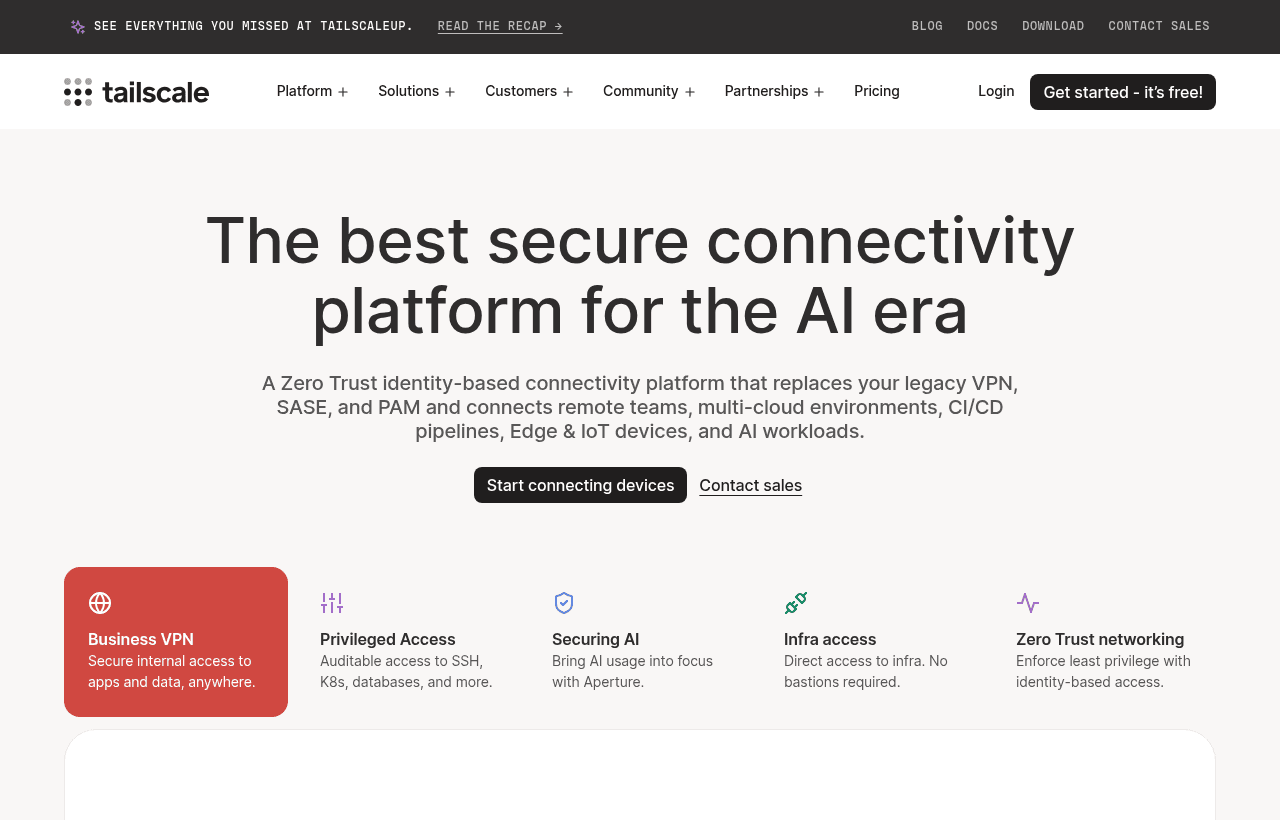
Tailscale, one of the tools included in this startup deal.
Zero Configuration as the Whole Point
The defining feature of Tailscale is that it requires almost no configuration, and for a startup that is not a convenience, it is the difference between having secure networking and not. Traditional VPNs fail teams not because they cannot work but because setting them up and keeping them working requires expertise and ongoing attention that a small team does not have. When something is that painful, it either does not get done or gets done badly.
Tailscale removes the setup burden. There is no VPN server to provision and maintain, no ports to forward, no firewall rules to hand-craft. A person installs Tailscale on a device, logs in, and the device joins the network. That simplicity means a startup can have proper secure networking without anyone on the team being a networking specialist, and without the ongoing maintenance that makes traditional VPNs a chore. The team gets the security outcome without paying the traditional configuration cost.
This matters because it changes secure networking from something a startup aspires to into something it actually has. When the barrier is high, teams cut corners, they expose a database to the internet to save time, they share credentials insecurely, they skip the VPN because setting it up is a project nobody owns. When the barrier is near zero, the secure path becomes the easy path, and teams take it. Tailscale makes doing the right thing the least effort, which is exactly how a small team ends up secure rather than merely intending to be.
Connecting Devices, Servers, and Cloud Instances
Tailscale connects everything a startup runs: developers' laptops, production servers, cloud instances across different providers, containers, and more, all onto one secure private network. Once a machine is on the network, it can reach the others directly and securely, regardless of where they physically sit or which cloud they run in. This unified reach is what makes the tool so useful in practice.
For a startup, infrastructure is usually scattered. Some servers are with one cloud provider, some with another, developers work from home and from cafes, and a staging environment lives somewhere else again. Making all of these talk to each other securely, without exposing anything to the public internet, is exactly the kind of problem that traditional networking makes hard. Tailscale makes it straightforward. Every machine on the network can reach every other one as if they shared a local network, which dramatically simplifies how the team connects its systems.
This is especially valuable for connecting to internal services safely. A database, an internal dashboard, a staging environment, an admin tool, these should not be exposed to the public internet, but the team still needs to reach them. With Tailscale, they live on the private network and are reachable by the team's machines without being open to the world. That is a large security win accomplished simply, and it removes one of the most common ways young companies accidentally expose sensitive systems.
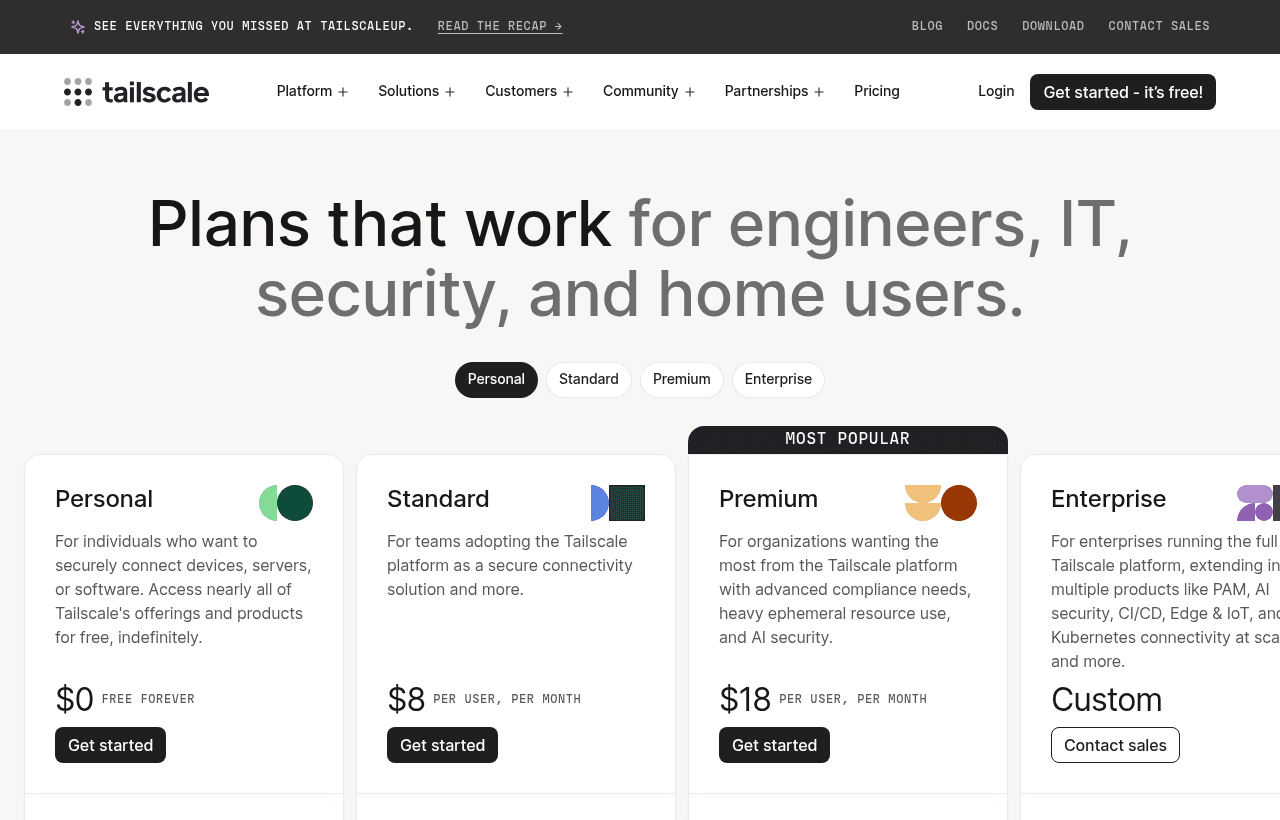
A look at Tailscale before the discount, so you can see what the deal saves you.
Security Without Exposing Anything to the Internet
The security model behind Tailscale matters as much as its convenience. The traffic between machines on the network is encrypted, and, crucially, services on the network do not have to be exposed to the public internet to be reachable by the team. This closes off one of the most common and dangerous mistakes a startup makes: putting an internal service on the open internet protected only by a password because that was the easy way to reach it.
Every service exposed to the public internet is a target. Attackers constantly scan for open databases, admin panels, and misconfigured services, and a young company that exposes an internal tool to save setup time is rolling the dice. Tailscale eliminates the need to take that risk. Because the team's machines can reach internal services over the private network, those services can stay closed to the public entirely. They exist only on the private network, invisible to the scanning and probing that hits everything with a public address.
For a startup, this is a meaningful reduction in attack surface achieved almost for free. Reducing what is exposed to the internet is one of the highest-leverage security improvements a small team can make, and Tailscale makes it the natural way to work rather than an extra project. The team reaches its internal systems easily and securely, and those systems are never open to the world. That combination, easy access and no public exposure, is hard to get any other way without significant effort.
Working From Anywhere as if on One Network
Startups are frequently distributed. Team members work from home, from different cities, sometimes from different countries, and traditional networking assumes everyone is behind the same office network, which is increasingly untrue. Tailscale is built for this reality. Because it creates a secure network across devices wherever they are, a distributed team operates as if all its machines are on one local network regardless of physical location.
This is a large practical benefit for how a modern startup actually works. A developer at home can reach the staging server, the shared database, and a teammate's dev environment securely, exactly as if everyone were in one office. The network follows the people rather than being tied to a place. For a remote or hybrid team, that means the location of any given person stops mattering for access, which removes a whole category of friction that office-centric networking imposes.
It also means the team can be flexible about where and how it works without weakening its security posture. Whether someone is at home, traveling, or in a shared workspace, their machine connects to the private network securely, and they have the same safe access to internal systems they would have anywhere. Security and flexibility usually pull against each other, and one of Tailscale's quiet achievements is letting a startup have both. The team can work from anywhere and still keep everything internal properly protected.
Access Control as the Team Grows
A private network for a startup is not a static thing. People join, people leave, and the set of who should reach what changes over time. Tailscale gives the team control over who and what is on the network, so access can be managed as the company grows rather than being an all-or-nothing arrangement that becomes a liability.
For a small team, this control is part of good hygiene. When a new engineer joins, they get added to the network and gain the access they need. When someone leaves, their access is removed, which is exactly the kind of offboarding step that is easy to forget and dangerous to skip when systems are exposed with shared passwords. Managing access centrally through the network means the team has a clear, controllable picture of who can reach the infrastructure, which matters more and more as headcount climbs.
This also sets the startup up for the security expectations it will face later. As the company grows and starts selling to larger customers or facing security reviews, being able to demonstrate controlled, managed access to internal systems is valuable. A startup that built its networking on Tailscale from early on has that control in place rather than scrambling to add it under pressure. Good access control is far easier to maintain from the start than to retrofit onto a sprawl of ad hoc connections.
Tailscale Compared to a Traditional VPN
The alternative to Tailscale is a traditional VPN, or worse, no VPN at all and services exposed directly to the internet. A traditional VPN can be secure, but it comes with the heavy setup and maintenance that make it a poor fit for a startup. Standing up and running a VPN server, forwarding ports, configuring firewalls, and keeping it all working as the network changes is real ongoing work that requires networking expertise a small team usually lacks.
The result is that traditional VPNs often fail startups in practice. Either the team does not set one up because it is too much effort, or they set one up and it becomes a fragile piece of infrastructure that breaks and that nobody wants to touch. In the gap, the team falls back on exposing services to the internet with passwords, which is the insecure default Tailscale is designed to eliminate. So the real-world comparison is often Tailscale versus insecure shortcuts, not Tailscale versus a well-run traditional VPN.
Tailscale's advantage is that it delivers the security of a private network with almost none of the setup and maintenance cost. It works across scattered infrastructure and distributed people, it does not require exposing anything to the internet, and it does not need a networking specialist to keep running. For a startup, that combination is what finally makes secure networking achievable rather than aspirational. The team gets the outcome a traditional VPN promises, without the burden that usually prevents a small team from realizing it.
Making the Year of Personal Pro Count
A full year free is enough time to make Tailscale the actual backbone of the team's networking rather than a tool the team tried once. The way to make the offer count is to move real infrastructure onto it and build the team's access patterns around it, so that by the end of the year secure networking is simply how the startup operates.
Start by getting every team member's machine onto the network and connecting the real servers, cloud instances, and internal services the team uses. Then close the doors that no longer need to be open: take internal services off the public internet now that the team can reach them privately, which is where much of the security benefit is realized. Set up who has access to what, and establish the habit of adding new people to the network when they join and removing them when they leave.
Use the year to let the team feel what it is like to reach everything internal securely from anywhere, so the convenience and the security both become normal. Connect the databases, the staging environments, the admin tools, and any other internal system that was previously either exposed or awkward to reach. By the time the year is up, the startup should have its whole team and infrastructure on a secure private network, its internal services closed to the public, and its access under control. That is a networking foundation the team can keep building on rather than a trial it walks away from.
Who Should Claim This Deal
Tailscale fits the team the requirement names: a startup that needs secure networking. In practice that is almost any technical startup, because as soon as a team has servers, cloud instances, internal tools, and people working from more than one place, it needs a secure way to connect them, and it needs one that does not require a networking specialist to run.
It is especially valuable for distributed and remote teams, where people work from many locations and office-centric networking does not apply. It suits any startup that has internal services, databases, staging environments, or admin tools that should not be exposed to the public internet but still need to be reachable by the team. And it fits small teams without dedicated networking expertise, because its near-zero configuration means they can have proper secure networking without hiring for it.
Since this deal gives a full year of Personal Pro free, a startup has ample time to adopt Tailscale properly, move its real infrastructure onto it, close its internal services off from the public internet, and build its access management around it. Claim it, connect the team and the servers, take internal systems off the open internet, and let secure, easy networking become the normal way the startup works. What the team gets is the security a traditional VPN promises without the burden that usually keeps a small team from ever getting there.
Who Is This Deal For?
Early-Stage Startups
Seed and pre-seed companies looking to move fast without overspending on tools.
Growing SaaS Teams
Series A+ companies scaling their stack and optimizing software costs.
Solo Founders
Indie hackers and bootstrapped founders who need enterprise tools at startup prices.
Get 1 year free Personal Pro off Tailscale
Premium deal. Upgrade once, unlock everything.
!Eligibility Requirements
Startup team needing secure networking
Frequently Asked Questions
Everything you need to know about this startup deal.
Yes, free for 3 users and 100 devices.
Get the weekly deals digest
New verified startup deals every week. No spam, ever. Unsubscribe anytime.
Related Offers

Toggl Track
Used by 1,100 members
Free Plan
Simple and intuitive time tracking for teams with reporting and integrations.
View offer
Auth0
Used by 994 members
1 year of B2B Professional free
Get 1 year of the Auth0 B2B Professional plan free, with up to 100,000 monthly active users, SSO, enterprise MFA and SCIM.
View offer
Bugsnag
Used by 471 members
Free Plan
Error monitoring and stability management for web and mobile applications.
View offer
Turborepo
Used by 1,880 members
Free & Open Source
High-performance build system for JavaScript and TypeScript monorepos by Vercel.
View offer
Windmill
Used by 1,501 members
Free Plan
Open-source developer platform for building internal tools, workflows, and scripts.
View offer
Height
Used by 1,442 members
Free Plan
AI-powered project management tool with autonomous task management and workflows.
View offerDeal Summary
Looking for more startup deals?
Browse all offers