
Uptime Robot Coupon: Free 50 Monitors
Website monitoring service with 5-minute checks and instant alerts.
Premium: $79/year for unlimited deals
Already have an account? Log in
Deal Highlights
What Uptime Robot Gives a Startup
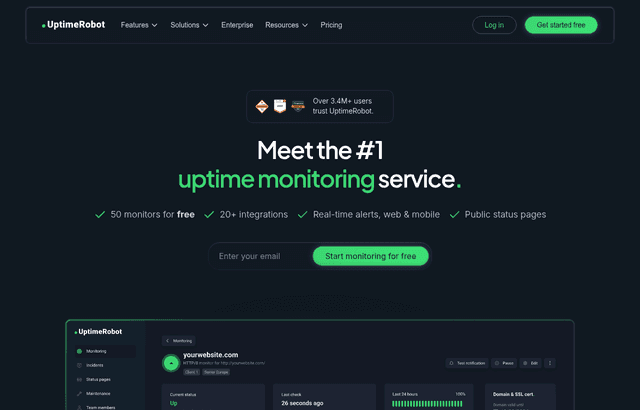
Uptime Robot is a website monitoring service that checks a site every few minutes and sends instant alerts when something goes down. The offer is generous and concrete: free monitoring for 50 monitors. That means a startup can watch its website, its API, and dozens of other endpoints, all without paying anything. For an early company, that is enough coverage to keep an eye on essentially every important part of its infrastructure from day one.
The value here is simple to state and easy to underrate. When a startup's site goes down, the worst outcome is not the outage itself but finding out about it from a customer. A user emails to say the site is broken, or worse, a prospect hits an error during a demo and quietly walks away. Every minute the team is unaware of a problem is a minute of lost trust and lost revenue. Uptime Robot closes that gap by watching continuously and telling the team the moment something breaks, so the company learns about problems before its customers do.
Fifty monitors on a free plan is a lot for an early team. A startup can monitor the main website, the API, the login flow, the checkout, the marketing site, the status of critical third-party dependencies, and still have room to spare. That breadth means monitoring does not have to be rationed to only the most obvious endpoint. The team can watch everything that matters, which is exactly the posture a company wants when its reputation rides on being available.
Knowing About Downtime Before Customers Do
The core job of Uptime Robot is to check whether a site is up on a frequent schedule and to alert the team instantly when it is not. Those checks run around the clock, at night, on weekends, during holidays, precisely when nobody on a small team is watching. That is the whole point. A startup does not have a night shift staring at dashboards. An automated monitor is the thing that never sleeps, so a 3 a.m. outage gets caught and escalated instead of festering until the first customer wakes up and complains.
The frequency of the checks matters because it bounds how long an outage can go unnoticed. With checks every few minutes, the team learns about a problem within minutes of it starting, not hours later. That tight loop is the difference between a brief, barely-noticed blip and a prolonged outage that damages the company's reputation. The faster the team knows, the faster it can respond, and response time is most of what customers actually experience during an incident.
Instant alerts turn detection into action. When a monitor goes down, Uptime Robot notifies the team right away through its alert channels, so the right person can start investigating immediately. For a startup, that immediacy is what makes monitoring worth having. Detection without notification is just a log nobody reads. The alert is what pulls a human into the loop at the moment it matters, turning a silent failure into a problem someone is actively fixing.
Coverage Across Everything That Matters
With 50 monitors available for free, a startup can build genuinely comprehensive coverage rather than watching a single endpoint and hoping the rest is fine. Modern products are made of many parts, and any of them can fail independently. The marketing site can be up while the app is down. The API can be responding while the login flow is broken. Checkout can fail while everything else looks healthy. Monitoring only the homepage gives a false sense of safety, because the homepage being up says nothing about whether customers can actually use the product.
Broad coverage lets the team monitor each critical path separately, so it knows not just that something is wrong but which part is wrong. A monitor on the API, a monitor on the login endpoint, a monitor on checkout, each one narrows down where a failure is the moment it happens. That specificity speeds up diagnosis, because the alert itself points at the affected component. Instead of getting a vague signal that the site is down and then hunting for the cause, the team gets told which piece failed.
A startup can also monitor its dependence on third-party services. Modern products lean on external APIs for payments, email, authentication, and more, and when one of those degrades it can take the product down with it. Watching those integration points means the team can quickly tell whether a problem is its own or a vendor's, which changes how it responds and what it tells customers. That clarity during an incident is worth a great deal, and the free monitor count leaves plenty of room to cover these external dependencies alongside the internal ones.
Building Trust Through Visible Reliability
Monitoring does more than catch outages; it builds a record of reliability that a startup can use to earn trust. Uptime Robot tracks uptime over time, producing the kind of history that lets a team know its real availability rather than guessing. That data is useful internally, for spotting a service that fails more often than anyone realized, and externally, for demonstrating to customers and prospects that the product is dependable.
Many monitoring setups can feed a public status page, giving customers a place to check whether an issue is on the company's side. That transparency is surprisingly powerful for trust. When something does go wrong, a status page that openly shows the incident and its resolution reassures customers more than silence ever could. It signals a team that takes reliability seriously and communicates honestly, which is exactly the impression an early company wants to make on customers who are deciding whether to depend on it.
The uptime history also holds vendors and the team itself accountable. If a startup promises reliability to its customers, having the data to back that promise turns a claim into a fact. And if an internal component is quietly unreliable, the record surfaces it so the team can fix the underlying problem rather than repeatedly firefighting the symptoms. Reliability that is measured is reliability that can be improved, and measurement is exactly what Uptime Robot provides.
Uptime Robot Compared to Rolling Your Own
A startup could build its own monitoring with a script that pings the site and sends an alert, and plenty of teams start there. The trouble is that a naive homemade monitor has a fatal flaw: it usually runs on the same infrastructure it is watching. If the server goes down, the monitor goes down with it, and no alert ever fires. Effective monitoring has to run from outside, independently of the thing it checks, which is precisely how an external service like Uptime Robot works.
Building a robust, external, always-on monitoring system is more work than it first appears. It needs to run reliably from somewhere separate, check on a tight schedule, avoid false alarms, and deliver alerts through channels the team will actually notice. That is a real project, and it is not one that differentiates a startup's product. Uptime Robot provides all of it as a service, and the free plan covers enough monitors that most early teams never need to build anything themselves. The time saved is time returned to the product.
The comparison is not really close for an early team. Rolling your own monitoring spends engineering effort on undifferentiated plumbing and tends to produce something less reliable than a dedicated service. Adopting Uptime Robot gives external, independent monitoring across many endpoints for free, with none of the maintenance. Unless a startup has genuinely unusual monitoring requirements, using the service is the obvious choice, and the free tier removes even the cost objection.
Making the Free 50 Monitors Count
Fifty free monitors is an invitation to be thorough, so map out every critical path before setting anything up. List the endpoints whose failure would hurt: the main site, the API, authentication, checkout or the core action of the product, the marketing site, and the key third-party services the product depends on. Each of those deserves its own monitor, because each can fail on its own. With 50 available, there is no reason to skimp, and comprehensive coverage is where the value lives.
Set up the alert channels with as much care as the monitors themselves, because a monitor that fires into a channel nobody watches is useless. Route alerts to where the team will actually see them, and make sure the right person is reachable when something breaks off-hours. Then test the setup by deliberately checking that an alert reaches someone, so the team is not discovering during a real outage that the notification path was broken. A monitoring system is only as good as the alert that gets a human's attention.
Use the uptime history the service accumulates. Review it periodically to find components that fail more than expected, and use the data to decide where reliability work is worth investing. If the product makes reliability promises to customers, consider putting up a public status page backed by the monitoring, turning the internal data into external trust. The monitors are the start; the discipline of acting on what they reveal is what turns monitoring into genuinely better reliability over time.
How Monitoring Scales With the Company
A startup's monitoring needs grow as its product grows more complex, and the free monitor count leaves ample room for that growth. Early on, a handful of monitors might cover everything. As the product gains services, APIs, and integrations, the number of things worth watching climbs, and with 50 monitors available the team can keep pace without hitting a wall. Comprehensive monitoring stays affordable, which is exactly what a growing company needs as its surface area expands.
The practice of monitoring also matures with the company. Early monitoring is about catching outages. Later it becomes part of a broader reliability discipline: tracking trends, setting expectations with customers, and feeding incident response. Starting with solid monitoring early means the team builds these habits from the beginning rather than bolting them on after a painful outage teaches the lesson. A company that has watched its uptime from day one has both the data and the reflexes that reliability at scale requires.
As the team grows, clear monitoring and alerting become shared infrastructure that supports on-call rotations and incident processes. When alerts route to the right people and the uptime history is visible, a larger team can respond to problems in an organized way rather than depending on one person happening to notice. Monitoring that was set up thoughtfully early scales into the backbone of how a growing company keeps its product reliable. The foundation laid with the free plan keeps paying off as the operation matures.
Who Should Claim This Deal
Uptime Robot is the right pick for essentially any startup with a website, an API, or a product that customers expect to be available. If the team cannot afford to learn about outages from angry customers, and no early company can, then external monitoring with instant alerts is not optional, it is basic hygiene. The free plan's 50 monitors make that hygiene available to even the leanest team at no cost, covering far more than an early startup typically needs.
There is almost no startup for which this does not apply, and almost no reason not to set it up. The service is free at the scale most early companies operate, it takes little time to configure, and it protects the reputation and revenue that depend on the product being up. A team with genuinely exotic monitoring needs might eventually layer on more specialized tooling, but as a baseline every startup should have external uptime monitoring, and this deal provides it generously.
For a founder who has not yet set up monitoring and is quietly relying on luck and customer emails to learn about outages, this is the moment to fix that. List the critical endpoints, set up a monitor for each, wire the alerts to where the team will see them, and test it. Claiming the free 50 monitors buys a startup the peace of mind of knowing it will hear about problems first, which is one of the cheapest and most valuable protections an early company can put in place.
Who Is This Deal For?
Early-Stage Startups
Seed and pre-seed companies looking to move fast without overspending on tools.
Growing SaaS Teams
Series A+ companies scaling their stack and optimizing software costs.
Solo Founders
Indie hackers and bootstrapped founders who need enterprise tools at startup prices.
Get Free 50 Monitors off Uptime Robot
Premium deal. Upgrade once, unlock everything.
How to get the Uptime Robot deal
- The offer: Free 50 Monitors.
- Create a free SaaSOffers account, then upgrade to Premium ($79 a year, or $250 once for lifetime access). Premium unlocks every Premium deal on the site.
- Open the Uptime Robot claim page from this deal. It shows the partner link, any promo code and the exact steps Uptime Robot asks for.
- Apply or sign up through that link before you pay Uptime Robot directly, since most startup offers only apply to new accounts.
Frequently Asked Questions
Everything you need to know about this startup deal.
Get the weekly deals digest
New verified startup deals every week. No spam, ever. Unsubscribe anytime.
Related Offers

Replicate
Used by 1,772 members
$500 in credits
Run open-source ML models in the cloud, deploy Llama, Stable Diffusion, and custom models via API without GPU management.
View offer
ZoomInfo
Used by 2,014 members
Free Trial
B2B data platform for sales and marketing intelligence with contact databases.
View offer
Chore
15% off your first month
Chore runs your startup's back office for you: payroll, HR, bookkeeping, compliance and equity, inside the tools you already use. 15% off your first month through SaaSOffers.
View offerDeal Summary
Looking for more startup deals?
Browse all offers