
Anthropic Startup Credits: $2,000 in API credits
Access Claude API credits to build AI applications with the most capable and safe large language model for enterprise use cases.
Free · Opens in new tab
Already have an account? Log in
Deal Highlights
What Anthropic Gives a Startup
Anthropic provides access to the Claude API, a large language model built for capability and safety in real products. Through this deal a startup gets $2,000 in API credits, which is meaningful runway to build, test, and ship AI features without the model bill becoming a blocker while the product is still early. Claude is designed to handle the kinds of work startups increasingly want to automate or augment: understanding and generating natural language, reasoning over documents, writing and analyzing code, powering assistants, and driving agentic workflows that take multiple steps toward a goal.
For a startup, the appeal of building on Claude is that it turns capabilities that used to require a research team into an API call. Summarizing long documents, extracting structure from messy text, answering questions over a company's own data, drafting and revising content, classifying support tickets, and building conversational interfaces all become achievable with a small team. The $2,000 in credits exists to remove the cost barrier during exactly the phase when a startup is figuring out whether and how AI fits its product. A team can prototype freely, measure quality against real inputs, and decide what to ship before spending its own money.
Anthropic, one of the tools included in this startup deal.
A Model Built for Capability and Safety
Claude is positioned as a capable and safe model for enterprise use cases, and both halves of that matter to a startup. Capability means the model can handle genuinely hard tasks: following complex instructions, reasoning through multi-step problems, maintaining coherence over long contexts, and producing output that holds up under scrutiny. A startup building a real product needs a model that does not fall apart on the messy, specific inputs that real users generate, and Claude's capability is what makes it viable as the engine behind a serious feature rather than a toy demo.
Safety matters just as much, especially for a startup that hopes to sell to businesses. A model that behaves predictably, resists producing harmful or off-brand output, and can be steered reliably is far easier to put in front of customers. When a startup's product speaks to users in the company's voice, the model's behavior is the product's behavior, and unpredictable output is a real liability. Anthropic's focus on building models that are steerable and well-behaved reduces that risk. For a team selling to enterprises that scrutinize AI vendors carefully, being built on a model designed with safety as a priority is a point in the startup's favor during procurement conversations.
Understanding and Generating Language at Product Quality
The foundational capability Claude offers is fluent understanding and generation of natural language. It can read text and grasp its meaning, and it can produce text that is coherent, appropriate, and tailored to a purpose. This sounds basic, but it is the ability that underpins most AI features a startup would build. A support assistant needs to understand what a customer is asking and respond helpfully. A content tool needs to generate drafts that a human would actually use. A data pipeline needs to extract meaning from unstructured text that no rigid parser could handle.
For a startup, having this capability available through an API collapses what used to be an enormous amount of work into something a small team can ship. Features that would have required custom natural language processing, extensive training data, and specialized expertise now start with a well-crafted prompt. This lowers the barrier to building AI-powered products dramatically, which is why so many startups now build on foundation models rather than training their own. The $2,000 in credits lets a team explore what the model can do for their specific problem, iterate on prompts, and find the quality bar their product needs before committing budget.
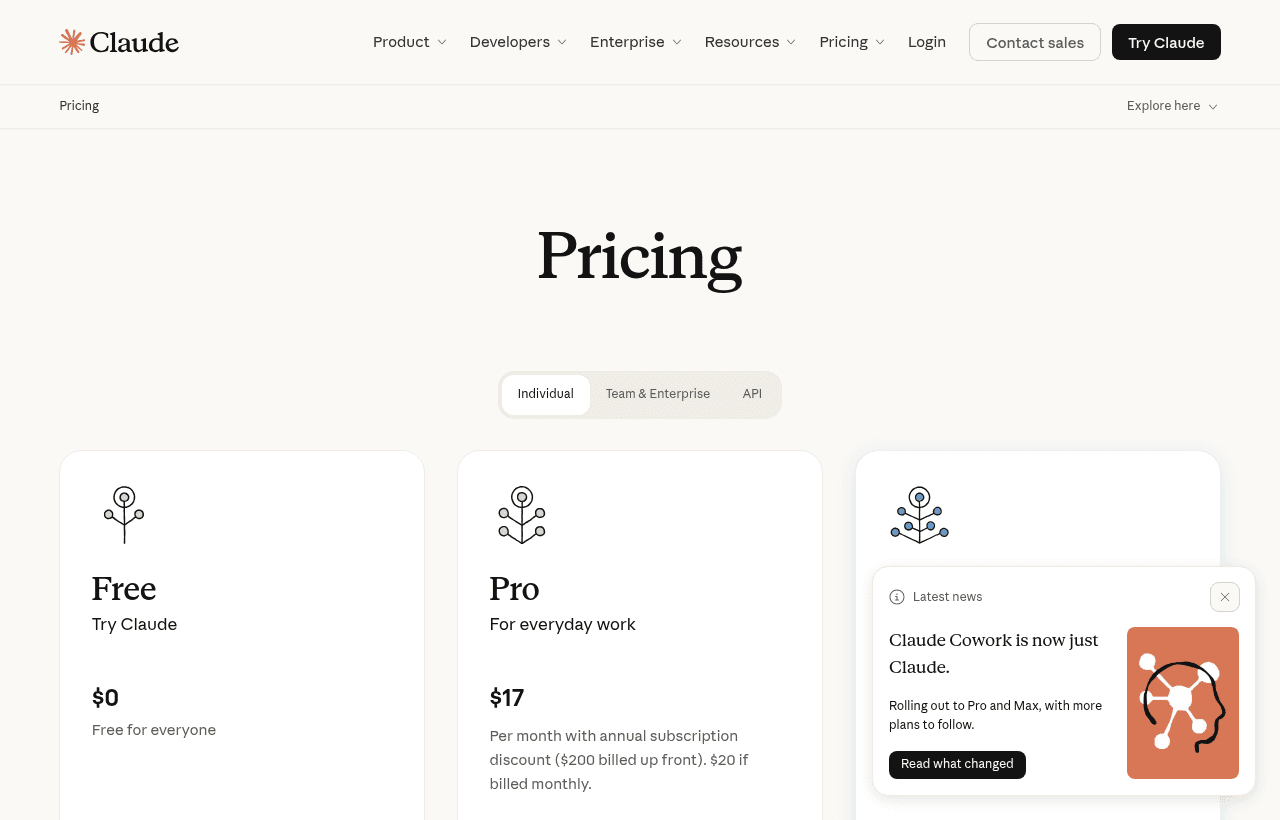
A look at Anthropic before the discount, so you can see what the deal saves you.
Reasoning, Long Context, and Working Over Documents
Claude is strong at reasoning and at handling large amounts of context at once. It can work through problems that require multiple logical steps, and it can take in long documents or large bodies of text and reason across all of it. For a startup, this unlocks a class of features that shorter-context or weaker-reasoning models struggle with.
Consider a product that answers questions over a company's internal documents, a tool that analyzes lengthy contracts, or an assistant that reasons about a complex user situation before responding. These depend on the model holding a lot of information in context and reasoning over it coherently rather than losing the thread. Claude's ability to work with long context means a startup can feed it substantial source material, whether a knowledge base, a set of documents, or an extended conversation, and get responses grounded in all of it. This is the foundation for retrieval-augmented applications and document intelligence features that many startups build their products around. The strength of the reasoning is what keeps those features accurate on inputs that are long and complicated rather than short and simple.
Code Generation and Developer-Facing Features
Claude is capable at working with code: writing it, explaining it, reviewing it, and transforming it. For a startup whose product touches software, this opens up a range of features. A developer tool can use Claude to generate code from natural language, explain unfamiliar code to a user, suggest fixes, or help migrate between frameworks. Even for products that are not developer tools, the coding capability is useful internally, letting a small engineering team move faster by drafting and reviewing code with the model's help.
This capability also matters for the growing category of agentic products, where the model does not just answer questions but takes actions: calling tools, executing steps, and working toward a goal over multiple turns. Claude's ability to reason and to work with structured tool use makes it a strong engine for these agentic workflows. A startup building an agent that automates a business process, orchestrates tasks across systems, or acts on a user's behalf can build that agent on Claude. The credits give the team room to experiment with these more complex, multi-step patterns, which take iteration to get right and where the ability to test freely without watching a meter is genuinely valuable.
Building Assistants and Conversational Products
A large share of AI products are conversational: assistants, chatbots, copilots, and interfaces where a user talks to the product in natural language and it responds helpfully. Claude is well suited to this because it maintains coherence over a conversation, follows instructions about how to behave, and can be given a persona and a set of guidelines that shape every response.
For a startup, this means building a conversational product is largely a matter of designing the right instructions and connecting the model to the right data and tools, rather than building conversational intelligence from scratch. A company can create an assistant that knows its domain, speaks in its voice, stays within defined boundaries, and helps users accomplish real tasks. The steerability of the model is what makes this practical, because a product-quality assistant needs to behave consistently and stay on-brand across thousands of conversations. The $2,000 in credits lets a startup build and refine that assistant, test it against real user interactions, and tune its behavior before it goes in front of customers at scale.
Anthropic Compared to Other AI Options
The main alternatives to building on Claude are building on another foundation model provider, running an open-source model a team hosts itself, or trying to train a model in-house. Each has a place, and the right choice depends on the startup.
Training a model in-house is out of reach for almost every startup. It requires enormous data, compute, and specialized talent, and the result rarely matches what a leading foundation model already offers out of the box. For the vast majority of teams, building on an API is the correct call, because it converts an impossible research project into an integration.
Hosting an open-source model gives a team control and can lower per-request cost at scale, but it shifts the burden of infrastructure, scaling, and quality onto the startup, and open models often trail the leading commercial models on the hardest tasks. For a small team, that operational load is usually not worth it early on, when the priority is shipping and learning rather than optimizing infrastructure.
Among commercial API providers, Anthropic's distinguishing emphasis is on models that are both highly capable and designed with safety and steerability as priorities, aimed squarely at enterprise use cases. For a startup that wants a reliable, well-behaved model it can confidently put in front of business customers, that positioning is a strong fit. The $2,000 in credits lowers the cost of trying Claude for a specific product, and because switching between providers is usually a matter of changing an integration rather than rebuilding a product, a team can evaluate Claude on its merits with real credits behind the test rather than deciding on reputation alone.
Making the $2,000 in API Credits Count
The credits are most valuable when a team uses them to answer the questions that actually gate a launch. The first is quality: does Claude handle the startup's specific inputs at the standard the product needs? The way to find out is to test the model against real, representative data from the product rather than clean examples, because real inputs are messier and more revealing. Using the credits to run these tests early tells the team whether the AI feature is viable before they build a product around it.
The second question is cost at scale. By building the real feature and running realistic volume through it during the credit period, a startup learns how many tokens its use case actually consumes and can forecast what the feature will cost once the credits run out. Knowing that number before committing is far better than being surprised by the bill later, and it lets the team design prompts and workflows that are efficient rather than wasteful from the start.
The third use is iteration on prompts and patterns. Getting good results from a model is a craft that takes experimentation: refining instructions, structuring inputs, deciding when to use tools, and shaping how the model reasons through a task. The credits give a team room to iterate without the cost of each experiment discouraging exploration. A startup that spends the credits learning how to get the most out of Claude comes away with prompt and architecture patterns that make the eventual paid usage more efficient and the product better. It is worth pointing the credits at the parts of the product where AI adds the most differentiated value, rather than spreading them thin across features that a simpler approach could handle, so the team learns the most about what makes its product distinctive.
Who Should Claim This Deal
This deal fits any startup building products that use the Claude API, which is exactly its stated requirement. If a team is adding AI features, whether that is a conversational assistant, document intelligence, content generation, classification, an agentic workflow, or code-related capabilities, these credits directly reduce the cost of building and validating those features.
It is an especially strong fit for startups that intend to sell to businesses and want to build on a model designed for capability and safety. The enterprise focus of Claude aligns with the needs of a startup whose customers will scrutinize how the product handles AI, and being built on a model with a strong safety posture is an asset in those conversations. Teams building serious, production AI features rather than throwaway experiments will get the most from the $2,000 in credits.
It is a lighter fit for a team with no AI ambitions at all, where the credits would go unused. But given how many products now incorporate language understanding, generation, or reasoning in some form, the set of startups that can benefit is large and growing. For any team building on Claude, claiming these credits is a straightforward way to fund the exploration and validation phase, learn what the model can do for their specific product, and reach a real launch decision with the model bill covered along the way.
Who Is This Deal For?
Early-Stage Startups
Seed and pre-seed companies looking to move fast without overspending on tools.
Growing SaaS Teams
Series A+ companies scaling their stack and optimizing software costs.
Solo Founders
Indie hackers and bootstrapped founders who need enterprise tools at startup prices.
Get $2,000 in API credits off Anthropic
Premium deal. Upgrade once, unlock everything.
!Eligibility Requirements
Startup building products using Claude API
Frequently Asked Questions
Everything you need to know about this startup deal.
Claude is Anthropic's AI model, ChatGPT is OpenAI's consumer product. Both use large language models but differ in training methodology (Constitutional AI vs RLHF), context window (Claude: 200K tokens vs GPT-4o: 128K), and design philosophy (Claude prioritizes safety and accuracy). For developers, the relevant comparison is Claude API vs OpenAI API — both provide programmatic access to their respective models.
Get the weekly deals digest
New verified startup deals every week. No spam, ever. Unsubscribe anytime.
Related Offers

Higgsfield
55% off annual Business plan
55% off an annual Higgsfield Business plan. Higgsfield is an AI video and image studio with Seedance, Kling, Veo and more in one account.
View offer
Seedance
55% off annual Business plan
55% off an annual Higgsfield Business plan with Seedance included. Seedance is ByteDance's AI video model for text, image and reference-driven clips.
View offerChromaDB
Used by 306 members
Free & Open Source
Open-source embedding database for building AI applications with semantic search.
View offer
Laxis
Used by 2,176 members
Free Plan
AI meeting assistant that records, transcribes, and generates actionable meeting notes.
View offer
Pictory
Used by 659 members
Free Trial
AI-powered video creation tool, turn text, scripts, and blogs into videos.
View offer
Segment
Used by 2,293 members
$25,000 in credits
Collect, clean, and route customer data to every tool in your stack with the leading customer data platform.
View offerDeal Summary
Looking for more startup deals?
Browse all offers