
Cohere Startup Credits: $2,000 in API credits
Enterprise AI models for text generation, embedding, classification, and reranking, alternative to OpenAI for NLP.
Free · Opens in new tab
Already have an account? Log in
Deal Highlights
Most AI attention goes to the chatbots, but a large share of real business value comes from the less glamorous work of search, classification, and retrieval, and that is exactly where Cohere focuses. It builds enterprise language models with particular strength in embeddings and reranking, the technology that powers semantic search and retrieval-augmented generation, alongside generation and classification. For a startup building AI features where finding the right information matters as much as generating text, Cohere is a serious and sometimes overlooked option.
Whether Cohere fits over the better-known providers is the question, and this covers what it offers, how it prices, and where its particular strengths pay off.
What Is Cohere?
Cohere is an AI company building large language models aimed squarely at enterprise use rather than consumer chat. Its product line reflects that focus.
Command is its family of generative models, for text generation, summarization, and the conversational and tool-using tasks the generative models from other labs also handle.
Embed is its embedding model, which turns text into numerical vectors that capture meaning. Embeddings are the foundation of semantic search, where you find results by meaning rather than keyword match, and of retrieval-augmented generation, where a model answers using retrieved context. Cohere's embeddings are well regarded and support many languages.
Rerank is a more specialized and distinctive product. Given a query and a set of candidate documents, it reorders them by genuine relevance, dramatically improving the quality of search and retrieval results. Rerank is one of Cohere's clearest differentiators, because it directly addresses the weakest link in most retrieval systems: getting the most relevant results to the top.
Together, Embed and Rerank make Cohere particularly strong for building search and RAG systems, which is a different emphasis from providers oriented mainly around their flagship chat model.

Cohere, one of the tools included in this startup deal.
What's Included in This Deal
- API credits across Cohere's models
- Command generative models for text and conversation
- Embed for semantic search and RAG
- Rerank for improving retrieval relevance
- Multilingual support across the model family
- Fine-tuning to adapt models to your domain
The credits let you build and evaluate a real retrieval or generation feature before committing spend, which is the right test, because Cohere's value is specific to your use case, and its retrieval strengths in particular are best judged on your own data.
Cohere Pricing
Cohere prices per token for generation and per unit of text processed for embeddings and reranking, in line with the rest of the industry, with the specialized products priced for their purpose.
| Product | Billing | For |
|---|---|---|
| Command (generation) | per token, input and output | Text generation and conversation |
| Embed | per unit of text embedded | Semantic search and RAG |
| Rerank | per search query reranked | Improving retrieval relevance |
Confirm current rates on Cohere's pricing page, since model prices move constantly. The structural point is that Cohere's generation pricing is competitive with the other providers, and its embedding and reranking are priced as the specialized tools they are. For a retrieval-heavy application, the cost that matters is not just generation but the embedding and reranking volume, so model that based on your document count and query rate rather than assuming generation dominates the bill.
As with any model provider, the disciplines that control cost apply: match the model to the task, cap output length, and reserve the most capable and expensive models for the work that needs them. Cohere's competitive generation pricing plus its retrieval strengths can make it economical for exactly the search-and-RAG workloads it targets.
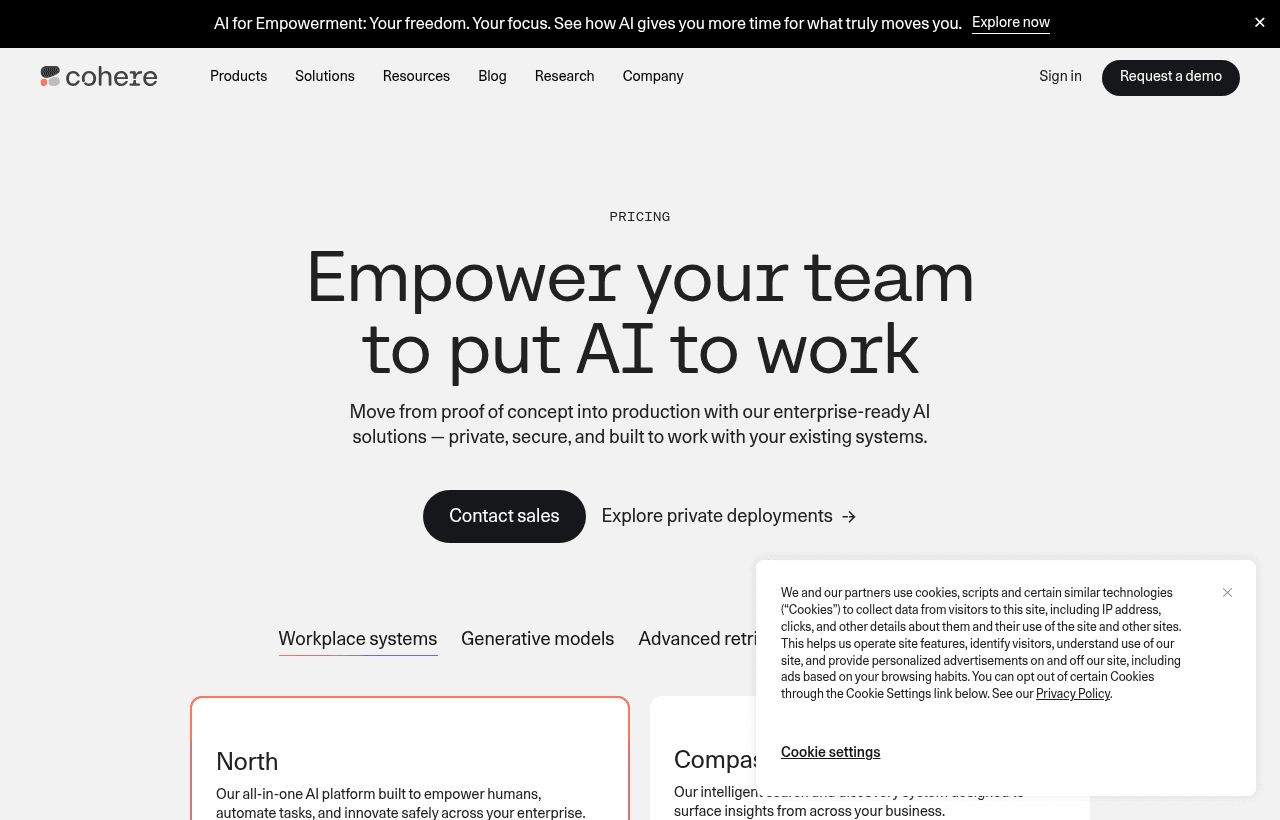
A look at Cohere before the discount, so you can see what the deal saves you.
Where Cohere's Strengths Actually Pay Off
Being specific about this is the most useful thing here, because Cohere's case is strongest for particular problems rather than as a general default.
Semantic search. If your product needs to find information by meaning, a help center that answers questions, a search that understands intent rather than keywords, a knowledge base, Embed and Rerank are exactly the tools for it, and Rerank in particular lifts result quality in a way that is hard to match by tuning a keyword search.
Retrieval-augmented generation. RAG systems answer questions using retrieved context, and their quality depends almost entirely on retrieving the right context. A generation model given poor retrieved documents produces poor answers regardless of how good the model is. Cohere's embedding and reranking directly improve the retrieval half, which is where most RAG systems actually fail.
Classification at scale. Categorizing support tickets, moderating content, routing messages, tagging documents, these high-volume classification tasks suit Cohere's models well and rarely need the most expensive frontier reasoning.
Multilingual applications. Cohere's models support many languages, which matters for products serving international users where English-only models fall short.
Where Cohere is less obviously the choice is the pure frontier-reasoning and consumer-chat territory the largest US labs dominate on the hardest benchmarks. If your product needs the absolute top of complex reasoning, evaluate against those. If your product is fundamentally about search, retrieval, and understanding at scale, Cohere is often the better-targeted and more economical fit.
Retrieval Is the Hard Part of RAG
Since Cohere's differentiation is retrieval, it is worth explaining why retrieval, not generation, is where most AI-search products actually break, because it reframes the buying decision.
The intuition is that the generation model is what determines answer quality, so teams reach for the most powerful one. But in a retrieval system, the model can only work with the documents it is given. Retrieve the wrong context and even the best model produces a confident wrong answer, because it is answering from bad source material. The bottleneck is getting the genuinely relevant documents in front of the model, and that is an embedding-and-ranking problem, not a generation problem.
This is why Rerank matters disproportionately. A common architecture retrieves a broad set of candidate documents cheaply, then uses reranking to precisely order them so the most relevant rise to the top before the generation step sees them. That two-stage approach, cheap broad retrieval followed by precise reranking, consistently outperforms relying on the initial retrieval alone, and it is exactly what Cohere's products are built to do.
The practical lesson for anyone building AI search or RAG: invest in retrieval quality before reaching for a more powerful generation model. A better retriever with a modest generator usually beats a weak retriever with a frontier one, at lower cost. Cohere's strength is precisely the half of the system teams tend to underinvest in.
Deployment and Data: The Enterprise Angle
One reason Cohere appears in enterprise deals more than consumer projects is its flexibility about where the models run and how data is handled, and that matters for startups selling into certain markets.
The default for most AI providers is a hosted API: your data is sent to their servers for processing. For many startups that is fine. For companies with strict data-residency or privacy requirements, or those selling to customers who impose them, it can be a blocker. Cohere has emphasized deployment options that address this, including arrangements that let the models run in environments the customer controls, which is relevant when data cannot leave a particular boundary.
The practical consequence for a startup is twofold. If you are building for a regulated industry or for enterprise customers who will scrutinize where their data goes, a provider with flexible deployment and clear data-handling commitments removes a recurring objection in security reviews. And if data control is central to your own product, having a provider that can accommodate stricter arrangements is a strategic advantage over one that offers only a public API.
This is not the deciding factor for every project, and for a simple consumer feature the hosted API is the obvious path. But it is part of why Cohere positions around enterprise use, and it is worth weighing if your customers care where their data is processed.
Building So You Are Not Locked In
The discipline that applies to any model provider applies here, and it is worth stating because Cohere's strengths make a mixed-provider setup particularly sensible.
Keep model calls behind a thin internal interface rather than scattering direct API calls through your code. This matters more than usual with Cohere, because its clearest advantage is retrieval, which means a common and effective architecture is to use Cohere for embeddings and reranking and possibly a different provider for frontier generation. That split only stays practical if switching or routing is a configuration change rather than a rewrite.
Log your queries, retrieved documents, and outputs from the start. For a retrieval system this is doubly valuable: it is the data you need to diagnose why a search returned poor results, whether the failure was in retrieval or generation, and the evidence for whether a change actually improved relevance. Teams building RAG without this instrumentation are debugging blind.
Treat your prompts and your retrieval configuration as versioned artifacts. A change to how you chunk documents, embed them, or rerank results shifts quality across every query, and you want to see what changed and roll it back. Retrieval quality is tuned incrementally, and that tuning is only safe if it is tracked.
Who Should Use Cohere?
Use it if you are building semantic search, RAG, or a knowledge system where retrieval quality is central, since Embed and Rerank are the strongest reasons to choose Cohere.
Use it if you run high-volume classification or multilingual applications, where Cohere's models are well suited and cost-effective for the task.
Use it if you want an enterprise-focused provider, where Cohere's emphasis on business use cases, deployment flexibility, and data handling suits companies with those requirements.
Look elsewhere, or evaluate carefully, if your product depends on the absolute frontier of complex reasoning or consumer-style chat, where the largest US labs currently lead on the hardest benchmarks and are worth comparing directly.
Real Startup Use Cases
A SaaS company built an in-product help system that answered user questions from its documentation, using Cohere's embeddings to find relevant articles and Rerank to order them precisely before generating an answer. The reranking step noticeably improved answer quality, because the generation model was consistently given the right source material.
A startup with a large document corpus built semantic search that let users find information by meaning rather than exact keywords, something a traditional keyword search could not do, using Cohere's embeddings as the foundation. The search understood intent, which was the whole value.
A team processing high volumes of text used Cohere's models to classify and route incoming messages automatically, a high-volume task that did not need frontier reasoning and where Cohere's models were both capable and economical.
How to Claim the Credits
- Follow the link on this page to Cohere and create an account.
- Apply the credits and confirm the balance.
- Identify which products your use case needs, generation, embedding, reranking, or a combination, since Cohere's strength is retrieval.
- If you are building search or RAG, prioritize evaluating Embed and Rerank on your own data, because that is where the differentiation shows.
- Adopt a two-stage retrieval pattern, broad retrieval then reranking, for search and RAG rather than relying on initial retrieval alone.
- Keep model calls behind an abstraction so you can route different tasks to the best-suited model and provider.
Tips to Get Value
- Invest in retrieval before generation. For search and RAG, a better retriever with a modest generator beats a weak retriever with a frontier one, at lower cost. This is where Cohere is strongest.
- Use Rerank as a second stage. Retrieve broadly and cheaply, then rerank to precisely order results before generation. It is Cohere's clearest advantage.
- Evaluate on your own data. Cohere's retrieval strengths are best judged on your actual documents and queries, not on benchmarks.
- Match the model to the task. Use the right size model for generation and reserve the most capable ones for genuinely hard work, as with any provider.
- Model embedding and reranking volume. For retrieval-heavy apps, these can matter as much as generation cost. Estimate based on document count and query rate.
- Abstract your providers. Keep model calls behind an interface so you can use Cohere for retrieval and another provider for frontier generation if that split serves you best.
Who Is This Deal For?
Early-Stage Startups
Seed and pre-seed companies looking to move fast without overspending on tools.
Growing SaaS Teams
Series A+ companies scaling their stack and optimizing software costs.
Solo Founders
Indie hackers and bootstrapped founders who need enterprise tools at startup prices.
Get $2,000 in API credits off Cohere
Premium deal. Upgrade once, unlock everything.
!Eligibility Requirements
AI startup building NLP features
Frequently Asked Questions
Everything you need to know about this startup deal.
Cohere excels at text understanding tasks — semantic search (Embed model), search result reranking (Rerank model), text classification, and retrieval-augmented generation (RAG). For startups building search, knowledge base, or document processing features, Cohere's models are purpose-built.
Get the weekly deals digest
New verified startup deals every week. No spam, ever. Unsubscribe anytime.
Related Offers

Higgsfield
55% off annual Business plan
55% off an annual Higgsfield Business plan. Higgsfield is an AI video and image studio with Seedance, Kling, Veo and more in one account.
View offer
Seedance
55% off annual Business plan
55% off an annual Higgsfield Business plan with Seedance included. Seedance is ByteDance's AI video model for text, image and reference-driven clips.
View offerChromaDB
Used by 306 members
Free & Open Source
Open-source embedding database for building AI applications with semantic search.
View offer
Laxis
Used by 2,176 members
Free Plan
AI meeting assistant that records, transcribes, and generates actionable meeting notes.
View offer
Pictory
Used by 659 members
Free Trial
AI-powered video creation tool, turn text, scripts, and blogs into videos.
View offer
Segment
Used by 2,293 members
$25,000 in credits
Collect, clean, and route customer data to every tool in your stack with the leading customer data platform.
View offerDeal Summary
Looking for more startup deals?
Browse all offers