At the start, the back office is one founder with a spreadsheet. Then the first hire joins, someone has to run payroll, the bank asks for KYC documents, a state sends a registration notice, and the cap table needs updating after the first option grant. None of this is the product, and all of it has deadlines.
This guide covers the HR and operations tools early-stage startups actually use, grouped by the job they do, with the startup deal for each one on SaaSOffers. It ends with a stack for each stage, so you can see what to set up now and what can wait.
How to choose your HR and operations stack
Three questions decide most of it:
- 1Where are your people? A team that is all in the US needs a US payroll tool. A team spread across countries needs an employer of record (EOR) or a global payroll platform.
- 2How many people? Under 5, keep it simple and cheap. From 10 to 50, you need a real HR system, benefits and someone who owns the process.
- 3Who does the work? Every tool below still needs a person to run it. If that person is you, add up the hours before you add another subscription.
That third question is the one founders skip. Software automates the steps. It does not own the deadline.
Run it for you: Chore
Chore is the option for founders who do not want to run the back office at all. It is not software. It is a team that runs HR, payroll, bookkeeping, compliance and equity admin inside the tools you already use, such as Gusto, Rippling, Carta and QuickBooks.
Each customer gets a Strategic Operations Partner who owns the outcome, specialists who do the work, and Ollie, Chore's AI ops assistant. The scope covers the jobs that usually fall to a founder: new hire and bonus payrolls, I-9s, state registrations, Delaware franchise tax, 1099s, the monthly close, cap table updates, option grants and 409A coordination.
- Pricing: Chore Finance from $249/month, Chore Human Resources from $1,300/month, Chief of Staff (the full back office) from $1,700/month. No retainers, no lock-in.
- Speed: Chore says it can be live in 48 hours.
- Deal: 15% off your first month when you book the intro call through the Chore deal page. Chore is a SaaSOffers partner.
Best for: funded US startups from pre-seed to Series A where a founder is still the de facto head of operations. If you have no employees yet, it is too early.
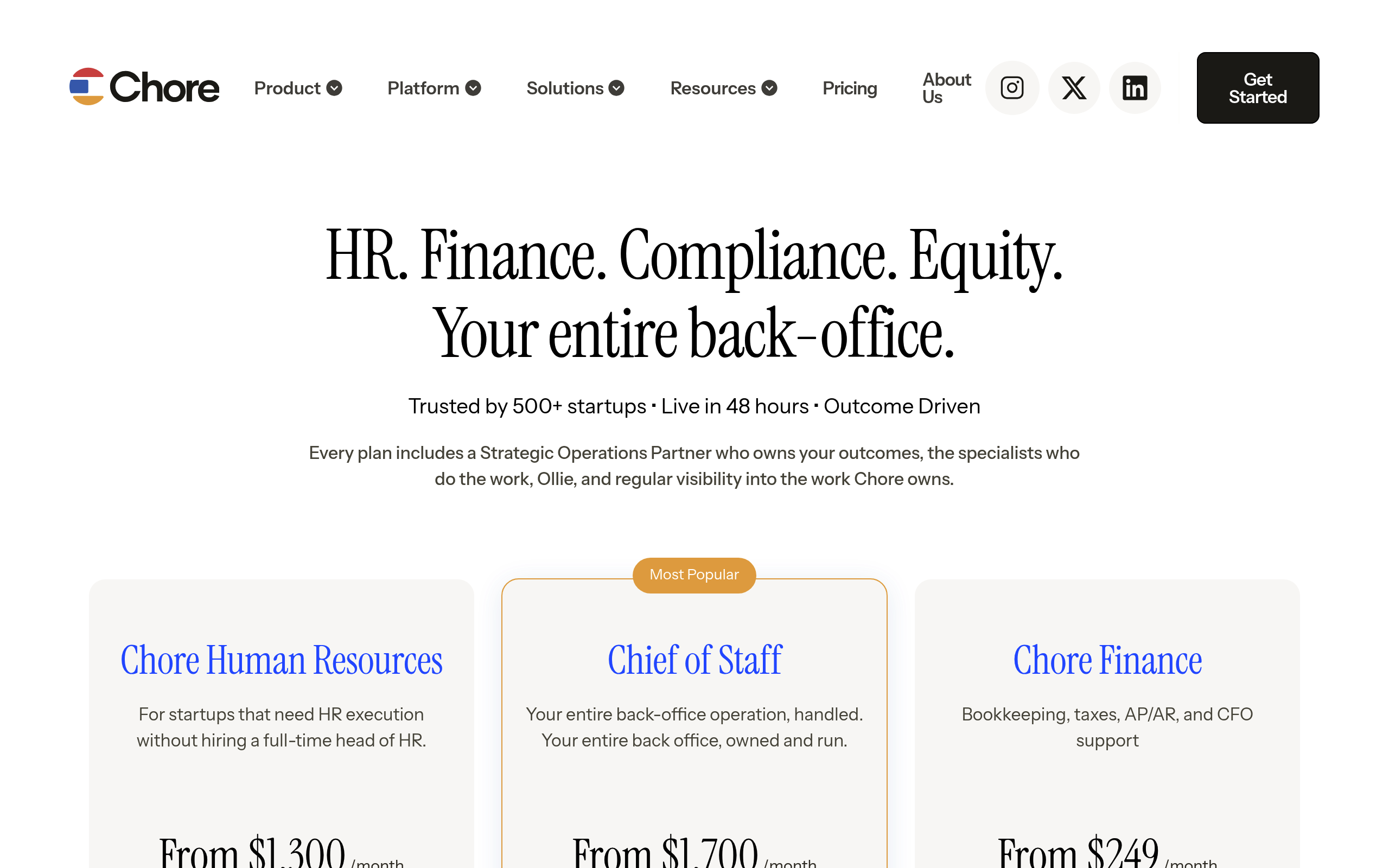
Chore's three plans. Founders who book through SaaSOffers get 15% off the first month.
Chore vs hiring a head of operations
The usual alternative to Chore is a first operations hire. Here is how the two compare for a seed-stage team:
| Head of operations hire | Chore | |
|---|---|---|
| Monthly cost | $9,000+ in salary, before benefits and equity (Chore's estimate) | From $1,300 (HR) or $1,700 (full back office) |
| Time to start | 3 to 4 months to recruit and ramp | 48 hours |
| Expertise | One generalist covering HR, finance, compliance and equity | Specialists for each area |
| When they leave | The knowledge leaves with them | The team and the documentation stay |
| Knows your company | Deeply, over time | Through the Strategic Operations Partner |
A full-time hire makes sense once operations is a full-time job and you want someone in the room for every decision. Before that point, most of the work is recurring execution: payroll runs, filings, the monthly close, cap table updates. That is the part Chore is built to take over, and it is where founders lose the most hours.
A practical path is to start with Chore at seed, then hire a head of operations at Series A or later. By then Chore will have left clean books, a current cap table and documented processes for the new hire to inherit.
Payroll and HR platforms (US)
These are the systems of record for your team: who works here, what they are paid, and which benefits they get.
Gusto
Gusto is the default payroll tool for small US teams. It runs payroll in all 50 states, files payroll taxes, handles contractor payments and 1099s, and offers health benefits and 401(k) plans. Setup takes an afternoon.
- Deal: 6 months free on the Simple plan.
- Best for: US teams from the first hire to around 50 people.
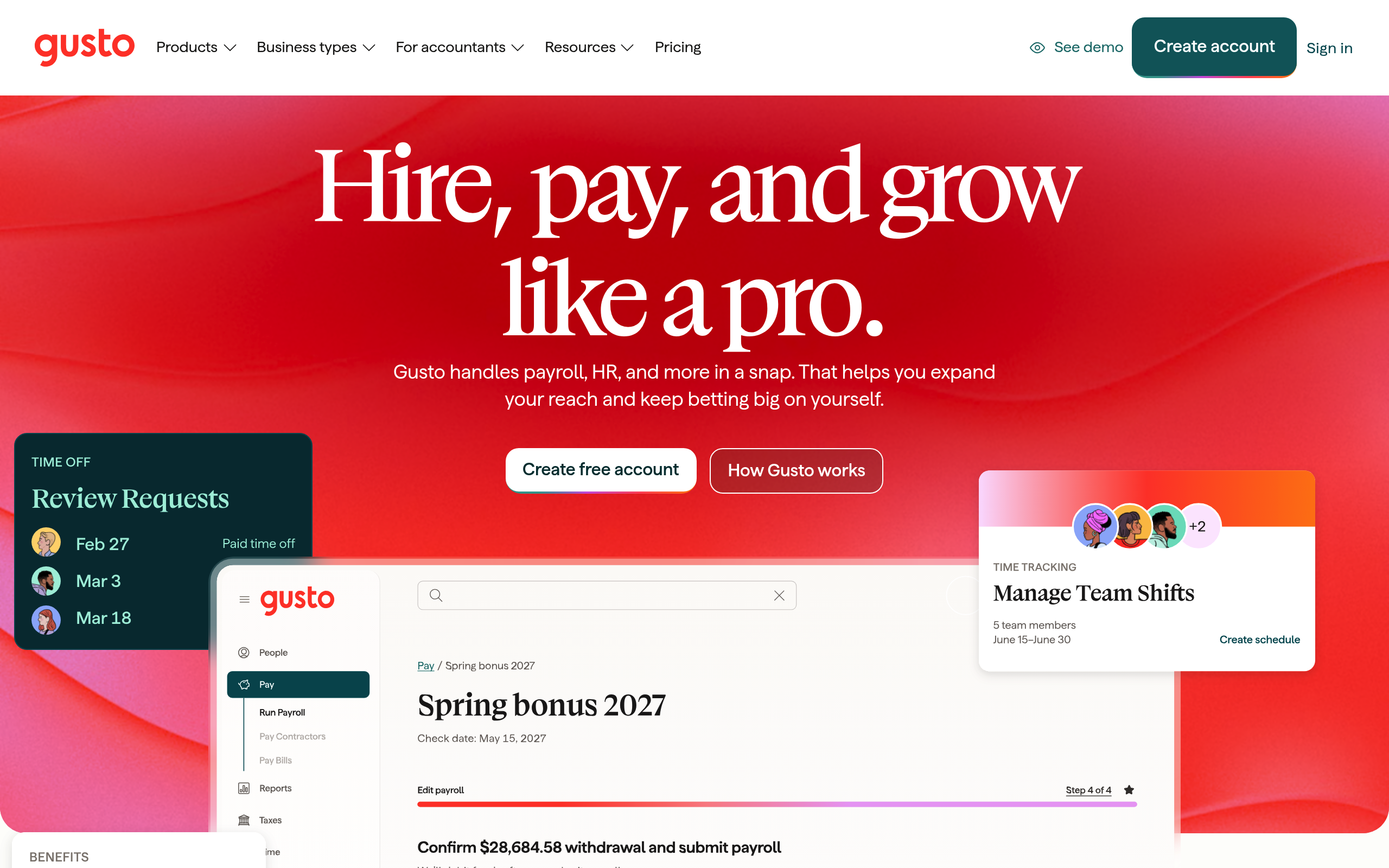
Gusto runs payroll, time off and benefits for US teams from one dashboard.
Rippling
Rippling combines HR, payroll, IT and devices in one system. When someone joins, it can create their accounts, ship a laptop and add them to payroll from one form. It also runs global payroll and EOR.
- Deal: book a demo through our page.
- Best for: teams of 20+ that want HR and IT in one place, or teams hiring abroad.
Justworks
Justworks is a PEO (professional employer organization). It becomes the co-employer of your team, which gives a small startup access to large-group health insurance rates, and it handles payroll and HR compliance.
- Deal: free demo.
- Best for: US startups where good health benefits matter for hiring.
ADP
ADP is the long-standing payroll provider for companies of every size. It is more than most seed startups need, but some founders choose it to avoid switching providers later.
- Deal: free quote.
Hiring and paying people abroad
If your first engineers are in Europe, Latin America or Asia, you either hire them as contractors or through an employer of record that employs them locally on your behalf.
Deel
Deel handles contractors in 150+ countries, EOR employment, and global payroll in one dashboard. It deals with local contracts, invoices and payments in local currency.
- Deal: $1,500 in credits.
- Best for: startups hiring contractors and employees in several countries.
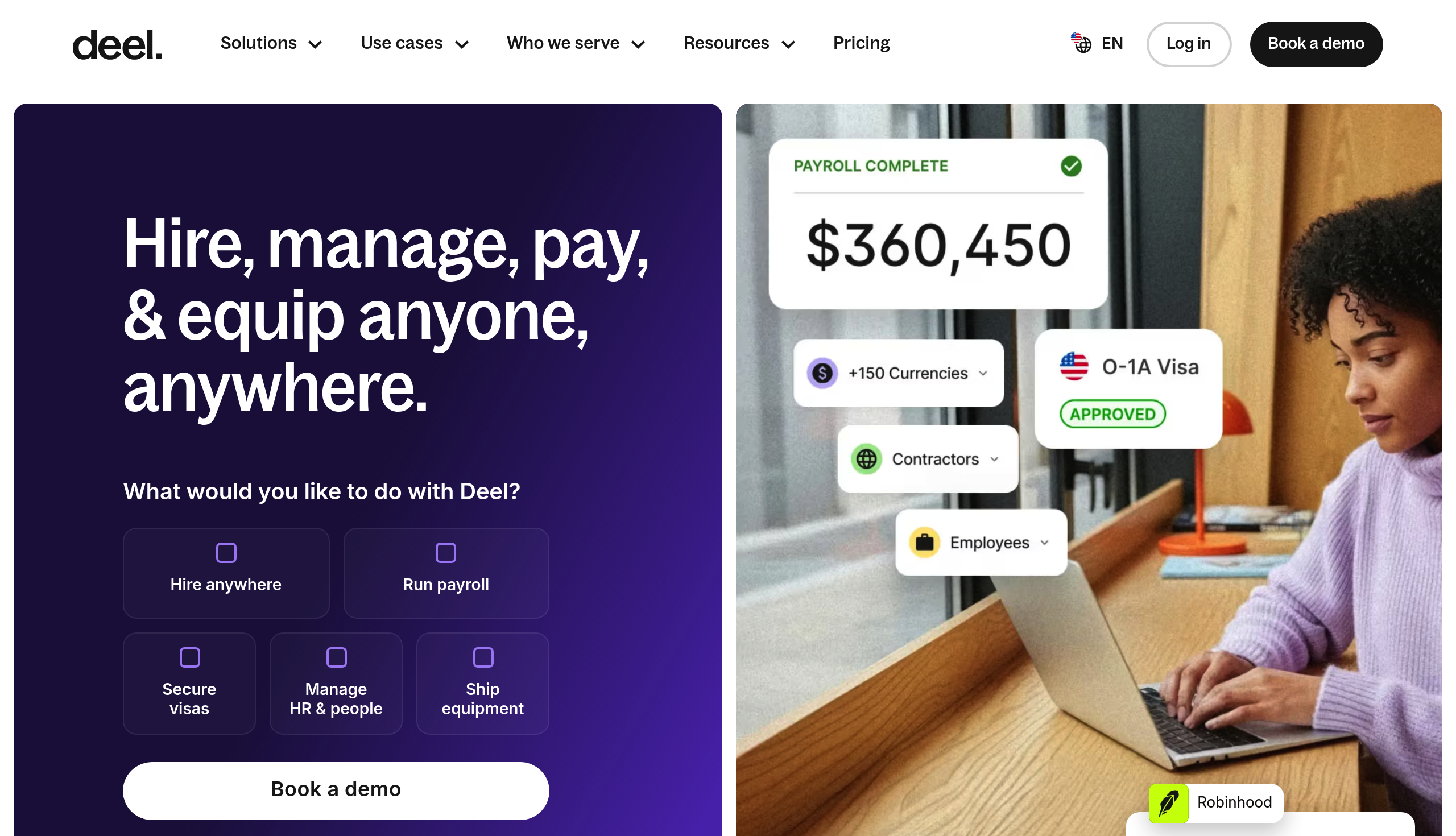
Deel covers contractors, employer of record hiring and global payroll in 150+ countries.
For a deeper comparison, see our Deel review and Deel vs Papaya Global.
Remote
Remote is an EOR built on its own legal entities in each country, which it presents as a compliance advantage. It also offers a free contractor management plan.
- Deal: 15% off for 1 year.
Oyster
Oyster focuses on hiring and paying people in developing markets as well as the usual hubs, with EOR, contractor payments and benefits.
- Deal: up to $1,200 off per team member.
People management
Once the team passes 15 to 20 people, you need a place for reviews, goals, time off and employee records.
- Lattice: performance reviews, goals and engagement surveys. Strong for teams that want a review process people actually complete.
- BambooHR: an HR system for employee records, time off and onboarding checklists.
- Personio: the common choice for European teams, with HR, time tracking and payroll prep.
- CharlieHR: simple HR for small UK teams. Free trial.
- Assembly: employee recognition and an intranet, with a free plan.
Time tracking and freelancers
- Hubstaff: time tracking and timesheets for remote teams and contractors. Deal: 3 months free on Starter.
- Upwork: hire freelancers for one-off projects before you commit to a full-time role. Deal: $50 gift card.
Benefits and retirement
- Vestwell: 401(k) plans for small businesses, which several US states now require employers to offer. Deal: 14-day free trial.
- Envoy: visitor sign-in and desk booking once you have an office. Free trial.
Finance operations
Operations is not only HR. Payments, spending and the books land on the same desk.
- Mercury: banking built for startups. Deal: $500 account bonus.
- Brex and Ramp: corporate cards with spend controls and receipt matching. Deals: $1,000 bonus on Brex, $500 cashback on Ramp.
- Melio: pay vendor bills by bank transfer or card, even when the vendor only takes checks. Deal: 90 days free on paid plans.
- QuickBooks and Xero: accounting software. Deals: 50% off QuickBooks for 3 months, 80% off Xero for 6 months.
- Expensify: expense reports and reimbursements. Deal: 3 months free.
- Pilot: outsourced bookkeeping and tax for startups. Free consultation.
- Airwallex: multi-currency accounts and international transfers. Deal: $50,000 in free FX.
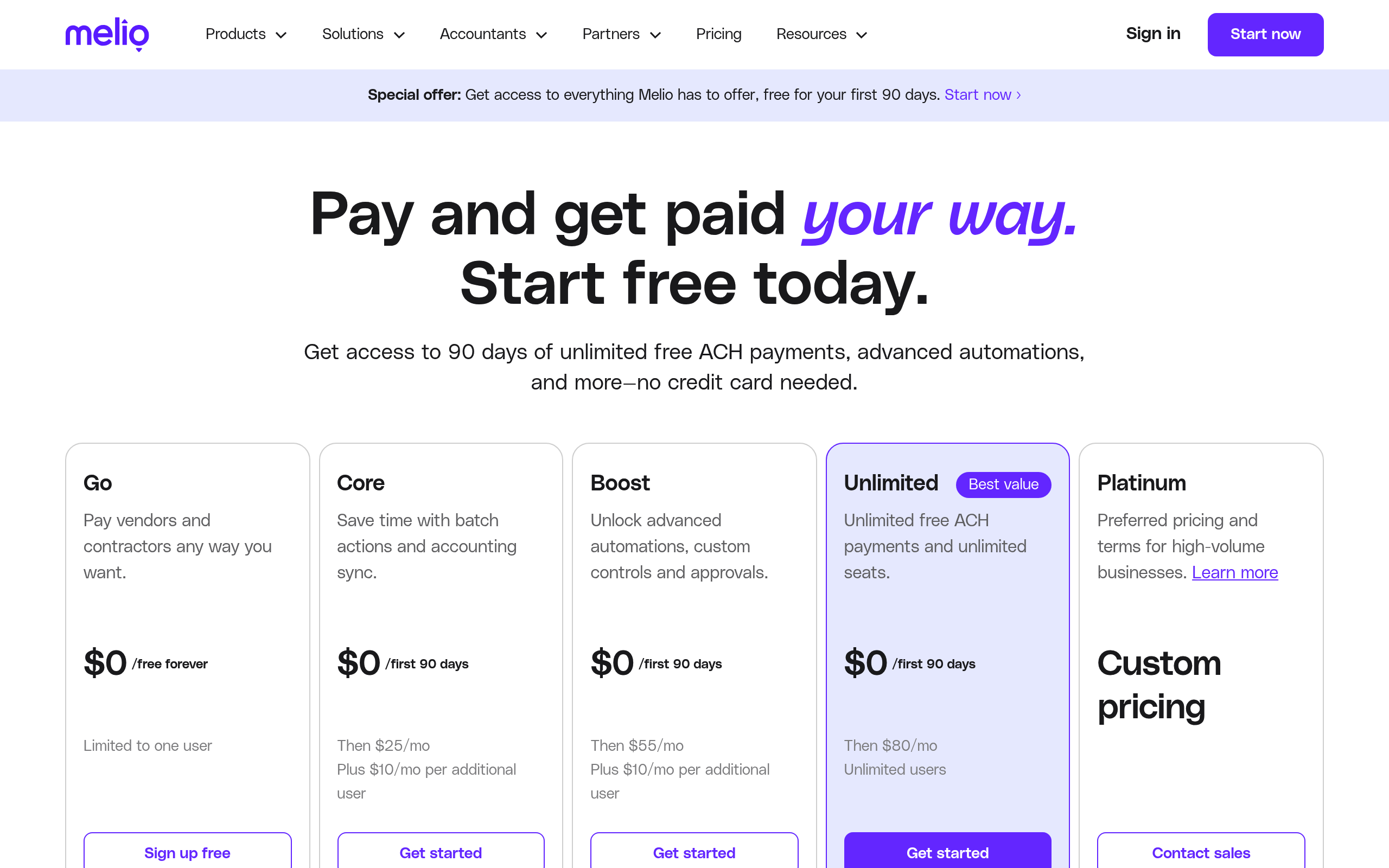
Melio's paid plans are free for the first 90 days, which is the deal on SaaSOffers.
Equity and legal
- Carta: cap table management, option grants and 409A valuations. Deal: Carta Launch free for companies that have raised under $1M.
- Stripe Atlas: incorporate a Delaware C-Corp from anywhere. Deal: $2,500 in Stripe credits plus $50K in perks.
- Clerky: startup legal documents (incorporation, SAFEs, offer letters), pay per document.
- DocuSign and PandaDoc: e-signatures for offer letters, contracts and board consents. Deals: 30% off DocuSign Business Pro for 2 years, a free eSign plan on PandaDoc.
Operations workspace
The tools where the processes live:
- Notion: the company wiki, onboarding docs and policies. Deal: 3 months free on Business.
- ClickUp: tasks and projects. Deal: up to $3,000 in credits.
- Slack: team chat. Deal: 25% off the first year.
- Google Workspace: email, calendar and drive. Deal: 20% off the first year.
- Zapier: connect the tools above so a new hire in Gusto creates accounts everywhere else. Deal: $500 in credits.
- 1Password: shared passwords and access when people join or leave. 14-day free trial.
The stack by stage
| Stage | Team | What to set up | What can wait |
|---|---|---|---|
| Pre-seed | 1 to 3, mostly founders | Stripe Atlas or Clerky, Mercury, Carta Launch, Notion, Google Workspace | HR system, benefits, people management |
| Seed | 3 to 15 | Gusto or Justworks, Deel for anyone abroad, Ramp or Brex, QuickBooks or Xero, Slack, 1Password | Lattice, a full HR platform |
| Series A | 15 to 50 | Rippling or Gusto with benefits, Lattice or BambooHR, Expensify, Zapier, 401(k) with Vestwell | An in-house head of operations |
At every stage after the first hire, there is one more question: who runs all of this? If the answer is "a founder, on weekends", that is the point where a service like Chore costs less than the time it saves.
Common mistakes
- Hiring in a new state without registering there. Payroll tax registration has to happen before the first paycheck in that state. Gusto and Chore both flag it, but someone has to act.
- Letting the 409A expire. A 409A valuation is generally valid for 12 months, or until a material event like a funding round. Option grants priced off an old one create tax risk for employees.
- Missing the 83(b) deadline. Founders and early employees with restricted stock have 30 days to file. There is no fix if it is missed.
- Treating full-time contractors as contractors forever. Misclassification is one of the most common compliance problems for small teams, especially across borders. An EOR like Deel, Remote or Oyster solves it.
- Buying an HR suite before you have HR problems. A 4-person team does not need performance review software.
Frequently asked questions

Software engineer and product builder with 13+ years of experience across software engineering, product development, and startup operations. Built SaaSOffers to make every startup deal discoverable and verified for founders worldwide.
Ready to unlock these deals?
Free account. No credit card required.