
Hubstaff Promo Code: 3 months free Starter
Time tracking and workforce management for remote teams, know what your team is working on without micromanaging.
Premium: $79/year for unlimited deals
Already have an account? Log in
Deal Highlights
What Hubstaff Gives a Startup
Hubstaff is time tracking and workforce management for remote teams, and this deal gives a startup three months of the Starter plan free. Its guiding promise is captured in one line from the description. Know what your team is working on without micromanaging. That balance is the whole point. A remote team needs some shared visibility into how work is progressing, but nobody wants to be watched over the shoulder, and no founder wants to spend their days chasing status updates. Hubstaff aims to give a startup the visibility it needs while keeping the trust and autonomy that make remote work good in the first place.
The requirement is a startup with remote team members, which is exactly the situation Hubstaff is built for. When a team is distributed, the natural, informal awareness of who is working on what, the kind that comes free in an office, disappears. You cannot glance across the room to see how things are going. Hubstaff replaces that lost awareness with a structured, low-friction view of the team's work, so a distributed startup can stay coordinated without reverting to constant check-in meetings.
This is an HR and People tool, and the three free months of Starter give a small remote team a real chance to establish a healthy way of tracking work and managing itself without a subscription cost during the early period when every dollar counts.
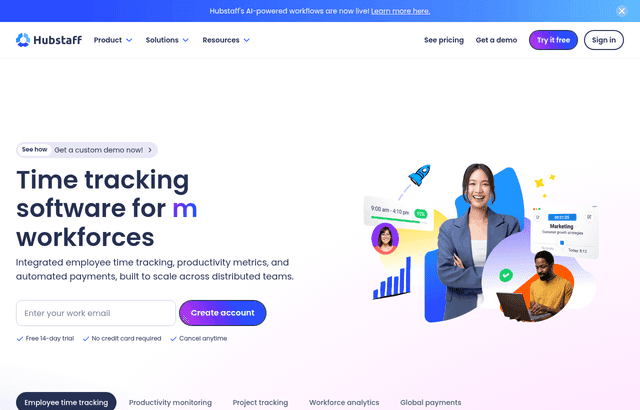
Hubstaff, one of the tools included in this startup deal.
Time Tracking Without the Overhead
At its core, Hubstaff tracks time, letting team members record the hours they spend and what they spend them on. Done well, this is not about surveillance, it is about clarity. A remote startup benefits from understanding where its time actually goes, because time is the team's main resource and knowing how it is spent is the first step to using it well.
For a startup, time tracking answers questions that are otherwise hard to answer with a distributed team. How much effort is really going into each project or client. Whether the team's time is aligned with its priorities. Where hours are being consumed by work that does not move the company forward. Without tracking, these questions get answered by guesswork, and a small team cannot afford to misjudge where its limited hours are going. Hubstaff makes the answers visible.
Time tracking is especially valuable for a startup that bills clients or needs to understand the true cost of its work. Knowing how many hours a project actually took lets the team price accurately, plan future work realistically, and see whether certain efforts are worth the time they consume. For a young company still learning its own economics, that clarity is directly useful, and it comes from simply having an honest record of where the hours went.
The key is that Hubstaff keeps this tracking low-overhead. Tracking time is only sustainable if it does not become a burden, and a tool that makes recording work easy is one the team will actually keep using. A startup that adopts lightweight time tracking gains the clarity without the friction that would otherwise make people abandon it.
Visibility Without Micromanaging
The phrase that defines this deal is knowing what the team is working on without micromanaging, and this balance is what makes Hubstaff suitable for a healthy remote culture rather than a controlling one. The goal is shared awareness, not surveillance. The team and its leaders can see that work is progressing and understand what everyone is focused on, which replaces the constant status-check meetings that otherwise fill a remote team's calendar.
For a startup, this visibility solves a genuine problem of distributed work without creating a worse one. When a team is remote, leaders lose the easy, ambient sense of how things are going, and the wrong response is to fill that gap with endless check-ins and requests for updates, which drain everyone's time and signal distrust. Hubstaff offers a better answer. A structured view of the team's work that keeps everyone informed without anyone having to constantly report in or be interrupted.
This matters because trust and autonomy are what make remote work productive, and a startup should protect them. Great remote teams run on the assumption that people are professionals doing their jobs, and any tool that undermines that assumption undermines the culture. Hubstaff, used well, supports the good version of remote work by providing just enough visibility to coordinate, while leaving people the autonomy to do their work their own way. The team stays aligned without feeling watched.
For a founder, this is the difference between spending the day chasing updates and simply having the information available when needed. Hubstaff frees a founder from the role of constantly asking what everyone is doing, which is both a time saving and a relief, and it lets the team get on with the work rather than reporting on it.
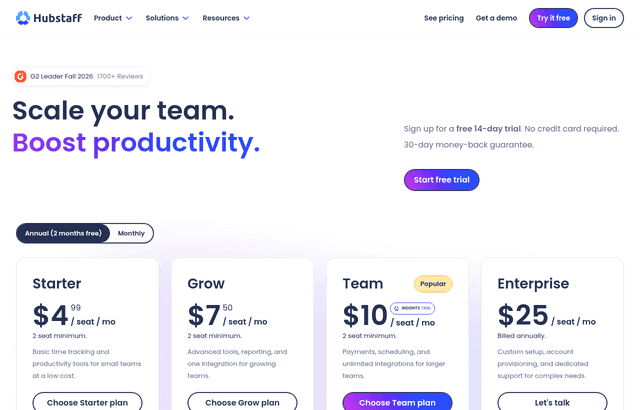
A look at Hubstaff before the discount, so you can see what the deal saves you.
Workforce Management for a Distributed Team
Beyond time tracking, Hubstaff offers workforce management, the broader set of capabilities that help a startup coordinate and organize a distributed team. Managing a remote team involves more than knowing hours worked. It involves understanding workloads, keeping projects on track, and having the information needed to make good decisions about how the team's effort is allocated. Hubstaff brings these into one place.
For a startup, having workforce management in a single tool is valuable because a small team cannot afford a heavy management apparatus. The founders and early leaders are managing the team on top of doing the work, so they need management to be efficient. Hubstaff consolidates the information and tools for running a remote team, which means less scattered effort spent on coordination and more of the picture available in one place.
This becomes more important as a remote startup grows. Coordinating three remote people is manageable by intuition, but coordinating a growing distributed team requires more structure, or things start to fall through the cracks. Hubstaff gives a startup that structure early, so the systems for managing a remote team are in place and familiar before the team gets large enough that informal coordination stops working. Building these habits while small makes scaling the team far smoother.
Workforce management also helps a startup make better decisions about its people and projects. With a clear picture of workloads and where time goes, leaders can balance the team's effort, spot when someone is overloaded, and allocate people to the work that matters most. For a small team where every person's time is precious, that ability to allocate well is a real advantage.
Supporting a Healthy Remote Culture
Used with the right intent, Hubstaff supports a healthy remote culture rather than a distrustful one, and this is worth being deliberate about. The same tool can be used to build trust or to erode it, depending on how a startup approaches it. Framed as a way to create shared clarity and fair understanding of everyone's contributions, time tracking and visibility can actually strengthen a remote team's culture.
For a startup, this framing matters because culture is set early and is hard to change later. A remote team that adopts visibility tools in the spirit of transparency and mutual understanding, rather than control, builds a culture where people trust that their work is seen and valued fairly. That is healthier than a culture where people feel monitored, and it is also more productive, because people do their best work when they feel trusted.
Hubstaff can also protect the team from a real remote hazard, which is overwork and burnout. Visibility into hours can help a startup notice when someone is consistently working too much, which is easy to miss when everyone is distributed and nobody sees the late nights. A team that uses this insight to protect its people, rather than to push them, builds the kind of sustainable culture that keeps good people for the long run. The three free months let a startup establish these healthy patterns from the start.
Hubstaff Compared to Informal Remote Coordination
Many small remote startups coordinate informally, through chat messages, occasional check-in calls, and a general sense of who is doing what. This works at the very smallest scale, when the team is a few people who talk constantly, but it strains quickly as the team grows or the work gets more complex. Informal coordination leaves gaps, and those gaps grow into misalignment, duplicated effort, and a fog about how the team's time is actually being spent.
The alternative some teams reach for is the opposite extreme, heavy check-in meetings and constant status requests, which fill the visibility gap but at a steep cost to everyone's time and morale. This is the micromanaging trap, and it makes remote work worse rather than better, draining the autonomy that makes distributed teams effective in the first place.
Hubstaff offers a middle path between these two failure modes. It provides structured visibility without the overhead of constant meetings and without the vagueness of purely informal coordination. A startup gets a clear, low-friction view of its team's work that neither burdens people with reporting nor leaves leaders in the dark. For a distributed team that has outgrown pure informality but does not want to descend into micromanagement, that middle path is exactly right. The free Starter months let a startup find this balance without an upfront cost.
Making the Three Free Months Count
The three free months are a chance to establish a healthy, sustainable way of managing a remote team, so treat the period as time to build good habits rather than to install surveillance. Introduce Hubstaff to the team with the right framing, as a tool for shared clarity and fair understanding, not for watching people. How a startup introduces the tool shapes whether the team embraces it or resents it, and the former is what makes it work.
Use the time-tracking insight to learn where the team's hours actually go, and act on what you learn. Look at whether time aligns with priorities, whether certain work consumes more than it should, and whether anyone is overloaded. A startup that uses these months to genuinely understand its team's time can then make better decisions about how to allocate effort, which is the real payoff of tracking.
Resist the temptation to use visibility to micromanage. The whole value of Hubstaff for a startup depends on maintaining trust, so use the information to coordinate and support the team, not to police it. A founder who checks the data to stay informed but leaves people the autonomy to work their own way gets the benefits of visibility without the costs of control.
Use the free period to build a management rhythm the team can keep. The point is to come out of three months with an established, healthy way of tracking work and coordinating the remote team, so the practice continues past the free window. A startup that establishes these patterns early has a management foundation that will scale as the team grows.
Who Should Claim This Deal
Hubstaff fits the requirement directly. It is for a startup with remote team members, and if your company works in a distributed way, its time tracking and workforce management give you the visibility to stay coordinated without resorting to micromanagement.
A small remote team that has lost the ambient awareness of an office should claim this first. When people are distributed, the informal sense of who is doing what disappears, and Hubstaff replaces it with structured, low-friction visibility. The three free months let a startup establish that visibility without a subscription cost while the team is small and the budget is tight.
A founder tired of chasing status updates should take this too. Constantly asking what everyone is working on drains time and signals distrust, and Hubstaff makes that information available without the endless check-ins. That frees the founder and the team to focus on the work rather than on reporting about it.
Any startup that wants to build a healthy remote culture from the start should value what these free months allow. Used with the right intent, Hubstaff supports transparency, fair recognition of contributions, and protection against overwork, all of which strengthen a distributed team. Introduce it thoughtfully, use its insight to support the team, and turn three free months into a lasting foundation for managing a remote startup well.
Who Is This Deal For?
Early-Stage Startups
Seed and pre-seed companies looking to move fast without overspending on tools.
Growing SaaS Teams
Series A+ companies scaling their stack and optimizing software costs.
Solo Founders
Indie hackers and bootstrapped founders who need enterprise tools at startup prices.
Get 3 months free Starter off Hubstaff
Premium deal. Upgrade once, unlock everything.
!Eligibility Requirements
Startup with remote team members
Frequently Asked Questions
Everything you need to know about this startup deal.
Hubstaff has a free plan for 1 user. The Starter plan ($4.99/user/month) adds project tracking and limited screenshots. The 3-month deal saves $15/user for your team.
Get the weekly deals digest
New verified startup deals every week. No spam, ever. Unsubscribe anytime.
Related Offers

Vestwell
Used by 290 members
14-day free trial
Get a 14-day free trial of Vestwell, the modern 401(k) and retirement benefits platform that powers small business plans, IRAs, and pooled employer plans with API-first technology.
View offer
Assembly
Used by 2,457 members
Free Plan
Employee recognition and engagement platform with rewards, surveys, and team building.
View offer
Oyster HR
Used by 1,316 members
$1,000 off first year
Get $1,000 off Oyster. The global employment platform for hiring, paying, and managing remote employees and contractors in 180+ countries.
View offer
ADP
Used by 2,527 members
Free Quote
Enterprise payroll, HR, and workforce management solutions for businesses of all sizes.
View offer
Justworks
Used by 1,773 members
Free Demo
PEO and payroll platform for startups, payroll, benefits, HR, and compliance in one place.
View offer
Gusto
Used by 2,125 members
6 months free Simple
Modern payroll, benefits, and HR for US-based startups, run your first payroll in minutes, not days.
View offerDeal Summary
Looking for more startup deals?
Browse all offers